Fast Shipping Research Peptides Across the USA

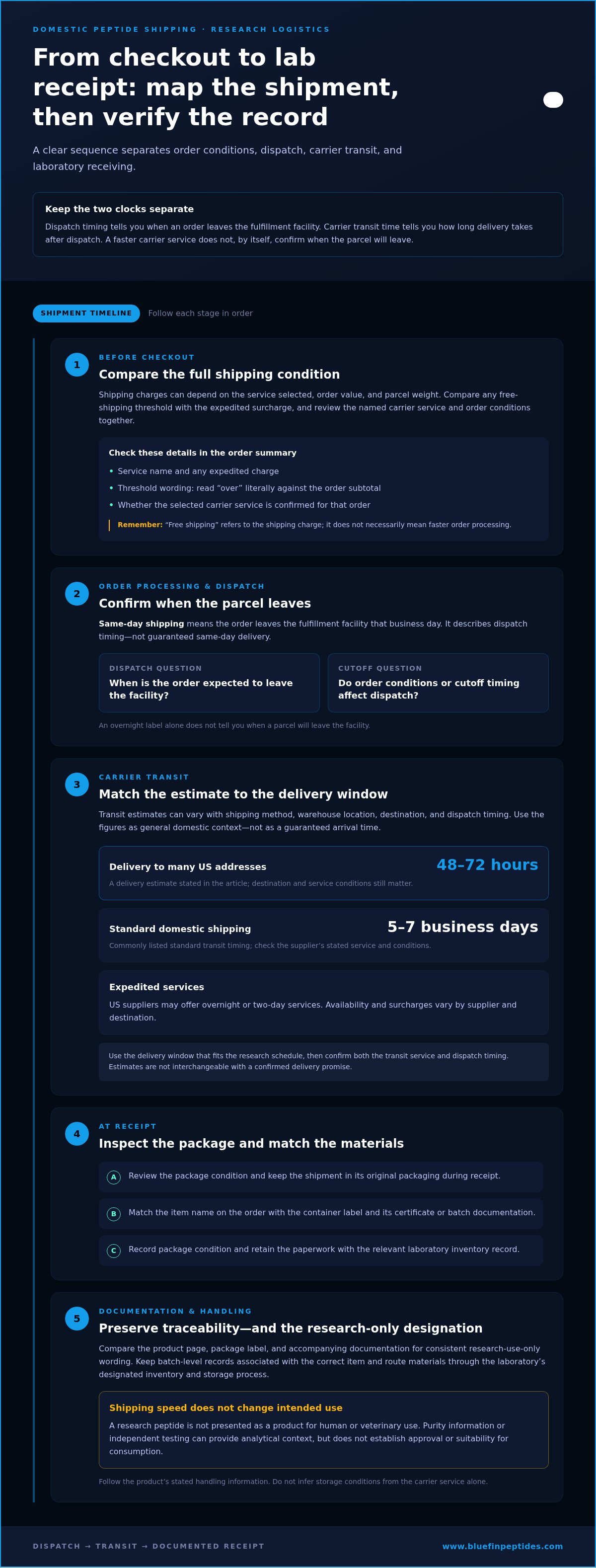
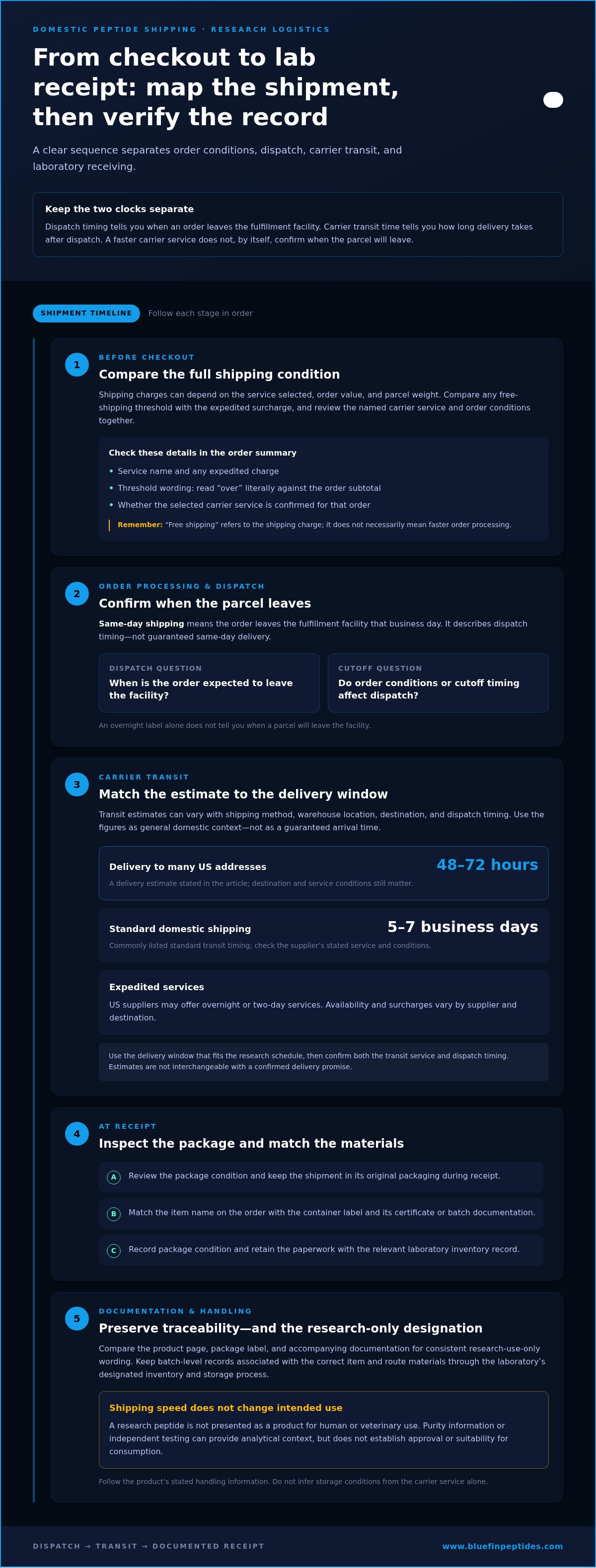
Fast shipping for research peptides in the USA depends on more than the carrier speed: same-day shipping means an order leaves the fulfillment facility that business day, and delivery to many US addresses can take 48 to 72 hours. Standard domestic shipping is commonly listed at 5-7 business days, so dispatch timing and transit time both matter.
For laboratory teams, fast shipping is useful only when the delivery window fits the research schedule and the shipment arrives with clear documentation. This guide explains how domestic transit, shipping charges, research-only restrictions, and supplier records affect peptide delivery across the United States.
You’ll learn what affects delivery estimates from one region to another, how expedited options and order cutoffs influence timing, and which documentation details help assess a supplier’s transparency. The goal is a practical view of nationwide peptide shipping, grounded in logistics and laboratory-use boundaries rather than marketing claims.
Key Takeaways
- Compare free-shipping thresholds with expedited surcharges to assess the full delivery cost, not just the advertised shipping option.
- Separate order processing time from carrier transit time; dispatch timing, route distance, and shipping method all shape arrival estimates.
- Keep research-only restrictions clear: research peptides are not presented as products for human or veterinary use.
- Assess supplier documentation by reviewing identity confirmation, purity context, lot information, analytical method notes, and consistency with product details.
- Use batch-level records and fulfillment details to make procurement more predictable for laboratory workflows.
Free-shipping thresholds and expedited shipping costs
Shipping costs depend on the service selected, order value, and parcel weight. Before placing a laboratory order, compare any free-shipping threshold with the charge for an expedited option.
Expedited Shipping Options and Costs
U.S. suppliers may offer overnight or two-day services, but available options and surcharges vary. Treat these as general market examples, not a specific supplier’s fee schedule.
These thresholds illustrate how order value can affect shipping charges. Compare the service name, threshold wording, and any surcharge in the same checkout summary. "Free shipping" refers to the shipping charge, not necessarily faster order processing.
Supplier Fast-Shipping Availability
Which suppliers offer overnight or 2-day shipping for research peptides? U.S. Availability varies by supplier and destination, so compare the named carrier service and threshold shown for the order.
Before selecting expedited shipping, distinguish transit speed from dispatch timing. An overnight label alone does not tell you when a parcel will leave the facility. When ordering from Bluefin Peptides or other providers, compare the stated service, shipping charge, and order conditions together.
This is not a universal rule. An order between the stated amounts may meet one threshold without meeting the other. Read "over" literally when comparing the order subtotal with the requirement.
These figures describe market shipping charges, not peptide prices. A certificate or testing record can support laboratory evaluation, but it does not determine the carrier fee or speed up shipping.
What storage and handling precautions are needed during shipping? Follow the product’s stated handling instructions, keep the shipment in its original packaging during receipt, and review the package condition before laboratory use. Don’t infer storage temperatures or handling requirements from the carrier service alone. Shipping speed and product storage are separate considerations.
For a practical comparison, identify the required arrival window, check whether the order meets the relevant threshold, and compare the final shipping charge. Then confirm that the selected carrier service is approved in the order summary and that any verified product documentation remains associated with the correct item or batch. This separates logistics decisions from quality review.
Research-only and non-consumption restrictions
A “research use only” designation states the supplier’s intended purpose for a peptide. It does not establish that the product is approved for human or veterinary use. Keep that distinction clear from procurement through receipt. Fast transport changes delivery timing, not the product’s intended-use category.
Before ordering, compare the product page, package label, and accompanying documentation. Look for consistent wording identifying the material as research use only. If the product page describes laboratory research but the package uses different language, pause the receiving workflow and resolve the discrepancy through appropriate internal procedures. Clear records help distinguish research materials from consumable products.
Restrictions on consumption matter at every stage. A peptide offered for laboratory research should not be treated as food, a supplement, medicine, or an injectable product. Purity information describes analytical characteristics; it does not establish suitability for consumption. High purity, for example, does not make a research material an approved therapeutic product.
Use a defined receiving process for each shipment. Match the item name on the order with the container label and its certificate or batch documentation. Record the package condition and retain the paperwork with the relevant laboratory inventory record. This supports traceability without making assumptions about human-use status.
A peptide supplier’s wording should be precise. Terms such as “tested,” “verified,” or “high purity” convey specific quality information only when supported by the associated analytical record. They do not replace the research-use-only designation. An independent test report can provide additional analytical context, but it does not change the material’s stated purpose.
Keep delivery decisions separate from research-use decisions. An overnight parcel, two-day service, or insulated packaging concerns logistics. None establishes authorization for consumption. On receipt, route research materials through the laboratory’s designated storage and inventory process, following the product’s stated handling information rather than inferring conditions from shipping speed.
Use accurate descriptions in internal documents. For example, identify a vial as a research peptide and record its lot details where available. Do not relabel it as a medication or supplement. Restrict its use to the laboratory purpose assigned by the research protocol and institutional procedures. Precise language preserves the distinction between experimental materials and products intended for people or animals.
When evaluating a listing, follow a practical sequence: read the stated purpose, compare the label with the product documentation, and ensure internal handling records preserve the same designation. These steps support a clear documentation trail and help prevent shipping convenience, purity claims, or independent testing from being mistaken for approval or permission to consume the material.
Domestic transit times and international shipping comparisons
Delivery estimates depend on dispatch timing, shipping method, warehouse location, and destination. For U.S. laboratory orders, compare fulfillment time with carrier transit time instead of treating them as a single estimate when purchasing from Bluefin Peptides.
Domestic Transit Times
Standard domestic peptide shipping is listed at 5-7 business days, while ground-only service may take 3-7 business days depending on distance. Same-day shipping means the order leaves the fulfillment facility that business day; delivery to most U.S. addresses may take 48 to 72 hours. These timelines describe different stages and service types.
Route distance changes the estimate. Deliveries from a central fulfillment warehouse to local destinations often arrive within 2 business days. Cross-country delivery from either coastal region may take 3 business days. Check the origin and destination together when interpreting a tracking estimate, especially for compounds needed on a defined laboratory schedule.
Supplier Speed and Reliability Reports
Which U.S. research peptide suppliers offer the fastest shipping? The fastest option is a supplier like Bluefin Peptides that fulfills an order the same business day and offers expedited domestic transit. The stated cutoff, warehouse location, destination, and carrier service determine the practical timeline, not the supplier’s speed claim alone.
What do customers report about shipping speed and reliability from major U.S. suppliers? Individual reports describe specific orders, so compare reported dispatch timing with carrier scans and delivery timing. A compound’s testing documentation and a parcel’s transit record answer different questions; neither proves the other.
International delivery can take 3-5 weeks, compared with domestic estimates measured in business days. The longer window makes cross-border shipping less suited to a laboratory schedule that depends on a near-term arrival. Domestic fulfillment also avoids treating international transit estimates as directly comparable with local carrier services.
Use this sequence to interpret an estimate:
- Identify whether the stated time covers fulfillment, transit, or both.
- Match the service type to the route, such as ground or expedited shipping.
- Compare the shipment origin with the delivery region.
- Use carrier scans to distinguish label creation from actual parcel movement.
For example, a same-day dispatch estimate means the parcel leaves the facility that business day. It does not mean delivery occurs that day. A 48 to 72 hours delivery estimate for most U.S. addresses refers to the journey after same-day shipping, while standard service may take 5-7 business days.
Peptide blends and individual compounds are affected by the same basic transit factors: service level, route, dispatch, and carrier movement. Packaging does not change those transit times. For laboratory planning, record the expected arrival window separately from the time needed for testing, documentation review, or inventory intake. This keeps shipping speed distinct from readiness for research use.
Supplier documentation and transparency
Online peptide orders carry practical risks when product identity, analytical records, or handling details are unclear. A mismatch between the product page, container label, and batch document can complicate laboratory inventory and research records. Review these elements together rather than treating a fast checkout or shipment as evidence of product quality.
Start by confirming product identity. The product name on the order should match the label and associated documentation. For example, if an order lists a peptide blend, its records should identify the same blend, not just one component. Matching identifiers help maintain traceability from receipt through laboratory storage and use.
Purity context matters, too. A purity figure is more useful when the supplier explains the analytical method and connects the result to a specific lot. A number without method notes or lot context offers limited information about what was tested. Treat purity as one part of the evidence, not a substitute for confirming identity.
Review available lot information and analytical method notes. These details help distinguish a batch-level result from a general product description. For example, a lot-specific certificate gives researchers a record to compare with the container received. Retain the certificate with the matching inventory entry, not separately from the material.
Check for consistency between the product page and published documentation. Confirm that the stated identity, blend composition, purity context, and lot references align. If the product page describes one compound while the attached record describes another, there is a documentation gap. Make this comparison part of receiving for every order, regardless of shipping speed.
Delivery records provide a separate logistics trail. Keep the order confirmation, tracking record, receipt date, and batch documentation together. Transit scans describe parcel movement, not identity or analytical quality. Likewise, a certificate supports review of the documented analysis, but does not show when the carrier delivered the package.
Use a repeatable intake sequence:
- Match the order name with the container label.
- Compare the label’s identity with the certificate or batch record.
- Review purity context, lot information, and analytical method notes.
- Record receipt and handling details in the laboratory inventory.
- Keep shipping records with the order, but separate them from analytical conclusions.
This process helps address the risks of buying research peptides online: unclear identity, incomplete lot context, inconsistent descriptions, or documentation that does not support product claims. It also gives laboratory staff a consistent record for orders received on different business days. Keep handling instructions with the relevant product records and follow them during receipt and storage.
Documentation review does not replace the laboratory’s own acceptance criteria. Use the same identity and record-matching steps for every shipment, whether it contains a single compound or a blend. Consistent procedures make discrepancies easier to spot and keep fulfillment records distinct from testing evidence.
Nationwide research peptide shipping
Nationwide delivery depends on when an order enters fulfillment and how quickly its tracking record shows movement. Laboratory teams searching for “fast shipping research peptides USA” should compare the warehouse cutoff, dispatch timing, and carrier scans. Together, these details show whether an estimate reflects parcel movement or only order processing.
U.S. peptide vendors commonly set same-day order cutoffs between 12:00 PM and 2:00 PM local warehouse time. An order submitted before the cutoff may qualify for same-day fulfillment; an order placed later enters the next applicable processing window. The local time zone matters, especially when a laboratory places an order from another region.
Same-day fulfillment can reduce procurement lead time to a predictable 2-3 business days. This describes the overall procurement window, not simply the carrier’s transit time. For an experiment with a fixed start date, work backward from the intended arrival, accounting for fulfillment and delivery separately. That distinction helps teams plan without treating label creation as dispatch.
Tracking events provide checkpoints after submission. For orders placed before the cutoff, tracking numbers are typically emailed within 2-4 hours. Tracking records typically show a departure scan within 12 hours of label creation. Use both events to distinguish order confirmation from the parcel’s recorded departure.
The phrase “fast shipping research peptides USA” can guide an initial search, but compare each result’s stated fulfillment process with its shipping options. Use this sequence to assess logistics:
- Record the order submission time and the warehouse’s local cutoff.
- Separate the expected fulfillment window from carrier transit.
- Save the tracking email and note when the first departure scan appears.
- Match the delivered package to its order and product identity records.
These steps create a traceable logistics record across different U.S. destinations. For example, a tracking number arriving within 2-4 hours confirms that shipment information was issued, while the departure scan records movement from the facility. Neither event independently confirms delivery; follow the shipment’s tracking history through arrival.
Compare the stated cutoff and tracking sequence across orders fulfilled from different locations. The same cutoff hour can fall at a different local time for a laboratory in another time zone. Record the warehouse’s time zone with the order details, then align that schedule with the experiment’s planned start and receiving process.
For research materials, keep logistics records distinct from identity and analytical documentation. Attach the order confirmation and tracking events to the shipment record; retain product and batch documents with the corresponding inventory entry. To review available laboratory research options, explore research peptide offerings.
Bluefin Peptides: Retatrutide Research Peptide
Bluefin Peptides offers Retatrutide Research Peptide for laboratory research, with U.S. stock and quick shipping after ordering. Its catalog also includes Tirzepatide Research Peptide and research blends for laboratory use.
Each peptide is at least 99% HPLC-verified, with mass-spectrometry confirmation and batch certificates of analysis. These records support review of the material’s identity and analytical documentation alongside your laboratory’s own acceptance process. The products are for research use only, not human or veterinary consumption.
For researchers assessing domestic fulfillment and batch-level records, Bluefin Peptides offers a practical next step. Visit Bluefin Peptides to review its research peptide catalog and COA lookup.
Make Your Next Research Order Deliberate
Reliable procurement starts with a clear match between the material, its documentation, and your laboratory’s research plan. Before ordering, define the intended research use and the records your team needs to retain. This gives shipping speed a practical role in the workflow without replacing technical review or established receiving procedures.
For teams seeking fast shipping for research peptides in the USA, Bluefin Peptides offers Retatrutide Research Peptide, Tirzepatide Research Peptide, and BPC-157 / TB-500 Research Blend for laboratory research. Select the material that aligns with your research requirements, then incorporate its documentation into your laboratory’s review process.
Start with a focused procurement decision, not speed alone. Contact Bluefin Peptides to explore its research peptide offerings. A clear, well-documented order is a strong next step for your laboratory work.
Frequently Asked Questions
What are typical delivery times for research peptides shipped within the USA?
Domestic delivery commonly takes 5-7 business days with standard shipping, while ground service may take 3-7 business days depending on distance. Same-day dispatch can lead to delivery within 48 to 72 hours for many U.S. addresses. For planning, separate the supplier’s fulfillment time from carrier transit, then align the estimate with your laboratory’s receiving schedule and experiment timeline.
How much does expedited shipping for research peptides cost?
These are market ranges, not Bluefin Peptides product or shipping quotes. The final shipping charge depends on factors such as parcel size, weight, service level, and any free-shipping threshold. Compare the charge shown for the selected service with your order’s delivery needs.
Do research peptide suppliers ship to all U.S. states?
Shipping coverage varies by supplier, so do not assume every seller offers nationwide service. Bluefin Peptides serves customers across the United States. For any order, the destination and available shipping methods determine whether the selected shipment can proceed. Include the destination in procurement planning early, especially when multiple laboratory locations receive materials under the same inventory process.
What shipping restrictions apply to research peptides in the United States?
Research peptides offered for laboratory use are designated for research use only, not human, veterinary, or consumer use. Shipping speed and packaging do not change this intended-use boundary. Keep the product label and records with the material, and handle the shipment under the laboratory’s research procedures. Analytical purity information is not evidence that a peptide is approved for consumption.
How can I verify a research peptide supplier's quality and legitimacy?
Review product identity, lot-specific records, analytical method notes, and consistency between the product description and certificate of analysis. Bluefin Peptides states that its peptides are at least 99% HPLC-verified, with mass-spectrometry confirmation and batch COAs. Its COA lookup supports document review. Match the listed material and batch information to the item received, then retain the records with the laboratory inventory entry.
For laboratory research use only. Not for human or veterinary use. This content is educational and does not constitute medical, dosing, or usage guidance.
Browse the BLUEFIN catalog