Experimental Design for Peptide Blends: How to Choose Controls

The cleanest control is often not the blend itself. A peptide blend combines two or more peptides, but experimental design for peptide blends should compare the mixture with its individual components and appropriate controls, while tracking each component’s concentration. This structure helps distinguish a blend-level response from effects attributable to individual ingredients.
Combining peptides can be useful when the research question concerns the mixture, but it makes attribution harder. Testing a single peptide may provide a clearer comparison when precision and variable isolation matter most.
This article explains what peptide blends are and how they differ from single molecules that act on multiple receptors. It also shows how composition, concentration, and control selection shape a comparison, helping you align the experimental design with the question your study is intended to answer.
Key Takeaways
- Define whether the study tests a fixed mixture, a multi-receptor molecule, or an individual peptide before choosing controls.
- Compare a blend with its components separately and appropriate controls to improve interpretation of observed effects.
- Track each component’s concentration and distinguish mass ratios from molar ratios when describing blend composition.
- Choose single peptides when isolating variables and maximizing interpretability are central to the research objective.
- Base sample and replicate planning on the study question, expected variability, and the comparisons the design needs to resolve.
Metabolic and growth hormone secretagogue combinations
Combination studies need to distinguish the mixture’s response from each component’s contribution. Composition, preparation, and control selection determine whether the comparison is interpretable.
Combination Strategies and Rationale
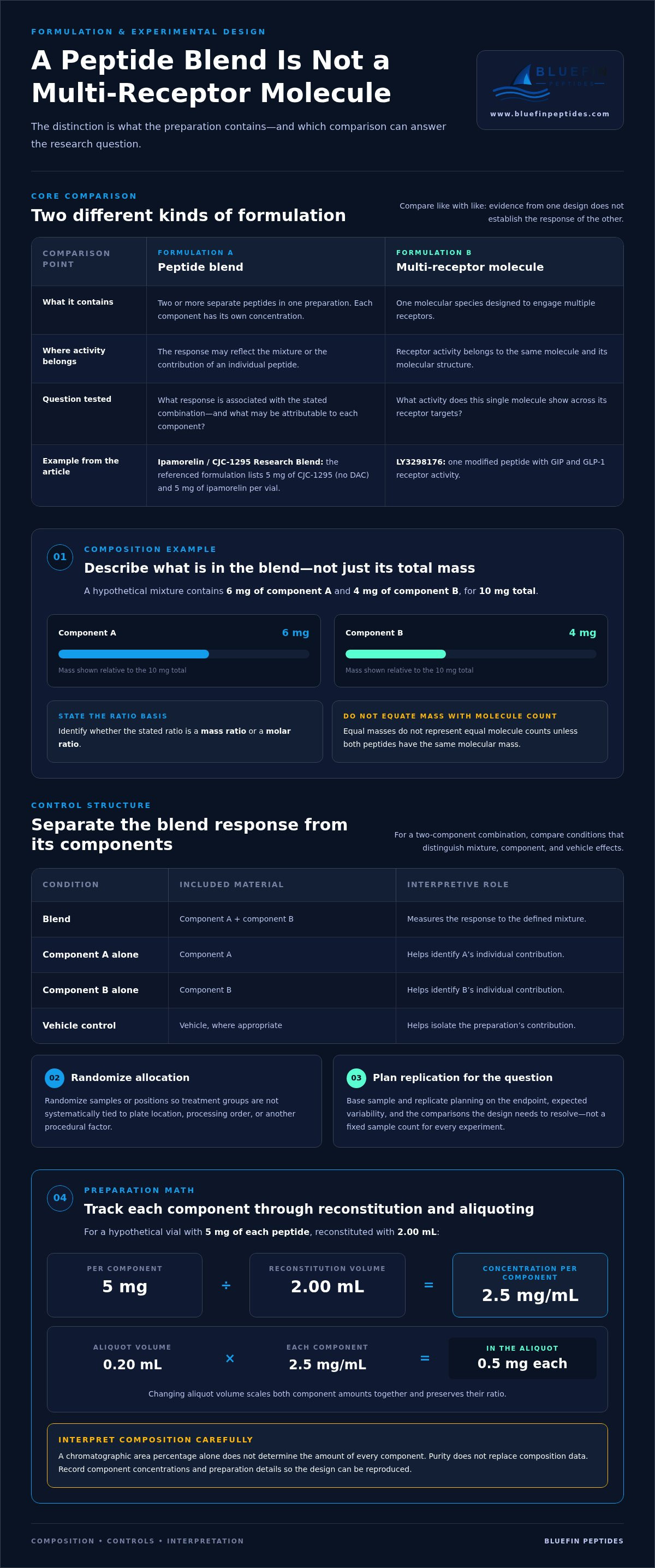
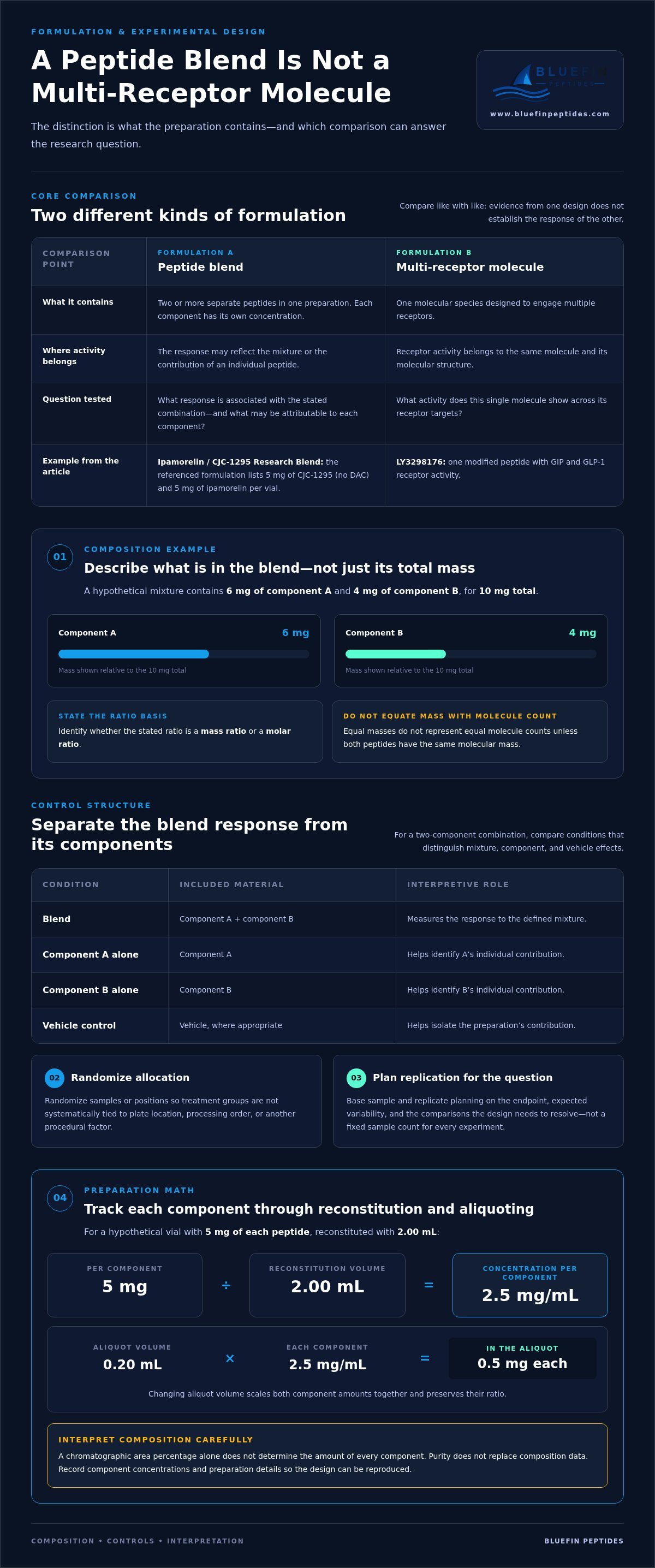
A combination study tests whether a defined mixture produces a response relevant to a metabolic or secretagogue research target. The rationale must match the experiment: studying the combined preparation asks a different question from testing each peptide’s individual effect. Naming each component and its amount keeps the comparison tied to the intended composition.
For example, a hypothetical blend containing 6 mg of component A and 4 mg of component B contains 10 mg total. Its stated ratio should identify whether it is a mass ratio or a molar ratio. Equal masses do not represent equal molecule counts unless both peptides have the same molecular mass. This distinction matters when researchers compare combinations or interpret a response across preparations.
Comparing Responses to Combined Peptides
A comparison of combined peptides measures the mixture alongside its components and appropriate controls. This helps researchers distinguish a response associated with the blend from one associated with an individual peptide or the experimental preparation. Keep component concentrations visible in the analysis rather than treating total peptide mass as a complete description.
Consider a hypothetical vial with 5 mg of each peptide, reconstituted with 2.00 mL. Each component is present at 2.5 mg/mL, so a 0.20 mL aliquot carries 0.5 mg of each. Changing the aliquot volume scales both amounts together and preserves the ratio. A chromatographic area percentage alone does not determine the amount of every component, and purity does not replace composition data.
Designing Combination Experiments
A controlled design compares the blend with component-only conditions and controls that isolate the preparation’s contribution. For a two-component combination, include the blend, component A alone, component B alone, and a vehicle control where appropriate. Randomize sample allocation across experimental positions so treatment groups are not systematically tied to plate location, processing order, or another procedural factor.
What controls and randomization are needed in peptide blend experiments? Use controls that distinguish the mixture’s response from individual-component and vehicle effects, then randomize treatment allocation across samples or positions. Plan replication around the endpoint, expected variability, and comparisons the study must resolve, rather than using a fixed sample count for every experiment. Record component concentrations and preparation details so the design can be reproduced.
Growth Hormone Secretagogue Combinations
A growth hormone secretagogue combination places multiple peptides in one preparation for a defined experimental comparison. The Ipamorelin / CJC-1295 Research Blend, for example, illustrates why the composition needs to be explicit: the referenced formulation lists 5 mg of CJC-1295 (no DAC) and 5 mg of ipamorelin per vial. These amounts describe the blend, not a single molecule.
That distinction shapes the experimental question. Testing the combination evaluates the response to both components together; testing each peptide separately helps identify which component contributes to an observed change. Keep the target, component amounts, and preparation consistent across groups. This anchors the comparison to the actual blend, rather than an assumed effect or an unmeasured transfer between components.
Peptide mixtures versus multi-receptor molecules
A peptide blend combines two or more peptides, while a multi-receptor molecule is a single molecule designed to engage multiple receptors. This difference changes what a formulation contains and which comparison can answer the research question.
Separate Components, Separate Mechanisms
A mixture contains separate molecular species in one preparation; a multi-receptor peptide is one species with activity at multiple receptors. The difference is in composition, not merely the number of biological targets. In a blend, each component can have its own concentration and contribution to an observed response. In a multi-receptor molecule, receptor activity belongs to the same molecular structure.
This distinction matters when interpreting evidence. A result involving one molecule cannot establish the response of a mixture, even if both engage a shared receptor. The components, their relative amounts, and their mechanisms must match the experimental target. Identify the formulation precisely when selecting controls or describing an outcome.
One Molecule, Multiple Receptors
LY3298176 is a modified peptide with GIP and GLP-1 receptor activity. Its two receptor targets belong to one molecule, unlike a blend containing separate peptides. This makes it a useful example when deciding whether a study concerns multi-receptor activity or combined components. The distinction sets the comparison: test the molecule as a single entity, or test separate ingredients and their mixture.
Do not transfer findings between these designs solely because their receptor names overlap. A peptide-blend experiment examines the stated combination, while a multi-receptor study examines one molecule’s activity across receptors. This distinction keeps claims aligned with the material tested.
Assessing Proposed Synergy
A synergy claim requires experimental data and a stated reference model for the interaction. A stronger response from a combination than from either component alone does not, by itself, establish synergy. Interpretation depends on the expected combined response under the chosen model and the measured response under the same conditions.
For a sound comparison, include the mixture and its components separately, then define the model used to assess interaction. Track each component’s concentration and keep preparation consistent across conditions. These details help distinguish an interaction from the simple presence of multiple peptides. Without them, “synergy” is an assertion, not a demonstrated relationship.
Reading Multi-Ingredient Formulations
A hypothetical three-component vial labeled 70 mg could contain 70 mg total, or 70 mg of each peptide, totaling 210 mg. If the total blend is reconstituted with 5.00 mL, its total peptide concentration is 14 mg/mL. The individual concentrations still depend on the component split. This example shows why a total amount alone cannot define the formulation a study examines.
Record each component’s identity, amount, and ratio before comparing preparations. State whether the ratio is mass-based or molar, since equal masses do not imply equal molecule counts unless molecular masses match. This precision helps researchers examine combination effects without confusing a multi-ingredient blend with a multi-receptor molecule.
Choosing single peptides for experimental control
A single-peptide formulation is often preferable when precision and interpretability are priorities. Testing one defined peptide at a time reduces the number of active ingredients that could explain an observed response. The intended target remains clearer, and the comparison can focus on that molecule rather than the combined effects of several components.
Use a single peptide when the question concerns its individual contribution, activity, or behavior under a defined assay condition. For example, if a blend changes an assay readout, testing each constituent separately can help identify which component contributes to the change. A vehicle control provides a baseline for the preparation itself. Together, these conditions support a more direct interpretation than testing the blend alone.
Single-peptide testing also clarifies what evidence a claim requires. A result from one molecule supports conclusions about that molecule and experimental setup, not a blend containing additional peptides. Keep the tested material’s identity, concentration, and preparation linked to each result. This record helps distinguish a biological response from variation introduced during sample handling or assay execution.
- Define the target: State which molecule and assay response the experiment examines.
- Separate conditions: Compare the peptide with appropriate controls, including the preparation vehicle where relevant.
- Track preparation: Record the concentration and handling conditions for each test sample.
- Interpret within scope: Keep conclusions tied to the molecule and conditions actually tested.
Analytical purity and experimental interpretation are related, but they are not interchangeable. A purity result describes the analytical profile measured by a method; by itself, it does not establish the amount of active peptide in a sample or explain a biological response. Impurities, degradation, or preparation differences may affect interpretation, so keep analytical documentation separate from assay results. This is especially important when a single-peptide result will inform a later comparison with a multi-component formulation.
Single-peptide controls can also establish a useful reference before testing a combination. If each component’s response is measured separately under matched assay conditions, the mixture can be evaluated against those individual responses. This helps researchers assess whether the combination behaves as expected without making unsupported assumptions about synergy or mechanism. A carefully defined single-peptide condition is a strong control, not a substitute for testing the actual formulation.
Keep research interpretation separate from medical use. A laboratory finding about a peptide does not establish a clinical effect or provide medical guidance. A strong experimental record identifies the molecule, documents preparation and handling, and limits conclusions to the evidence generated by the assay.
What is an experimental design for peptide blends?
An experimental design for peptide blends is the plan connecting a research question to defined conditions, controls, measurements, and analysis. It specifies which mixture is tested, how its components are represented, and which comparisons will support interpretation. For example, a study asking whether a blend changes an assay signal needs conditions that distinguish the mixture’s response from component-specific and preparation-related effects.
Start by defining the experimental unit and primary response measure. Then identify the blend’s components and their individual amounts, rather than recording only total peptide mass. A hypothetical vial containing 10 mg of one peptide and 2 mg of another, reconstituted with 2.00 mL, has component concentrations of 5 mg/mL and 1 mg/mL. This composition determines what each test condition actually contains.
Build the conditions around the comparison the study needs to resolve. A two-component blend study may include:
- The complete mixture at a defined component concentration.
- Each component tested separately under comparable assay conditions.
- A vehicle control to measure the preparation’s contribution.
- An untreated or assay-specific baseline, when the research question requires it.
These conditions make the design informative because each addresses a different part of the question. The blend condition examines the combined formulation; component-only conditions help isolate individual contributions. The baseline anchors the readout, while the vehicle control distinguishes peptide-associated changes from effects linked to the preparation. Keep these comparisons tied to the same endpoint and analysis plan.
Concentration accounting must follow each component through preparation and allocation. In the hypothetical 10 mg plus 2 mg vial, a 0.10 mL aliquot contains 0.10 mg of the minor component. That example shows why total mass alone can obscure exposure to a less abundant ingredient. Changing aliquot volume scales both components together, so it does not create a new blend ratio.
Plan randomization and replication before measurements begin. Randomly allocate conditions across sample positions or processing order to reduce systematic placement effects. Choose replicates according to the endpoint, expected variability, and comparisons the study must distinguish; no universal sample count fits every design. Record each replicate’s assigned condition and preparation details so the analysis can trace results to the experimental setup.
Finally, define the limits of interpretation. A blend-level response describes the tested mixture under its stated conditions; it does not automatically establish synergy or identify a mechanism. To evaluate an interaction, specify the reference model and compare observed results with the model’s expected response. Composition, concentration, controls, and a prespecified analysis together make the experiment interpretable.
How many samples and replicates are needed for a peptide blend experiment?
There is no universal sample count for a peptide blend study. Determine it from the primary comparison, expected effect, variability, endpoint, and analysis plan. A study comparing a two-component blend with its separate components needs enough independent samples to evaluate each planned contrast. The required count changes with the endpoint and study design.
Start by defining the experimental unit: the independently assigned sample receiving a condition. Then specify the primary outcome and the smallest difference the study is designed to detect. A statistical power calculation can use these inputs, along with expected variability and the chosen analysis. This produces a study-specific estimate rather than borrowing a sample count from an unrelated peptide assay.
Replicates serve different purposes. Independent biological replicates capture variation between experimental units. Technical replicates repeat measurement of the same sample and help assess assay precision, but they do not replace independent samples. For example, repeated readings from one sample remain measurements of that sample, not separate independent experimental units. Keep these categories distinct in the data and analysis.
For a two-component blend, plan sample allocation around the comparisons that answer the research question:
- Blend condition: measures the combined formulation’s response.
- Component-only conditions: help assess each peptide’s contribution.
- Vehicle control: identifies effects associated with the preparation.
- Baseline condition: provides a reference when the assay requires one.
Each condition needs enough independent samples for its intended comparison. Uneven allocation can be appropriate when a primary contrast requires more precision, but plan allocation and analysis together. Randomize condition assignments across plate positions or processing order. This reduces the risk of location or sequence effects becoming entangled with treatment.
Account for the blend’s composition when preparing samples. In a hypothetical vial with 10 mg and 2 mg of two peptides, reconstituted with 2.00 mL, concentrations are 5 mg/mL and 1 mg/mL. A 0.10 mL aliquot contains 0.10 mg of the minor component. Recording each component’s concentration helps connect the sample allocation to the actual exposure in each condition.
Before collecting data, define exclusions, the primary endpoint, and how replicates will be summarized. These decisions prevent post hoc changes from obscuring the planned comparison. For research planning involving defined peptide formulations, review research peptide options alongside the study’s composition and control requirements.
Bluefin Peptides: Retatrutide Research Peptide
Bluefin Peptides offers Retatrutide Research Peptide for laboratory research when a study calls for a single-peptide condition rather than a multi-component blend. This can support a design focused on isolating one compound’s contribution, while blend comparisons can use offerings such as the BPC-157 / TB-500 Research Blend or Ipamorelin / CJC-1295 Research Blend.
Products are ≥99% HPLC-verified, with mass-spec confirmation and batch COAs. These records support review of identity and analytical documentation as researchers plan sample preparation and controls. Bluefin Peptides’ catalog is for laboratory use, not medical consultation or treatment. Select the material that matches the experimental question and comparison structure. For research peptide information, contact Bluefin Peptides.
Put Your Research Question Into Practice
Next, match material selection to the comparison your study is designed to resolve. Before starting, align the research question, planned controls, and selected peptide so the study stays focused on the intended variable. This gives your experimental design for peptide blends a clear starting point, whether your work examines an individual peptide or a defined combination.
Bluefin Peptides offers Retatrutide Research Peptide, Tirzepatide Research Peptide, and BPC-157 / TB-500 Research Blend for laboratory research. Select the offering that best fits your research materials plan, then keep the composition and experimental conditions aligned throughout the study.
Contact Bluefin Peptides to discuss your research peptide requirements. A well-defined question is a strong foundation for the work ahead.
Frequently Asked Questions
How do you choose peptides and define blend ratios for an experiment?
Choose peptides based on the research question and the biological target being examined. Before setting a ratio, decide whether the comparison concerns equal mass, equal molecule count, or a formulation’s fixed composition. For example, equal masses of two peptides do not represent equal molecule counts unless their molecular masses match. Record each component and its amount separately so the ratio has a clear, reproducible meaning.
What experimental designs are used to test peptide blend combinations?
Researchers commonly use factorial designs to assess component effects and their interaction, or mixture designs when proportions are the main variables. A factorial comparison can include each peptide alone and the combination, while a mixture design varies component proportions across formulations. Choose the approach that fits the question: comparing ingredients, testing blend proportions, or evaluating a specific fixed formulation.
How do you analyze interaction effects and synergy between peptides?
Analyze interaction by comparing the observed combination response with an expected response defined by a prespecified reference model. A statistical interaction term can test whether the measured effect differs from the model’s expectation. Do not call a combination synergistic simply because it outperforms either peptide alone. Interpret the result alongside component-level responses, assay variability, and the concentration range tested, and state which model was used.
What are common risks and sources of bias in peptide blend studies?
Common sources of bias include inconsistent sample preparation, untracked component concentrations, plate-position effects, and treating repeated measurements of one sample as independent replicates. Batch variation or sample degradation can also complicate comparisons. Where practical, use coded samples, randomize allocation and processing order, and maintain a record linking each measurement to its preparation and batch. Define exclusions and analysis choices before examining results to reduce selective interpretation.
What safety, ethical, and regulatory rules apply to peptide blend experiments?
Applicable requirements depend on the material, research purpose, institution, and jurisdiction. Follow institutional review procedures, laboratory safety protocols, and regulations that apply to the work; do not assume one protocol covers every experiment. Bluefin Peptides identifies its products as intended for laboratory research, not human, veterinary, or consumer use. Keep research findings separate from clinical or personal-use conclusions, and document approvals and handling procedures required by your institution.
For laboratory research use only. Not for human or veterinary use. This content is educational and does not constitute medical, dosing, or usage guidance.
Browse the BLUEFIN catalog