Ethical Considerations in Peptide Research and Participant Safeguards

Ethics is not a paperwork exercise: it determines whether a study respects the people who make it possible. The ethical considerations in peptide research include informed consent, independent review, participant safety, fair selection, privacy, and honest reporting. Participants must be free to leave a study at any time, without giving a reason or facing negative consequences.
These standards matter especially when evidence about a peptide is limited and potential risks are still being assessed. Consent must clearly explain the study’s purpose, methods, risks, potential benefits, duration, funding, and institutional approval, so participants can make an informed decision.
This article explains how research ethics and review boards shape peptide studies in the United States, how researchers assess and reduce risks, and what fair participant selection involves. It also considers how past misconduct informs current safeguards and outlines proposed reforms to oversight and quality verification. Together, these topics provide a practical framework for understanding ethical responsibility, from study design through reporting results.
Key Takeaways
- Recognize the elements of informed consent, including clear disclosure of a study’s purpose, methods, risks, and potential benefits.
- Understand how institutional review boards assess research plans and monitor participant protections.
- Learn how risk assessment, prompt response to adverse events, and careful data handling support participant safety.
- Identify fair selection practices that reduce exploitation and distribute research burdens and benefits equitably.
- Explore proposed oversight and quality-verification measures, and how research-use-only peptide sourcing fits within laboratory work.
What are ethical considerations in research?
Ethical research protects participants, supports reliable evidence, and makes scientific decisions accountable. In peptide studies, ethical considerations include informed consent, proportionate risk, fair treatment, privacy, and transparent reporting.
Informed Consent and Participant Withdrawal
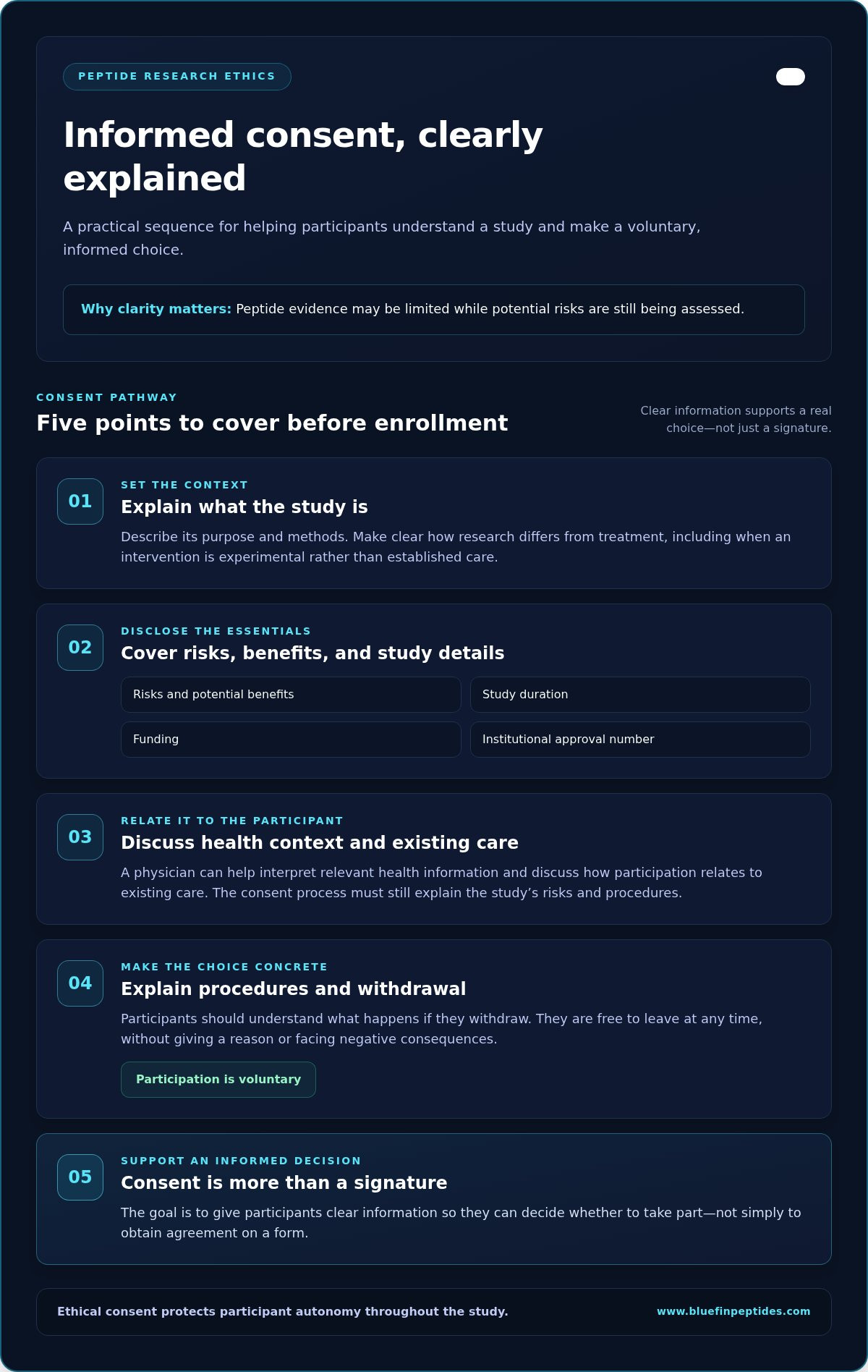
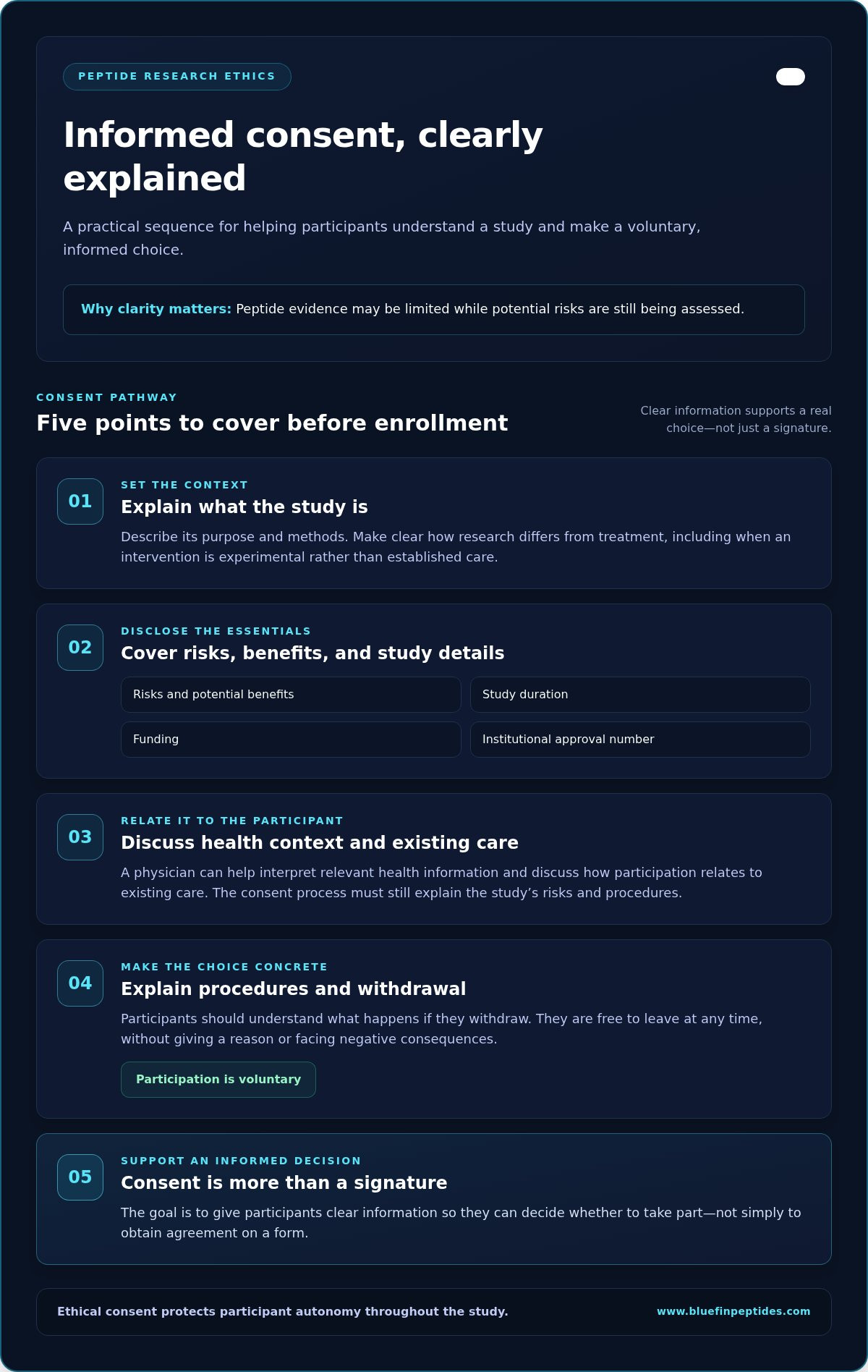
Informed consent is a voluntary decision made after a participant receives clear information about a study. Before enrollment, researchers should explain its purpose, methods, funding, duration, institutional approval number, risks, and potential benefits. Participants must be free to leave at any time, without giving a reason or facing negative consequences. This protects their autonomy, particularly when a clinical study involves unfamiliar compounds or uncertain outcomes.
Before agreeing to a peptide study, participants should understand how research differs from treatment. A physician can help interpret relevant health information and discuss how participation relates to existing care, but the consent process must still explain the study’s risks and procedures. For example, researchers should distinguish an experimental intervention from established treatment and explain what happens if a participant withdraws. The goal is to support an informed choice, not simply obtain a signature.
Animal Welfare in Peptide Research
Animal welfare in peptide research means designing studies to limit avoidable harm and using findings responsibly before research advances to people. Biomedical drug development may use animal models before human studies, after nonclinical safety and therapeutic activity have been demonstrated. Researchers should justify the model, monitor animal welfare, and link each procedure to a defined scientific purpose. These safeguards matter because animal findings can inform, but do not replace, evidence about human safety.
Animal-welfare requirements cannot be applied identically to every peptide experiment without considering the study and its institutional oversight. Researchers should assess the model, procedures, expected harms, and scientific value before work begins, then monitor animal welfare during the study. They should also report results accurately, including findings that do not support the proposed effect. This helps ensure that animal use is not a substitute for rigorous study design.
Ethical sourcing, synthesis, storage, and disposal depend on documented controls throughout a material’s lifecycle. Researchers should record the peptide’s identity and source, synthesis and handling procedures, storage conditions, and waste-disposal methods in the study protocol. Packaging and safety information should help laboratory staff identify and handle the material appropriately, and follow the study’s storage and disposal procedures. These controls support traceability and reduce preventable exposure and mix-ups.
Genetic engineering and peptide design raise ethical concerns when sequence changes may alter biological activity, stability, or unintended effects. Ethical considerations in peptide research also include describing the design rationale, methods, and uncertainties in protocols and consent materials when relevant. Clear reporting helps review bodies assess whether proposed work has a sound scientific purpose and proportionate risks.
Participant privacy requires protection during data collection, access, storage, and reporting. Researchers should restrict access to sensitive records, use anonymized data whenever possible, and remove identifying details from final reports. Anonymity means not collecting identifiers such as names, phone numbers, email or IP addresses, photographs, videos, or identifying physical characteristics. If identifiable information is necessary, researchers should explain how it will be handled before obtaining consent.
Institutional review boards and regulatory oversight
Independent review assesses whether a study’s design, oversight, and disclosures support responsible research. In the United States, the review pathway depends on the type of research and whether it involves human participants or an investigational drug.
Ethics Committee Review
An institutional review board (IRB) independently evaluates biomedical research involving people. Under FDA regulations, U.S. IRBs can approve research plans, require modifications, or reject them. They also review ongoing studies, and researchers should promptly report and address unexpected adverse events. This oversight gives participants a formal protection mechanism beyond the study team’s own judgment.
The federal government passed the National Research Act in 1974. According to the U.S. Department of Health and Human Services, the Act created the National Commission for the Protection of Human Subjects of Biomedical and Behavioral Research to establish a code of research ethics. That history frames independent review as a system of accountability, not a substitute for sound study design.
Review continues after approval. A new safety concern, protocol change, or unexpected adverse event can affect a study’s risk profile, so the committee needs relevant updates to reassess protections. Researchers should document the event, report it through the applicable review process, and address any resulting safety concerns. This creates a traceable record of the oversight response.
Regulatory Requirements and Conflicts of Interest
U.S. requirements depend on whether a project involves human subjects, drug development, or laboratory work. FDA regulations allow IRBs to approve, modify, or reject covered biomedical research plans. The FDA also describes an Investigational New Drug application, or IND, as a pathway for controlled clinical research under its oversight. A laboratory study intended for research use is not automatically a clinical trial.
FDA guidance addresses clinical pharmacology considerations for proposed peptide drug products submitted in a new drug application under section 505(b) of the Federal Food, Drug, and Cosmetic Act. The guidance was issued by the Center for Drug Evaluation and Research and is identified by docket number FDA-2023-D-3391. It concerns a defined drug-development submission pathway; it does not establish that every peptide experiment requires an application.
Conflicts of interest arise when financial or professional interests could influence study design, analysis, or reporting. Practical safeguards include disclosing funding and relevant relationships to the review committee, separating commercial roles from data analysis where feasible, and documenting decisions that could affect results. Independent reviewers can scrutinize these disclosures and methods, helping readers distinguish evidence from commercial influence.
Independent review also matters beyond individual studies. The World Health Organization and the National Institute of Care Excellence include independent review as a routine part of guideline development. In peptide research, transparent protocols, documented oversight decisions, and accurate adverse-event reporting make evidence easier to assess. Together, these practices help keep medical claims aligned with the methods and findings that support them.
Risk minimization and participant safety
Participant safety depends on anticipating harm, explaining uncertainty, and monitoring outcomes. In peptide studies, safeguards should address pharmacokinetics, product sourcing, dosing, and responses to adverse events.
Researchers should assess how a peptide is absorbed, distributed, metabolized, and eliminated before interpreting its clinical effects. These pharmacokinetic properties help shape study design and safety monitoring. For newer injectable peptides, evidence about long-term or frequent dosing remains limited, and appropriate dosing and frequency are uncertain. Reports of effects largely come from anecdotal accounts rather than a consistent clinical evidence base.
Physician Ethics and Patient Safety
Physician ethics connects patient welfare with honest disclosure, careful risk assessment, and responsible clinical practice. Participants need to distinguish experimental research from established treatment before deciding what risks to accept. Researchers should explain known and uncertain risks, monitor participants, and arrange medical resources or counseling when necessary. If an adverse event occurs, prompt reporting and a documented response support safer study decisions.
Risk assessment must weigh possible harms against the study’s potential benefits. Researchers should minimize avoidable risks, define how they will monitor participants, and explain the response plan before enrollment. Examples of reported effects from newer injectable peptides include injection-site skin irritation, fatigue, headaches, and gastrointestinal issues. Insulin can cause low blood sugar; GLP-1 medications can cause gastrointestinal symptoms and may carry a risk of pancreatitis.
Risks of Unapproved Peptides
Unapproved peptides marketed for human use can present contamination, sourcing, safety, and dosing risks. In the United States, unapproved research peptides may be sold for research use only, but cannot legally be marketed for human use. This distinction matters: laboratory research materials are not a substitute for a prescribed treatment or evidence of human safety.
For clinics and research teams, safety practices begin with documented sourcing and a clear separation between laboratory materials and clinical care. A label or advertised identity alone does not establish that a material contains the stated ingredients or is suitable for human use. Where research and oversight are not standardized or FDA-reviewed, newer injectable peptides may be manufactured unsafely or contain ingredients different from those advertised.
Monitoring should connect each observed outcome to the study protocol. Researchers can consistently record dosing, timing, symptoms, and clinical assessments, then review patterns rather than treating each report in isolation. This record supports accurate safety analysis and transparent reporting. Participants should also know how to report symptoms and what medical support the study provides, so emerging concerns reach the study team promptly.
Consumer safety depends on distinguishing research-use products from approved medical treatments. Research requires defined protocols, controlled handling, and appropriate oversight; clinical decisions require evidence relevant to human use. When evidence about a peptide’s dosing, frequency, or long-term effects is limited, those uncertainties should be addressed in risk disclosures and study monitoring plans.
Fair participant selection and equitable distribution
Fair selection means recruiting participants according to scientific criteria without exploiting vulnerability or excluding groups without justification. This matters because study results may not apply to populations that were unfairly omitted. For a peptide study focused on a particular disease, eligibility criteria should relate directly to the research question, anticipated risks, and scientific need, rather than convenience or social disadvantage.
The Tuskegee Syphilis Study illustrates the lasting harm caused when research fails to protect participants. It involved approximately 600 Black men and ran from 1932 to 1972. Its history underscores why participant selection requires ethical scrutiny, not only efficient enrollment. Reviewers should examine who bears the study’s burdens, whether selection criteria are justified, and whether affected communities have meaningful opportunities to participate.
Fair recruitment also requires considering who can realistically enroll. Travel, time away from work, and other routine participation costs can create barriers, particularly for economically disadvantaged people. Reimbursing routine costs can reduce those barriers without creating undue influence. Reimbursement offsets expenses, while excessive compensation may compromise a person’s ability to make a voluntary decision.
Equitable distribution concerns how the burdens and benefits of biomedical research are shared across groups in society. A study should not repeatedly place risk on one population while its expected benefits primarily serve another. For example, researchers studying a disease that affects diverse communities should assess whether recruitment can produce relevant evidence across those groups. Inclusion supports fair access and findings that apply to more people.
International peptide collaborations require attention to cultural, social, and economic differences. Consent materials, recruitment practices, and the practical demands of participation should make sense in each community involved. Researchers should engage and collaborate with those communities and ensure the work addresses their needs. These steps can reveal concerns that a protocol developed elsewhere might overlook.
Written guidelines make recruitment decisions reviewable. A protocol can explain why each group is eligible, how recruitment avoids coercion, and how routine costs are handled. An ethics committee can then assess whether selection criteria match the disease or scientific question and whether burdens fall unfairly on a particular group. During recruitment, researchers should track who is approached and enrolled, then investigate patterns that suggest unjustified exclusion. This record helps keep participant selection aligned with the study’s purpose.
Fairness matters after a study ends, too. Researchers should report who participated and describe limitations that affect how findings apply to other populations. If a peptide study excludes a group for a defensible safety reason, the rationale should be clear. If exclusion reflects access barriers, researchers should consider changes to recruitment. Transparent reporting helps readers judge whether the evidence can inform decisions across communities affected by the disease.
Proposed regulatory reforms and quality verification
Quality safeguards work best when research protocols define measurable acceptance criteria before peptide batches enter a study. Proposed reforms emphasize consistent testing, traceable results, and independent review rather than relying on a label alone.
A biologics transition framework covering 2020-2023 reclassified many therapeutic peptides. This context makes clear classification and oversight important: researchers need to distinguish a research material from a regulated drug product and apply controls appropriate to the study. A regulatory pathway does not replace scientific evaluation of identity, purity, or suitability for a specific experiment.
One proposed batch-quality approach uses high-performance liquid chromatography (HPLC) to verify peptide purity. The recommended minimum is ≥ 95 % purity. For downstream research applications, the stated endotoxin limit is below 0.5 EU/mL. These measurements address different properties: HPLC assesses purity, while an endotoxin assay evaluates a separate potential contaminant. Neither result alone establishes safety for human use.
Testing becomes more credible when acceptance limits are set before results arrive. NIH 2023 ethical guidelines require predefined acceptance criteria for peptide-batch quality-control metrics before release. A protocol can therefore specify the assay, threshold, documentation, and response to a failed result in advance. This prevents post hoc changes to criteria from making an unsuitable batch appear acceptable.
Independent testing adds another safeguard. The proposed approach recommends that independent laboratories retest a random 5 % of peptide batches each month. Random selection can reveal discrepancies that routine supplier testing might miss, while documented results create a record for later review. The monthly period matters: sporadic testing may not identify a recurring variation across batches as clearly.
Useful batch records connect each result to the material tested. They can identify the batch, testing method, measured value, acceptance threshold, analysis date, and disposition. For example, a result below the established purity threshold should prompt a documented decision before the material is used. Recording only a passing summary, without the underlying result or method, weakens traceability.
Researchers can use reform proposals as a framework for continuous quality improvement, not as a substitute for applicable oversight. Compare assays across batches, preserve original records, and review deviations before interpreting experimental effects. Clear documentation helps a scientific team distinguish biological findings from variation in the material itself. It also gives reviewers a concrete basis for assessing whether quality controls were defined and followed.
Bluefin Peptides: Retatrutide Research Peptide
Bluefin Peptides’ Retatrutide Research Peptide is intended for laboratory research use, not human treatment. For researchers applying the quality principles discussed here, Bluefin Peptides provides research peptides with ≥99% HPLC verification, mass-spec confirmation, and batch COAs. These records support review of identity and analytical data alongside a study’s own protocol and acceptance criteria.
The catalog also includes Tirzepatide Research Peptide, BPC-157 / TB-500 Research Blend, and Ipamorelin / CJC-1295 Research Blend. Each material should be used within appropriately reviewed research, with handling and safety controls set by the laboratory. Research-use materials are not substitutes for approved treatment or medical advice.
For product information, contact Bluefin Peptides or visit www.bluefinpeptides.com.
Carry Ethical Principles Into the Next Study
Strong research practice turns ethical considerations in peptide research into decisions teams can apply consistently. Before a study begins, define who is responsible for reviewing materials, documenting deviations, and responding when new evidence changes the risk assessment. Revisit those responsibilities as the protocol develops, not just during initial approval. This keeps ethical review connected to the work itself.
For laboratory research, material selection is one practical part of that planning. Bluefin Peptides offers Retatrutide Research Peptide, Tirzepatide Research Peptide, and BPC-157 / TB-500 Research Blend for research use. Match any material to the study’s scientific purpose, handling controls, and established quality criteria. Research peptides are not substitutes for medical treatment.
Use the next study-planning stage to make those controls visible in the protocol and recordkeeping. For laboratory research material information, contact Bluefin Peptides. Careful planning and transparent documentation give research teams a stronger foundation for responsible work.
Frequently Asked Questions
What are the main ethical principles governing peptide research?
The core principles are respect for autonomy, minimizing harm, fairness, and scientific integrity. In practice, autonomy means people make informed choices; minimizing harm means assessing study risks against potential value; fairness concerns who bears research burdens and may benefit. Integrity requires honest methods and reporting. For example, a team should document protocol changes and report results that do not support its hypothesis, rather than presenting only favorable findings.
What IRB and informed consent requirements apply to human peptide studies?
For research under FDA oversight, an institutional review board can approve a plan, require modifications, or reject it. Consent materials should explain the study’s purpose, methods, funding, duration, risks, benefits, and institutional approval number. A useful test is whether a prospective participant can explain the study procedures and distinguish them from usual care. If protocol changes affect participation, the review and consent materials should reflect those changes.
How should researchers assess peptide toxicity, dosing, and off-target risks?
Researchers should evaluate nonclinical safety and therapeutic activity before human research, then design monitoring around the peptide’s intended mechanism and plausible unintended effects. Pharmacokinetic evidence helps characterize how a compound moves through the body, while dose and frequency require study-specific justification. Evidence about long-term or frequent dosing for newer injectable peptides is limited. A protocol should define safety observations and how findings will inform dose decisions, rather than treating anecdotal reports as clinical evidence.
How can researchers ensure equitable participant selection and fair access to benefits?
Link eligibility criteria to the scientific question and document why exclusions are necessary. Recruitment plans should identify practical barriers, such as travel or time away from work, and account for routine participation costs where appropriate. Researchers can also involve relevant communities in shaping study priorities and communication. Afterward, report who participated and explain limits on applying results to groups not represented, so readers can assess whose needs the findings address.
For laboratory research use only. Not for human or veterinary use. This content is educational and does not constitute medical, dosing, or usage guidance.
Browse the BLUEFIN catalog