Ensuring Batch-to-Batch Consistency in Peptides Through Testing and Handling

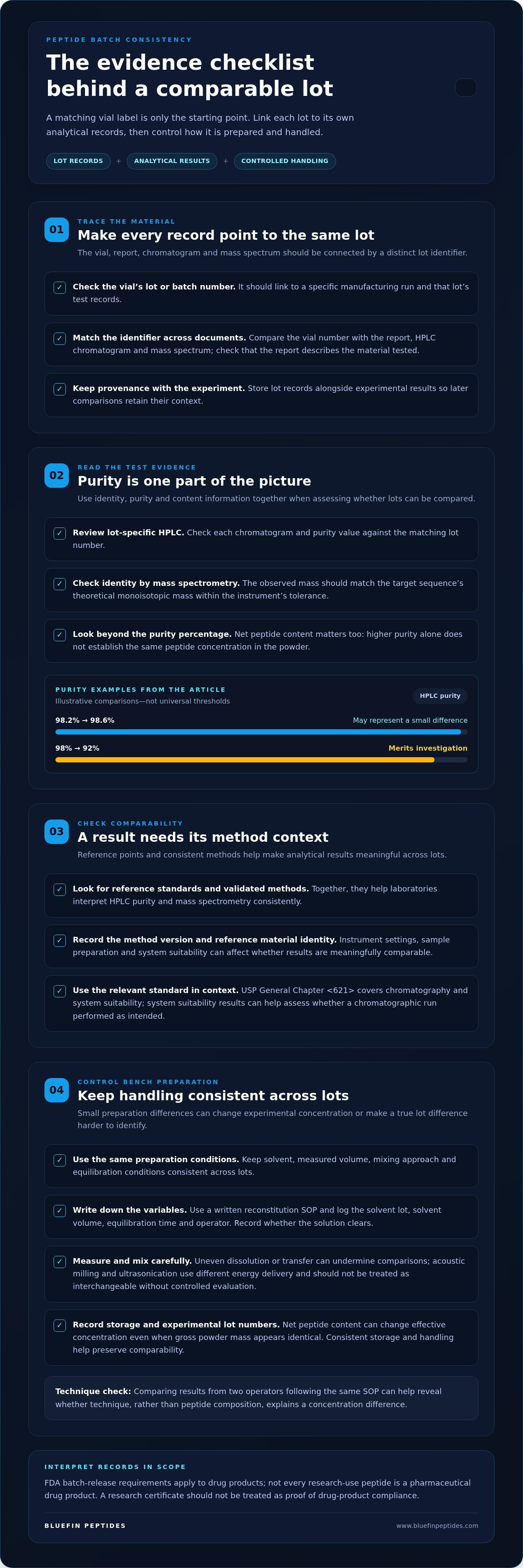
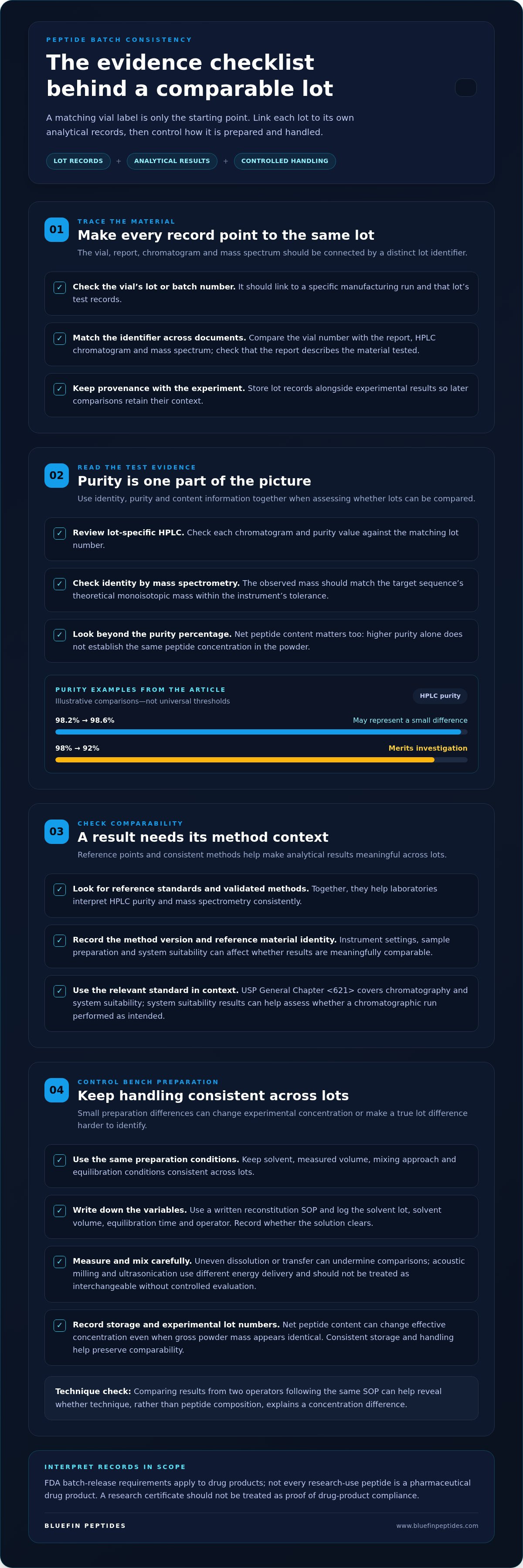
A matching vial label alone does not establish peptide batch consistency. Ensuring batch-to-batch consistency in peptides starts with lot-specific evidence: each lot should have its own HPLC chromatogram and mass spectrum, both linked to the vial’s lot number. The observed mass should match the target sequence’s theoretical monoisotopic mass within the instrument’s tolerance. Consistent reconstitution and handling also help preserve comparability at the bench.
Purity results matter, but they do not tell the whole story. Net peptide content, storage conditions, solvent volume, and mixing technique can all affect the concentration used in an experiment, even when the gross powder mass appears identical. Small differences in these variables can complicate comparisons across runs.
This guide explains what batch testing can show, how to assess supplier documentation, and how batch variation can affect reproducibility. It also covers storage, handling, and mixing precision, including records that help distinguish a true lot difference from a change in laboratory technique.
Key Takeaways
- Compare lot-specific HPLC and mass spectrometry records to assess purity, identity, and whether documentation matches the vial.
- Look for a distinct lot number linked to the batch documentation, and consider material condition and experimental needs when deciding what testing is relevant.
- Record lot numbers alongside experimental results; differences in net peptide content can change the effective concentration even when gross powder mass is the same.
- Control storage conditions and document reconstitution details, including solvent volume and equilibration time, to help separate handling effects from lot variation.
- Use consistent mixing technique and precise volume measurements, since uneven dissolution or transfer can undermine comparisons between experiments.
What Is Batch Testing in Peptide Production?
Batch testing compares documented identity, purity, and content results across peptide lots. It helps distinguish differences in the material from changes in laboratory technique.
Lot-Specific Analytical Results
Lot-specific analytical results are chromatography and mass spectrometry findings tied to an individual manufacturing lot. Compare each HPLC chromatogram and purity value with its matching lot number, then compare observed mass with the target sequence’s theoretical monoisotopic mass within instrument tolerance. For example, 98.2% and 98.6% purity may represent a small difference, while a change from 98% to 92% merits investigation.
Review net peptide content as well as purity. A higher purity result does not, on its own, establish that the powder contains the same peptide concentration. Keep lot records with experimental data so later comparisons retain their provenance.
Reference Standards and Validated Methods
Reference standards provide a defined comparison point, while validated analytical methods establish that a test reliably measures its intended attribute. Together, they help laboratories interpret HPLC purity and mass spectrometry results consistently. Instrument settings, sample preparation, and system suitability all affect whether results can be meaningfully compared.
USP General Chapter <621> covers chromatography and system suitability. A laboratory applying that chapter can use system suitability results to assess whether a chromatographic run performed as intended. Record the method version and reference material identity with each result.
GMP Controls and Process Validation
GMP controls standardize materials, equipment, procedures, and records; process validation evaluates whether a defined process repeatedly produces material meeting its specifications. For peptide quality control, these controls connect manufacturing steps with lot-level test results. FDA drug-product GMP requires testing against specifications before release for distribution under 21 CFR 211.165.
For laboratory work, use a written SOP for reconstitution and log the solvent lot, volume, equilibration time, and operator. Comparing results from two operators following the same SOP can help reveal whether technique, rather than peptide composition, explains a concentration difference.
Manufacturing Requirements and Batch Release
FDA batch-release requirements apply to drug products, while ICH quality guidance provides harmonized frameworks for pharmaceutical quality and process control. According to the Office of the Federal Register, each drug-product batch must meet final specifications, including the identity and strength of each active ingredient, before release. These requirements make lot documentation central to pharmaceutical compliance.
These requirements do not mean that every research-use peptide is a pharmaceutical drug product. Interpret regulatory requirements in the context of the relevant product, and do not treat a research certificate as proof of drug-product compliance.
Mixing and milling also influence comparison. Acoustic milling and ultrasonication use different energy delivery, so results should not be treated as interchangeable without controlled evaluation. A settling-behavior comparison used ultrasonication for 5 minutes and 10 minutes, demonstrating why process duration belongs in the method record.
For reconstitution, use the same solvent, measured volume, mixing approach, and equilibration conditions across lots. Record whether the solution clears, and do not combine materials unless their compatibility is established for the experiment. These controls help separate batch variation from differences introduced during preparation.
How do I know if a supplier tests every batch individually?
Look for documentation tied to each lot, not just a generic specification sheet. The lot number should connect the vial to its own test records and manufacturing run.
Lot-Specific Records and Traceability
Lot-specific records link a peptide sample to its batch, tests, and release decision. Each vial from a controlled research peptide supplier should carry a lot or batch number linked to a specific manufacturing run. Check that the report repeats the identifier and describes the material tested.
Compare the vial’s lot number with the number on the report, chromatogram, and mass spectrum. Matching identifiers let you trace results to the amino-acid sequence and synthesis batch under review. Keep these records with the laboratory data.
Chromatographic Stability Testing
Chromatographic stability testing compares a sample’s chemical profile under defined storage or handling conditions. HPLC can show changes in the principal peak or the appearance of additional peaks, helping identify a stable profile or possible degradation.
Interpret results alongside the method and sample conditions. USP General Chapter <621> covers chromatography and system suitability, which helps establish whether a run performed as intended. A chromatogram alone does not establish every physical property, so evaluate it with relevant appearance and handling observations.
Endotoxin and Microbial Checks
Endotoxin and microbial checks assess different quality attributes and should not be treated as interchangeable. USP General Chapter <85> is the Bacterial Endotoxins Test; USP General Chapter <61> covers microbiological examination of nonsterile products and microbial enumeration tests.
Match the test to the material’s intended research use and risk. A supplier report should identify the test performed and the associated lot. These checks do not replace identity, purity, or concentration testing.
Check whether each lot has its own report, then compare identifiers and test dates across records. Batch-specific reports matter because a supplier’s routine testing statement does not show that the vial in hand was tested. Additional testing should reflect material risk, condition, retest guidance, and experimental needs.
Physical monitoring can complement chemical analysis. Inline particle-size, rheology, and near-infrared (NIR) systems can monitor batch quality during manufacturing. NIR is non-destructive and can support real-time process monitoring, but it does not replace a lot-specific analytical report. The report should identify the sample tested and the method used for each result.
For a study requiring traceable research material, batch-documented research peptides provide a starting point for reviewing lot-level records. Keep the supplier report with the laboratory’s own sample, storage, and testing logs so later comparisons remain anchored to the correct batch.
Does batch variability affect experimental reproducibility?
Yes. Differences in net peptide content, moisture, or handling can change the effective concentration between experimental runs. Consistent lot records and preparation protocols help identify whether a result reflects biology or material variation.
Sources of Lot-to-Lot Variability
Lot-to-lot variability means that peptide attributes differ between manufacturing batches. Sampling quality, material flow, moisture variation, and equipment condition can all contribute. Moisture and counterion content can affect net peptide content, even when gross powder mass appears identical. Tracking these factors matters because a protocol based only on gross mass may deliver different amounts of peptide across lots.
Effects on Experimental Results
Variability can shift the actual concentration used in an assay, affecting comparisons between runs. For example, at 1 mg of gross powder per mL, material with 80% net peptide content yields 0.80 mg/mL; material at 65% yields 0.65 mg/mL. Record each lot number with experimental data, then recalculate reconstitution when the new lot’s net content differs.
Acceptable Variation Thresholds
Practical thresholds help researchers distinguish a small difference from a change needing investigation. HPLC purity values of 97% and 99% are described as unlikely to introduce impurities at levels affecting most in vitro assays. A practical guideline is to keep HPLC purity within two percentage points across lots. A change from 98% to 92% is a red flag to investigate before use.
Consistency by Peptide Grade
Research-grade and pharmaceutical-grade peptides have different quality-control contexts. For research material, assess lot-specific identity, purity, and net content against the requirements of the experiment. U.S. drug-product GMP requires testing against specifications before distribution under 21 CFR 211.165. According to the Office of the Federal Register, each drug-product batch must meet final specifications for active-ingredient identity and strength before release.
Moisture monitoring and controlled material flow support meaningful comparisons. SciMed recommends timestamping raw materials and using first-in, first-out inventory practices to reduce batch variation. In a study spanning multiple lots, keep each lot identifier alongside the results and preparation records. This creates a traceable comparison instead of treating every vial as chemically interchangeable.
Purity alone does not establish equal peptide content. If a new lot has a different net content, adjust the reconstitution calculation rather than relying on the previous gross-powder measurement. Keep solvent volume and preparation protocol consistent, and document the operator and handling conditions. These controls help distinguish a material difference from one introduced during laboratory preparation.
Ingredient storage and handling
Storage conditions can affect the peptide material used in a study, so keep handling consistent across lots. For research use, track the vial’s lot number, storage history, and preparation details alongside each experiment.
Powdered peptides are generally stored refrigerated or frozen. Available storage guidance states that shelf life can be up to two years when powder is kept cold. Treat this as storage guidance, not a substitute for the product’s lot documentation or stability information. Record the storage location and any temperature excursion that could affect the material.
Room-temperature exposure is a separate consideration. Most peptides can remain stable at room temperature for several days when kept away from heat and direct sunlight. That does not make room-temperature storage equivalent to refrigerated or frozen storage. Return material to its specified storage conditions after handling, and document any exposure outside the established procedure.
Reconstituted material requires its own handling record. Research guidance gives a typical refrigerated shelf life of 3-6 months when reconstituted peptides are handled properly. The actual stability of a particular peptide solution depends on its chemical properties, solvent, concentration, and storage conditions. Label the solution with its lot, reagent, concentration, and preparation date so its identity remains traceable.
Use the same preparation sequence for every lot. Record the solvent identity and lot number, measured volume, equilibration time, and operator. Add solvent according to the written protocol, then gently swirl the vial until the powder dissolves. Do not shake it. Note whether the solution remains clear or becomes cloudy, since a visible change can affect how the sample is handled.
Retesting after a storage change is appropriate when the material’s history affects whether you can rely on its existing results. For example, a documented temperature excursion may prompt a review of the lot’s stability information and the experiment’s acceptance criteria. Retesting should address the attribute at risk, such as identity, purity, or concentration, rather than repeat an unrelated measurement. Record the reason, method, and result with the sample.
For consistent comparisons, use the same storage and mixing conditions for every batch in a study. If one amino acid peptide lot is refrigerated while another experiences prolonged room-temperature exposure, the observed difference may reflect handling rather than the target material. A controlled log makes that distinction easier to assess.
How mixing precision affects batch consistency
Mixing does not change a manufactured lot’s composition, but it can change the concentration delivered to an experiment. Powder left on a vial wall or incompletely dissolved can make preparations differ, even when they are intended to be identical. Controlled preparation is therefore central to ensuring batch-to-batch consistency in peptides and distinguishing material variation from handling variation.
Start with the lot’s net peptide content, then calculate the required powder mass and solvent volume. The same gross powder mass across lots may not produce equal peptide concentrations when net content differs. Record the calculation, solvent identity, and final volume for each preparation. This gives you a clear basis for later analysis.
Apply the same sequence to every vial. Add solvent carefully, then gently swirl until the powder dissolves; do not shake. Record the solvent lot, volume, equilibration time, and operator. These details help identify whether an observed difference came from the material or the mixing technique.
- Control solvent conditions. A research preparation guideline suggests warming solvent to approximately 37°C to improve solubility. Keep temperature and equilibration conditions consistent across compared samples.
- Handle difficult-to-dissolve powder consistently. The guidance recommends using no more than 10% DMSO of the total volume to wet difficult-to-dissolve peptide powder before dilution. Record the amount and dilution sequence.
- Assess the final solution. Note whether it remains clear or develops cloudiness after mixing. For peptides containing aromatic residues, concentration checks can use UV absorbance at 280 nm or HPLC.
Volume accuracy matters at every transfer. A preparation error can alter final concentration even when the powder dissolves fully. Use the same calibrated equipment and transfer approach across lots. Record actual volumes rather than relying on a typical estimate. For sterile laboratory applications, guidance identifies a 0.22 µm syringe filter; use filtration consistently when the protocol requires it.
When preparing mixtures, keep the order of addition and mixing conditions consistent. Record each component’s lot and volume, and assess compatibility and homogeneity under the experiment’s defined conditions. Do not assume peptide chains and other components form a uniform mixture simply because they share a vessel.
For researchers ensuring batch-to-batch consistency in peptides, separate three variables in the analysis: lot content, solvent volume, and mixing procedure. Keep preparation conditions constant while changing only the planned experimental variable. Retain the records with the results so concentration differences remain interpretable and repeatable across batches.
Bluefin Peptides: Retatrutide Research Peptide
Bluefin Peptides’ Retatrutide Research Peptide is a research-use option for laboratories seeking documented peptide material. Bluefin Peptides states that its peptides are at least 99% HPLC-verified, with mass-spectrometry confirmation and batch certificates of analysis (COAs). These records support lot-level review alongside your own preparation and experimental logs.
For other research protocols, the catalog also includes Tirzepatide Research Peptide, BPC-157 / TB-500 Research Blend, and Ipamorelin / CJC-1295 Research Blend. Compare each lot’s documentation with your study requirements, then apply consistent storage and preparation procedures to keep experimental records traceable. These products are supplied for laboratory research use only, not human consumption.
Visit Bluefin Peptides online to review its research peptide offerings.
Build Consistency Into the Next Study
A practical next step in ensuring batch-to-batch consistency in peptides is to define acceptance criteria before the next study begins. Decide how your team will document deviations, compare results, and handle a material change. A shared framework helps keep future decisions consistent across operators and experimental runs.
Bluefin Peptides offers Retatrutide Research Peptide, Tirzepatide Research Peptide, and BPC-157 / TB-500 Research Blend for laboratory research use. Select material that fits your research plan, then carry your documentation and handling controls forward into the study.
For questions about Bluefin Peptides’ research offerings, contact Bluefin Peptides. A clear protocol and a well-documented next step can keep your research moving with purpose.
Frequently Asked Questions
How much variation is too much?
It depends on the attribute being compared and the experiment’s acceptance criteria. As a practical guideline, HPLC purity should stay within two percentage points across lots. A purity change from 98% to 92% is a red flag to investigate before use. Also distinguish purity from net peptide content: similar purity values do not establish equal amounts of peptide in weighed powder.
Is some batch-to-batch variation normal in research peptides?
Yes. Research peptide lots can differ in net content because moisture and counterion content contribute to gross powder mass. Net content may vary by five to ten percentage points between lots, which can change the effective concentration prepared from the same weighed mass. Check the lot’s reported content and account for any difference in your experimental calculations and records.
What does batch-to-batch consistency actually mean?
It means that material from separate production lots remains sufficiently comparable for the intended research protocol. Comparability involves more than a matching label: identity, purity, and net content each answer a different question about the sample. Consistency also depends on preparing and storing lots under comparable conditions. Define which attributes matter to your assay before comparing results, rather than treating one measurement as a complete quality assessment.
What is a lot number on a research peptide vial?
A lot number identifies a specific manufacturing run and connects a vial to that run’s records. Use it as the traceability key in inventory and experimental data. For example, record the vial’s identifier alongside the sample name, preparation entry, and assay result. If you compare results from separate lots later, those identifiers help distinguish a material change from a change in protocol or analysis.
What causes batch-to-batch variability in peptide manufacturing?
Several process and material factors can contribute, including sampling quality, material flow, moisture variation, and equipment condition. Differences in moisture or counterion content can also change net peptide content without an equivalent change in gross powder mass. To investigate a result, compare the lot records and preparation history, then consider whether handling, sampling, or manufacturing conditions could explain it.
Which analytical tests verify peptide identity, purity, and potency between batches?
Mass spectrometry supports identity assessment by comparing the observed mass with the target sequence’s theoretical monoisotopic mass. HPLC provides a purity profile, while net peptide content helps estimate how much peptide is in the material. These tests measure distinct attributes, so none can substitute for all the others. Match each result to the lot under study and interpret it against the assay’s defined requirements.
What acceptance criteria and specifications are used for peptide batch consistency?
Acceptance criteria should specify the attributes relevant to the study, such as identity, HPLC purity, and net peptide content. A practical guideline is to keep HPLC purity within two percentage points across lots, while a change from 98% to 92% warrants investigation before use. For concentration-sensitive experiments, include a calculation based on the current lot’s net content, not only gross powder mass.
How do peptide synthesis and purification processes reduce batch variability?
Controlled synthesis and purification help produce material with a defined sequence and a more consistent impurity profile. In liquid-phase synthesis, intermediates can be isolated, purified, and characterized at each step, supporting structural accuracy and synthesis fidelity. Consistent process records make it easier to compare runs and identify where a difference arose. Analytical testing then evaluates the resulting material against the relevant specifications.
For laboratory research use only. Not for human or veterinary use. This content is educational and does not constitute medical, dosing, or usage guidance.
Browse the BLUEFIN catalog