Dual Agonist Peptide Research: Mechanisms, Evidence, and Quality Evaluation

A peptide’s label can name its receptor targets, but it cannot establish what a specific batch contains. In dual agonist peptide research, separating pharmacological classification from material verification is essential. This is especially important when clinical coverage blurs the difference between investigational findings and laboratory use.
The terminology is easy to confuse. Tirzepatide acts on GIP and GLP-1 receptors, while retatrutide targets those receptors plus glucagon, making it a triple agonist. That distinction describes receptor activity, not whether a research material is suitable for human use. Bluefin Peptides’ listed materials are for research use only, not human, veterinary, or consumer use.
This article explains how to distinguish dual from triple agonism, assess claims against the available evidence, and review analytical records relevant to a laboratory-focused evaluation. Batch-level COAs, HPLC results, and mass-spectrometry confirmation can support review of identity and purity. They are evidence to interpret, not a substitute for independent assessment. The practical sequence is straightforward: classify the pharmacology first, then examine the documentation.
Key Takeaways
- In dual agonist peptide research, classify compounds by receptor targets, then assess efficacy and safety claims as separate questions.
- Distinguish mechanistic hypotheses from experimental observations and study conclusions before drawing interpretations.
- Compare research claims with the evidence type and analytical records. HPLC and mass spectrometry address different questions.
- Use a structured checklist to review batch documentation, identity, analytical methods, and traceability for research materials.
- Qualified researchers can access Bluefin Peptides’ catalog and COA lookup through Researcher Access, which is free to join after self-attestation and email verification.
What Does Dual Agonist Peptide Research Mean?
In dual agonist peptide research, a dual agonist is a compound described as activating two distinct receptor targets. The term classifies a proposed or demonstrated mechanism. It does not, by itself, show how well a compound works, whether it is safe, or what an experiment will find. Each of those questions requires evidence suited to the specific claim.
How receptor targets define a dual agonist
An agonist binds to a receptor and activates it, producing a receptor-mediated response. Naming two targets distinguishes a dual agonist from a compound described as acting at one target. For example, “GLP-1 and GIP receptor agonist” identifies two proposed targets, but does not establish the strength, selectivity, or biological significance of activity at either one.
Read mechanism language alongside the evidence supporting it. Separate a proposed mechanism from experimental observations and from conclusions drawn by a study. The model, methods, and results set boundaries on what the findings establish. A label or summary phrase alone does not demonstrate receptor activation or predict an experimental outcome. Broader terminology and examples are outlined in GLP1 poly-agonist peptides.
Dual versus triple agonism in peptide research
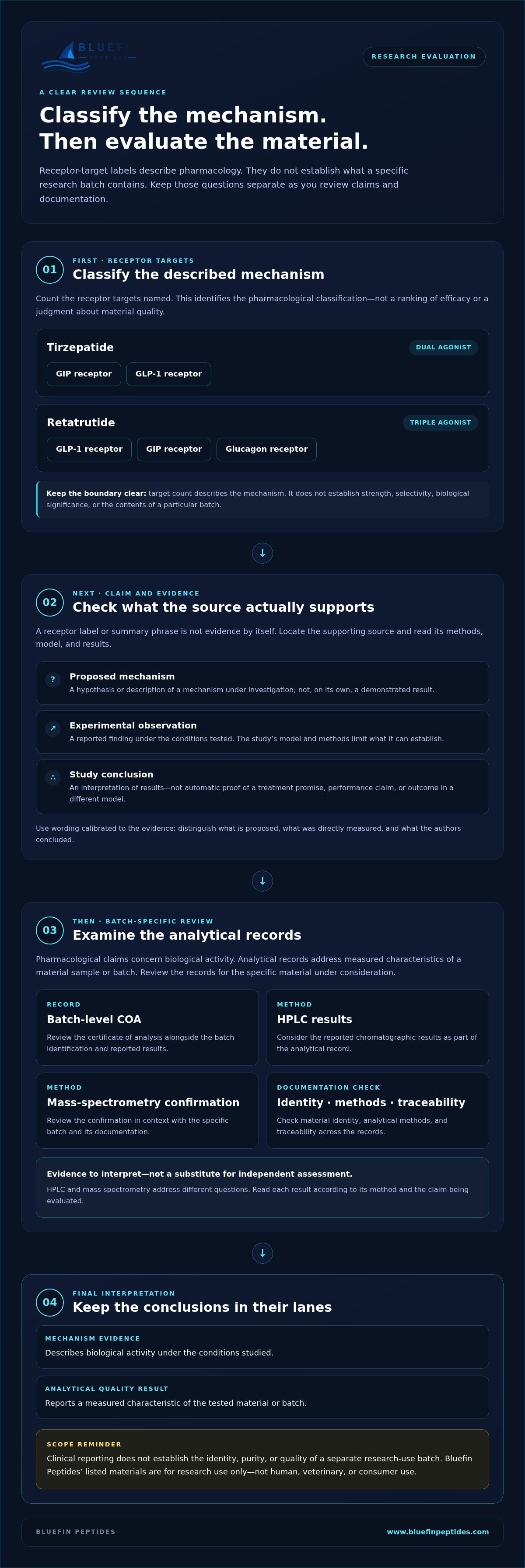
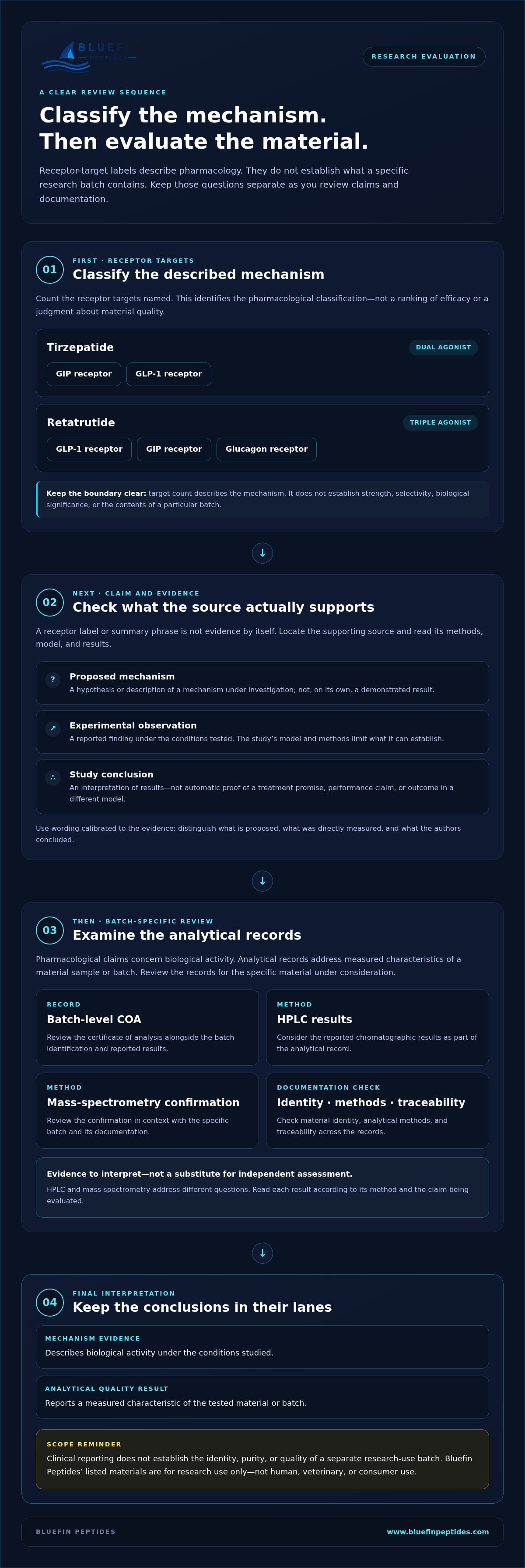
Tirzepatide is the dual-target example in this context, described as acting at the GIP and GLP-1 receptors. Retatrutide is classified differently: it is a triple agonist targeting GLP-1, GIP, and glucagon receptors. This distinction follows the number of receptor targets described. It is not a ranking of efficacy or a statement about which compound is preferable.
Receptor classification has limits. A target description does not establish the identity or purity of a particular research material, or verify the contents of an individual batch. Those are separate analytical questions that require material-specific evidence. Keep the pharmacological label and batch documentation in separate parts of the evaluation.
For readers reviewing retatrutide research peptide specifications, the analytical guide on that topic can complement receptor classification. Interpret specifications and analytical records for the specific batch and purpose under review. They do not convert a research-use material into evidence of a clinical outcome.
Start by identifying the named receptor targets, then determine what evidence supports the mechanism claim. Do not treat the classification as proof of product quality. This separation keeps terminology clear and gives later evaluation of research claims and batch records a sound footing.
How Dual Agonist Peptides Are Described in Research
Receptor labels are useful shorthand, but they are not evidence on their own. In dual agonist peptide research, evaluate each target claim against its source and the study design behind it. A review may summarize a proposed mechanism, while an experimental paper may report measured receptor activity. Those are different kinds of support and should not be treated as interchangeable.
Reading receptor and mechanism claims precisely
First identify the receptor targets named in the claim, then locate the study or other source supporting each one. Check whether the work describes a hypothesis, directly measures receptor activity, or interprets downstream observations. A study’s methods and model limit what its results can establish. A mechanistic result in one experimental setting cannot automatically be generalized to another.
Keep the wording calibrated to the evidence. “Proposed to activate two receptors” signals a mechanism under investigation. “Activity was observed” reports a finding within the tested conditions. Neither statement alone supports a treatment promise, performance claim, or prediction about a different model. Preserve that distinction when summarizing papers, product descriptions, and research findings.
Separating research evidence from clinical interpretation
Clinical reporting can help explain why a receptor mechanism is being studied, but it does not characterize a separate research-use material. Clinical findings concern the intervention and context studied. They do not establish the identity, purity, or quality of a particular supplied batch. Keep the evidence streams separate: pharmacological claims describe biological activity, while analytical records address properties measured in a material sample.
Citation-ready distinction: “Receptor-mechanism evidence describes biological activity under the conditions studied, whereas an analytical quality result reports a measured characteristic of the tested material or batch.”
This separation also prevents clinical language from being applied to laboratory materials. Bluefin Peptides’ listed peptides are research-use materials, not human, veterinary, or consumer products. Clinical coverage can provide context for interpreting the literature, but it is not a substitute for batch-specific documentation or a basis for claims about human-use outcomes.
For a structured approach to laboratory documentation, the research peptide quality standards guide provides related context on analytical evaluation. Use standards as a framework for understanding what a record may show, then examine the actual method, result, and batch identification in the document.
Keep three questions distinct as you read: What receptor mechanism is proposed? What did the study directly measure? What does the analytical record establish about the tested material? This disciplined approach makes evidence easier to compare without letting a mechanism claim drift into a quality or clinical conclusion. Researchers applying that distinction to laboratory materials can explore the research-use peptide catalog as part of their evaluation.
How to Compare Dual Agonist Research Claims and Analytical Evidence
A sound comparison keeps pharmacology and material analysis separate. A receptor-target claim describes proposed or measured biological activity. An analytical result describes a characteristic measured in a sample. Neither substitutes for the other, and neither should be stretched beyond the method and context reported.
Use this framework to sort the evidence before drawing conclusions:
What HPLC and mass spectrometry can document
HPLC is used to assess chromatographic purity, while mass spectrometry supports identity assessment by measuring molecular mass. These methods answer different questions. Read a purity figure alongside the method, underlying report, and batch context, rather than treating it as a standalone verdict. Bluefin Peptides states that its peptides are at least 99% HPLC-verified, with mass-spectrometry confirmation and batch COAs as company-wide quality documentation. Treat these records as evidence to examine, not a substitute for independent assessment. Researchers reviewing a chromatogram can use a focused how to interpret HPLC peptide purity reports guide to understand what the reported result represents.
A purity percentage alone does not establish biological activity, safety, or suitability for a particular research purpose. Nor does it reveal every possible property of a material. The reported value belongs to a method and sample, so do not detach it from its documentation or generalize it to other batches.
Why batch-specific records matter
A batch COA connects reported results to a defined batch, allowing the researcher to compare the document with the material under evaluation. Check that the product identity and batch reference correspond, then review the named analytical methods and reported results. If those elements do not align, the record may not answer the question at hand.
Use the record for what it establishes, and no more. A report containing HPLC and mass-spectrometry results does not automatically prove every quality attribute or experimental property. In dual agonist peptide research, separating receptor evidence from batch evidence keeps comparisons precise. Researchers can apply that approach while reviewing the research-use peptide catalog.
A Researcher’s Checklist for Evaluating Dual Agonist Peptide Materials
A consistent review process helps qualified laboratory researchers distinguish documented material attributes from claims about mechanism or outcomes. Keep the review within the research-use context. No single description or analytical result answers every question. Keep unresolved points visible in the record rather than filling gaps with assumptions.
A stepwise review of research documentation
Begin with the material description and its stated research-only context. Then compare the product identity and batch reference across the accompanying documentation. For dual agonist peptide research, keep the receptor-target claim and material record in separate parts of your assessment, so one cannot stand in for the other.
- Confirm the description. Note the material identity and whether the documentation clearly presents it for research use. Keep the intended research question and any receptor claim distinct.
- Match the batch. Check that the batch reference on the material documentation corresponds with the batch COA. Record any mismatch as unresolved.
- Review analytical methods. Read the stated HPLC result and mass-spectrometry confirmation alongside their reported methods and results. Treat each as evidence for the question that method addresses.
- Preserve limitations. Record missing details, ambiguous references, or questions the available documents do not answer. Do not infer unreported characteristics from a purity figure or product description.
This is a bounded documentation check, not a universal acceptance standard. The appropriate interpretation depends on the research question and evidence available. This checklist does not establish a universal threshold or replace a laboratory’s own review procedures.
Interpreting supplier and study claims separately
Supplier documentation and published research serve different purposes. A supplier’s batch records describe reported analytical results for material tied to a batch. A study supports claims only within its design, methods, and findings. Clinical news coverage may offer context about a compound, but it does not establish the identity or analytical quality of a particular supplied batch.
When reviewing batch-specific COAs for research peptides, compare the document’s product identity, batch reference, methods, and results with the material record. A COA can support traceability and show reported results. It does not prove every property or predict experimental performance. Bluefin Peptides provides batch COAs, HPLC verification, and mass-spectrometry confirmation as company-wide quality documentation for researchers to examine.
Checklist summary: Match the identity, align the batch references, review methods and results, separate supplier records from study evidence, and document what remains unanswered. Keep the conclusion within the evidence.
Qualified researchers can access the research catalog and COA lookup through Researcher Access after self-attestation and email verification. Access is free to join.
Accessing Bluefin Peptides’ Research Catalog and COA Lookup
For qualified researchers, catalog access and analytical documentation serve complementary purposes. The catalog provides product and research information; the COA lookup supports review of batch-level records. In dual agonist peptide research, keeping those roles distinct helps separate product information from the evidence needed to assess a specific batch.
What the catalog and COA lookup support
Bluefin Peptides’ research catalog is intended for qualified researchers and presents research-use materials, including Retatrutide Research Peptide and Tirzepatide Research Peptide. These materials are for research use only, not human, veterinary, or consumer use. Catalog information helps researchers review materials for laboratory evaluation, while the COA lookup provides access to batch documentation.
A COA is a record to examine, not an automatic conclusion. Researchers can use the lookup to review documentation associated with a batch and interpret its reported results in light of the research question. As with any analytical record, the document supports evaluation. It does not replace independent interpretation or establish outcomes beyond what it reports.
Access is SSL encrypted and data protected. These stated safeguards describe the access environment, not a guarantee about research results or material performance. Keeping that boundary clear supports a disciplined, documentation-focused workflow.
Starting with Researcher Access
Researcher Access is free to join. Qualified researchers begin by completing self-attestation and email verification, then can sign in using a one-time code or a password. This process provides access to the research catalog and COA lookup.
Once inside, use the catalog to review available research and product information, then use the COA lookup to examine batch-level documentation relevant to your evaluation. Keep records aligned: compare the material identity and batch reference in the COA with the item under review, and interpret the reported analytical evidence within its stated scope.
This access pathway is designed for laboratory-focused review, not clinical decisions or personal use. Bluefin Peptides’ listed materials remain for research use only. Catalog details and batch records can inform qualified research evaluation, but they do not turn research documentation into a human-use claim.
For researchers ready to review product information and batch documentation, access Bluefin Peptides’ research catalog through Researcher Access.
Carry a Documentation-First Approach Into Your Next Review
Make the next step in dual agonist peptide research a disciplined record review. Align the question your laboratory is investigating with the evidence available, and keep unresolved identity or documentation points visible in your evaluation. Receptor claims and analytical records serve different purposes. Careful interpretation depends on keeping those lines clear.
Bluefin Peptides states that its peptides are ≥99% HPLC-verified, with mass-spectrometry confirmation and batch COAs provided as company-wide quality documentation. These records are available for researchers to examine and interpret, not as a substitute for independent assessment. The materials are for research use only, not human, veterinary, or consumer use.
Researcher Access is free to join and provides access to the research catalog and COA lookup after self-attestation and email verification. Use it to bring product information and batch documentation into your laboratory-focused review.
Access the Bluefin Peptides Research Catalog and COA Lookup through Researcher Access to support your next documentation review.
Frequently Asked Questions
What is a dual agonist peptide?
A dual agonist peptide is a peptide described as activating two receptor targets. In a paper, check whether both targets are named and whether the authors report measured activity or propose a mechanism for further study. The phrase classifies a receptor claim. It does not establish the strength of activity, predict an experimental result, or verify the identity of a material used in a separate laboratory.
Is retatrutide a dual agonist or a triple agonist?
Retatrutide is described as a triple agonist because its target profile includes GLP-1, GIP, and glucagon receptors. That three-target classification distinguishes it from tirzepatide, which is described as acting at GIP and GLP-1 receptors. In dual agonist peptide research, naming each receptor helps prevent a compound with three targets from being grouped inaccurately with dual agonists.
How does a dual agonist differ from a single agonist?
A single agonist is described as activating one receptor target, while a dual agonist is described as activating two. For example, a mechanism statement naming only the GLP-1 receptor is a single-target description; one naming both GLP-1 and GIP is dual-target. The classification counts stated targets, but researchers still need to examine the study evidence for how activity was assessed.
Can HPLC purity alone confirm a peptide’s identity?
No. HPLC is used to assess chromatographic purity, but a purity result alone does not confirm molecular identity. For example, a report may show a dominant chromatographic peak without establishing that the material corresponds to the intended peptide. Review the stated method and report alongside identity evidence, such as mass-spectrometry confirmation, and check that the documentation relates to the batch being evaluated.
What does mass-spectrometry confirmation show in peptide research?
Mass spectrometry measures ions by their mass-to-charge ratio and can support an assessment of whether the measured molecular mass is consistent with the expected material. It addresses an identity-related question, not the same question as an HPLC purity assessment. Interpret the result in the context of the method and report. Mass-spectrometry confirmation alone does not establish every structural or quality attribute.
Why should researchers review a batch-specific COA?
A batch-specific Certificate of Analysis links reported analytical results to an identified batch, which is useful when records need to be matched to a particular material. Compare the product name and batch reference on the COA with the documentation for the material under review. Then note which methods and results are reported. A COA supports assessment of those stated results, not every possible property.
Can research peptide materials be used for human or veterinary purposes?
No. Bluefin Peptides’ listed peptide materials are intended for research use only, not human, veterinary, or consumer use. They should not be treated as medicines, veterinary products, or supplements. Clinical information about a related compound does not change a material’s stated research-only purpose or establish that a particular batch is suitable for use outside laboratory research.
How do qualified researchers access Bluefin Peptides’ research catalog?
Qualified researchers can create Researcher Access by completing self-attestation and email verification. Access is free to join and provides the research catalog and COA lookup. Users can sign in with a one-time code or a password. The access environment is SSL encrypted and data protected. The catalog and lookup support review of research information and batch documentation, not human or veterinary use.
For laboratory research use only. Not for human or veterinary use. This content is educational and does not constitute medical, dosing, or usage guidance.
Browse the BLUEFIN catalog