Designing a Long-Term Peptide Study: A Rigorous Research Framework for 2026

Designing a long-term peptide study takes more than extending the observation period. If the model shifts, material batches vary, or measurements miss meaningful changes, results may be difficult to interpret. A rigorous plan controls these sources of uncertainty from the outset.
Start by defining the research question, then align the model, comparison groups, endpoints, and measurement schedule with it. This framework explains how to make those decisions, account for confounding factors, and keep conclusions within the limits of the evidence.
Reproducibility also depends on clear records of materials, methods, measurement procedures, and deviations. For research-use peptides, recording HPLC purity, mass-spectrometry confirmation, and batch-specific certificates of analysis can help identify the material used. The aim is a study plan that remains traceable from the initial question through final interpretation.
Key Takeaways
- Define “long-term” by the research question, model, and observation plan rather than a universal duration.
- When designing a long-term peptide study, align comparison groups, timeline, primary endpoints, and analysis before data collection.
- Use consistent measurement methods and intervals, and distinguish primary endpoints from exploratory observations.
- Plan how to record attrition, missing data, protocol deviations, and unplanned analyses to support transparent interpretation.
- Maintain clear protocol, material, and batch records. Bluefin Peptides products are for qualified research use only, not human, veterinary, or consumer use.
Define the Research Question Before Calling a Peptide Study Long-Term
A peptide study is long-term when its observation period fits the research question and model, not because it reaches a universal number of days or months. State what will be observed, in which model, over what interval, and what evidence would answer the question. This keeps “long-term” tied to the study’s purpose rather than an arbitrary label.
First identify the kind of claim the study is designed to support. A descriptive study characterizes a pattern over time. A mechanistic study tests a proposed biological process. A comparative study evaluates differences between defined conditions. Each needs a clear primary endpoint. Without one, a study can collect extensive data without a consistent basis for interpretation. The principles of Longitudinal Study Design Principles provide context for repeated observations over time.
Turn a broad peptide topic into a testable question
Specify the peptide-related variable and outcome before selecting measurement methods. For example, ask whether a defined analytical measure changes over a planned observation period in a specified experimental model. This is more testable than asking whether a peptide has “long-term effects,” which leaves the outcome, population, and meaning of “long-term” undefined.
Separate exploratory work from confirmatory testing. An exploratory question looks for patterns or helps refine a later hypothesis; it should not be presented as proof. A confirmatory question states a prespecified hypothesis and primary endpoint that can be evaluated with the planned analysis. In both cases, name the model, experimental unit, and inclusion criteria. The experimental unit is the independently assigned unit, such as an individual organism, culture, or sample, depending on the design. Define eligibility and exclusions in advance so that decisions are not shaped by the results.
Set limits on the inference. A finding in a defined laboratory model supports a conclusion about that model and the measured outcome. On its own, it does not establish clinical relevance, human benefit, or effects in another system.
Set boundaries for duration and scope
Choose the observation period based on the biology or analytical process under study, the model’s constraints, and the time needed to detect the primary outcome. Set time points that can distinguish baseline status, change, and persistence when those features matter to the question. The schedule should be feasible and scientifically justified, not extended simply to make the study sound more comprehensive.
Before data collection, record the boundaries that will shape interpretation:
- Model and scope: Identify the system studied and the conditions to which conclusions apply.
- Observation plan: Define the start, end, and rationale for every planned measurement time point.
- Eligibility and exclusions: State which units or samples qualify and the prespecified reasons for exclusion.
- Assumptions and limits: Document what the design cannot resolve, including unmeasured factors and omitted comparisons.
For designing a long-term peptide study, this is the first safeguard against scope drift. A precise question, model, and timeframe give later decisions about controls, endpoints, and analysis a stable foundation.
Build a Long-Term Peptide Study Around a Stable Experimental Design
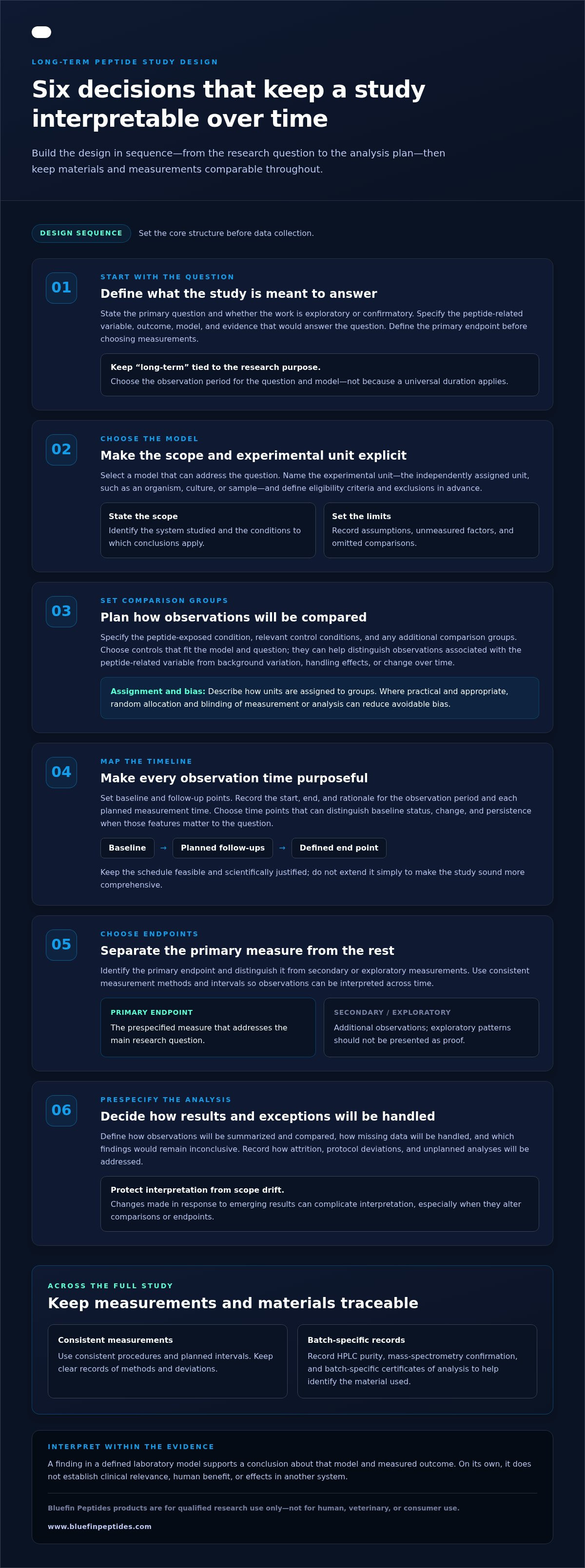
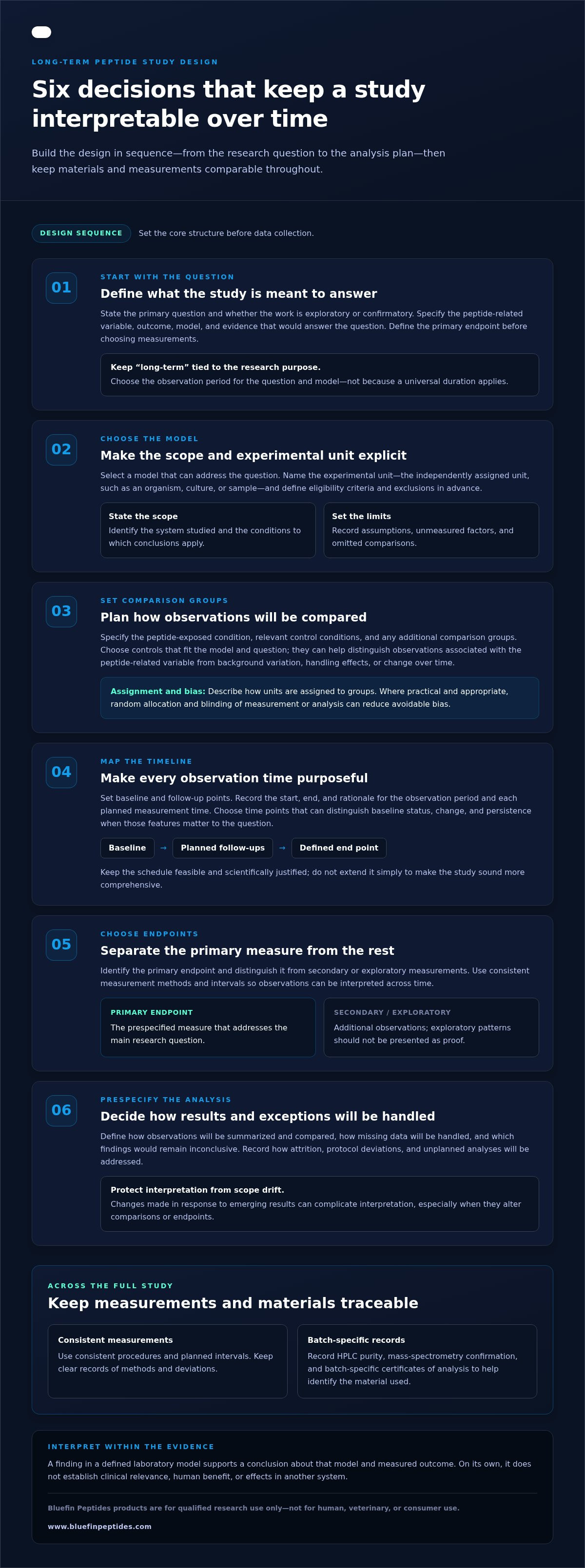
A stable design translates the research question into decisions that can be applied consistently from baseline through final analysis. Set the core structure before data collection. Changes made in response to emerging results can complicate interpretation, particularly when they alter comparisons or endpoints.
Use this sequence to move from question to analysis:
- Question: State the primary question and whether the work is exploratory or confirmatory.
- Model: Choose a model that can address the question. Define the experimental unit, eligibility criteria, and scope of inference.
- Comparison groups: Specify the peptide-exposed condition, relevant control conditions, and any additional comparison groups.
- Timeline: Set baseline and follow-up points, with a rationale for the observation period and each measurement time.
- Endpoints: Identify the primary endpoint and distinguish it from secondary or exploratory measurements.
- Analysis plan: Define how observations will be summarized and compared, how missing data will be handled, and which findings would remain inconclusive.
The sequence matters: choose the model and endpoint to fit the question, not simply because they are convenient to measure. Researchers designing a long-term peptide study should also state how the evidence is intended to be used. FDA drug-development guidance can help frame work intended for regulatory contexts, but a guidance library does not replace study-specific regulatory and statistical review.
FDA Guidance for Peptide Drug Studies
Choose a model and comparison structure
Control conditions help distinguish observations associated with the peptide-related variable from background variation, handling effects, or changes over time. Select controls that fit the model and research question, and specify them in the protocol along with the method for assigning units to groups. Where practical and appropriate, random allocation and blinding of measurement or analysis can reduce avoidable bias. Define the experimental unit clearly: repeated measurements from one unit describe change within that unit, but they are not independent replicates. Replication should reflect independently assigned experimental units.
Plan sample size around the primary endpoint, expected variability, study design, and the smallest effect the study is intended to detect. Avoid choosing group size by convention alone. Document the assumptions and seek qualified statistical input before finalizing the plan.
Plan time points without overcomplicating the study
Set baseline and follow-up measurements to fit the endpoint and model. Consistent intervals make patterns easier to compare across groups and over time. Extra measurement points can add work without improving the answer, so include each one for a defined reason. Record how measurements will be performed and how unavoidable schedule changes will be documented, rather than silently absorbing them into the dataset.
Connect the study design to traceable material records. Bluefin Peptides supplies research-use peptides, including Retatrutide Research Peptide, exclusively for qualified research use. Researchers can review Bluefin Peptides research materials alongside their protocol and study records.
Keep Measurements and Peptide Materials Comparable Across Time
Repeated measurements are interpretable only when methods and materials remain traceable throughout the observation period. Before starting, define how each endpoint will be measured, when it will be measured, which checks will support data quality, and what the result can establish. Use this table as a protocol-planning template.
| Measure | Method | Timing | Quality checks | Interpretation limits |
|---|---|---|---|---|
| Primary endpoint | Prespecified assay or instrument method | Baseline and planned follow-ups | Document calibration, controls, and any method changes | Supports the stated primary question only |
| Exploratory measure | Label as exploratory before collection | Scheduled alongside, or distinct from, primary measurements | Record deviations and missing observations | Generates hypotheses; does not replace the primary endpoint |
| Peptide material record | Link material identity and lot to study records | At receipt and each use or change | Retain available analytical documentation and handling records | Characterizes material; does not demonstrate a biological effect |
Select endpoints that remain interpretable
Define each endpoint operationally: specify the variable, unit or scoring rule, collection procedure, and time point. Use the same assay, instrument settings, sample processing, and decision rules throughout where feasible. If a method change is necessary, record when and why it occurred, which observations it affects, and whether results collected before and after the change can be compared directly.
Distinguish primary endpoints from secondary and exploratory measurements in both the protocol and analysis plan. This helps prevent an interesting secondary pattern from being treated as though it were the original study target. Keep a transparent record of missing and outlying values. When the reason is known, document it, retain the original observation, and use the prespecified handling approach rather than silently deleting or replacing data.
Track peptide identity and batch-level records
Link each material to its identity, lot or batch identifier, associated certificate of analysis, and handling history. Record material changes and when they enter the study. If a new lot is introduced, mark that point in the dataset so that a change in observations is not automatically attributed to the measured condition. Analytical documentation helps characterize the material; it cannot establish that the material caused a biological observation.
For context on analytical verification and the limits of purity testing, consult the guide to analytical quality standards for research peptides. Bluefin Peptides research-use peptides are at least 99% HPLC-verified, with mass-spectrometry confirmation and batch-specific certificates of analysis. These records help identify the material documented in a study, but they do not replace endpoint controls or study-specific validation.
When using Retatrutide Research Peptide as research material, consider its analytical context alongside the study records. In designing a long-term peptide study, keep material and measurement records connected, while interpreting each according to what it actually verifies.
Address Bias, Attrition, and Limits Before Interpreting Long-Term Results
Long observation periods create more opportunities for conditions to change. Operator turnover, equipment maintenance, environmental shifts, sample handling, and material-lot changes can all complicate comparisons. Identify plausible sources of bias and variation before results are available, then decide how to monitor and report them. This keeps interpretation grounded in the study record rather than a retrospective explanation.
In designing a long-term peptide study, transparency is part of the analysis. Document attrition and missing measurements by group and time point, including the reason when known. Report protocol deviations and unplanned analyses separately from prespecified methods. A complete account helps readers assess how these events may have influenced the findings.
Manage drift and protocol deviations
Maintain a dated, version-controlled protocol that distinguishes the original plan from approved changes. Record who made or authorized each change, when it took effect, and which samples or measurements it affected. Track relevant environmental, procedural, instrument, operator, and material changes. Even a seemingly small shift, such as changing the measurement procedure partway through the study, may limit direct comparisons across the full timeline.
Report deviations plainly, noting whether they were planned, unavoidable, or discovered after the fact. Describe their potential influence without assuming that they did or did not alter the outcome. For missing data, report the number and timing of unavailable observations, the recorded reason, and the prespecified handling approach. Do not describe incomplete follow-up as though every planned measurement had been collected.
Keep conclusions within the evidence
Use precise language. An observation describes what was measured. An association describes a relationship between variables. A causal interpretation requires a design capable of supporting that inference, not merely a change that followed the introduction of a peptide-related condition. Controls and allocation procedures may strengthen causal assessment, but conclusions must still reflect the design’s limitations.
Make the boundary of each finding explicit by naming the model, conditions, measured endpoints, and observation period. Separate results from hypotheses that need further testing. Nonclinical findings should not be translated into human or veterinary advice, and model-specific results should not be presented as universal effects.
Before finalizing the interpretation, use this limitations checklist:
- Model: Are conclusions restricted to the system actually studied?
- Comparability: Are changes in personnel, procedures, environment, instruments, or materials disclosed?
- Completeness: Are attrition, missing values, and deviations reported with timing and context?
- Analysis: Are unplanned analyses identified and distinguished from prespecified tests?
- Inference: Are observations, associations, and causal claims clearly separated?
For qualified research use, review Bluefin Peptides research materials as part of your material-documentation workflow. Products are intended exclusively for qualified research use, not human, veterinary, or consumer use.
Operationalize the Study With Clear Records and Research-Only Materials
A defensible protocol needs an operational record that remains useful after the study ends. Link protocol versions, material records, measurements, and analysis decisions with consistent identifiers so each result can be traced to the conditions under which it was generated. Before work begins, assign responsibility for data ownership, access, retention, and final reporting. Clear roles reduce ambiguity when staff or project responsibilities change.
Create a reproducible study record
For designing a long-term peptide study, build recordkeeping into the study plan instead of leaving it until analysis. Use dated entries for changes and retain earlier protocol versions rather than overwriting them. Specify where source data and derived files will be stored, who can edit them, and how corrections will be recorded. Check applicable institutional requirements before beginning regulated or animal-related work.
Use this pre-study checklist to confirm that the workflow is ready:
- Protocol: The approved version defines the question, model, groups, timeline, endpoints, and planned procedures.
- Records: Roles, data access, retention, file naming, and change documentation are assigned.
- Materials: Identity, lot information, available certificates, and handling records can be linked to study records.
- Analysis: The primary endpoint, analysis approach, and treatment of missing observations are stated before results are reviewed.
- Reporting: Responsibilities are set for documenting attrition, deviations, limitations, and unplanned analyses.
Match research materials to documentation needs
Material traceability depends on linking the identity and lot used to the relevant study period, measurements, and records. Retain the associated certificate of analysis and document material changes rather than treating all material as interchangeable. Bluefin Peptides peptides are at least 99% HPLC-verified, with mass-spectrometry confirmation and batch-specific certificates of analysis. These details support material characterization and traceability, not conclusions about biological activity or experimental suitability.
Analytical documentation has limits. HPLC verification and mass-spectrometry confirmation do not establish that a material will produce a particular result, nor do they replace study-specific controls or validation. Interpret documentation according to what it measures, and link it to the relevant lot.
Bluefin Peptides products are intended exclusively for qualified research use, not human, veterinary, or consumer use. To plan material documentation, review Bluefin Peptides research materials and incorporate the relevant records into your study workflow.
Move From Study Plan to a Traceable Research Workflow
Turn the design into a working protocol your team can follow and audit. Before the first observation, assign responsibilities, link the records, and document how decisions that could affect interpretation will be handled. This discipline helps keep the evidence traceable as conditions change.
When selecting research materials, connect their analytical records to the study’s traceability plan. Bluefin Peptides peptides are at least 99% HPLC-verified, with mass-spectrometry confirmation and batch-specific certificates of analysis. The products are intended exclusively for qualified research use, not human, veterinary, or consumer use.
Designing a long-term peptide study means making every conclusion answerable to the protocol and evidence behind it. Keep the scope precise, the records easy to navigate, and interpretation bounded by the model. Review Bluefin Peptides research materials as you prepare your study workflow.
Frequently Asked Questions
How long should a long-term peptide study run?
There is no universal duration. The research question, model, endpoints, and observation schedule determine the study period. Set a planned window that includes the measurements needed to address the primary endpoint, then distinguish it from any additional follow-up needed to assess persistence or later changes. For example, a study may complete its main endpoint window but have a separately defined follow-up phase. Duration alone is not a scientific standard.
What is the difference between a longitudinal and a cross-sectional peptide study?
A longitudinal study collects observations from the same units at multiple time points, allowing researchers to examine change or patterns over time. A cross-sectional study assesses units during a defined point or period, providing a snapshot rather than a trajectory. Choose based on the question, planned measurements, and available resources. Neither design is inherently superior; the right choice is the one that can answer the question with interpretable evidence.
Why include a pilot phase in a long-term peptide study?
A pilot can test whether the planned workflow is feasible before the main study begins. It may show whether sample collection fits the schedule, instruments produce usable measurements, records capture the required details, or procedures introduce unexpected variation. Use pilot observations to refine logistics and identify assumptions that need review. A pilot is not proof of efficacy and cannot replace a suitably planned main study.
Can results from one peptide research model be generalized to other models?
Not automatically. A result applies first to the model, conditions, endpoints, and methods actually studied. Extending it to another model requires evidence that supports the broader inference, such as follow-up work under relevant conditions. A finding may justify a hypothesis for further testing, but that is not the same as an established conclusion. Nonclinical observations should not be converted into human or veterinary guidance.
What should researchers record when a study protocol changes?
Record the change date, reason, affected procedures or measurements, and whether it was planned or unplanned. Note which samples, groups, or time points were affected, and preserve the previous protocol version so the sequence of decisions remains clear. A measurement-method change, for example, may affect comparisons between earlier and later observations. Documentation supports interpretation but does not eliminate the change’s potential effect on comparability.
Does a batch certificate of analysis prove that a peptide will produce a particular research result?
No. A batch certificate of analysis reports specified testing and material attributes; it does not establish biological activity, suitability for every experimental question, or a particular outcome. Interpret the document in light of its methods and scope, then assess the material within the study’s design and applicable laboratory procedures. A certificate supports traceability; it does not replace controls or evidence generated by the experiment.
What does HPLC purity tell researchers about a peptide sample?
High-performance liquid chromatography separates components in a sample and can provide a purity-related profile under the method’s stated conditions. Interpret the result alongside the method and its documentation, since analytical conditions affect what is detected and reported. A purity figure alone does not establish molecular identity, biological activity, or expected study performance. Consider other relevant analytical evidence and the experimental question when interpreting the material.
For laboratory research use only. Not for human or veterinary use. This content is educational and does not constitute medical, dosing, or usage guidance.
Browse the BLUEFIN catalog