Common Mistakes in Handling Research Peptides: A Laboratory Guide

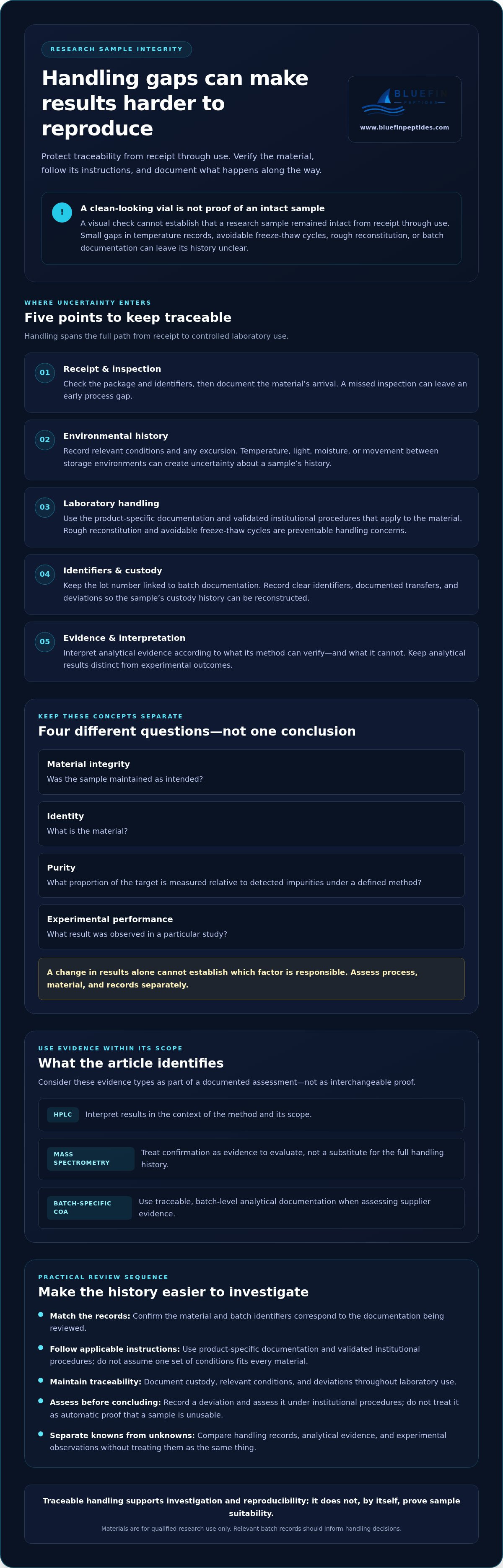
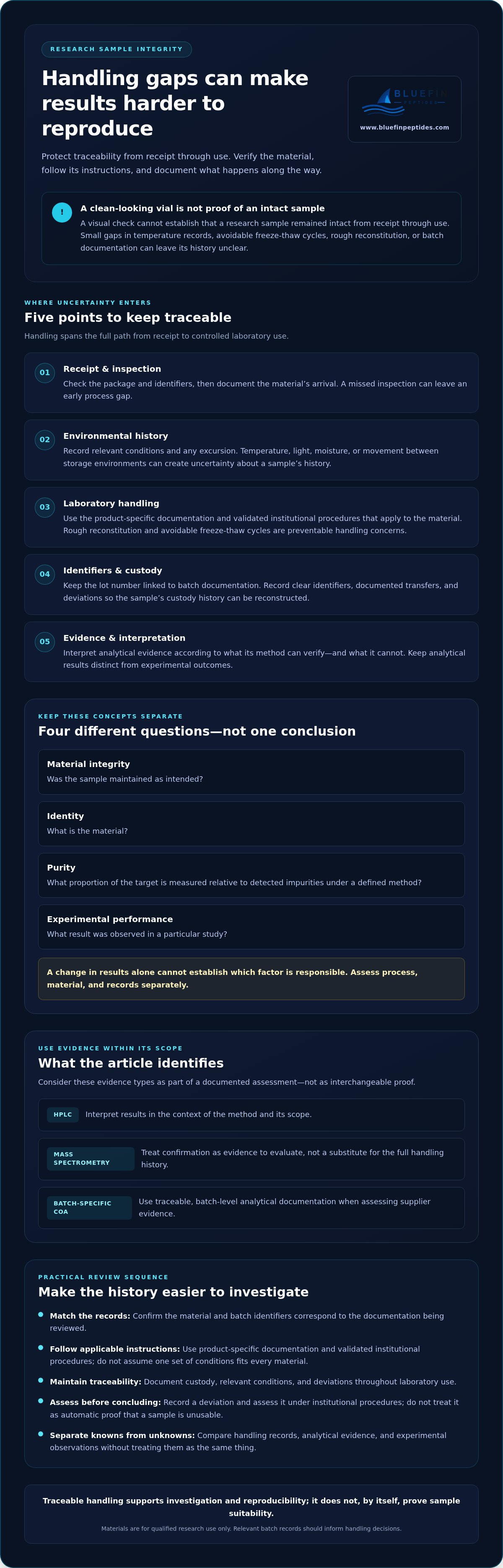
A clean-looking vial doesn’t prove that a research sample remained intact from receipt through use. Common mistakes in handling research peptides often happen between those checkpoints: incomplete temperature records, avoidable freeze-thaw cycles, rough reconstitution, or a lot number that no longer links clearly to its batch documentation. Small gaps can make results harder to reproduce.
Researchers know handling matters. The challenge is determining which details are critical for a specific material and whether an observed issue reflects sample quality, handling conditions, or both. A disciplined process makes those factors easier to investigate.
This guide identifies preventable handling and documentation errors, then outlines a practical framework for protecting research material integrity. You’ll learn how to follow product-specific documentation and institutional procedures, maintain batch and chain-of-custody records, and assess suppliers using traceable, batch-level analytical documents such as a certificate of analysis. The focus is verification, not assumptions. Materials are for qualified research use only, and relevant batch records should inform handling decisions.
Key Takeaways
- Separate material integrity, identity, purity, and experimental performance before drawing conclusions about a sample.
- Recognize how common mistakes in handling research peptides can arise from preventable process gaps, not just material-quality problems.
- Use product-specific instructions and institutional procedures to manage environmental exposure. Don’t assume one set of conditions fits every material.
- Build traceable records around clear identifiers, documented transfers, and any deviations from procedure.
- Interpret HPLC results, mass-spectrometry confirmation, and batch-specific COAs according to what each can verify and what it cannot.
Common Mistakes in Handling Research Peptides and Why They Matter
Material integrity, identity, purity, and experimental performance are related, but they are not interchangeable. Integrity concerns whether a sample has been maintained as intended. Identity concerns what the material is. Purity describes the measured proportion of the target relative to detected impurities under a defined method. Experimental performance is the observed result in a particular study. A change in results alone cannot establish which factor is responsible.
Treat common mistakes in handling research peptides as preventable process or documentation gaps, not automatic proof that a sample has been compromised. Risk points can arise during receipt and inspection, environmental exposure, laboratory handling, recordkeeping, and interpretation of analytical evidence. Since peptides differ in composition and physical form, follow the product-specific documentation and validated institutional procedures that apply to the material. Generic storage assumptions are not a substitute.
What counts as a peptide-handling mistake?
Handling spans the full path from receipt to controlled laboratory use: checking the package and identifiers, documenting custody, maintaining the specified environment, and following approved procedures during sample preparation and use. A missed inspection or undocumented transfer is a process deviation. An analytical result is evidence produced by a method; an experimental outcome is what the study observes. Record and assess these categories separately.
Requirements can vary with the peptide, its physical form, packaging, and the protocol validated for the intended research. Peptides are chemically defined chains of amino acids, and Peptide synthesis provides foundational context for how these molecules are assembled. That context does not establish a universal handling rule. Follow relevant product records and institutional instructions instead of inferring conditions from a broad category.
Why small process gaps affect reproducibility
A missing batch identifier, an unrecorded environmental excursion, or an unclear handoff can leave researchers unable to reconstruct what happened to a sample. That uncertainty can complicate comparisons between batches or study runs. An apparent difference may reflect the material, the procedure, or incomplete records. Consistent documentation does not prove that a sample is suitable, but it gives reviewers a clearer basis for investigating variation.
Traceable sample handling links each material to its identity, batch records, custody history, and documented conditions throughout laboratory use.
Keep the distinction clear. A deviation calls for documentation and assessment under institutional procedures, not an unsupported conclusion that the material is unusable. Likewise, interpret analytical evidence within its method and scope. This separation helps researchers identify what is known, what remains uncertain, and what needs review before drawing conclusions.
Storage and Environmental Errors That Can Undermine Peptide Integrity
Environmental control is not one setting to apply to every vial. Uncontrolled temperature, light exposure, moisture, and repeated movement between storage environments can all create uncertainty about a sample’s history. The relevant risk depends on the specific peptide, its formulation and packaging, and its handling stage. Don’t treat a general rule as a validated instruction for a particular material.
Assuming one storage rule applies to every peptide
Conditions can differ by compound, physical form, packaging, and handling stage. A recommendation for one product or form does not establish a shelf life or stability profile for another. Check the batch documentation, supplier specifications, and validated institutional SOPs. Avoid unsupported universal claims about storage conditions or duration in handling guidance.
Read the instructions as a connected record: confirm which material and batch they describe, what state and packaging they address, and whether they specify relevant environmental controls. The research peptide quality standards guide offers context for evaluating specifications and analytical evidence. Documentation informs decisions; it does not replace the laboratory’s validated procedures.
Ignoring receipt checks and environmental history
At receipt, document the package and container condition, verify identifiers against accompanying records, and record discrepancies through the laboratory’s established process. If a relevant exposure or excursion is reported or observed, capture the available details, such as when it occurred and which material may have been affected. Follow institutional review procedures rather than assuming a visual check determines disposition.
A vial can appear unchanged while its identity, purity, or stability remains unverified. Conversely, a packaging irregularity is a documented observation, not an analytical finding by itself. Keep those distinctions clear.
Environmental history matters because missing information can make later results harder to assess. For example, a receipt record that omits a reported excursion leaves an unresolved gap for subsequent review. Record what is known, identify what is uncertain, and avoid filling gaps with assumptions.
- Temperature: Record relevant conditions or excursions as required by product instructions and SOPs.
- Light and moisture: Check the specified controls and note any packaging or exposure concerns.
- Packaging: Compare the received state and identifiers with batch documentation.
For qualified research procurement, review the product-specific records available from Bluefin Peptides alongside your laboratory’s requirements before making handling decisions.
Handling and Recordkeeping Mistakes That Reduce Traceability
A sample label and its record are part of the evidence trail, not administrative extras. Unclear identifiers, missing batch links, undocumented transfers, and unrecorded deviations can make it difficult to establish which material was used in a study or reconstruct its history. These gaps are preventable, but their presence alone doesn’t prove that a sample was compromised.
Labels, batch identifiers, and chain of custody
Use unambiguous identifiers that link the container to the relevant product and batch documentation. Keep records legible and controlled according to institutional procedures. Depending on the laboratory’s SOPs, entries may include receipt, transfer, use, responsible personnel, dates, and the associated study or protocol. Include the fields required by the established process, and ensure updates preserve a clear history.
A weak entry might identify a vial only by a shorthand name, with no batch identifier or link to a study record. A traceable entry connects the sample identifier to the batch, relevant documentation, and required custody or use events. If those links are missing, an investigation of unexpected results may not establish whether samples from different batches or histories were compared.
Keep batch identity linked to study records so each result can be traced to the material documented for that work.
Preventing cross-contamination and undocumented deviations
Follow approved SOPs for workspace controls, equipment, and material segregation. Don’t substitute informal habits for required procedures or formal safety training. Documentation requirements, product-specific handling instructions, and applicable laboratory requirements serve related but distinct purposes: the SOP governs the process, while product records describe the material and its documented specifications.
If a procedure isn’t followed as written, record the deviation and escalate it through the institution’s quality process. Don’t edit a record in a way that obscures the original entry or treat an undocumented workaround as routine. A clear account allows appropriate personnel to assess the event under established procedures.
- Weak: An ambiguous sample name, no batch link, and a transfer that appears only in an informal note.
- Traceable: A unique sample identifier connected to batch documentation, required custody events, study records, and documented deviations.
These controls address several common mistakes in handling research peptides without assuming every laboratory needs an identical log. The practical standard is consistency with institutional SOPs, clear links between records, and prompt documentation through approved channels. That gives reviewers a more reliable basis for assessing study materials and interpreting results.
How to Evaluate Peptide Quality Evidence Without Overinterpreting It
Analytical documents are useful when each result is read within its scope. A purity figure, an identity-related result, and a certificate of analysis (COA) answer different questions. Treating one as proof of every quality attribute can obscure what has actually been tested, a key source of confusion in handling research peptides.
What HPLC and mass spectrometry can indicate
High-performance liquid chromatography (HPLC) is used to assess chromatographic purity under specified analytical conditions. Mass spectrometry provides evidence about molecular mass and can support an identity assessment. Neither result, on its own, establishes how a material will perform in a particular research model. Interpretation depends on the method, the sample, and the scope of the reported analysis.
| Evidence | What it can indicate | What it does not establish by itself |
|---|---|---|
| HPLC | Chromatographic purity under the reported method | Identity, stability, sterility, or research suitability |
| Mass spectrometry | Molecular mass evidence that may support identity | Purity, stability, sterility, or performance in a study |
| Batch-specific COA | Reported analytical results associated with a stated batch | Any attribute not included in the report or established by its methods |
For a compound-specific example, review the retatrutide analytical specifications in context. Specifications for one compound should not be generalized to other materials or batches.
Reading a COA as batch-linked evidence
Check that the report’s material description and batch identifier match the purchased material and its accompanying documentation. Review which analyses are reported and what they measure. A COA is most useful when its link to the physical batch is clear. If identifiers do not align or the report’s scope is unclear, record the discrepancy and follow the laboratory’s procurement or quality-review process.
Analytical purity is one measured attribute, not a complete judgment of sample suitability. A purity result does not independently establish identity, stability, sterility, or fitness for a specific research protocol. Keep those claims separate in procurement records and study interpretation.
For qualified research procurement, review Bluefin Peptides’ batch documentation and compare the applicable records with your laboratory’s requirements.
A Practical Framework for Preventing Peptide-Handling Errors
A consistent pre-use review helps turn the issues discussed above into a controlled process. Apply institutional requirements first, then use product-specific records to resolve material questions. This framework is for qualified laboratory research and does not replace training, SOPs, or product-specific instructions.
- Qualify the research purpose. Confirm that the material is appropriate for the documented research purpose and that its research-only designation aligns with institutional requirements.
- Inspect the documentation. Compare the material description and batch identifier with the accompanying records. Review the batch-specific certificate of analysis (COA), the stated analytical methods, and product-specific instructions. Flag missing or mismatched information for review.
- Follow approved procedures. Use validated institutional SOPs and applicable product instructions for receipt, handling, and laboratory use. Don’t substitute generic guidance for established requirements or infer technical conditions that aren’t documented.
- Record deviations. Document discrepancies or departures from procedure through the laboratory’s established quality process. Escalate unresolved condition or documentation concerns to the responsible laboratory contact.
- Review traceability. Confirm that the sample identifier, batch records, and study documentation remain connected as required by the laboratory procedure. Resolve gaps through approved channels before relying on incomplete records.
Choosing a supplier with verifiable documentation
Assess whether analytical claims are linked to an identifiable batch and supported by records that specify what was tested. A COA should correspond to the material under review, and its reported methods and results should be interpreted within their stated scope. Clear research-only labeling also helps establish the intended context of the material. These procurement checks support traceability; they don’t replace laboratory controls.
Bluefin Peptides states that its research products are HPLC-verified at 99% or greater, with mass-spectrometry confirmation and batch-specific COAs. Review the relevant product and batch documentation rather than assuming a general statement supplies every handling detail. Keeping procurement evidence connected to laboratory records can help prevent common mistakes in handling research peptides from becoming gaps in study review.
For qualified researchers, review Bluefin Peptides’ research catalog and documentation to assess available research materials and their associated records.
Make Traceability Part of Every Research Workflow
Preventable handling errors are easier to identify when material records, environmental history, and study documentation stay connected. Follow product-specific instructions and institutional SOPs rather than applying universal storage assumptions. Document discrepancies or deviations through established procedures.
Common mistakes in handling research peptides often create uncertainty, not automatic proof of compromised material. Interpret analytical evidence within its scope: a purity result alone doesn’t establish identity, stability, or suitability for a specific research purpose. Keep the batch identifier linked to the relevant COA and study records so decisions can be reviewed against verifiable information.
Bluefin Peptides states that its research products have HPLC verification at 99% or greater, mass-spectrometry confirmation, and batch-specific COAs. These records can support procurement review and traceability, but they don’t replace laboratory controls. Products are intended exclusively for qualified laboratory research, not human, veterinary, or consumer use.
Review Bluefin Peptides’ research catalog and product documentation to assess available batch-level records for your research requirements. A consistent, evidence-led workflow gives your team a stronger foundation for careful and reproducible research.
Frequently Asked Questions
What are the most common mistakes in handling research peptides?
Common mistakes include relying on generic storage assumptions, failing to inspect or document received materials, losing batch traceability, and overlooking environmental excursions. These are process risks, not automatic evidence that a sample has degraded. Follow the applicable product documentation, laboratory SOPs, and institutional requirements. Record deviations through established quality procedures, and distinguish documented observations from analytical findings or conclusions about material condition.
How should research peptides be stored?
There is no single storage condition or duration that applies to every peptide, formulation, and handling stage. Use the product-specific documentation and validated laboratory procedures to determine relevant controls. Record conditions or excursions as required by the applicable SOP. Don’t infer stability from appearance alone or apply an online recommendation that conflicts with the supplied product documentation. If instructions are unclear, consult the responsible laboratory contact.
Does 99% HPLC purity guarantee a research peptide is suitable for a study?
No. A 99% HPLC purity result describes an analytical finding under the reported method. It doesn’t independently establish identity, stability, sterility, or suitability for a particular research protocol. Check that the report matches the material’s batch, review its stated methods, and consider complementary evidence such as mass spectrometry. Then assess the available documentation against the study requirements and institutional procedures.
What should a research peptide certificate of analysis include?
A useful certificate of analysis (COA) should identify the material and relevant batch, report the analyses performed, and present results that can be checked against supplied product documentation. Review the methods and stated limits rather than treating the certificate as a blanket guarantee. Confirm that its identifiers correspond to the batch received, then retain the document with the appropriate procurement and study records.
What should a laboratory do if a peptide shipment arrives with a damaged package?
Follow the institution’s receipt and discrepancy procedures. Document the package condition and relevant material identifiers, retain associated records, and notify the responsible laboratory contact or supplier through established channels. Packaging damage alone doesn’t prove that material is unusable, and an intact appearance doesn’t establish that it’s unaffected. Any decision to accept, quarantine, or investigate the material should be made under applicable SOPs.
Can research peptides be handled using general laboratory practices alone?
No. General laboratory practices provide a foundation, but they don’t replace product-specific documentation, validated protocols, or institutional requirements. Handling considerations can depend on the material, packaging, and research context. Qualified personnel should follow approved laboratory procedures and relevant safety documentation. If a deviation occurs, document it through established channels instead of relying on informal workarounds or universal online instructions. This guidance doesn’t replace training or SOPs.
Qualified researchers can review Bluefin Peptides’ research catalog and product documentation for available materials and batch-level records.
For laboratory research use only. Not for human or veterinary use. This content is educational and does not constitute medical, dosing, or usage guidance.
Browse the BLUEFIN catalog