Cell Culture Peptide Concentration Guide: Calculations, Units, and Documentation

A peptide concentration can be calculated correctly and still be difficult to reproduce if its units, molecular-weight source, or dilution assumptions aren’t recorded. This cell culture peptide concentration guide explains how to calculate a working concentration and document the inputs so another researcher can verify the result.
It’s easy to confuse mass concentration with molar concentration, especially when converting units or calculating a dilution from a stock solution. Arithmetic or transcription errors can then carry into experimental records. A consistent method makes these errors easier to spot and supports clearer comparisons across experiments.
Here, you’ll learn how to choose and report concentration units, use molecular weight in conversions, and check calculations against dilution relationships. The guide also covers documentation that supports reproducibility, including assumptions, calculation steps, and peptide batch identity. A batch-specific certificate of analysis (COA), where available, can help verify material details used in planning. The focus is qualified laboratory research: clear inputs, explicit units, and a record another researcher can follow.
Key Takeaways
- Distinguish mass concentration from molar concentration before comparing values or recording a result.
- Follow each mass and volume conversion, then verify the units in the calculated value.
- Apply C₁V₁ = C₂V₂ only when the concentration units are compatible, and identify the source and target concentrations clearly.
- Record peptide identity, batch, molecular-weight source, purity assumptions, rounding choices, and calculation date so the result can be traced.
- Check the formula and arithmetic before use. A second-person review can help catch transcription and unit errors.
Cell Culture Peptide Concentration Guide: What the Terms Actually Mean
Concentration describes the amount of a substance present in a specified volume. Mass concentration reports mass per volume, such as µg/mL. Molar concentration reports amount of substance in moles per volume, such as µM. These values describe different quantities and are not interchangeable without a valid conversion.
Keep the measured quantity and its unit attached to every value. Concentration describes composition. It does not prescribe an experimental condition or predict a biological outcome, which depend on the research question and other experimental factors.
Mass concentration and molar concentration are not interchangeable
Mass-per-volume units express how much peptide mass is present in a volume. Symbolically, mass concentration = peptide mass ÷ solution volume. A value written as x µg/mL therefore identifies mass relative to volume, not a number of peptide molecules.
Molarity expresses the amount of substance in moles per volume, commonly mol/L; µM means micromoles per liter. Moles relate measured mass to the number of molecules through molecular weight. Converting between mass and molar concentration requires the applicable molecular weight, compatible units, and the correct chemical form. The reference on Molar concentration outlines the molar definition and its units.
For calculation records, specify the molecular-weight source and any relevant form or purity assumptions. A unit label without its basis can leave later reviewers unable to determine how a reported value was derived.
Stock concentration versus final experimental concentration
Stock concentration is the value assigned to a prepared or supplied stock solution. An intermediate concentration describes a subsequent preparation between the stock and the experiment. The final concentration is the value in the defined experimental volume after the relevant components have been combined.
These terms identify different stages and are not interchangeable. A concentration without context can be misread as the stock, an intermediate preparation, or the final value. State which one it represents, along with the unit and volume basis. If a preparation involves a traceable peptide batch, retain its identity and relevant batch documentation alongside the calculation. This connects the concentration to the material and preparation record.
How to Calculate Peptide Concentration from Mass and Volume
Start with the relationship between the amount of peptide and the solution volume. Mass concentration equals peptide mass divided by solution volume, with mass and volume expressed in compatible units such as mg/mL or µg/mL. This calculation gives a nominal mass-per-volume value. It does not, by itself, specify a preparation or handling procedure.
A stepwise mass-per-volume calculation
Before calculating, write down the stated peptide mass, the relevant solution volume, the requested concentration unit, and whether the result describes a stock or another solution. Convert the quantities first so the units align, then divide mass by volume. Keeping these inputs visible makes the arithmetic easier to audit.
- Hypothetical arithmetic example: Assume a stated mass of 2 mg and a solution volume of 4 mL.
- Convert the mass: 2 mg × 1,000 µg/mg = 2,000 µg. The volume remains 4 mL.
- Divide: 2,000 µg ÷ 4 mL = 500 µg/mL.
- Check: 500 µg/mL × 4 mL = 2,000 µg, which converts back to 2 mg.
This example illustrates unit arithmetic only; it does not recommend an experimental condition. Also distinguish nominal weighed mass from actual peptide content. A weighed quantity may include material that is not peptide, depending on the material and the information available. Apply a purity correction only when the calculation basis and relevant documentation support it. Make clear whether a reported figure uses total stated mass or an adjusted peptide-content value.
Converting mass concentration to molar concentration
Molar concentration requires an applicable molecular-weight value. The unit pathway is mass per volume divided by molecular weight: for example, g/L ÷ (g/mol) = mol/L. Convert the mass concentration to g/L if needed, then divide by molecular weight in g/mol. Confirm that the value matches the peptide’s sequence and chemical form, and record its source and assumptions. Sigma-Aldrich’s Molarity Calculator can help check the relationship between formula weight and molar concentration.
Keep the arithmetic separate from laboratory-specific preparation decisions. For traceability, retain the peptide identity and batch documentation used to establish the stated mass or composition. Researchers can consult Bluefin Peptides’ research peptide information as a source of batch documentation. Verify the relevant batch record before using product-specific values.
How to Calculate Dilutions and Check Final Peptide Concentration
The general dilution relationship is C₁V₁ = C₂V₂. It applies when the concentration units match and the quantities describe compatible source and target volumes. The equation tracks the amount of peptide transferred; it does not define an experimental condition or a laboratory-specific preparation procedure.
Using the dilution equation without mixing up variables
C₁ is the source concentration, and V₁ is the volume of that source needed. C₂ is the target concentration, and V₂ is the target’s specified final volume. Before solving, confirm the starting concentration and intended final volume. Keep C₁ and C₂ in the same units, and use compatible volume units for V₁ and V₂.
Hypothetical arithmetic example: If C₁ is 100 µg/mL, C₂ is 10 µg/mL, and V₂ is 2 mL, then V₁ = (C₂ × V₂) ÷ C₁ = (10 µg/mL × 2 mL) ÷ 100 µg/mL = 0.2 mL. This illustrates the equation only; it is not a universal research condition or handling instruction. Check the calculated source volume against the stated final volume, rather than mistaking it for the final volume itself.
| Input | Typical notation | Check |
|---|---|---|
| Source concentration | C₁, such as µg/mL | Confirm the value and its source |
| Source volume | V₁, such as mL | Verify the solved volume units |
| Target concentration | C₂, same unit as C₁ | Confirm it describes the intended target |
| Target final volume | V₂, such as mL | Record the defined final volume |
When serial dilution calculations need extra checks
A direct calculation connects one source concentration to one target. A serial dilution uses one intermediate result as the source for the next step. Each step depends on the accuracy of the preceding calculation and transfer, so small deviations or rounding choices can carry forward and affect later values.
For a reliable calculation record, list every intermediate concentration, volume, and dilution factor in sequence. Note where rounding occurs and document any assumptions about transfer precision or mixing. Make the calculation trail easy to follow instead of showing only the final figure. Recalculate the final concentration from the recorded steps and check that each equation uses the correct source value, target value, and units.
How to Document Concentration Assumptions for Reproducible Cell Culture
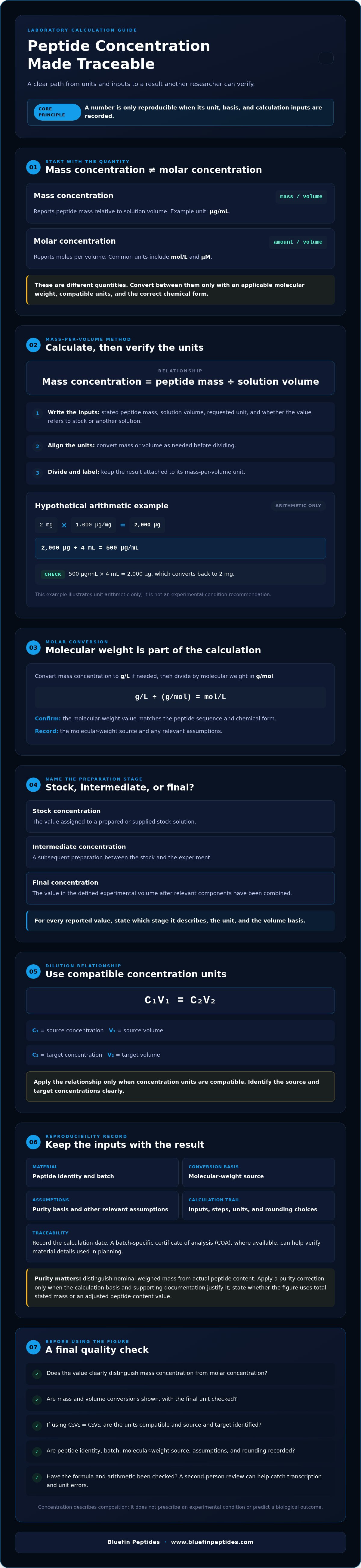
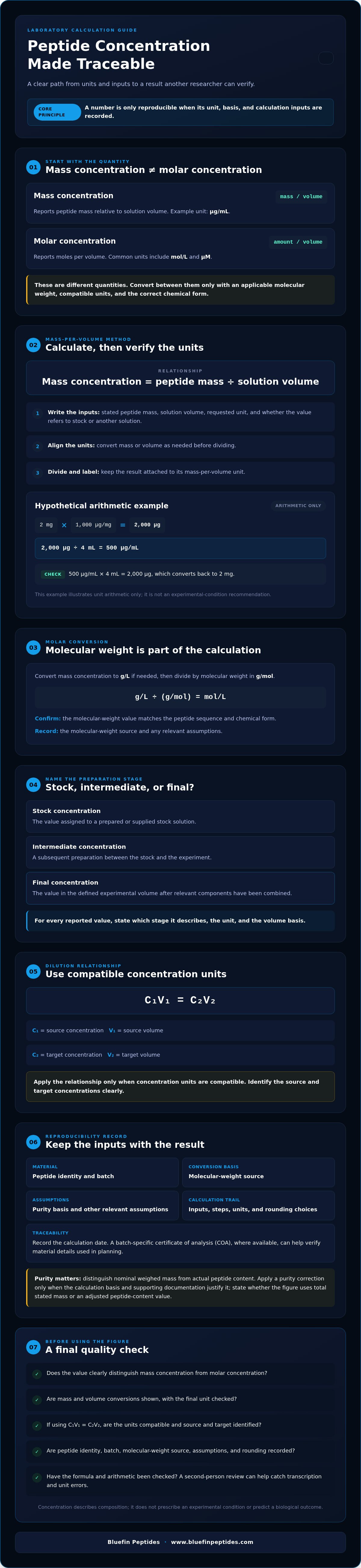
A concentration value is only as traceable as the inputs behind it. Record the calculation alongside the material identity and batch details so another researcher can see what was measured, assumed, and calculated. This record supports reproducibility; it does not guarantee a particular experimental result.
Inputs and assumptions to record
Use a consistent record for each concentration figure. This checklist captures the core details needed to retrace a calculation:
- Material: peptide identity and batch identifier.
- Inputs: stated mass, volume, units, and calculation date.
- Conversion basis: molecular-weight value and source, plus any sequence or chemical-form assumptions.
- Calculation: formula, working steps, unit conversions, and rounding decisions.
- Result status: identify whether the concentration is nominal, calculated, or analytically measured.
- Purity assumption: state whether the calculation uses the stated mass as-is or applies a documented adjustment.
These distinctions prevent a later reader from mistaking a nominal value derived from weighed mass for a separately measured solution concentration. Preserve relevant batch documentation with the record and verify that it corresponds to the material being documented. For broader context on evaluating documentation, see this analytical quality standards guide.
Separating analytical evidence from concentration calculations
Analytical purity and solution concentration answer different questions. HPLC can characterize the relative distribution of detected components under the method used. Mass spectrometry can support assessment of molecular mass or identity. Neither result, by itself, establishes the amount of peptide in a particular solution volume.
Do not treat a purity percentage as a direct concentration measurement. A purity value may inform a calculation only when the material basis, method, and assumptions are clear and appropriately applied. Keep any adjustment separate from the basic mass-per-volume calculation, and label the resulting value accordingly. Compound-specific analytical documentation can provide context, but it does not replace verification of the relevant batch.
For qualified research use, consult the available research peptide and batch documentation when tracing material inputs. Clear records keep the calculation’s assumptions visible and make the result easier to review and reproduce.
A Practical Quality Check Before Using a Peptide Concentration Figure
Before relying on a calculated value, audit the source information and calculation trail. This final check can expose mismatched material records, unit errors, and undocumented assumptions before they enter research records. A number that cannot be traced should not be presented as definitive.
A concise concentration-calculation audit
- Identity and batch: Confirm the compound identity and batch identifier match the source documentation.
- Units: Check that mass, volume, and concentration units are compatible, and that every conversion is explicit.
- Molecular weight: For molar values, verify the molecular-weight reference and relevant sequence or chemical-form assumptions.
- Formula and arithmetic: Recalculate the equation from the recorded inputs, then confirm the result has the requested units and represents the intended stock, intermediate, or final concentration.
- Uncertainty: Record unresolved assumptions, discrepancies, or rounding decisions instead of presenting an uncertain figure as exact.
A second-person review is useful when a value will be reused, when calculations involve several unit conversions or dilution steps, or when a transcription error could affect interpretation. Ask the reviewer to verify the inputs and redo the arithmetic independently, rather than only checking the displayed answer. The goal is a calculation another qualified researcher can follow and assess.
Research-material documentation and next steps
A batch-specific certificate of analysis (COA) can support review of the documented analytical information associated with a material. Match the COA to the batch in the record and use it as a verification aid, not as a replacement for laboratory judgment or a direct measurement of the concentration in a prepared solution. Analytical identity or purity information and a calculated mass-per-volume value describe different things.
Bluefin Peptides supplies research-use materials to qualified researchers. Its products are not intended for human, veterinary, or consumer use. The calculations and checks in this guide apply to qualified laboratory research and should not be interpreted as instructions for other uses.
Once the inputs, assumptions, and arithmetic have been checked, preserve the calculation with the relevant batch documentation. For researchers reviewing material records, review Bluefin Peptides research materials and their available batch documentation.
Carry Clear Concentration Records Into Your Next Study
A dependable concentration figure starts with a clear distinction between mass-based and molar units, followed by a calculation that can be checked from its inputs. This guide also emphasizes another essential practice: record the assumptions, material identity, and calculation context alongside the result. Together, these habits make values easier to interpret and review across research records.
Batch documentation adds traceable information about the material, but it is not a substitute for calculating solution concentration or applying laboratory judgment. Bluefin Peptides states that its research peptides are at least 99% HPLC-verified, with mass-spectrometry confirmation and batch-specific certificates of analysis. Researchers should consult the relevant batch documentation and verify that it matches the material under review. Products are supplied for qualified research use only, not for human, veterinary, or consumer use.
To review available research materials and related documentation, visit Bluefin Peptides research materials. Clear units and records that preserve the calculation trail help your team review concentration figures with confidence.
Frequently Asked Questions
How do you calculate peptide concentration in µg/mL?
Divide the peptide mass in micrograms by the solution volume in milliliters. For example, a hypothetical 0.8 mg mass is 800 µg; in 2 mL, the nominal concentration is 400 µg/mL. Show the conversion and keep the units attached to the result. Record whether the mass represents total weighed material or an adjusted peptide-content value.
How do you convert peptide concentration from mg/mL to µM?
Use the applicable molecular weight in g/mol. Since mg/mL has the same numerical value as g/L, calculate µM as (mg/mL × 1,000,000) ÷ molecular weight in g/mol. For a hypothetical concentration of 0.5 mg/mL and molecular weight of 2,000 g/mol, the result is 250 µM. Verify the molecular-weight source and chemical-form assumptions before reporting the converted value.
What is the difference between stock concentration and final concentration?
Stock concentration describes the concentration assigned to a prepared or supplied stock solution. Final concentration describes the concentration in the defined experimental volume after relevant components are combined. The values may differ because a stock can be diluted. Label every reported number with its context, unit, and volume basis so it cannot be mistaken for a different preparation stage.
How do you calculate a peptide dilution?
Use C₁V₁ = C₂V₂ when the source and target concentrations use compatible units. C₁ and V₁ are the source concentration and volume; C₂ and V₂ are the target concentration and specified final volume. To find an unknown, rearrange the equation, such as V₁ = C₂V₂ ÷ C₁. Check the units and recalculate the result to confirm the relationship balances.
Does HPLC purity tell you the peptide solution concentration?
No. HPLC purity describes analytical information about the material under the method used. By itself, it is not a measurement of peptide mass per volume in a prepared solution. Solution concentration is calculated or measured on its own basis. If purity is considered in a mass calculation, document the method, material basis, and assumptions. Do not present a purity percentage as a direct concentration result.
What information should be recorded with a peptide concentration calculation?
Record peptide identity, batch identifier, stated mass, volume, units, calculation date, formula, and unit conversions. For molar values, include the molecular-weight value and source, plus sequence or chemical-form assumptions. Note whether the result is nominal, calculated, or analytically measured, and document purity assumptions and rounding. Preserve matching batch documentation so a reviewer can trace the material information used.
Can this concentration guide determine a peptide concentration for human use?
No. This guide explains concentration calculations for qualified laboratory research; it does not establish a concentration, condition, or use for people or animals. Bluefin Peptides supplies research-use materials to qualified researchers, and its products are not intended for human, veterinary, or consumer use. Concentration arithmetic cannot determine suitability or provide medical guidance. Keep research calculations within their appropriate laboratory context.
For laboratory research use only. Not for human or veterinary use. This content is educational and does not constitute medical, dosing, or usage guidance.
Browse the BLUEFIN catalog