BPC-157 In Vitro Study Protocol: A Research Design Guide

A technically precise protocol can still produce an uninterpretable result. A defensible BPC-157 in vitro study protocol starts with a focused hypothesis, then aligns the model, controls, and endpoints with that question. Without those foundations, a measured response may be difficult to reproduce or attribute to the material being studied.
Published methods can vary, and laboratory findings are sometimes presented without a clear boundary between preclinical observations and clinical claims. In vitro results describe what happened under specific experimental conditions. They do not establish human safety, efficacy, or therapeutic benefit.
This guide provides a practical framework for defining a testable question, selecting a relevant model, and planning controls and measurable endpoints. It also covers documenting compound identity and sourcing, distinguishing single-compound experiments from blend-level research, and reporting limitations so others can assess and reproduce the work. The goal is disciplined interpretation: a clear experimental signal, described within the limits of the model and evidence.
Key Takeaways
- Use the BPC-157 in vitro study protocol as a planning framework, not a universal recipe. Tailor the design to the model and research question.
- Choose controls based on the alternative explanations they address, and state what each comparison cannot establish.
- Make findings easier to assess by reporting model identity, endpoints, analysis choices, replicate structure, and sources of variability.
- Keep conclusions within the boundaries of the laboratory model. An in vitro result does not establish clinical effects.
- Record compound identity and batch-level analytical documentation so readers can trace the research materials used.
What an in vitro BPC-157 study can, and cannot, show
An in vitro investigation examines a biological question in a controlled laboratory model outside a living organism. For BPC-157, a study might use a selected cell type or another laboratory system to observe a defined response under specified conditions. The resulting evidence applies to that model and those conditions. It is not a direct forecast of what would happen in an animal or person.
An in vitro BPC-157 study is a controlled laboratory investigation of a defined response in a selected model outside a living organism. This article offers a study-design framework, not a validated, universal BPC-157 protocol. Researchers need to justify the question, model, and endpoints for each study, then report methods and limitations clearly.
What does “in vitro” mean in BPC-157 research?
Cell-based research isolates a limited part of biology for observation. A model may be selected because it is relevant to a particular hypothesis, but that relevance depends on the question and the evidence supporting the choice. A general overview, such as the BPC-157 Wikipedia article, can provide background. Experimental claims still require careful review of primary research.
Keep three design elements distinct:
- Study material: the compound being investigated, with its identity and source documented.
- Experimental model: the cells or other laboratory system used to examine the question.
- Outcome: the prespecified measurement used to assess a response.
These elements are not interchangeable. A measured change is interpretable only in relation to the model and material actually studied. If a study tests a blend, its findings concern that blend under the stated conditions. They cannot automatically be attributed to BPC-157 alone.
Why cell-model results do not establish human outcomes
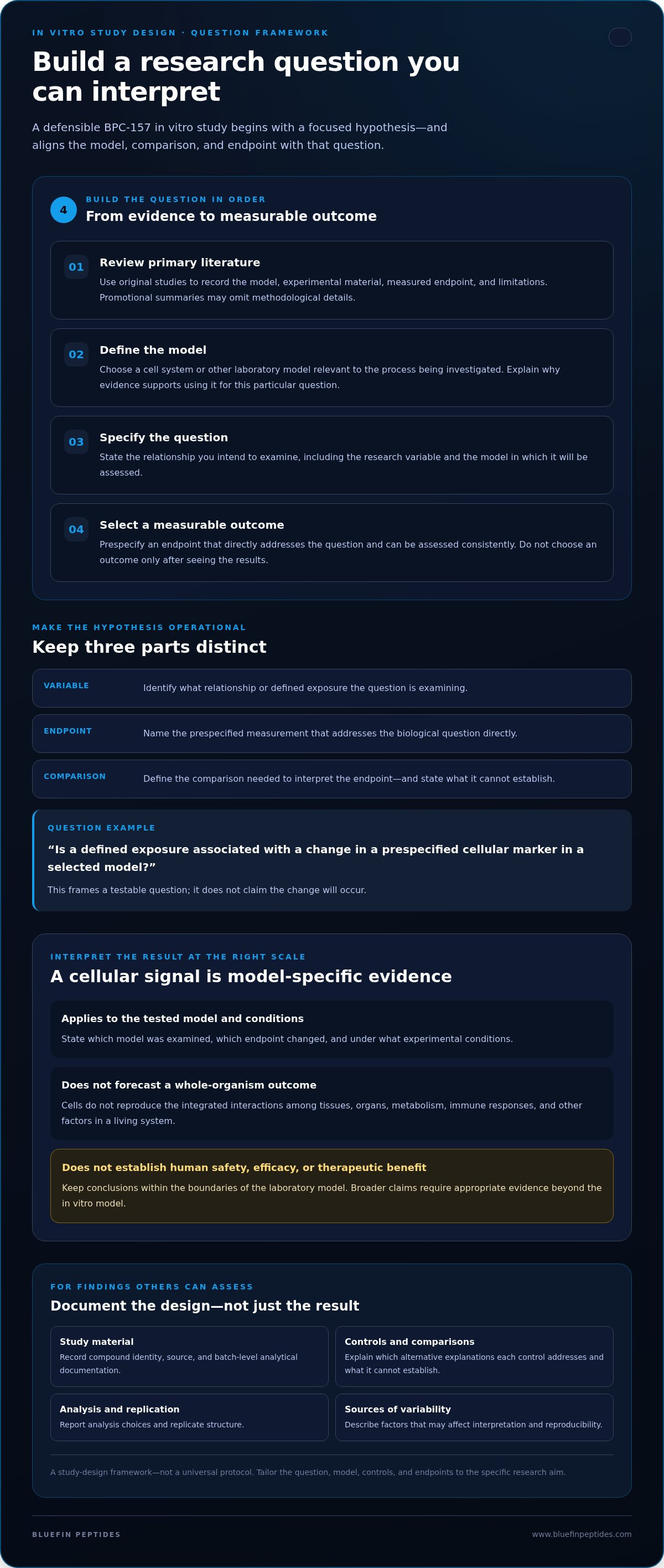
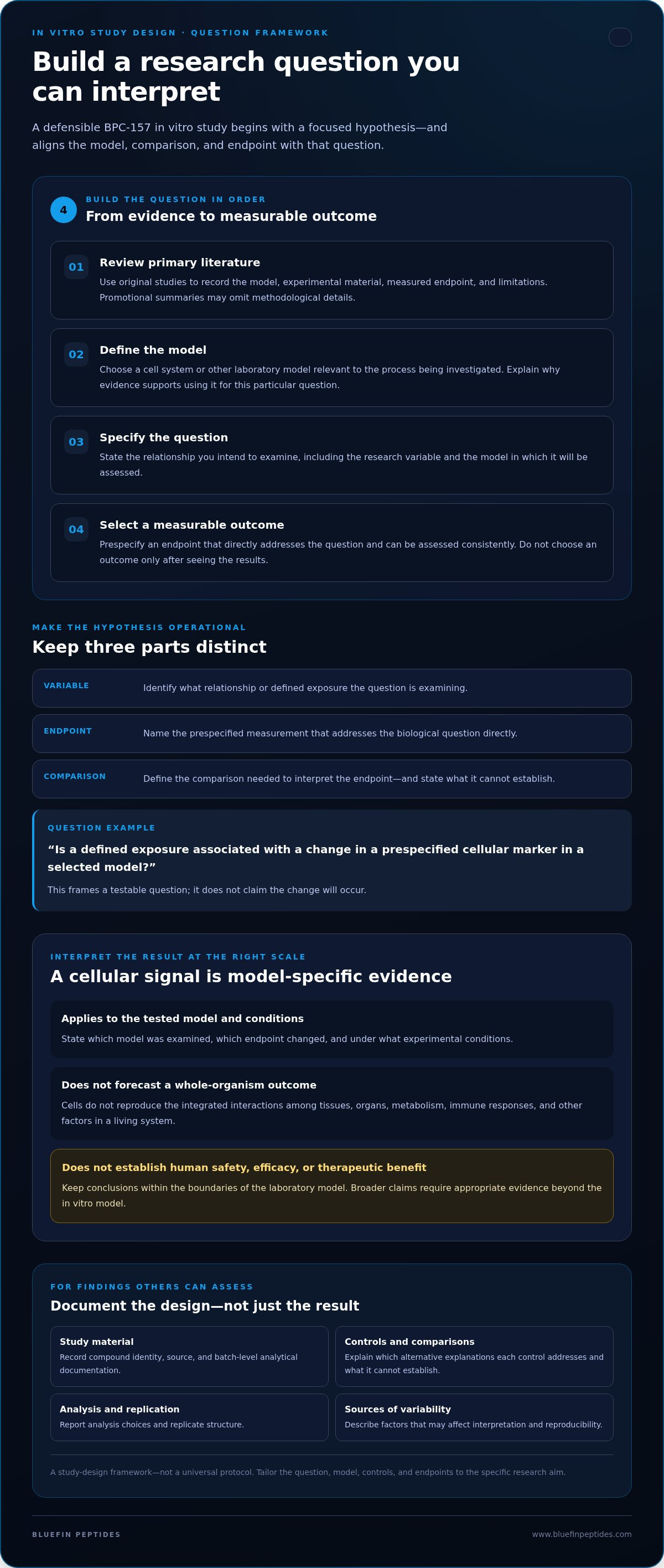
Cells do not reproduce whole-organism physiology. They lack the integrated interactions among tissues, organs, metabolism, immune responses, and other factors that shape biological effects in a living system. They also do not capture the clinical context in which a treatment might be used. A signal observed in culture therefore cannot, by itself, establish a human effect.
Interpret findings at the narrowest defensible level. State which model was examined, which endpoint changed, and under what experimental conditions. Avoid turning a cellular observation into a claim about therapeutic benefit, safety, or efficacy. Broader conclusions require independent evidence from appropriate research beyond the in vitro model.
This boundary is central to a defensible BPC-157 in vitro study protocol. A focused experiment can assess a specific biological question and guide further investigation, but it cannot resolve questions its model was not designed to answer. Clearly state the scope to keep interpretation on course.
How to define a focused BPC-157 in vitro research question
A strong research question is narrow enough to test and specific enough to interpret. Start with the biological process you intend to investigate, not an assay you already have available or an assumed effect. Then define what evidence would support or fail to support the hypothesis. This gives the BPC-157 in vitro study protocol a clear direction and helps prevent exploratory observations from being presented as confirmation.
Build the question in order:
- Review primary literature. Locate original studies and record the model, experimental material, measured endpoint, and limitations. Promotional summaries can omit methodological details and should not substitute for the paper.
- Define the model. Choose a cell system or other laboratory model relevant to the process under investigation. Explain why evidence supports its use for this particular question.
- Specify the question. State the relationship you intend to examine, including the research variable and the model in which it will be assessed.
- Select a measurable outcome. Prespecify an endpoint that directly addresses the question and can be assessed consistently. Do not choose an outcome only after seeing the results.
Translate the literature into a falsifiable hypothesis
A hypothesis identifies a possible relationship that results can support or fail to support. For example, a researcher might ask whether a defined exposure is associated with a change in a prespecified cellular marker in a selected model. This frames a question; it does not claim that the change will occur. Review original papers to distinguish model-specific findings from unresolved questions, and describe proposed mechanisms as hypotheses unless direct evidence supports them.
Before choosing an assay, make the hypothesis operational: identify the variable, endpoint, and comparison needed to interpret that endpoint. This keeps the study anchored to a test rather than a broad expectation.
Match the model and endpoint to the question
The model must represent the biological process being examined well enough for the chosen endpoint to be meaningful. If the question concerns a cellular response, select a model and measurement that address that response directly rather than relying on a loosely related marker. Different cell systems, measurement methods, and endpoint definitions can make results difficult to compare, so document the rationale for each choice.
Keep the scope bounded. A finding in one cell system does not establish the same response in another, and a measured endpoint does not necessarily demonstrate a complete biological mechanism. When comparing studies, check whether their models and outcomes are genuinely aligned before treating results as consistent or conflicting.
Compound identity also shapes the research question. A single-compound experiment and a blend-level experiment address different questions. Results from a BPC-157 / TB-500 blend cannot isolate the contribution of BPC-157. For blend-specific context, consult the BPC-157 and TB-500 research blend analytical guide. Qualified researchers sourcing research materials can review research peptide materials as part of documenting compound identity and study scope.
Which controls and comparisons strengthen an in vitro study?
Controls give an experimental result a reference point. They help show whether an observed signal is associated with the test condition or could also arise from the model, delivery medium, or measurement system. Choose comparisons to address specific alternative explanations, not simply to make a study appear more comprehensive.
Controls help distinguish a compound-associated signal from background variation by showing what the model and measurement produce without the experimental condition.
What each control type contributes
Baseline controls establish a reference for interpreting the experimental condition. An untreated group may show the model’s response without added material. If a delivery medium is used, a vehicle control can help account for effects associated with that medium. These are design categories, not universal requirements. Their relevance depends on the study question and materials.
A positive control tests whether a particular model and measurement can detect a response the assay is intended to capture. Justify it for the selected model and endpoint. A positive result does not confirm that BPC-157 acts through the same pathway or that the observed response is biologically or clinically relevant.
The comparison table clarifies the scope of each control:
| Control category | Question answered | Interpretation limit |
|---|---|---|
| Untreated or baseline | What does the model show without the experimental material? | Does not account for a delivery medium if one is used. |
| Vehicle | Could the delivery medium contribute to the measured response? | Does not isolate other differences between experimental conditions. |
| Positive control | Can this model and endpoint detect a defined response? | Does not validate every aspect of the experiment or establish BPC-157’s mechanism. |
In a BPC-157 in vitro study protocol, explain why each comparison is included and what it can resolve. A control that does not address a plausible alternative explanation may add complexity without improving interpretation.
Check assay validity before interpreting a signal
A measured change may reflect the biology of interest, but it may also arise from interference with the assay. Consider whether the compound or sample matrix could affect the measurement itself, for example by altering signal detection or producing a readout unrelated to the endpoint. Document how assay suitability was assessed, and distinguish a technical signal from its biological interpretation.
Reproducibility also depends on the structure of the evidence. State which observations are independent replicates and which are repeated measurements within the same experimental unit. These are not interchangeable. Explain how variability was handled, and define exclusion criteria before reviewing outcomes. Post hoc exclusions can bias interpretation if their rationale is not transparent.
Report deviations from the planned design, unexpected results, and failed or ambiguous measurements. Do not omit inconvenient observations without a documented reason. A clear record allows readers to assess whether a result is robust, conditional, or better treated as a prompt for further investigation.
How to document, analyze, and report BPC-157 in vitro findings
A reproducible report lets readers trace the path from study materials to measured result. The BPC-157 in vitro study protocol should capture not only what was observed, but how the model, comparisons, and analysis shaped that observation. Keep measured results distinct from interpretation: a change in an endpoint may be associated with an experimental condition without demonstrating a specific mechanism.
Use this reporting checklist to identify essential details:
- Model identity: State the cell type or other model, its relevant characteristics, and why it fits the research question.
- Materials: Identify the test material, source, identifiers, and relevant batch documentation. Clearly distinguish a single compound from a blend.
- Experimental conditions: Describe the planned conditions and any deviations that could affect interpretation.
- Controls and endpoints: Name each comparison and define the primary measurements, including how outcomes were assessed.
- Analysis: Explain the analytical approach, replicate structure, handling of variability, and criteria for excluding data.
- Limitations: Identify constraints in the model, study design, and scope of conclusions.
What a reproducible methods record should capture
Record material identifiers and batch-specific documentation where available, alongside the model and experimental conditions. Analytical records, such as a certificate of analysis, can support material traceability; they do not establish biological activity in the chosen model. For context on documenting research-peptide materials, consult this analytical quality standards guide.
Make the analysis auditable. State which observations count as independent replicates and which are repeated measurements from the same experimental unit. Report the planned method, any departures from it, and the reason for each deviation. This detail helps readers distinguish variation among biological samples from repeatability of the measurement process when the design permits that distinction.
How to interpret variability and negative results
Variation is information, not clutter. Describe plausible sources, including differences among biological samples and technical measurement variability, without claiming to separate them when the design cannot. Report null, inconsistent, or unexpected outcomes alongside positive findings. A result that does not support the hypothesis still defines what was observed under the tested conditions.
Interpret cautiously. A small or narrowly defined study may not resolve uncertainty, and one model cannot establish broad generalizability. State limitations related to sample size, model relevance, measurement precision, and the extent to which findings apply beyond the experimental system. Avoid converting an association into a mechanism claim unless the evidence directly supports that inference.
For qualified research use, review research-grade peptide materials and documentation as part of planning traceable study sourcing.
Research materials and next steps for a BPC-157 study
A sound study plan depends on more than a well-defined question. Materials must be identifiable, records must connect each experimental result to the batch used, and conclusions must stay within the limits of the model. Before work begins, bring the literature, model rationale, planned comparisons, and documentation together in one traceable study file.
Use this checklist to prepare the next steps:
- Literature: Review primary studies and record the models and endpoints relevant to your question.
- Model: Document why the selected system fits the biological process being examined.
- Controls: Identify what each comparison is designed to clarify.
- Materials: Record the material name, identifiers, source, and batch documentation.
- Interpretation: State the study’s limitations and avoid extending conclusions beyond the evidence.
This final check helps keep a BPC-157 in vitro study protocol traceable from material selection to reported findings. It also makes clear whether the experiment investigates a single compound or a combination of materials, a distinction that shapes what can be inferred.
Research-material documentation and traceability
Analytical records support material characterization and provenance. High-performance liquid chromatography (HPLC) can provide information about a material’s chromatographic profile, while mass spectrometry can support identity assessment. A batch-specific certificate of analysis (COA) connects documentation to a particular batch, helping researchers preserve traceability in the study file.
These records have defined limits. A COA documents analytical information; it does not demonstrate biological activity in a chosen cell model or validate an experimental result. Bluefin Peptides lists its peptides as ≥99% HPLC-verified and provides mass-spectrometry confirmation and batch-specific COAs. Retain the applicable records alongside precise material identifiers so readers can distinguish the material tested from materials used elsewhere.
Keep blend research distinct from single-compound research
The BPC-157 / TB-500 Research Blend is a blend, not standalone BPC-157. A result produced using that blend cannot automatically be attributed to BPC-157 alone because the study evaluates a combined material. Keep the material description accurate in the hypothesis, methods, and conclusions. Do not treat blend-level evidence as single-compound evidence.
Before finalizing the study file, check that the material identity, batch record, model, controls, and endpoint descriptions align. Confirm that the analysis follows the planned approach, and make limitations visible in the report. That disciplined record gives other researchers a clearer basis for assessing and reproducing the work.
For qualified researchers planning research-use studies, review Bluefin Peptides research materials and their accompanying analytical documentation.
Put the next study on a traceable footing
Turn your research question into a study record that can guide decisions before data collection begins. Define what would count as an informative result, what would prompt a design review, and which limitations must remain visible in the final report. A well-scoped BPC-157 in vitro study protocol makes those decisions explicit rather than leaving them to interpretation after results are known.
Material documentation belongs in that record, too. Bluefin Peptides lists its research peptides as ≥99% HPLC-verified, with mass-spectrometry confirmation and batch-specific certificates of analysis. These records support material traceability; they are not evidence of biological activity. The BPC-157 / TB-500 Research Blend is a blend, not standalone BPC-157, so research conclusions must reflect the material actually studied. Products are intended exclusively for qualified research use.
Set a clear standard for the work, then follow it through analysis and reporting. Review Bluefin Peptides research materials as you plan your next qualified research project. Careful documentation and appropriately bounded interpretation help make research findings easier to assess and reproduce.
Frequently Asked Questions
Does an in vitro BPC-157 study prove an effect in humans?
No. A result in cultured cells applies directly to the tested model and conditions, not automatically to people. For example, a change in a cellular marker cannot establish that the same change occurs in human tissue or produces a clinical outcome. Human conclusions require relevant evidence beyond cell-based experiments. In reporting, describe the observation and model precisely, and avoid presenting laboratory results as proof of human benefit or safety.
What controls should a BPC-157 in vitro study consider?
Consider comparisons that address plausible sources of a result, such as the model’s baseline response, the effect of a delivery medium where applicable, and whether the assay can detect its intended signal. The BPC-157 in vitro study protocol should explain why each control fits the question. For example, a vehicle control is relevant when a vehicle is used, while a positive control should be appropriate to the specific model and endpoint.
Can BPC-157 research results be compared across different cell models?
Only with care. Two studies may use different cell types, endpoint definitions, measurement systems, or experimental conditions, so similar labels do not guarantee equivalent evidence. Before comparing outcomes, check whether the models represent the same biological process and whether the studies measure the same kind of response. Treat cross-model agreement as useful context, not automatic replication, and note methodological differences that could explain divergent findings.
Does a high HPLC purity result confirm biological activity?
No. HPLC results provide analytical information about a sample, but they do not show how that material will behave in a biological model. A purity result cannot replace an experiment designed to measure a prespecified endpoint, nor does it establish a mechanism or clinical effect. Researchers should interpret analytical records within their stated scope and keep material characterization separate from biological outcomes in reports and conclusions.
Can findings from a BPC-157 and TB-500 blend be attributed to BPC-157?
Not on their own. If an experiment tests a BPC-157 / TB-500 blend, its findings relate to the combined material under the conditions studied. They cannot isolate BPC-157’s contribution from TB-500 or establish what either component would do separately. To make a single-compound claim, the study design must test that compound distinctly and support the conclusion with the relevant comparisons.
What information makes an in vitro study easier to reproduce?
Report enough detail for another researcher to understand what was tested and how results were assessed: model identity, material identifiers and batch records, experimental conditions, control rationale, endpoint definitions, replicate structure, analysis methods, and deviations from the plan. Clarify which measurements are independent rather than repeated readings of the same sample. Include unexpected and null results, too. These details help others assess whether a difference reflects the biology, the measurement, or a design limitation.
For laboratory research use only. Not for human or veterinary use. This content is educational and does not constitute medical, dosing, or usage guidance.
Browse the BLUEFIN catalog