Benefits of US-Based Peptide Companies for Research Labs

A U.S. address is not a quality-control system. The benefits of US-based peptide companies are clearest when domestic fulfillment comes with transparent product information, batch-specific documentation, and analytical verification. Location can simplify procurement, but it cannot replace evidence of identity and purity.
Research labs know that reproducibility depends on more than a supplier’s location. Key considerations include how a peptide is characterized, what documentation accompanies its batch, and whether fulfillment fits the lab’s workflow. Research-grade peptides are intended for scientific use, not clinical application or human consumption.
This article explains how U.S.-based suppliers can support laboratory purchasing through domestic fulfillment, HPLC and mass-spectrometry documentation, and products for different research needs. It also separates practical advantages from assumptions: a U.S. location alone does not establish purity, and a certificate of analysis is useful only when it relates to the specific batch. Use these criteria to assess sourcing, quality records, and fit for laboratory research.
Key Takeaways
- Domestic fulfillment can simplify procurement, but a supplier’s location alone does not establish peptide quality or sourcing transparency.
- Learn how HPLC impurity profiling, mass-spectrometry identity confirmation, and batch-specific certificates of analysis support product evaluation.
- Assess quality systems through the documentation and verification processes a supplier provides, rather than assuming a certification guarantees a particular result.
- Understand why shipping origin and analytical evidence are separate considerations when comparing U.S. and overseas suppliers.
- Distinguish research-use peptides from prescription compounding and FDA-approved drugs when considering U.S. regulatory boundaries.
Manufacturing, sourcing, and contamination risks
U.S. fulfillment and U.S. manufacturing are separate supply-chain details. A supplier can ship from domestic stock while sourcing a peptide synthesized elsewhere. Traceability starts with information about the production site, raw materials, purification stages, and batch identification. A domestic dispatch address alone does not show where synthesis occurred or how intermediates were handled.
Assess manufacturing practices through process evidence, not company age or confident claims. A documented workflow identifies the synthesis, purification, analytical testing, and packaging steps for each batch. For example, records that connect a batch identifier to its testing and release documentation make it easier to trace a discrepancy to a specific lot. Consistent records also support investigations when experimental results differ.
Contamination control depends on handling across the full chain. Unwanted material can enter during synthesis, purification, transfer, or packaging, while storage and transit can affect product condition. Clear sourcing records help identify the origin of materials and the parties involved in production and fulfillment. The FDA had issued more than 50 warning letters across the peptide industry by September 2025. That industry-wide figure does not establish that every supplier or product presents the same risk.
Domestic fulfillment offers practical advantages when a product is already stocked in the United States. A domestic dispatch point can reduce international transit stages between stock and a laboratory and simplify shipment coordination. These logistics do not replace manufacturing records, identity testing, or impurity analysis. The benefits of US-based peptide companies therefore depend on both supply-chain visibility and evidence tied to the material delivered.
There is no single price comparison based on supplier location. Peptide prices depend on sequence length, synthesis complexity, purification requirements, batch scale, analytical testing, and fulfillment arrangements. Dispatch country alone does not show whether two quotations cover equivalent specifications or documentation.
U.S. companies do not automatically provide better customer support, documentation, or return policies. Practices vary by supplier. Documentation is most useful when it identifies the batch and describes relevant analytical results; support and return terms depend on the supplier’s stated policies. For research-grade peptides, intended for scientific use rather than clinical application or human consumption, sourcing transparency and batch records remain essential to procurement.
Purity and lot-specific certificates of analysis
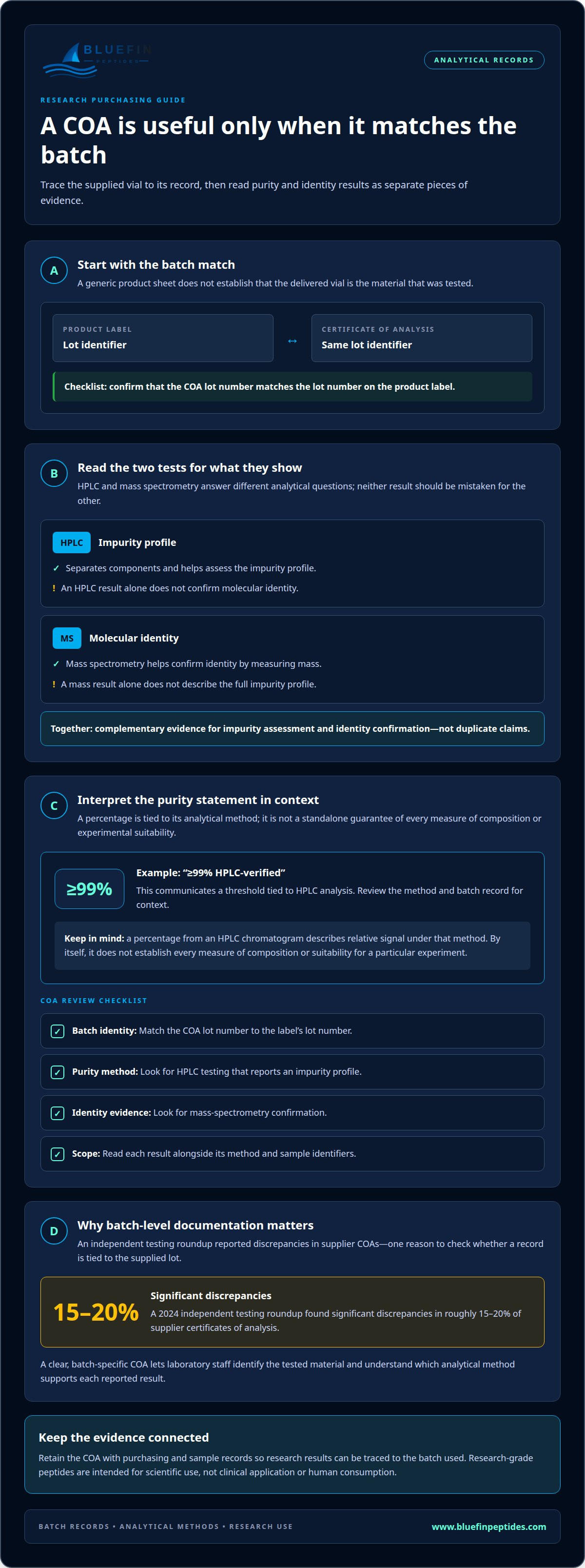
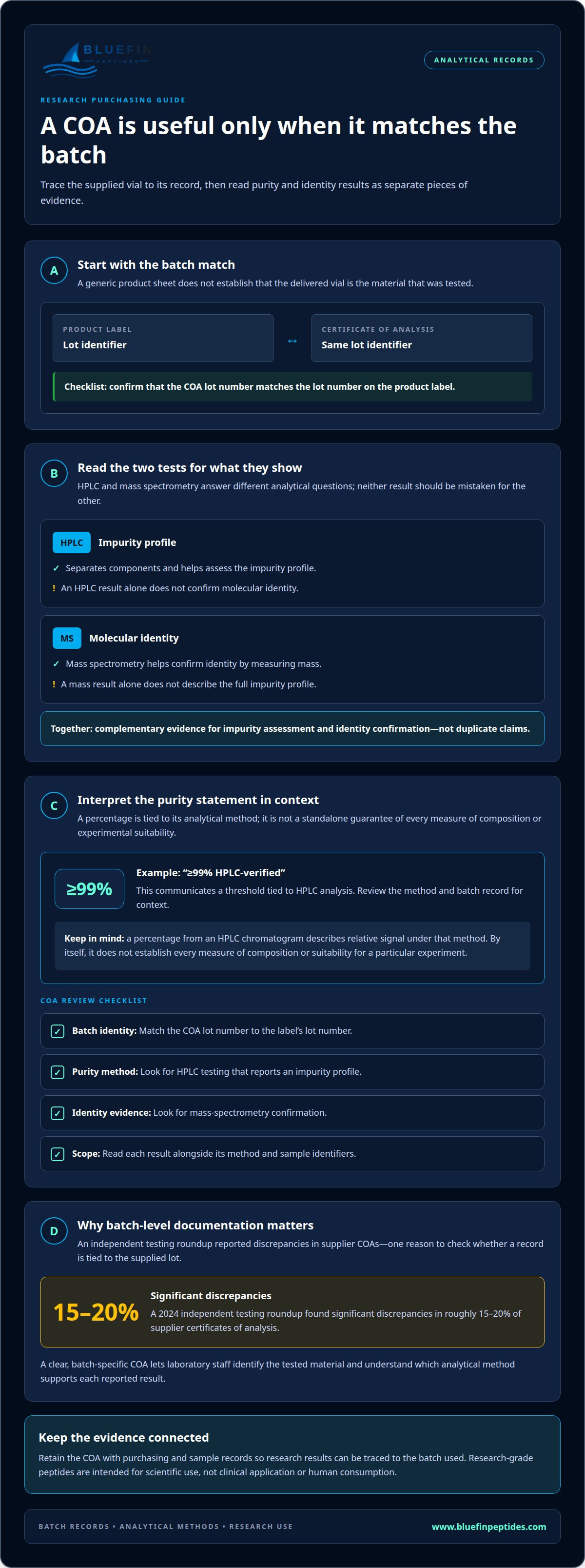
A certificate of analysis (COA) is useful when it describes the specific batch supplied. A generic product sheet cannot establish that the delivered vial matches the tested material. The lot identifier on the product label should match the identifier on its COA. This connection lets a laboratory link its sample to documented analytical results instead of relying on a general purity statement.
The two methods answer different analytical questions. High-performance liquid chromatography (HPLC) separates components and helps assess the impurity profile. Mass spectrometry helps confirm molecular identity by measuring mass. Together, the tests provide complementary evidence: an HPLC result alone does not confirm identity, and a mass result alone does not describe the full impurity profile.
Purity options should be interpreted through their stated method and intended use, not as interchangeable labels. A percentage from an HPLC chromatogram describes the relative signal under that method; it does not, by itself, establish every measure of composition or suitability for a particular experiment. For example, a specification stating ≥99% HPLC-verified communicates a threshold tied to HPLC analysis. The accompanying method and batch record provide essential context.
- Batch identity: Match the COA lot number to the label’s lot number.
- Purity method: Review whether HPLC testing reports an impurity profile.
- Identity evidence: Look for mass-spectrometry confirmation.
- Scope: Read the reported result alongside its method and sample identifiers.
Documentation deserves close attention. A 2024 independent testing roundup found significant discrepancies in roughly 15-20% of supplier certificates of analysis. That finding makes batch-level records more informative than a certificate that is not tied to the supplied lot. A clear COA should let laboratory staff identify the tested material and understand which analytical method supports each reported result.
For a practical review, start with the product label, locate the matching lot on its COA, then distinguish identity confirmation from purity analysis. If a document reports HPLC testing and mass-spectrometry confirmation, treat those as separate pieces of evidence, not duplicate claims. Retain the COA with the lab’s purchasing and sample records so results can be traced to the batch used in research. A supplier specification of ≥99% HPLC-verified, with mass-spec confirmation and batch COAs, gives laboratories concrete documentation to assess rather than an unsupported purity adjective.
These records provide a stronger basis for review. HPLC assesses impurity profiles, while mass spectrometry helps confirm peptide identity. Laboratories should review the supplier’s COA for each batch and check that the lot number on the product label matches the COA.
Supplier quality systems and certifications
A supplier’s quality system connects each peptide sequence to controlled production and release records. Useful evidence for a laboratory includes documented procedures, batch identification, deviation review, and retained testing records. These practices help trace a specific lot through manufacturing and packaging.
Quality control extends beyond a final test. A supplier’s process may document incoming materials, synthesis, purification, packaging, and release approval. If a laboratory reports an unexpected result, for example, batch records can help determine whether to investigate production, handling, or experimental conditions. Defined procedures make that inquiry more systematic than a general quality claim.
Independent testing can provide a separate analytical review, but the term alone does not explain what was tested. The report should identify the sample or batch and state which analysis was performed. Peptide sequence matters too: a sequence change means the material being assessed has changed, so results for one sequence cannot automatically characterize another. These distinctions help laboratories judge whether the evidence applies to the research material in question.
- Traceability: Connect production and release records to a specific batch.
- Process control: Look for documented steps covering materials, production, and packaging.
- Review: Identify how deviations and out-of-specification results are recorded.
- Testing scope: Distinguish independent analysis from a supplier’s internal quality checks.
Read a certification as evidence of a defined scope, not proof that every peptide or batch has identical characteristics. The certifying body, covered activities, and validity period help explain what the credential represents. Certification related to a facility or management process does not, by itself, provide batch-specific analytical results. For research purchasing, process documentation and lot records answer different questions and should be considered separately.
Are peptides sold by U.S. companies FDA-approved for human use? Research-grade peptides are intended for scientific use, not clinical application or human consumption. FDA approval applies to specific drug products, not to a supplier simply because it operates in the United States.
When assessing a quality system, follow the evidence from sequence to batch: identify the material, review relevant production controls, then connect release records to that lot. A supplier’s quality claims are most useful when they describe verifiable processes rather than broad assurances. This approach helps research teams distinguish documented controls from certification language and select evidence suited to their study requirements.
How do US peptide companies compare with overseas suppliers on quality and purity?
Country of origin does not, by itself, establish peptide quality. Assess U.S. and overseas suppliers using the same evidence: product identity, impurity data, batch traceability, and handling records. For example, domestic stock without batch-linked documentation offers less basis for quality assessment than a clearly documented overseas lot. Location is a logistics factor, not an analytical result.
Compare equivalent materials and testing scopes. Before comparing records, check that both suppliers specify the same peptide sequence, form, and stated purity threshold. HPLC can characterize an impurity profile, while mass spectrometry supports identity confirmation. A test result for one sequence or lot cannot automatically establish the characteristics of another. This matters when purchasing repeated batches for a study.
Domestic fulfillment can shorten the supply route when material is already stocked in the United States. Fewer transit stages may simplify shipment coordination and reduce reliance on international transport schedules. This benefit concerns delivery logistics, not the peptide’s synthesis origin or purity. An overseas-manufactured peptide held in U.S. inventory still requires manufacturing and batch documentation to establish its provenance.
Overseas purchasing can involve additional handoffs between the manufacturing site, exporter, carrier, and receiving laboratory. With each transfer, shipment records and product identifiers need to remain aligned. A U.S.-based supplier may make communication and fulfillment coordination more direct for domestic laboratories, but neither proximity nor responsiveness demonstrates analytical quality. The decisive comparison is the evidence attached to the actual lot.
- Origin: Separate the synthesis location from the shipping origin.
- Identity: Compare the specified sequence and mass-spectrometry evidence.
- Purity: Review equivalent HPLC methods and reported results.
- Traceability: Connect the supplied lot to its batch documentation.
- Fulfillment: Consider transit route and handling records separately from test results.
For a concrete comparison, imagine two suppliers offering the same peptide sequence. One provides domestic dispatch and a batch-linked analytical record; the other ships internationally with comparable lot documentation. The domestic option may simplify delivery, while the documentation lets you assess quality on its merits. If either quotation lacks an equivalent analytical scope, the comparison is incomplete, not proof that one country produces superior material.
Apply the same criteria to every order, regardless of supplier location. Record the sequence, lot identifier, testing scope, and shipment origin in procurement files. This creates a consistent basis for reviewing material used across experiments. The benefits of US-based peptide companies are practical when domestic fulfillment and transparent documentation fit a laboratory’s workflow, not because a national address guarantees purity.
What regulations apply to peptide manufacturers and sellers in the United States?
U.S. rules depend on whether a product is a research chemical, an FDA-approved drug, or a compounded prescription. These categories are not interchangeable. Research-grade peptides are intended for scientific use, not clinical application or human consumption. A domestic address does not turn a research product into an approved medicine or establish that it can be used for patient treatment.
FDA-registered 503A compounding pharmacies dispense patient-specific prescriptions and operate under a defined legal and quality framework. That prescription pathway differs from the sale of research chemicals. The distinction matters: a laboratory peptide labeled for research is not the same regulatory category as a compounded prescription or an FDA-approved drug. FDA approval for drugs such as insulin and GLP-1 medications provides oversight of their manufacture and distribution.
In early 2026, the SAFE Drugs Act was introduced. It proposes to bar sales of research chemicals biologically identical to FDA-approved drugs without a New Drug Application. A proposal is not an enacted prohibition. Its stated scope concerns research chemicals biologically identical to approved drugs, so it should not be generalized into a rule covering every peptide or every laboratory purchase.
FDA actions concerning compounding also require precise interpretation. On April 22, 2026, the FDA removed twelve peptides from Category 2 for evaluation for the 503A list. Removal was not FDA approval. On July 23-24, 2026, the FDA Pharmacy Compounding Advisory Committee reviewed seven peptides and recommended six for the 503A compounding list. A committee recommendation is not the same action as FDA approval.
HHS announced an interim enforcement-discretion policy on October 28, 2026, for compounding certain peptides under specified conditions. It covers BPC-157, TB-500, MOTS-C, KPV, epitalon, and Semax, none of which is FDA-approved. The policy was published in the Federal Register on October 30, 2026, with a two-week comment period. Enforcement discretion does not make the covered substances FDA-approved.
- Identify the category: distinguish research chemicals from approved drugs and patient-specific compounded prescriptions.
- Read the legal action precisely: separate a proposal, committee recommendation, evaluation, and approval.
- Keep intended use clear: research-use labeling does not establish clinical authorization.
For laboratory procurement, these distinctions define the boundary between research supply and medical use. Regulatory status follows the product and its intended pathway, not simply the supplier’s U.S. location. Review research-use peptide options for laboratory purchasing.
Bluefin Peptides
Bluefin Peptides supports laboratory procurement with research peptides stocked in the United States and shipped after ordering. Its catalog includes individual research peptides and blends for different laboratory needs, with batch documentation to help researchers assess the material supplied.
Products are ≥99% HPLC-verified, with mass-spec confirmation and batch certificates of analysis. These records provide analytical details for research evaluation; research-grade peptides are intended for laboratory research, not clinical application or human consumption. Domestic stock can also support a more direct fulfillment route for U.S. laboratories.
For teams applying the criteria in this guide, Bluefin Peptides offers a practical next step when research-use peptides with documentation fit the project. Sign up for free Researcher Access to explore the research catalog and COA lookup.
Build a procurement path around your research
Make supplier selection a repeatable part of study planning. Before ordering, define the material your protocol requires, the documentation your team will retain, and how procurement records will connect each purchase to the work it supports. A consistent intake process helps keep purchasing decisions aligned with experimental design as projects develop.
The benefits of US-based peptide companies matter most when domestic fulfillment and accessible product documentation fit a laboratory’s workflow. Treat supplier location as one procurement consideration, alongside intended research use and the records your team needs for its procedures. This gives you a practical basis for future sourcing decisions without relying on location as a substitute for project-specific requirements.
Bluefin Peptides offers Retatrutide Research Peptide, Tirzepatide Research Peptide, and BPC-157 / TB-500 Research Blend for laboratory research. If these offerings fit your research needs, contact Bluefin Peptides to discuss your procurement requirements. A disciplined next step can help your team move from supplier evaluation to a research plan with clear purchasing criteria.
Frequently Asked Questions
What are the benefits of buying peptides from US-based companies?
For domestic laboratories, U.S.-stocked products can make shipment coordination more direct by avoiding an international transit leg. This can simplify procurement planning, especially when orders need to align with laboratory workflows. Location alone does not establish purity or manufacturing origin, so treat it as a logistics factor. The practical benefit is strongest when domestic fulfillment comes with documentation relevant to the research material.
How do US-based peptide companies verify product identity, purity, and batch consistency?
Companies may use analytical testing and batch records, but methods and evidence can differ. For a particular lot, connect the container’s lot identifier to its documentation, then distinguish identity evidence from purity analysis. To assess consistency across orders, compare the records for each batch using the same criteria. A matching product name alone does not establish that different lots have identical analytical profiles.
How do shipping times, customs, and import risks differ for US and overseas peptide suppliers?
A domestic order shipped from U.S. stock avoids the international transit leg involved in cross-border fulfillment. Overseas orders may involve additional transport handoffs and customs processing, which can affect coordination and delivery timing. Actual transit depends on stock location, carrier handling, and route. A U.S. supplier can still rely on international manufacturing, so shipping origin and peptide origin are separate details.
What risks and limitations should buyers consider when purchasing peptides from US companies?
A U.S. supplier’s location does not establish that a peptide is FDA-approved, suitable for clinical use, or free from contamination. Research-grade peptides are for scientific use, not human consumption. Buyers should also consider how incomplete sourcing information or batch documentation could limit their ability to assess a material. Keep intended use within laboratory research, and do not treat research products as medicines or personal-use products.
How can buyers check a US peptide company's credentials, testing, and reputation?
Review the company’s stated research-use scope and the analytical records associated with its products. Bluefin Peptides provides Researcher Access to its research catalog after self-attestation and email verification, along with a COA lookup. Qualified researchers can use these tools to review product information and available certificates. For any batch, consider its documentation alongside your laboratory’s procurement and recordkeeping procedures, rather than relying on broad quality claims.
For laboratory research use only. Not for human or veterinary use. This content is educational and does not constitute medical, dosing, or usage guidance.
Browse the BLUEFIN catalog