Avoiding research delays from bad reagents through smarter stock management

Expired reagents aren’t automatically usable or unusable. Their suitability depends on stability, storage conditions, contamination risk, and the intended experiment. Manufacturers generally advise against using them, so avoiding research delays from bad reagents starts with assessing the reagent’s condition and determining whether appropriate testing can confirm its properties before use.
That caution is practical: a degraded or contaminated reagent can compromise results, while discarding one solely because its date has passed may interrupt work unnecessarily. Base the decision on evidence, not guesswork.
This article explains how to assess expired reagents and reduce preventable delays through controlled storage, clear inventory records, planned purchasing, careful handling, and temperature monitoring. Learn which factors matter when evaluating a reagent and how consistent stock practices can keep research moving without compromising experimental reliability.
Key Takeaways
- Assess an expired reagent by considering its stability, storage history, contamination risk, and intended use rather than relying on its date alone.
- Record each reagent’s identity, batch, expiration date, and remaining quantity so stock status is visible before work begins.
- Match storage conditions to the reagent’s requirements, and limit exposure to temperature shifts, light, and humidity.
- Use planned purchasing, careful preparation, and appropriate handling practices to reduce stockouts and contamination risks.
- Combine suitable temperature indicators with digital logging to identify storage excursions and maintain useful monitoring records.
1. Why are Laboratory Reagents important?
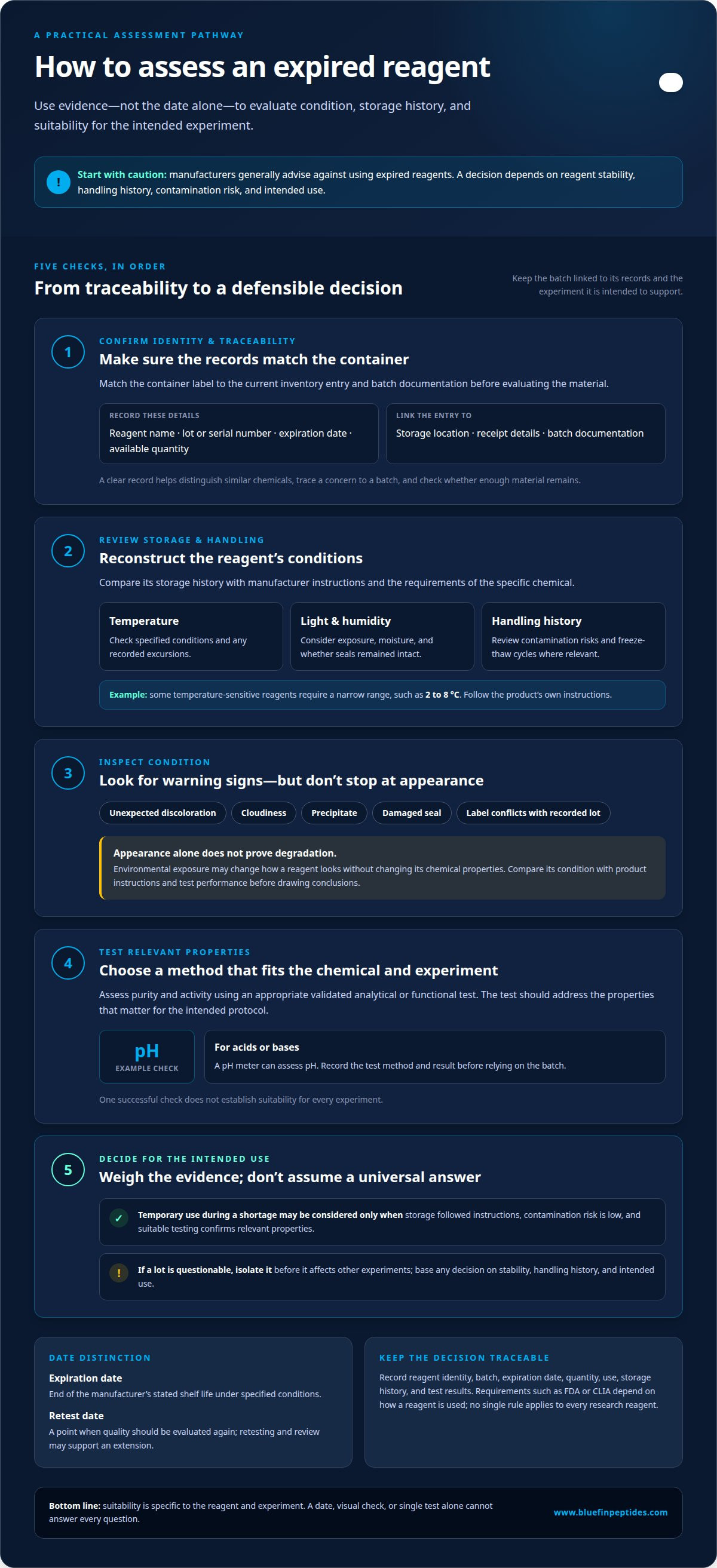
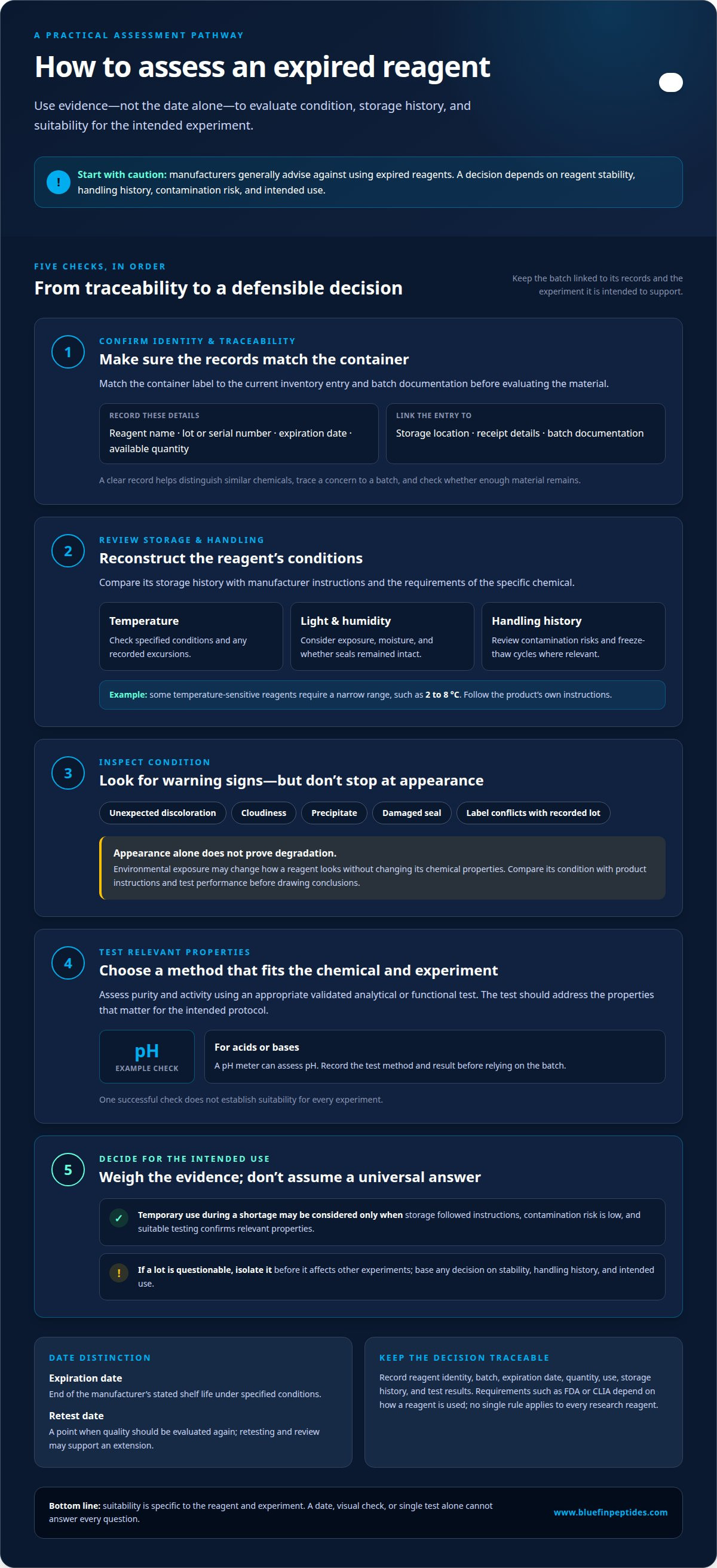
A reagent’s identity and condition can determine whether an experiment produces interpretable data. Record its unique name, lot or serial number, expiration date, and available quantity in a current inventory. Link each entry to its storage location and receipt details. These records help staff distinguish similar chemicals, trace a problem to a batch, and see whether enough material remains before starting work.
Use inventory records as active controls, not an archive. Label each container with its name, lot, and expiration date, then update the quantity after use. An electronic inventory can flag approaching expiration dates and low stock. These practices help isolate a questionable lot before it affects other experiments and support reproducibility by linking results to the reagent batch used.
FDA or CLIA requirements depend on how a reagent is used; no single rule applies to every research reagent. For traceability, maintain records of reagent identity, batch, expiration date, quantity, and use, especially where audits or regulated testing apply.
Reagent failure can consume samples, staff time, repeat assays, and scheduled instrument access. Delays can also arise when a failed result requires troubleshooting or replacement stock. The impact depends on the experiment and resources committed, so a universal cost figure would be misleading.
To verify a reagent, match its container label to the inventory entry and batch documentation, then confirm that its intended use and storage history fit the protocol. Assess purity and activity using a method appropriate to the chemical and experiment, such as a validated analytical or functional test. Record the method and result before relying on the batch. This traceable process helps avoid research delays from bad reagents.
Possible warning signs include unexpected discoloration, cloudiness, precipitate, a damaged seal, or a label that conflicts with the recorded lot. Appearance alone does not prove degradation: environmental exposure may change how a reagent looks without changing its chemical properties. Compare its condition with product instructions and test performance before drawing conclusions.
An expiration date marks the end of the manufacturer’s stated shelf life under specified conditions. A retest date indicates when quality should be evaluated again; a retest and quality review may support extending it. Manufacturers generally advise against using expired reagents. During a shortage, consider temporary use only if storage followed instructions, contamination risk is low, and suitable testing confirms relevant properties. For example, a pH meter can assess acids or bases. Do not assume that one successful check establishes suitability for every experiment: the decision depends on the reagent’s stability, handling history, and intended use.
2. Storage temperature, light, and humidity
Storage conditions shape a reagent’s stability from receipt through use. Follow the manufacturer’s instructions for temperature, light exposure, and humidity, because each chemical has distinct properties. Some temperature-sensitive reagents require a narrow range, such as 2 to 8 °C. A refrigerator set outside the specified range can expose stock to conditions that compromise performance, even if the container remains sealed.
Keep reagents in their original containers whenever possible. Preserve the manufacturer’s label, and add clear identification if secondary labels are needed. Include the reagent name and expiration date on the storage location, such as a shelf bin or freezer rack. Store containers away from heat, direct light, and contamination risks. For example, a fluorescent reagent may lose effectiveness after prolonged light exposure, so follow its specified light-protection practices.
Humidity matters, too. High humidity can accelerate degradation, particularly when containers are opened repeatedly or seals are compromised. Keep caps tightly closed and return each container promptly to its assigned storage area. Use clean, dry handling tools, and avoid leaving powdered chemicals exposed while preparing solutions. These steps limit moisture uptake and reduce the chance of environmental contaminants entering the reagent.
Warehousing adds exposure points. A shipment may encounter temperature changes during transport, temporary staging, or transfer into laboratory storage. On receipt, inspect the packaging and any available temperature indicators before placing stock in its designated location. Record delivery conditions and storage placement so later performance changes can be compared with the reagent’s handling history. Train staff to recognize alerts and respond consistently.
Temperature excursions can have consequences beyond the time spent outside a recommended range. A general Arrhenius-based rule of thumb estimates that each 10 °C increase doubles reaction rate. For example, storing a product at 35 °C for 30 days is estimated to cause degradation comparable to storage at 5 °C for 3 years. This comparison is an illustration, not a substitute for product-specific stability data. Reagents normally stored at -10 °C or lower may also behave differently during elevated-temperature testing because they can transition from frozen to liquid.
To preserve stability and performance, match the storage location to the manufacturer’s specified conditions, protect light-sensitive material, control moisture exposure, and return reagents promptly after use. Minimize freeze-thaw cycles for reagents that require freezing. Record temperature excursions and follow relevant handling instructions before returning affected stock to routine use.
For laboratories sourcing research materials, research peptide options can be considered alongside storage requirements and experimental needs.
3. Reagent purchasing and stock management
Base purchasing decisions on experimental demand, reagent stability, and supplier documentation. Review which reagents each protocol consumes, how often they are used, and whether they have short shelf lives after opening or preparation. Larger orders may make sense for frequently used items. For infrequently used or unstable chemicals, choose quantities that can be used within their supported storage period. This reduces both stockouts and avoidable expired inventory.
Compare suppliers using evidence relevant to the experiment: product identity, stated purity or quality, batch documentation, storage and delivery conditions, and availability. A certificate of analysis (CoA) should identify the batch and report applicable tests, methods, and results against product specifications. Requirements vary by reagent and research purpose; a generic certificate alone does not establish suitability for every method.
Set an incoming quality-control process before ordering. On receipt, match the product name and lot on the container to the purchase record and CoA. Inspect packaging for damage, review shipment conditions where relevant, and place the reagent in its assigned storage promptly. For critical applications, define acceptance tests in advance, such as an identity, purity, or activity assay that reflects the experiment’s needs. Record the outcome and quarantine stock that fails the criteria.
Build inventory around actual use rather than guesswork. A laboratory information management system (LIMS) can record usage, lot, expiration date, and freeze-thaw cycles, helping managers time replenishment and route requests. Review consumption patterns and current quantities regularly. Set reorder points based on expected use during procurement and delivery, along with the consequences of a delay. There is no universal safety-stock level: reagent stability, supplier availability, and experimental criticality determine the appropriate buffer.
Assign a responsible person to oversee purchasing and stock records. Clear ownership helps prevent duplicate orders, missed replenishment, and gaps when staff change roles. Keep backup options practical: identify whether an approved alternative kit or method can meet the same research objective, and decide how the team will evaluate that substitution before a shortage occurs. If compatible, an aliquot from a colleague’s laboratory may bridge a short supply gap, provided its lot and handling history are documented.
When a critical reagent is unavailable, contact the supplier or manufacturer about delivery timing and possible expedited shipment. A nearby laboratory may also have an appropriate reagent for temporary use. These options can reduce downtime, but they do not replace acceptance checks. A sound purchasing method connects forecast demand, scientific requirements, batch evidence, and controlled storage, making each decision traceable.
4. Safe reagent preparation and handling
Preparation errors can alter a reagent before it reaches an experiment. Follow the manufacturer’s instructions for reconstitution, dilution, mixing, and handling. Use the specified dilution rate and compatible materials; an incorrect method can change concentration or introduce contaminants. Before starting, confirm the reagent’s identity, intended procedure, and required work environment. This sequence gives each preparation a defined purpose and reduces avoidable variation.
Only trained, qualified personnel should handle chemical reagents, particularly corrosive, explosive, or peroxidizable materials. Select personal protective equipment appropriate to the reagent and procedure, such as goggles, gloves, and masks. Review the container’s hazard information before opening it, then keep the work area organized to prevent spills and cross-contamination. Record preparation details so another researcher can interpret the resulting solution and repeat the method.
Keep containers clean and dry, and seal them tightly when not in use. A loose cap can allow moisture, air, or contaminants to affect the contents. Use clean tools for each reagent, and never return unused material to its original container. For sterile work, sealing containers, using biosafety cabinets, and filtering media can help mitigate contamination risks. Choose practices that fit the material and protocol.
Aliquoting can limit repeated access to a stock container. Pre-measured portions reduce contamination risk and may help preserve shelf life by avoiding repeated opening. Label each aliquot with its identity and relevant hazard information, and maintain its link to the original batch record. Avoid preparing more diluted reagent than the procedure requires, since diluted chemicals are generally less stable than concentrated forms.
Some compounds need particular care during preparation. Metal halides such as TiCl4, AlCl3, FeCl3, and SnCl2 are easily hydrolyzed, so exposure to moisture can affect their condition. Solid potassium permanganate and potassium dichromate are generally stable in air, but their solutions can deteriorate through contact with reducing impurities such as H2S and SO2. These examples show why container integrity, clean tools, and suitable preparation conditions matter.
When a ready-made solution is unavailable, a laboratory can prepare one from chemical powder by following the manufacturer’s handling and preparation directions. Keep the powder sealed until needed, measure it with clean equipment, and clearly identify the prepared reagent. Before testing, document the source material, batch, preparation date, dilution, and preparer. This record helps trace unexpected results to the material or preparation step instead of prompting unnecessary repetition of the entire experiment.
Keep preparation and handling aligned with manufacturers’ instructions, including the specified dilution rate. Keep reagent containers clean and dry, and seal them tightly whenever they are not in use. Labels should identify associated hazards, including toxicity, flammability, and explosion potential, so handlers can recognize risks before use.
5. Layered monitoring for ambient, chilled, and frozen reagents
A single temperature check cannot show every exposure between delivery and use. Pair passive indicators with digital loggers for temperature-sensitive reagents, choosing indicators suited to the material’s storage category: ambient, chilled, or frozen. Together, these monitoring methods provide layered visibility, helping staff detect conditions that could contribute to degradation before a reagent reaches an experiment.
Start by mapping monitored storage locations to reagent requirements. Group materials by their specified ambient, chilled, or frozen conditions, and place the appropriate monitoring device with each group. Chilled reagents and frozen samples need indicators suited to their respective conditions. This prevents an indicator designed for one temperature range from being treated as evidence for another.
Use passive indicators as visible signals and digital loggers to preserve monitoring data. Together, they can help staff identify a potential excursion and review its record. A visible change should trigger a defined response: isolate affected stock, record the location and observed condition, and assess the event against the reagent’s storage instructions before returning it to use.
Monitoring works only if people know how to act on the signal. Train staff who receive, move, store, and retrieve reagents to interpret indicators and respond to logger alerts. For example, someone transferring a frozen reagent should recognize an alert, keep the material segregated, and notify the person responsible for quality review. Clear responsibilities prevent alerts from being overlooked during a shift change.
Retain monitoring records with inventory and quality documentation. Note the relevant storage location, reagent or batch, alert, response, and disposition. These records help explain whether a change in experimental performance may be linked to a storage event. They also support trend reviews, such as identifying repeated alerts around one refrigerator or during routine stock transfers.
Apply the same response sequence across ambient, chilled, and frozen storage, while matching indicators to each condition. Review alert records alongside the reagent’s handling history and intended use. A logger alert alone does not prove that a reagent has failed; it identifies an event that requires assessment. Conversely, an unchanged passive indicator does not replace appropriate digital monitoring where layered protection is used.
Build the monitoring procedure into staff training and routine inventory work. Assign responsibility for reviewing alerts, retaining records, and documenting decisions about affected stock. This creates a traceable path from storage event to quality assessment, reducing the chance that questionable material enters experiments unnoticed. For research planning, review research peptide options alongside your laboratory’s monitoring and storage procedures.
Plan monitoring carefully: labs and logistics teams should choose temperature indicators suited to the reagent type and temperature range, including ambient, chilled, or frozen conditions, and combine passive indicators with digital loggers for layered protection.
Bluefin Peptides: Retatrutide Research Peptide
Bluefin Peptides offers Retatrutide Research Peptide for laboratory research use. Researchers whose experimental plans call for this specific peptide can review the product’s batch documentation through the company’s COA lookup.
Bluefin Peptides states that its peptides are at least 99% HPLC-verified, with mass-spectrometry confirmation and batch certificates of analysis. These records provide analytical information to consider alongside your protocol, acceptance criteria, and storage requirements. Review the batch documentation as part of your incoming quality process, rather than treating product selection as a substitute for experiment-specific assessment.
The catalog also includes Tirzepatide Research Peptide, BPC-157 / TB-500 Research Blend, and Ipamorelin / CJC-1295 Research Blend. Select only an offering that aligns with your laboratory’s research requirements and planned method. Contact Bluefin Peptides to discuss its research peptide offerings.
Build a More Predictable Research Workflow
Make the next project easier to launch by treating reagent decisions as part of experimental planning, not as a task to handle only after stock runs low. Set a procurement review point alongside protocol approval, assign an owner for supply decisions, and define how incoming materials will be evaluated before active use. This gives the team a clear path from reagent selection to experimental readiness.
For peptide research, align material selection with the study design and your laboratory’s evaluation criteria before ordering. Record the intended use and acceptance approach in the project plan so purchasing decisions support the experimental method. A disciplined workflow helps avoid research delays from bad reagents by making readiness a planned decision, not a last-minute correction.
Use the next protocol review to identify critical materials, assign purchasing responsibility, and set the acceptance process before work begins. For research peptide inquiries, contact Bluefin Peptides today. A clear plan puts your next experiment on a more deliberate course.
Frequently Asked Questions
Can Expired Reagents Be Used?
Sometimes, but an expired reagent should not be treated as suitable by default. For a low-risk exploratory procedure, compare its condition with the experiment’s acceptance criteria and test a relevant property before use. For a critical assay, an unverified reagent can make results difficult to interpret. Keep any evaluation separate from routine stock, document the decision, and use a fresh control to identify possible performance changes.
How to prevent and mitigate the deterioration of chemical reagents?
Reduce avoidable exposure during each preparation and transfer. Prepare only the volume required for the planned work, keep the source container closed, and use clean tools to prevent introducing moisture or contaminants. For a reagent used across multiple experiments, maintain a sealed master container and dispense working portions as needed. If a control signal shifts unexpectedly, pause use and assess the affected material before interpreting sample results.
Is there an alternative method you could use?
Yes. Researchers can assess whether an alternative kit or method addresses the same research objective, then evaluate it against suitable controls before substituting it. If the planned reagent is unavailable and the experiment cannot proceed, freezing cells of interest for later use may preserve the option to resume. An alternative experiment using cultivated organisms can also produce informative data, provided it addresses a meaningful part of the research question.
Why are Laboratory Reagents important?
Reagents enable researchers to detect or measure properties of substances. For example, a titration uses a reagent to determine a sample’s concentration, while a redox reaction can reveal chemical behavior. If reagent activity changes, the observed signal may reflect the material’s condition instead of the sample being studied. Selecting and evaluating reagents for the method supports interpretable results and meaningful comparisons between experiments.
What FDA, CLIA, or other U.S. requirements apply to research reagent quality and traceability?
FDA or CLIA requirements depend on how the reagent is used; no single rule applies to every research reagent. Maintain traceable records of reagent identity, batch, expiration date, quantity, and use, especially for audits or regulated testing.
For laboratory research use only. Not for human or veterinary use. This content is educational and does not constitute medical, dosing, or usage guidance.
Browse the BLUEFIN catalog