What is Glucagon-Like Peptide-1? A Technical Overview for Researchers

The utility of GLP-1 in a laboratory setting is dictated less by its clinical reputation and more by the fragile kinetics of its N-terminal degradation. When investigating what is glucagon-like peptide-1 from a strictly biochemical perspective, researchers often find themselves submerged in a sea of conflicting data where pharmaceutical marketing obscures the fundamental chemical nature of the molecule. You've likely encountered the frustration of finding reliable stability data for reconstitution or navigating the vague purity standards that often compromise experimental integrity.
This article provides an analytical deep-dive into the molecular structure, biological mechanisms, and laboratory stability of the GLP-1 peptide hormone to provide the clarity your work demands. We'll explore the complexities of the proglucagon processing pathway and identify the structural deviations that distinguish endogenous GLP-1 from synthetic analogues like Tirzepatide or Retatrutide. Finally, we'll establish the rigorous criteria for high-purity research materials to ensure your results remain as precise as your methodology.
Key Takeaways
- Define what is glucagon-like peptide-1 through the lens of the proglucagon processing pathway and its secretion from intestinal L-cells.
- Examine the molecular architecture of GLP-1 (7-36) amide, focusing on the N-terminal histidine residue required for receptor binding and activation.
- Trace the intracellular signaling mechanisms, including adenylate cyclase activation and the subsequent rise in cyclic AMP within experimental models.
- Identify the specific proteolytic vulnerabilities at the Ala8 position that dictate the rapid degradation of the peptide by the DPP-4 enzyme.
- Establish rigorous standards for laboratory procurement by utilizing HPLC and mass spectrometry to ensure batch-specific purity of at least 99%.
Defining the Incretin System: The Biological Origin of GLP-1
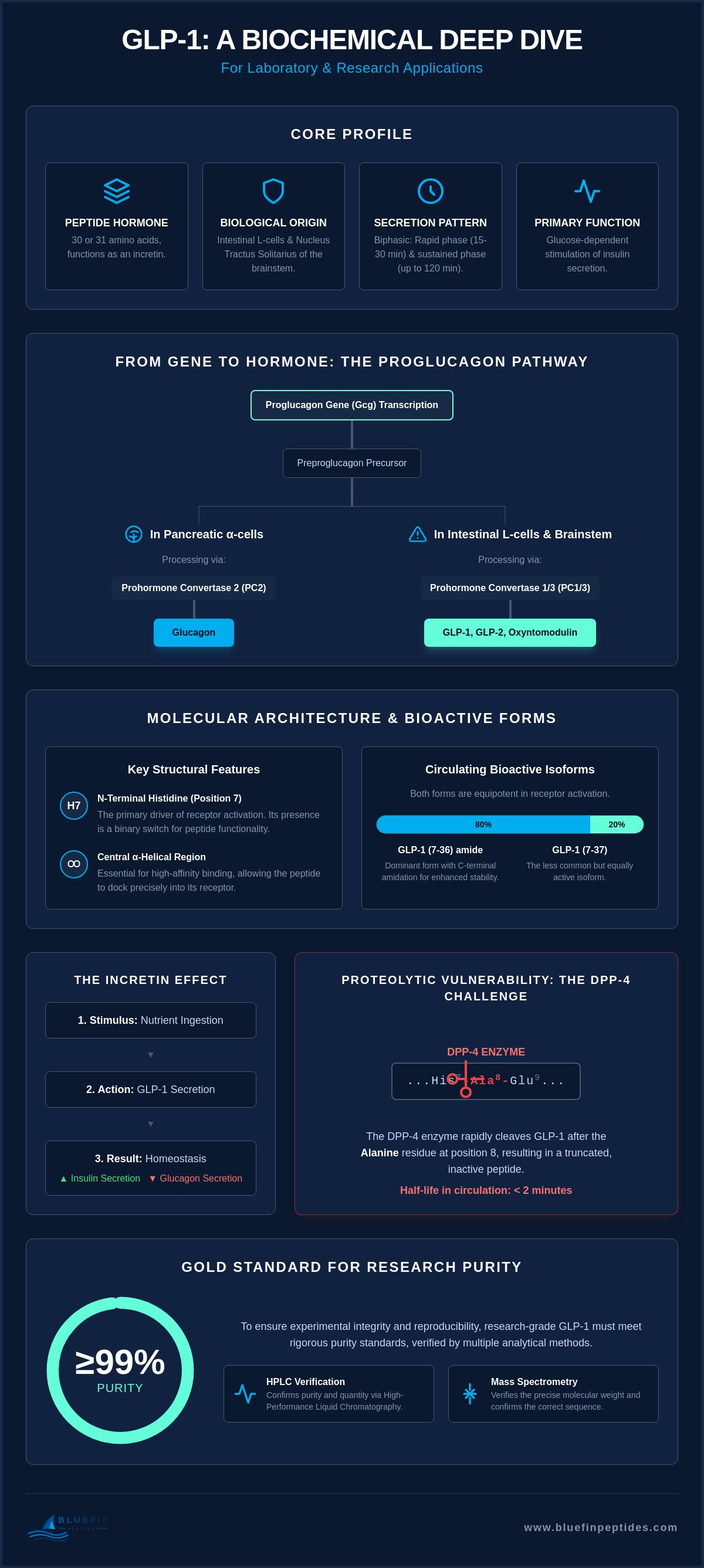
Understanding what is glucagon-like peptide-1 requires a rigorous analysis of its genetic lineage and tissue-specific expression. Glucagon-like peptide-1 (GLP-1) is a 30- or 31-amino-acid incretin hormone derived from the transcription of the proglucagon gene (Gcg). While its clinical profile is widely discussed, its biological origin is rooted in the enteroendocrine L-cells of the distal small intestine and colon. This peptide functions as a primary signaling node, responding with high-fidelity kinetics to the presence of nutrients in the intestinal lumen. When investigating what is glucagon-like peptide-1, researchers must account for these tissue-specific variations that dictate systemic availability.
The secretion of GLP-1 follows a biphasic pattern. An initial rapid phase occurs within 15 to 30 minutes of nutrient ingestion. A sustained second phase follows, often lasting up to 120 minutes. Precision is paramount in defining these pathways. This stimulus-response mechanism is triggered primarily by carbohydrates and long-chain fatty acids. Beyond the gastrointestinal tract, GLP-1 is also synthesized in the nucleus tractus solitarius of the brainstem. These dual production sites suggest a complex regulatory network that bridges peripheral metabolic status with central nervous system signaling.
The Proglucagon Processing Pathway
The bioactive nature of GLP-1 is determined by tissue-specific post-translational processing. The preproglucagon precursor undergoes cleavage by distinct prohormone convertases (PC) depending on the cellular environment. In pancreatic alpha cells, PC2 activity primarily yields glucagon. Conversely, in intestinal L-cells and the brainstem, PC1/3 mediates the processing of proglucagon into GLP-1, GLP-2, and oxyntomodulin. This divergence ensures that the same genetic blueprint produces antagonistic or complementary hormones based on localized metabolic requirements. The chemical transition from the inert proglucagon protein to the bioactive peptide is a high-stakes event that defines the hormone's biological potency.
Physiological Role in Glucose Homeostasis
In metabolic research models, GLP-1 is the cornerstone of the "incretin effect." This phenomenon describes the significantly higher insulin response observed following oral glucose administration compared to an isoglycemic intravenous infusion. GLP-1 facilitates this through glucose-dependent stimulation of insulin secretion from pancreatic beta cells. It binds to its specific receptor, initiating a cascade that enhances insulin exocytosis only when blood glucose levels are elevated. This mechanism provides a built-in safeguard against hypoglycemia. Additionally, GLP-1 suppresses postprandial glucagon secretion from alpha cells, further refining the glycemic profile during nutrient absorption. These coordinated actions establish a stable baseline for metabolic homeostasis.
Molecular Architecture: The Chemical Structure of GLP-1
The chemical identity of the hormone is defined by its specific amino acid sequence and spatial orientation. When defining what is glucagon-like peptide-1 for laboratory applications, one must distinguish between the full-length proglucagon fragment and the truncated bioactive forms. The primary sequence consists of 30 or 31 residues. The most critical structural feature is the N-terminal histidine at position 7. This residue is the primary driver of receptor activation. Without this specific amino acid moiety, the peptide loses its metabolic signaling capacity entirely. It's a binary state of functionality. Precision is the only metric that matters.
The secondary structure of the peptide is characterized by a central alpha-helical region. This helical conformation is essential for high-affinity binding. It allows the peptide to dock precisely within the receptor's binding pocket. Amidation at the C-terminus, specifically in the 7-36 form, provides a marginal increase in stability against exopeptidases. This modification is a hallmark of the dominant circulating isoform in humans. The peptide's architecture is a balance of structural rigidity and flexible docking. Understanding these nuances is vital for researchers aiming to replicate endogenous signaling.
Bioactive Isoforms: 7-36 Amide vs. 7-37
The human incretin system utilizes two primary isoforms: GLP-1 (7-36) amide and GLP-1 (7-37). GLP-1 (7-36) amide accounts for approximately 80% of circulating active GLP-1. In experimental models, both forms demonstrate equipotent activation of the GLP-1 receptor. For researchers, the standard GLP-1 (7-36) amide research vial typically features a molecular weight of approximately 3297.7 Da and a chemical formula of C149H226N40O45. Verification of these constants is a prerequisite for accurate molar calculations in high-stakes laboratory environments. Data integrity begins at the molecular level.
Receptor Binding Dynamics
The interaction between GLP-1 and its receptor (GLP-1R) follows a complex "two-domain" binding model. The GLP-1R is a Class B G-protein coupled receptor (GPCR). The C-terminal portion of the peptide first anchors to the large extracellular domain of the receptor. This initial tethering facilitates the subsequent insertion of the N-terminal histidine into the transmembrane core. This precise docking initiates GLP-1 signal transduction via the adenylate cyclase pathway. The structural integrity of the N-terminus is the gatekeeper for downstream cAMP production. Understanding what is glucagon-like peptide-1 at the atomic level is the only way to predict its behavior in complex biological assays. Even minor impurities or sequence errors can disrupt this delicate docking mechanism. Utilizing high-purity research peptides ensures that these molecular interactions remain consistent across experimental replicates. Every batch must meet the threshold of analytical certainty.
Signal Transduction: GLP-1 Mechanisms in Experimental Models
The biological significance of what is glucagon-like peptide-1 is realized through its role as a high-affinity ligand for the GLP-1 receptor (GLP-1R). Upon binding, the receptor undergoes a conformational shift that activates the stimulatory G-protein (Gs). This activation triggers adenylate cyclase, the enzyme responsible for converting adenosine triphosphate (ATP) into cyclic adenosine monophosphate (cAMP). The resulting surge in intracellular cAMP acts as the primary second messenger in the metabolic signaling pipeline. This process is highly sensitive to the role of DPP-4 in GLP-1 degradation, which can terminate signaling within minutes if the peptide isn't structurally protected from enzymatic cleavage.
Downstream of cAMP production, two distinct pathways converge to modulate cellular output: Protein Kinase A (PKA) and the exchange protein directly activated by cAMP (Epac2). The PKA and Epac2 pathways don't just trigger vesicle movement; they also modulate the closure of ATP-sensitive potassium (KATP) channels. This closure leads to membrane depolarization and the subsequent opening of voltage-dependent calcium channels. The resulting influx of extracellular calcium is the final catalyst for insulin secretion. It's an elegant feedback loop. This architecture ensures that the hormone's primary effect is only exerted when extracellular glucose levels provide sufficient ATP to initiate the process, maintaining strict metabolic control.
Extra-Pancreatic Effects in Research
GLP-1 signaling isn't confined to the pancreas. In the central nervous system, GLP-1R activation in the arcuate nucleus and the nucleus tractus solitarius modulates satiety signals, effectively reducing caloric intake in experimental models. Research indicates that this central signaling may also influence reward-seeking behavior related to palatable foods. Additionally, the inhibition of gastric emptying remains a critical variable in metabolic studies. By slowing the transit of chyme from the stomach to the duodenum, GLP-1 flattens the nutrient absorption curve. This prevents the sharp glycemic spikes that characterize metabolic dysfunction. These findings expand the scope of what is glucagon-like peptide-1 from a simple glycemic regulator to a systemic metabolic coordinator.
Implications for Metabolic Research
Current research has shifted from isolated GLP-1 studies to the development of multi-agonist scaffolds. GLP-1 serves as the foundational anchor for these chimeric peptides. By combining GLP-1R activation with GIP or glucagon receptor signaling, researchers can achieve synergistic metabolic effects that exceed the capacity of single-receptor models. For a detailed breakdown of these advanced tri-agonist models, refer to our analysis on Retatrutide Research Peptide: Analytical Specifications and Laboratory Standards. This evolution highlights the peptide's utility as a precision tool for investigating complex endocrine interactions. It marks a transition from viewing hormones in isolation to understanding them as part of a fluid, integrated network.

Proteolytic Vulnerability: Stability and the Role of DPP-4
The primary constraint in metabolic research involving endogenous GLP-1 is its extreme proteolytic vulnerability. When analyzing what is glucagon-like peptide-1, researchers must account for the rapid enzymatic degradation that occurs almost immediately upon secretion. The enzyme Dipeptidyl Peptidase-4 (DPP-4) is the primary agent of this inactivation. It specifically targets the N-terminus of the peptide, cleaving the bond between the second and third amino acids. This cleavage occurs at the Alanine at position 8 (Ala8), transforming the bioactive GLP-1 (7-36) into the inactive metabolite GLP-1 (9-36). This single enzymatic strike renders the hormone incapable of receptor activation.
The biological half-life of native GLP-1 is remarkably brief, typically measured at less than 2 minutes. This rapid clearance creates a significant hurdle for longitudinal studies or experimental models requiring sustained signaling. For researchers, understanding what is glucagon-like peptide-1 involves recognizing that the native form is a transient signal rather than a stable endocrine actor. To overcome this, specific chemical modifications are integrated into GLP-1 research peptides to extend their functional window from minutes to several days.
From Endogenous Peptide to Stable Analogue
Structural modifications focus on shielding the Ala8 position from DPP-4 recognition. A common strategy involves substituting the L-alanine with an alpha-aminoisobutyric acid (Aib) residue, a non-proteinogenic amino acid that provides steric hindrance against enzymatic cleavage. Another critical modification is fatty acid acylation. By attaching a lipid chain to the peptide backbone, researchers can facilitate reversible binding to serum albumin. This prevents rapid renal filtration and extends the half-life significantly. While native GLP-1 degrades within minutes, acylated analogues can maintain metabolic activity for extended periods in high-fidelity research models.
Laboratory Handling and Stability
Peptide integrity is highly susceptible to environmental stressors during storage and reconstitution. The GLP-1 sequence is particularly prone to aggregation and oxidation, especially at the methionine residues. Lyophilized powders must be handled with care to prevent deamidation, a chemical degradation process that alters the peptide’s charge and binding affinity. Adhering to strict cold-chain logistics is non-negotiable for maintaining batch-level consistency.
- Store lyophilized peptides at -20°C or -80°C for long-term stability.
- Avoid repeated freeze-thaw cycles after reconstitution to prevent aggregation.
- Use sterile, buffered solutions to maintain a stable pH during experimental assays.
Ensuring your research relies on verified materials is essential for data reproducibility. You can procure HPLC-verified research peptides to guarantee the molecular stability required for high-stakes metabolic analysis. Every batch must meet the threshold of analytical certainty to ensure your results are not compromised by proteolytic degradation.
Procuring Analytical Grade GLP-1 Analogues for Laboratory Research
The integrity of metabolic signaling data is inextricably linked to the chemical purity of the reagents utilized. When determining what is glucagon-like peptide-1 in the context of a controlled study, the distinction between crude material and analytical grade analogues is absolute. High-fidelity research requires a purity threshold of ≥99%. This standard ensures that the intracellular responses observed, such as cAMP surge or calcium-induced exocytosis, are the result of the peptide itself rather than residual trifluoroacetic acid (TFA), salts, or truncated sequences. In a high-stakes laboratory environment, even a 1% variance in purity can introduce confounding variables that compromise the reproducibility of the entire dataset.
Verification of these standards requires a multi-layered analytical approach. High-Performance Liquid Chromatography (HPLC) is the primary tool for assessing chemical purity, providing a visual chromatogram that identifies any secondary peaks representing impurities. While HPLC confirms the concentration of the target molecule, Mass Spectrometry is non-negotiable for confirming the identity of the peptide. By measuring the precise mass-to-charge ratio, researchers can verify that the molecular weight aligns with the theoretical sequence of the GLP-1 analogue. These compounds are strictly intended for laboratory research and are not for human use; maintaining this boundary is essential for both legal adherence and scientific ethics.
Verification Standards: HPLC and Mass-Spec
Interpreting a Certificate of Analysis (COA) is a core competency for any research professional. A valid COA must be batch-specific, documenting the exact HPLC and mass-spec results for the current inventory rather than relying on historical data. This level of transparency allows for consistency across longitudinal studies, where multiple phases of research may span several months. For a comprehensive breakdown of these protocols, refer to our Analytical Quality Standards for Research Peptides: A Laboratory Guide. This documentation serves as the anchor for experimental validity, providing the verifiable data necessary to support peer-reviewed conclusions.
Bluefin Peptides: US-Stocked Research Solutions
Maintaining research momentum requires a logistics partner that prioritizes speed without sacrificing precision. Bluefin Peptides manages a US-based inventory to ensure rapid fulfillment, reducing the window of transit-related stress on sensitive materials. Every peptide, including GLP-1 related analogues like Tirzepatide and Retatrutide, is provided in a lyophilized state. This freeze-dried format ensures maximum chemical stability during shipping and long-term storage, preventing the deamidation and aggregation discussed in previous sections. By providing batch-level COAs and HPLC-verified materials, Bluefin Peptides functions as a high-performance laboratory partner. We provide the tools for verification so you don't have to rely on blind trust. Secure the stability of your next study by selecting research materials that meet the highest standards of analytical certainty.
Advancing Metabolic Research with Molecular Precision
Molecular signaling research relies on the intersection of structural integrity and chemical stability. We've analyzed the specific amino acid sequence defining the hormone's function and the enzymatic pressures threatening its biological half-life. Establishing a comprehensive understanding of what is glucagon-like peptide-1 provides the foundation for investigating complex metabolic interactions and multi-agonist models. The transition from native peptides to stable research analogues demands a commitment to analytical verification that leaves no room for ambiguity.
Experimental success is predicated on the quality of your research materials. Bluefin Peptides serves as a disciplined logistics specialist and laboratory partner. You don't have to rely on blind trust when every batch is supported by ≥99% purity guarantees and batch-specific COAs. Our rapid US-based logistics ensure your momentum isn't stalled by supply chain inefficiencies. Precision is the only metric that matters in high-stakes environments.
Secure HPLC-Verified GLP-1 Analogues for Your Next Study and ensure your data remains as robust as your methodology. We look forward to supporting the integrity of your next experimental phase.
Frequently Asked Questions
What is the difference between GLP-1 and glucagon?
Glucagon and GLP-1 are both products of the proglucagon gene (Gcg) but exert antagonistic effects on glucose metabolism. Glucagon is synthesized in pancreatic alpha cells and increases blood glucose via glycogenolysis. Conversely, GLP-1 is produced in intestinal L-cells and stimulates insulin secretion. The tissue-specific expression of prohormone convertases dictates which peptide is produced from the common precursor.
How long does the GLP-1 peptide remain stable after reconstitution?
Stability after reconstitution depends on the storage temperature and the buffer utilized. When dissolved in sterile bacteriostatic water or buffered saline, GLP-1 remains stable for approximately 7 to 14 days at 4°C. For extended experimental timelines, reconstituted aliquots should be stored at -20°C or -80°C to prevent aggregation. Repeated freeze-thaw cycles must be avoided to maintain the structural integrity of the peptide sequence.
Why does native GLP-1 have such a short half-life in research models?
The truncated half-life of native GLP-1 is caused by the ubiquitous enzyme dipeptidyl peptidase-4 (DPP-4). This enzyme cleaves the N-terminal dipeptide at the Ala8 position within approximately 120 seconds of its appearance in circulation. This rapid inactivation is a primary reason researchers utilize stable analogues. Understanding what is glucagon-like peptide-1 in a laboratory context requires recognizing this vulnerability to ensure experimental designs account for rapid clearance.
What is the specific amino acid sequence of bioactive GLP-1?
The primary sequence of human GLP-1 (7-36) amide is HAEGTFTSDVSSYLEGQAAKEFIAWLVKGR-NH2. This 30-amino-acid peptide is the dominant bioactive isoform. The N-terminal histidine is designated as position 7 because it corresponds to the seventh residue of the full proglucagon molecule. The C-terminal glycine is amidated to enhance stability against carboxypeptidases in certain biological environments.
How is GLP-1 purity verified in a laboratory setting?
Purity is verified through a combination of High-Performance Liquid Chromatography (HPLC) and Mass Spectrometry (MS). HPLC measures the relative concentration of the target peptide against secondary peaks or impurities. Mass-spec confirms the molecular weight of the batch, ensuring the chemical identity matches the theoretical sequence. Every research batch should be accompanied by a specific Certificate of Analysis (COA) to document these metrics.
What are the primary degradation products of GLP-1?
The primary metabolite of enzymatic degradation is GLP-1 (9-36) amide. This occurs when DPP-4 removes the His7-Ala8 dipeptide from the N-terminus. While GLP-1 (9-36) amide is biologically inactive regarding glucose homeostasis, it may still interact with other pathways. Researchers must distinguish between the active (7-36) and inactive (9-36) forms to interpret metabolic signaling data accurately.
Is GLP-1 considered a growth hormone secretagogue?
No, GLP-1 is not a growth hormone secretagogue. It's classified as an incretin hormone. While growth hormone secretagogues like Ipamorelin target the ghrelin receptor to stimulate GH release, GLP-1 acts on the GLP-1 receptor to modulate insulin and glucagon secretion. These two classes of peptides operate through entirely different signaling cascades and physiological mechanisms.
What role does the N-terminus play in GLP-1 receptor activation?
The N-terminus is the primary driver of receptor docking and signal initiation. The histidine residue at position 7 specifically interacts with the transmembrane domain of the GLP-1 receptor. This interaction triggers the conformational change required to activate G-proteins and stimulate cAMP production. Loss of the N-terminal dipeptide prevents this docking, rendering the hormone incapable of initiating what is glucagon-like peptide-1 signaling.
For laboratory research use only. Not for human or veterinary use. This content is educational and does not constitute medical, dosing, or usage guidance.
Browse the BLUEFIN catalog