Vetting Peptide Suppliers for Purity: A Researcher's Guide

A forged HPLC report is more than a clerical deception; it's a direct threat to the integrity of longitudinal research. In an environment where the FDA has reclassified substances like BPC-157 and GHK-Cu as Category 2 bulk drug substances, the margin for error has vanished. Vetting peptide suppliers for purity is now a mandatory technical competency for any laboratory prioritizing reproducibility over convenience. Batch-to-batch inconsistency often stems from opaque supply chains that prioritize volume over chemical fidelity. Quality must be verified, not assumed.
You understand that the validity of your data depends entirely on the reagents in your vials. Substandard purity isn't just a technical failure; it's a resource drain that compromises months of work. This guide provides the analytical framework needed to decode complex Certificates of Analysis and identify the communication red flags that signal vendor instability. We'll examine the specific protocols required to verify sequence identity and ensure your procurement aligns with the June 2026 EMA thresholds for impurity reporting. Mastering these standards ensures that your research remains anchored in objective reality.
Key Takeaways
- Understand why the final 1% of impurities can skew cellular signaling data and why a ≥99% purity threshold is the baseline for credible research.
- Learn to decode analytical documentation, specifically HPLC chromatograms and Mass Spectrometry reports, to verify sequence identity and molecular weight.
- Develop a technical framework for vetting peptide suppliers for purity that prioritizes batch-specific verification over generic, reused Certificates of Analysis.
- Recognize red flags in procurement, including opaque overseas shipping routes and a lack of transparency regarding physical inventory locations.
- Secure laboratory reproducibility by implementing a rigorous vetting checklist that confirms reagent quality and US-based fulfillment before procurement.
The Criticality of Purity in Peptide Research Models
In the disciplined environment of molecular biology, purity isn't a secondary metric. It's the primary determinant of experimental validity. A purity level of ≥99% is the established baseline for credible research. When a peptide is only 95% pure, the remaining 5% consists of unknown chemical entities. These aren't inert fillers. They're uncontrolled variables. Vetting peptide suppliers for purity involves recognizing that these contaminants can actively interfere with cellular signaling pathways, leading to data that's impossible to replicate. Precision is the only protection against these invisible errors.
Navigating the "Research Use Only" (RUO) landscape requires the same precision as a deep-sea navigator. You're searching for stability in a market that's often turbulent. Lyophilization is the industry standard for maintaining this stability. By removing moisture through sublimation, the peptide's chemical integrity is locked in. This prevents the degradation that occurs during transit and storage. Without this protective state, the peptide's primary structure remains vulnerable to hydrolysis and oxidation, which effectively ruins the reagent before it ever reaches your lab bench.
The Impact of Truncated Sequences and Residual Solvents
The synthesis process is complex. During Peptide Synthesis Methods, several byproducts can contaminate the final lot. Trifluoroacetic acid (TFA) is a standard counter-ion used during HPLC purification. If residual TFA levels are too high, they can alter the pH of your assay or induce direct cellular toxicity. Truncated sequences present an even more insidious risk. These are chains where an amino acid failed to attach, resulting in a shorter fragment. These "ghost" peptides often retain enough structural similarity to bind to receptors, but they lack the full biological activity of the target molecule. This leads to false-positive binding data that can derail an entire study.
Residual organic solvents like acetonitrile or N,N-Dimethylformamide (DMF) are also common synthesis remnants. These solvents are potent toxins. Even trace amounts can compromise cell viability in vitro, making it impossible to determine if an observed effect is caused by the peptide or the solvent. Vetting peptide suppliers for purity must include a rigorous check for these specific synthesis failures.
Reproducibility: The Anchor of Scientific Progress
The current "reproducibility crisis" in the life sciences is often fueled by batch-to-batch inconsistency. If your reagents change, your results will change. High-purity peptides provide the anchor needed for longitudinal laboratory studies. By setting a strict analytical baseline, you ensure that every iteration of your experiment is testing the same chemical entity. This consistency is what allows for peer-reviewable data and the eventual advancement of your research. Reliability is built on the foundation of verified reagent quality. There's no substitute for data-driven procurement.
Decoding Analytical Documentation: HPLC and Mass Spectrometry
High-Performance Liquid Chromatography (HPLC) is the gold standard for quantifying peptide purity via UV absorbance at 214nm. While many vendors offer a "Typical COA," these documents are often generic placeholders that don't reflect the specific lot in your possession. Vetting peptide suppliers for purity requires a batch-specific report that serves as a unique chemical fingerprint for your reagent. Without this direct link between the data and the vial, laboratory reproducibility remains an elusive goal. Transparency is the only metric that matters in high-stakes research.
Interpreting the HPLC Chromatogram
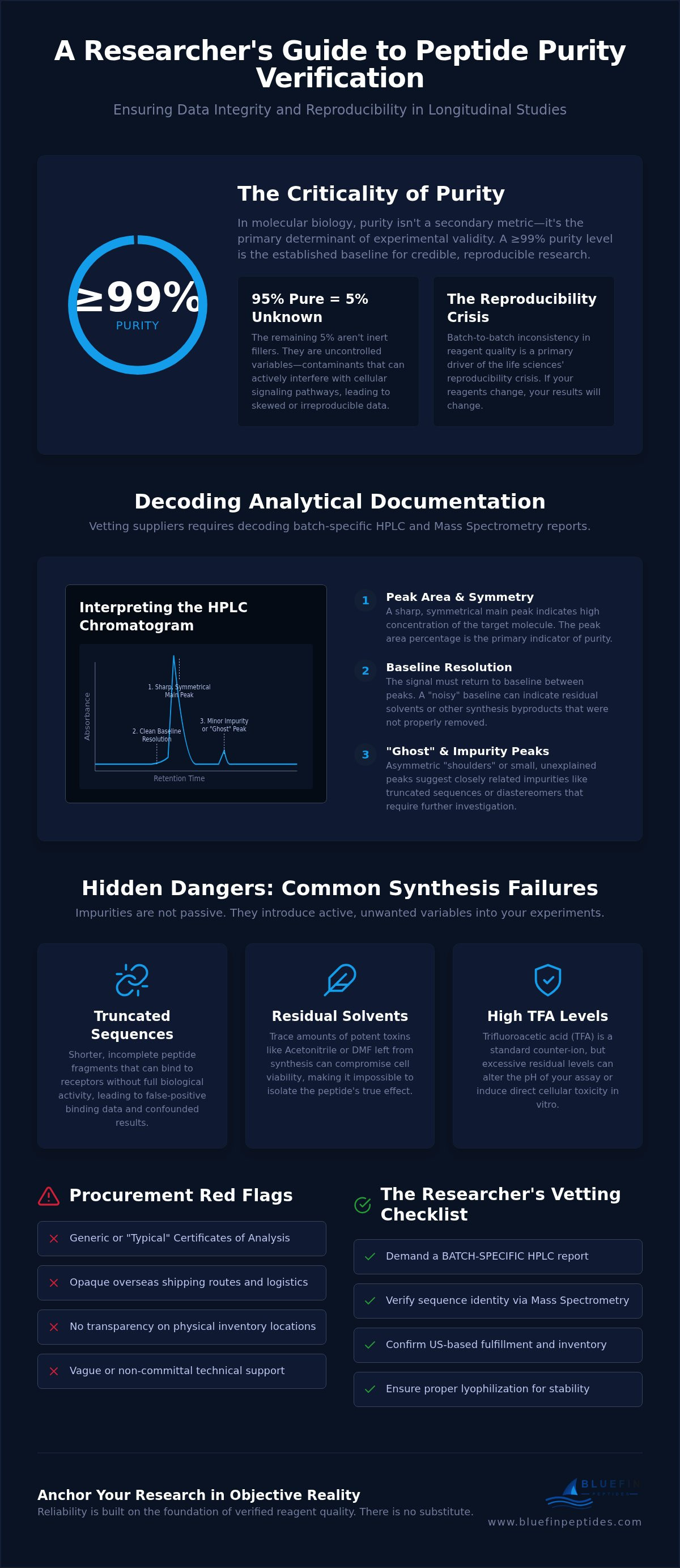
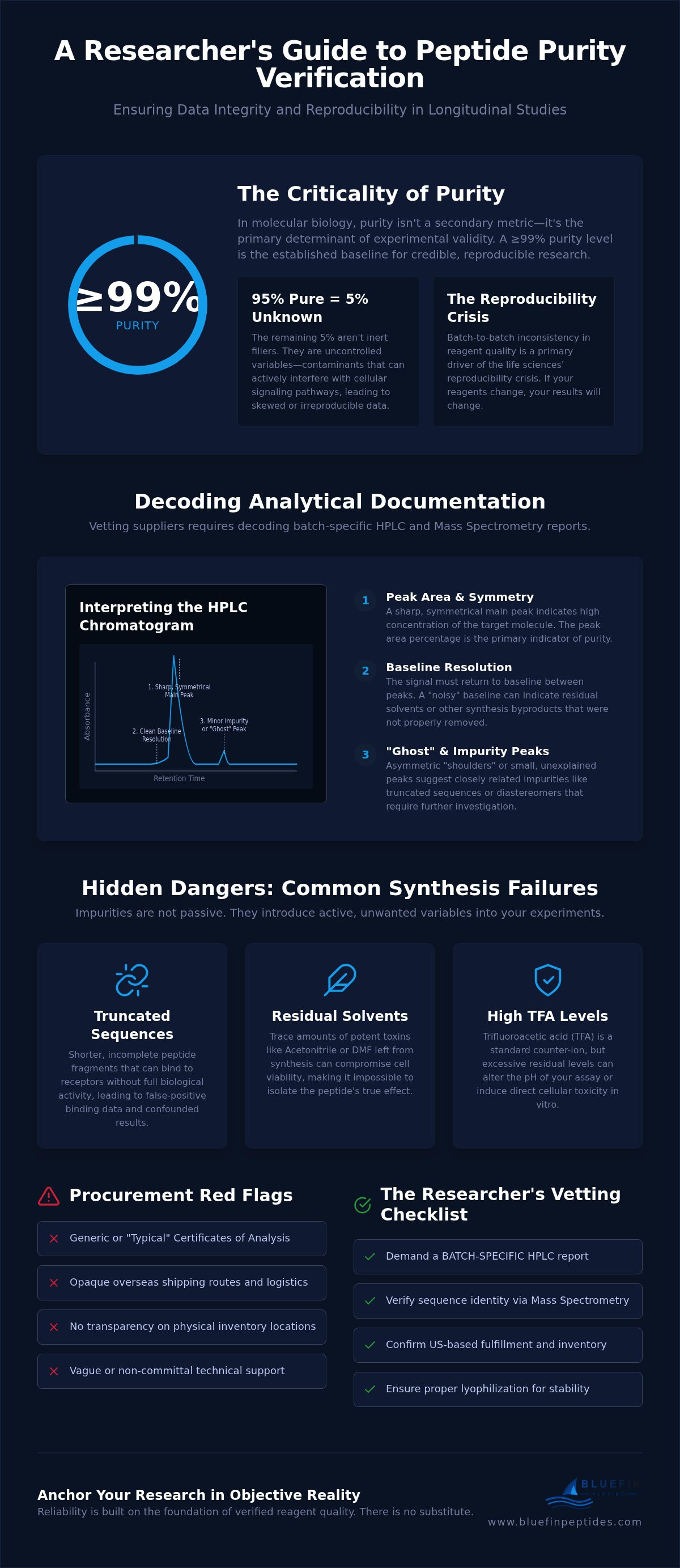
Navigating an HPLC chromatogram requires focus on peak symmetry and baseline resolution. A sharp, symmetrical main peak indicates a high concentration of the target molecule. Conversely, "shoulders" or asymmetric peaks suggest the presence of closely related impurities, such as diastereomers or truncated sequences, that eluted at similar times. Baseline resolution is equally critical. The signal must return to the baseline between the main peak and any minor contaminants. If the baseline is "noisy," it indicates residual solvents or synthesis byproducts that weren't properly removed.
- Peak Area Percentage: This value represents the ratio of the main peak area to the total area of all peaks. It's the primary indicator of purity.
- Ghost Peaks: Unexplained signals often point to column carryover or chemical instability within the batch.
- Baseline Integration: Verify that the software has integrated the entire width of the peak to prevent overestimation of purity.
Mass Spec Verification: Beyond the Purity Percentage
Purity alone doesn't confirm identity. Mass Spectrometry (MS) is the essential second half of the analytical equation, used to confirm the molecular weight and sequence identity of the peptide. By comparing the observed mass-to-charge (m/z) ratio against theoretical values, you can verify that the synthesized chain matches the intended design. If the observed mass deviates by more than a few Daltons, the batch is compromised. This often happens due to incorrect amino acid coupling or incomplete deprotection during the synthesis process.
Secondary ion peaks in the MS report can reveal hidden degradation products. These peaks represent fragments of the peptide that have broken off or failed to form. High-quality reagents will show a clean spectrum with a single dominant peak corresponding to the target mass. For researchers who demand this level of analytical resolution, batch-specific mass spectrometry is a non-negotiable requirement for every procurement. This depth of data ensures your experimental model is built on a stable chemical foundation.
Red Flags in Research Chemical Procurement
Identification of systematic failures requires an analytical eye. A "Generic COA" is the most common indicator of a supplier that prioritizes turnover over technical accuracy. These documents are often reused across multiple lots. This practice effectively severs the link between the analytical data and the physical product. Vetting peptide suppliers for purity must involve a demand for unique, lot-specific identifiers. If a supplier cannot provide a clear data trail, the chemical integrity of the batch is compromised. Trust is not a variable; it's a result of verification.
The Risk of Overseas Fulfillment and Cold Chain Failures
International dropshipping introduces a logistical fog that compromises research outcomes. Transit temperature fluctuations are particularly damaging to sensitive GLP-1 research peptides. These molecules require precise thermal management to maintain bioactivity. Overseas shipping routes often involve multiple handoffs and extended customs delays. This exposure to thermal stress can induce peptide degradation even in lyophilized states. US-based inventory acts as a logistical anchor. It ensures rapid fulfillment and minimizes the window for environmental degradation. Reliability is a function of proximity and control.
Inconsistent Documentation and Forged Reports
Digital forgeries are a growing threat to research integrity. Researchers must scrutinize HPLC reports for inconsistent fonts, edited dates, or generic lot numbers. A common red flag is the absence of third-party laboratory verification. "In-house only" testing represents a critical failure in the verification process. It removes the objective distance required for true quality assurance. High-value compounds demand independent confirmation from established analytical facilities. This ensures the sequence identity and purity claims are verifiable and accurate. Transparency is mandatory.
Synthesis costs are dictated by raw materials and labor standards. Pricing that falls significantly below the market average for high-purity synthesis suggests a compromise in purification methodology or the use of crude batches. Traceability is another non-negotiable standard. Physical vials must display batch numbers that correspond exactly to the provided documentation. A failure in lot traceability is a failure in laboratory accountability. Inconsistent labeling suggests an unstable supply chain. Precision in procurement mirrors precision in the laboratory.
The Researcher’s Vetting Checklist for Batch Consistency
Operational reliability in the laboratory is built on a foundation of rigorous procurement. Vetting peptide suppliers for purity isn't a singular event; it's a continuous audit of chemical and logistical data points. To ensure reproducibility, researchers must follow a structured navigational chart before committing resources to a specific lot. This process begins with data acquisition and ends with physical verification at the lab bench. Precision is the only protection against experimental drift.
- Step 1: Request batch-specific HPLC and MS reports. Generic documentation is a signal of instability.
- Step 2: Verify the supplier’s physical inventory location. A US-based inventory reduces the risk of thermal degradation during international transit.
- Step 3: Cross-reference lot numbers on the physical vial with the provided COA. Lot traceability is the only defense against batch mix-ups.
- Step 4: Audit the supplier’s commitment to research peptide quality standards to ensure alignment with 2026 analytical thresholds.
- Step 5: Perform a secondary in-lab check for solubility and reconstitution clarity.
Establishing a Lot Traceability Protocol
Traceability is the anchor of institutional memory. Implementing an internal database for batch-specific performance tracking allows researchers to correlate experimental variances with specific reagent lots. Archive every Certificate of Analysis (COA) to facilitate future laboratory audits or peer-review inquiries. When analytical discrepancies arise, clear documentation is the only tool for effective communication with a supplier. Demand an immediate technical explanation for any variance in retention time or mass-to-charge ratio. Vetting peptide suppliers for purity requires a "show, don't tell" philosophy regarding data.
Reconstitution as a Quality Indicator
The physical behavior of a peptide during reconstitution provides immediate feedback on synthesis and lyophilization quality. Observing the clarity of tirzepatide research peptide upon the addition of a diluent is a critical field test. High-purity reagents should result in a clear, colorless solution within seconds. The presence of particulates, cloudiness, or persistent "floaters" indicates poor lyophilization or the presence of insoluble synthesis byproducts. These markers signal a compromise in chemical integrity that could skew your cellular signaling assays.
Secure your research by partnering with a supplier that treats analytical transparency as a baseline requirement. For batch-specific COAs and US-stocked reagents, source your research peptides from Bluefin Peptides today.
Bluefin Peptides: Precision-Engineered for Laboratory Integrity
Bluefin Peptides operates as a high-performance laboratory partner. We recognize that vetting peptide suppliers for purity is a technical necessity, not a procurement formality. Our operations are built on a baseline standard of ≥99% HPLC-verified purity. This rigorous benchmark ensures that every vial supports the reproducibility of your experimental models. By prioritizing chemical fidelity over retail volume, we provide the stability required for sensitive biochemical assays. Our focus remains exclusively on providing reagents for laboratory research use, ensuring that every batch meets the stringent requirements of the 2026 analytical landscape. Precision is our only standard.
US-Based Logistics and Fulfillment Speed
Domestic inventory serves as the anchor of our logistical strategy. International shipping routes introduce variables that threaten peptide stability, including extended customs delays and unmonitored thermal fluctuations. Bluefin eliminates these uncertainties by maintaining a robust US-based inventory for rapid distribution. This maritime advantage allows for high-precision fulfillment that protects the chemical integrity of the lyophilized state from departure to delivery. Efficient domestic processing is essential for time-sensitive laboratory protocols where reagent delay can compromise months of longitudinal data. We treat speed as a component of precision, ensuring your research timeline remains uninterrupted by logistical failures.
The Bluefin Standard of Analytical Transparency
Transparency is our primary mode of operation. We adhere to a "show, don't tell" philosophy regarding quality. Every order includes batch-specific COAs that provide the raw data researchers need to anchor their findings in objective reality. We don't rely on generic reports or outdated documentation. Our mass spectrometry and HPLC data are linked directly to the specific lot in your possession, confirming both sequence identity and purity levels. This level of detail supports academic and biotech innovation by removing the guesswork from reagent procurement. Reliability is a result of verified data.
Our catalog is curated for high-stakes research needs. It features high-demand analogs and established research blends, including:
- Retatrutide Research Peptide
- Tirzepatide Research Peptide
- BPC-157 / TB-500 Research Blend
- KPV / GHK-Cu / BPC-157 / TB-500 Research Blend
Navigate our catalog of HPLC-verified research peptides for your next study. Secure the analytical foundation your laboratory requires through reagents that are built for reproducibility and domestic reliability.
Anchoring Research Integrity through Analytical Rigor
Scientific progress requires a stable chemical foundation. Purity isn't a static claim; it is a verifiable data trail that dictates the validity of your cellular signaling models. By mastering the interpretation of HPLC chromatograms and Mass Spectrometry reports, you eliminate the uncontrolled variables that lead to the reproducibility crisis. Vetting peptide suppliers for purity is a technical obligation that ensures your laboratory resources yield peer-reviewable results rather than anomalous data points. Success in the field begins with discipline in the procurement process.
Reliability is a result of rigorous, data-driven procurement. At Bluefin Peptides, we act as your high-performance laboratory partner. We provide the tools for verification through ≥99% HPLC-verified purity and batch-specific Mass-Spec confirmation for every lot. Our US-based inventory ensures rapid fulfillment and maintains the cold chain integrity your research demands. Secure your laboratory data with HPLC-verified peptides from Bluefin today. Precision in the vial ensures precision on the bench. Your commitment to these analytical standards will define the success of your next longitudinal study.
Frequently Asked Questions
What does "≥99% purity" actually mean for a research peptide?
It means that 99% of the UV absorbance is attributed to the target peptide sequence, while the remaining 1% consists of synthesis byproducts or residual solvents. In laboratory models, this threshold is the baseline for ensuring that observed biological effects aren't skewed by unknown chemical entities. Bluefin Peptides maintains this as a non-negotiable standard for all offerings, including Retatrutide and Tirzepatide, to ensure that your experimental variables remain strictly and accurately controlled.
How can I verify if an HPLC report is authentic and batch-specific?
Cross-reference the lot number on the physical vial with the header of the HPLC report. Authentic reports must display a unique injection date and a clear integration table that matches the visual chromatogram peaks. Vetting peptide suppliers for purity requires scrutinizing these documents for inconsistent fonts or digital artifacts that suggest forgery. A batch-specific report serves as a unique chemical fingerprint, acting as the navigational chart for the specific reagent in your possession.
Why is mass spectrometry necessary if I already have an HPLC report?
HPLC measures quantity and purity, while mass spectrometry confirms sequence identity by measuring molecular weight. It's possible for an impurity to co-elute with the target peptide, showing a single peak on an HPLC chromatogram while being a completely different molecule. Mass spectrometry provides the mass-to-charge (m/z) ratio, ensuring the synthesized chain matches the theoretical design. Sequence identity is the only way to anchor your laboratory findings in objective reality.
Does the location of the supplier’s inventory affect peptide quality?
Physical proximity directly impacts the stability of the cold chain during fulfillment. International shipping introduces extended exposure to thermal fluctuations and customs delays that can induce peptide degradation. US-based inventory acts as a logistical anchor, allowing for rapid transit and minimizing the window for environmental stress. Bluefin Peptides utilizes domestic fulfillment to ensure that lyophilized stability is maintained from the warehouse to your laboratory bench, reducing the risk of bioactivity loss.
What are the common impurities found in low-quality research peptides?
Common contaminants include truncated sequences, deletion sequences, and residual organic solvents like acetonitrile or TFA. Truncated sequences occur when amino acid coupling fails, resulting in shorter fragments that may still bind to receptors and produce false-positive binding data. Residual solvents can induce direct cellular toxicity in vitro, effectively ruining the experimental model. Identifying these synthesis failures is a critical component of vetting peptide suppliers for purity before finalizing any procurement agreement.
Is it necessary to perform in-house testing on every batch I purchase?
While third-party verification is the gold standard, a reliable supplier should provide batch-level data that removes the need for redundant testing. If a vendor provides transparent, lot-specific HPLC and Mass-Spec reports, you can anchor your research on that verified data. However, performing a secondary in-lab check for reconstitution clarity and solubility is a prudent field test to confirm that the lyophilized powder hasn't degraded during transit or storage before you begin your study.
How should I store lyophilized peptides to maintain their verified purity?
Lyophilized peptides should be stored in a desiccated environment at -20°C for short-term use or -80°C for long-term preservation. Moisture is the primary driver of peptide hydrolysis, so vials must remain sealed until they reach room temperature to prevent condensation. Proper thermal management locks in the chemical integrity established during synthesis. Avoid repeated freeze-thaw cycles after reconstitution, as this mechanical stress can fracture the peptide chains and compromise the validity of your results.
What is the difference between research-grade and GMP-grade peptides?
The primary difference lies in the regulatory documentation and manufacturing environment rather than the chemical purity itself. GMP-grade peptides are produced under Good Manufacturing Practices for clinical applications, involving exhaustive environmental controls and multi-step validation. Research-grade peptides are intended exclusively for laboratory use. While they often meet the same ≥99% purity standards, they lack the specific regulatory certifications required for human or veterinary administration, focusing instead on providing analytical precision for experimental models.
For laboratory research use only. Not for human or veterinary use. This content is educational and does not constitute medical, dosing, or usage guidance.
Browse the BLUEFIN catalog