Signs of a Fraudulent Peptide Supplier: A Researcher’s Checklist

What separates a fraudulent peptide supplier from one whose claims are simply difficult to verify? The signs of a fraudulent peptide supplier rarely come down to a polished product page or a single purity figure. More useful evidence includes batch-level records, consistent product and business information, and clear research-use boundaries. A missing document is a reason to pause, not conclusive proof of fraud.
Researchers need evidence they can examine, not marketing language they must take on trust. This checklist explains what HPLC purity data and mass-spectrometry results can establish, why a batch-specific Certificate of Analysis (COA) matters, and where those records have limits. Bluefin Peptides provides HPLC verification, mass-spectrometry confirmation, and batch COAs for its research-grade peptides, which are intended exclusively for qualified laboratory research. You’ll also learn how to assess supplier and shipping information, spot unsupported claims, and weigh concerns without treating any single signal as a verdict. The goal is a consistent, evidence-led review before a research purchase.
Key Takeaways
- Assess the signs of a fraudulent peptide supplier as reasons for closer review, not standalone proof of fraud.
- Separate what HPLC purity data can indicate from what mass spectrometry can support about compound identity.
- Check whether the COA, batch identifier, and product description refer to the same material, and note any gaps.
- Use a repeatable procurement workflow and keep the product listing, COA, and batch details together in your records.
- Bluefin Peptides’ research-use peptides are at least 99% HPLC-verified, with mass-spectrometry confirmation and batch COAs.
Signs of a Fraudulent Peptide Supplier: Red Flags to Check First
Warning signs justify closer scrutiny, but none, by itself, proves that a supplier has committed fraud. Treat the signs of a fraudulent peptide supplier as a risk-assessment checklist. An isolated gap carries less weight than a direct contradiction between a product listing and its batch records.
Which supplier behaviors should trigger closer scrutiny?
Start with identity and traceability. Missing batch records, contact details that do not align with the stated business, or an unclear company identity make claims harder to assess. Pressure to buy immediately and unsupported promises of exceptional quality also warrant caution because they discourage a methodical review.
Compare the product page, order information, and analytical documents. A compound name that changes between pages, a stated quantity that differs between the listing and COA, or research-use boundaries that shift across the site create uncertainty about what is being offered. A COA naming a different batch from the product listing is a direct contradiction that needs resolution. A broken link or generic page is a weaker clue, not proof on its own.
Research procurement also depends on reliable records and data practices. Good Laboratory Practice (GLP) describes principles for the organization and conduct of nonclinical studies. It is distinct from evidence that a particular peptide batch has been analytically characterized, so assess those questions separately.
Why a polished website is not proof of product quality
Professional design, testimonials, and a smooth checkout can show attention to presentation, but they do not establish compound identity, purity, or batch traceability. Logos and badges need context: identify the organization behind them, what the claim applies to, and whether it can be substantiated. Broad purity statements are also limited without analytical results tied to the material under review.
A polished website can shape confidence, but only traceable analytical evidence can help authenticate a specific peptide batch.
Separate presentation from evidence. Check whether the documentation identifies the material and batch, whether the stated method fits the claim, and whether the product description is consistent across records. A quality claim that cannot be connected to a specific lot remains an assertion, not batch-level verification. Record unresolved gaps rather than filling them with assumptions, and do not label a supplier based on one weak signal.
How to Assess a Peptide Supplier’s COA, HPLC, and Mass-Spec Evidence
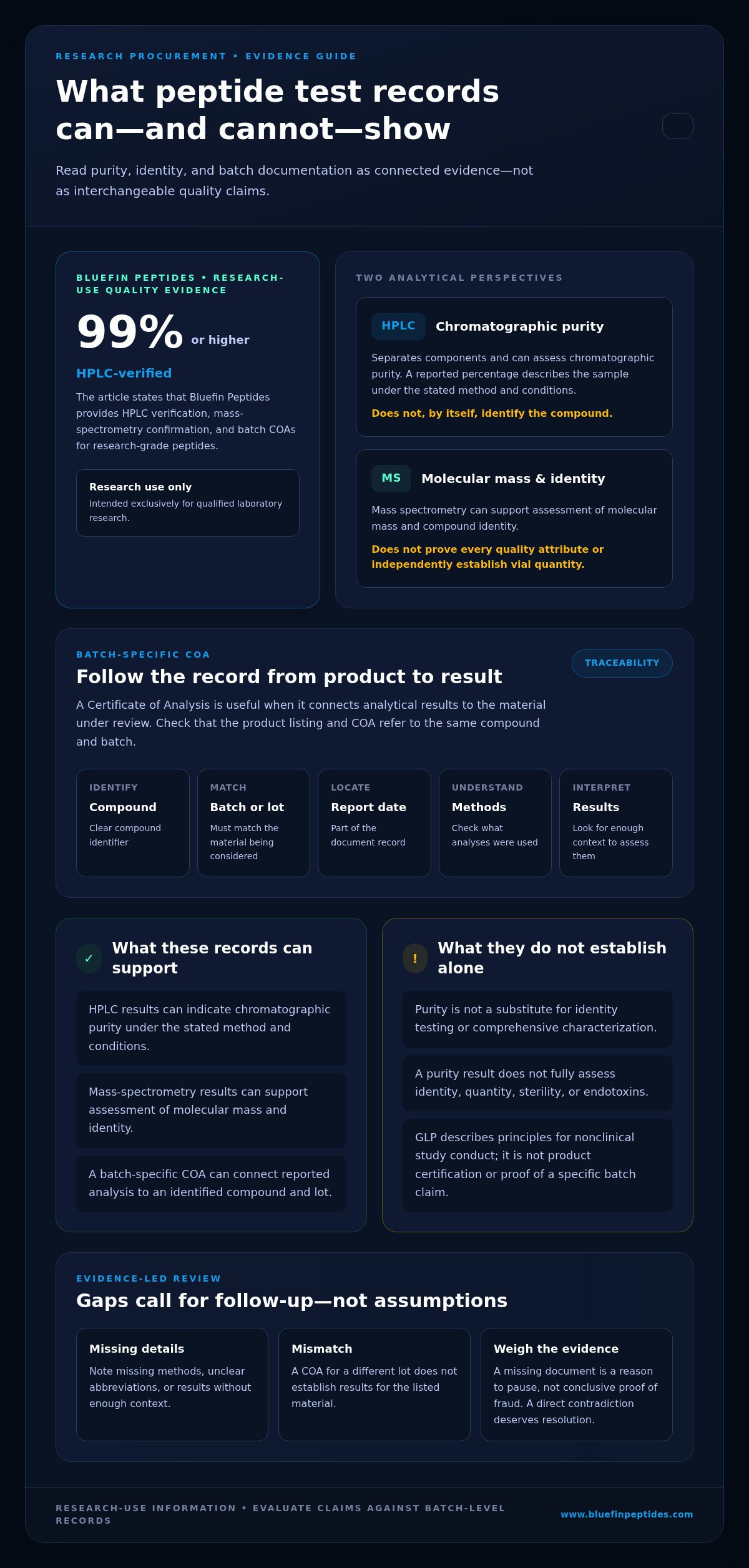
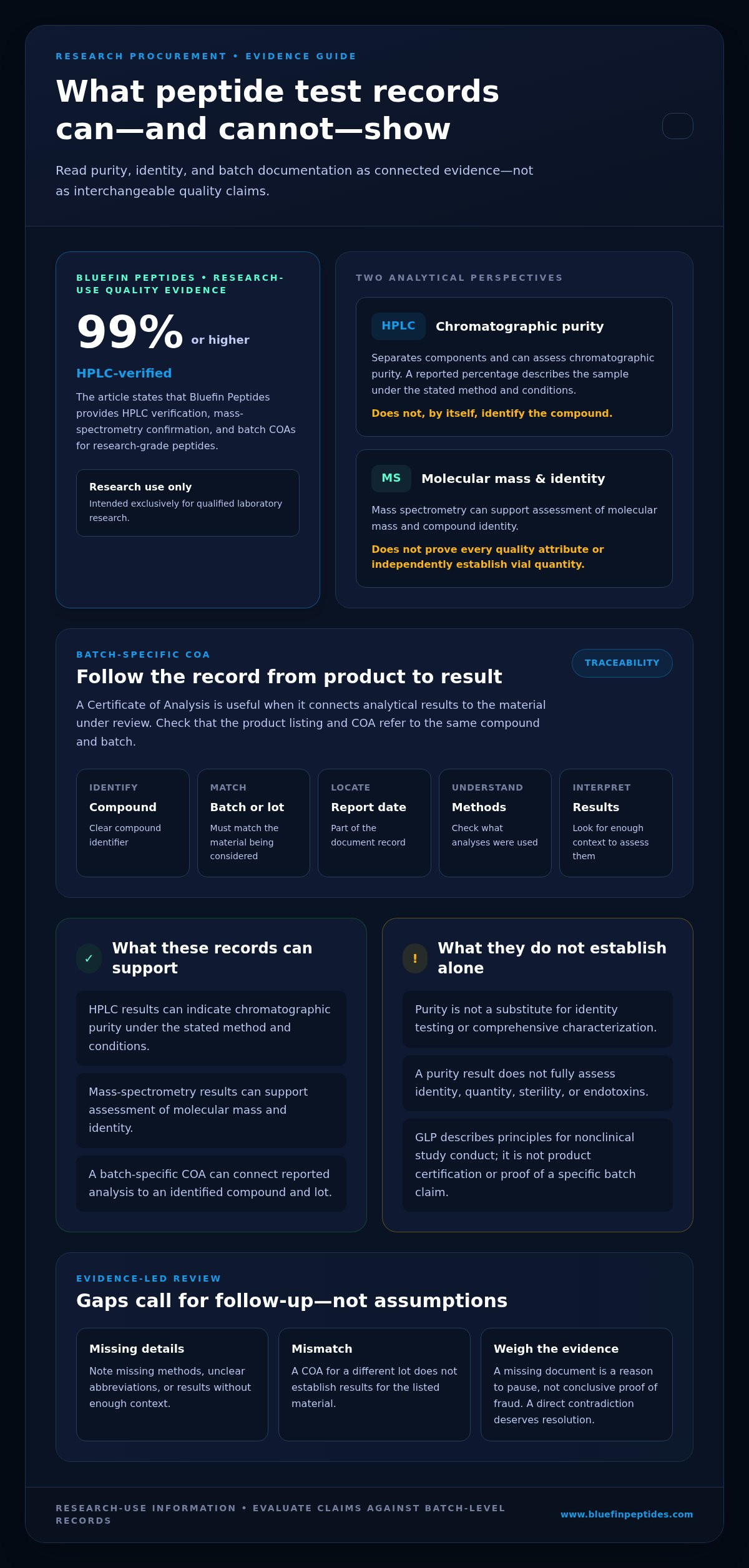
A Certificate of Analysis (COA) is useful only when it can be connected to the material under review. A batch-specific COA identifies the compound and its batch or lot, then reports analytical results for that material. Treat it as a traceability record, not a general quality certificate that automatically applies to every batch.
What should a traceable, batch-specific COA show?
Start by matching the document to the product listing. Look for a clear compound identifier, batch or lot reference, report date, analytical methods, and results. The identifiers should match the batch being considered; a COA for a different lot does not establish results for the listed material. Note missing methods, unexplained abbreviations, or results presented without enough context to interpret them.
Then consider what each method can support. HPLC separates components and can be used to assess chromatographic purity. The reported percentage describes the sample under the stated method and conditions; it does not, by itself, identify the compound. For a closer look at chromatograms and reported percentages, see how to interpret HPLC peptide reports.
What purity testing can and cannot establish
Mass spectrometry provides a different analytical perspective. Its results can support assessment of molecular mass and identity, but they do not prove every quality attribute or independently establish the amount of material in a vial. Likewise, a purity result is not a complete assessment of identity, quantity, sterility, or endotoxins. Each claim requires evidence suited to that attribute.
Purity data describe chromatographic composition; they are not a substitute for identity testing or comprehensive product characterization.
Read the COA as a connected record: compound, batch, date, method, and result should form a coherent trail. If a report gives a purity percentage but omits the method or batch identifier, record that limitation rather than treating the number as conclusive. Apply the same scrutiny to mass-spectrometry data: consider whether the result is interpretable and clearly tied to the material in question.
21 CFR Part 58 sets out Good Laboratory Practice requirements for covered nonclinical laboratory studies. It provides context for understanding study-quality systems, but it is not a general product certification or proof that a particular peptide batch meets a specific quality claim.
For additional background, Bluefin Peptides explains mass spectrometry verification in a separate guide. Qualified researchers can also review the analytical documentation provided with research-use peptides in the Bluefin Peptides catalog.
Compare Supplier Claims Against Traceability, Transparency, and Consistency
Evaluate each claim against records that can be checked. Supplier statements generally fall into three groups: specific and verifiable, broad but unsupported, or contradicted by available information. “Batch 123 was analyzed by HPLC” is specific if a matching report is provided. “Premium quality” says little without defined criteria. A product page and COA naming different compounds or batches present a direct inconsistency that deserves resolution. These distinctions make the signs of a fraudulent peptide supplier more useful as a structured risk assessment than as a quick verdict.
| Claim | Evidence to inspect | Limitation |
|---|---|---|
| Batch traceability | Product listing, lot identifier, and analytical document refer to the same material and batch. | A matching identifier supports traceability, but does not alone establish every quality attribute. |
| Analytical testing | COA names the method and presents interpretable results tied to the batch. | Each method answers specific questions; no single result proves all characteristics. |
| Consistent product information | Compound name, stated quantity, and other product details align across pages and records. | Minor wording differences may need clarification; substantive conflicts carry more weight. |
| Research-use language | Product descriptions and purchase materials consistently state laboratory research use. | A disclaimer alone does not substantiate analytical claims or resolve contradictory messaging. |
Separate checkable claims from marketing language
Terms such as “premium,” “pharmaceutical-grade,” or “guaranteed” call for precise, relevant support, not an automatic assumption of misconduct. Check whether the supplier defines the term and provides evidence that matches it. Assess the whole record: one missing detail may reflect incomplete documentation, while repeated gaps alongside conflicting identifiers create a stronger pattern of uncertainty.
Understand what independent testing adds
Supplier-provided results document the supplier’s stated analytical controls. Independent testing means another party analyzed a sample; the result applies to that sample, the methods used, and the reported attributes. It does not automatically characterize every batch or future shipment. Rankings and isolated test results can inform a review, but they are snapshots, not permanent guarantees.
Assess logistics information separately. A clear statement that products are stocked in the United States and shipped after ordering can help evaluate fulfillment transparency. It does not establish identity, purity, or analytical quality. Keep those evidence streams distinct. For additional method context, consult this guide to analytical quality standards for research peptides.
Use This Peptide Supplier Checklist Before Making a Research Procurement Decision
Apply the same review sequence to each potential laboratory purchase. A repeatable process helps qualified researchers distinguish a correctable documentation gap from a material inconsistency, without turning uncertainty into an unsupported accusation.
A five-step evidence review for laboratory buyers
- Identify the compound. Record the exact research compound name shown on the product listing. Note any stated form or other identifier needed to distinguish it from similarly named materials.
- Match the batch. Locate the batch or lot reference on the relevant documentation. Confirm that it corresponds to the material under review, rather than relying on a general report that cannot be tied to a specific lot.
- Review the methods. Check which analytical methods are named and what results are reported. Confirm that the evidence addresses the stated claim, such as chromatographic purity or identity assessment. Do not assume one test establishes every quality attribute.
- Assess consistency. Compare the product listing, COA, and related records for matching compound names, batch identifiers, quantities, and research-use language. Mark discrepancies clearly instead of reconciling them by assumption.
- Record unresolved gaps. Note what is missing, unclear, or contradictory, and route the evidence through your laboratory’s procurement procedures before approval.
Keep the product listing, COA, and batch identifiers together in your internal procurement records. Save the versions reviewed and record the review date, so the basis for a purchasing decision remains traceable if product information changes later.
When a warning sign is not enough to reach a conclusion
Not every irregularity carries the same weight. A typographical error or incomplete field may be a document-quality issue; a missing method limits interpretation. A COA that identifies a different compound or batch from the listing is a substantive contradiction. Record each issue and its potential effect on procurement review. One warning sign is not, by itself, proof of fraud.
If evidence remains unresolved, pause the review and document the reason under your laboratory’s procedures. Keep conclusions proportionate to the records available. This disciplined approach is more useful than making public allegations that the documentation cannot substantiate.
For research-use peptides with analytical documentation to review alongside product information, review Bluefin Peptides’ research catalog.
How Bluefin Peptides Presents Research-Use Quality Evidence
Bluefin Peptides’ research-grade peptides are at least 99% HPLC-verified, with mass-spectrometry confirmation and batch Certificates of Analysis (COAs). These analytical controls give qualified researchers specific evidence to assess. They are not a blanket guarantee of every quality attribute or research outcome.
How Bluefin Peptides stated documentation maps to the checklist
Each evidence type serves a distinct purpose. HPLC can support assessment of chromatographic purity, while mass-spectrometry results provide an analytical basis for assessing molecular mass and identity. A batch COA can be reviewed alongside the corresponding product listing to check whether compound and batch references align and to examine the reported methods and results.
Interpret each document within its stated scope. HPLC purity data do not independently establish identity, and mass-spectrometry confirmation does not establish every other product attribute. These controls are not evidence of sterility, endotoxin status, or suitability beyond the results documented for the material. Apply the same record-matching process described in this checklist, and note any information that remains unclear.
Keep research procurement within the stated use boundaries
Bluefin Peptides supplies research materials for qualified researchers and laboratory use only. Its peptides are not intended for human, veterinary, or consumer use. Product documentation and analytical information should be considered in that research context; they are not personal-use instructions, medical advice, or treatment guidance.
This distinction matters when evaluating the signs of a fraudulent peptide supplier. Clear research-use boundaries are one part of consistent supplier communication, while batch-level analytical records provide a separate basis for assessing specific quality claims. Neither should be treated as a substitute for the other.
For research-product information, review Bluefin Peptides research peptide catalog and evaluate the available details against your laboratory’s procurement requirements.
Make Your Next Research Purchase Evidence-Led
The signs of a fraudulent peptide supplier are most useful as prompts for structured review, not as proof based on one isolated concern. Match the product description to its batch-specific COA, then interpret HPLC purity data and mass-spectrometry results according to what each method can establish. Document unresolved gaps and weigh direct contradictions more heavily than minor omissions.
Bluefin Peptides’ research-grade peptides are at least 99% HPLC-verified, with mass-spectrometry confirmation and batch COAs. Products are stocked in the United States and shipped after ordering. They are intended exclusively for qualified laboratory research, not human, veterinary, or consumer use. Evaluate the available documentation against your lab’s procurement requirements.
Review Bluefin Peptides’ research catalog for research-product information. Use a consistent, evidence-led process to keep procurement decisions clear, careful, and grounded in records.
Frequently Asked Questions
What are the most common signs of a fraudulent peptide supplier?
Common warning signs include missing or generic COAs, unclear business identity, inconsistent product details, and broad purity claims without interpretable analytical records. These signs of a fraudulent peptide supplier warrant scrutiny, but none proves fraud alone. Check whether documents match the listed compound and batch, whether records support the claims, and whether research-use boundaries are clear. Consider the overall evidence pattern and avoid unsupported accusations based on one concern.
Can a peptide supplier’s COA be fake or misleading?
Yes. A COA can be incomplete, altered, generic, or unrelated to the batch being evaluated, so its presence alone does not establish product quality. Compare the compound and batch identifiers with the product listing. Review whether the analytical methods and results are clearly described and interpretable. If information conflicts or appears incomplete, record the discrepancy as unresolved evidence. It calls for careful review, not an automatic conclusion of fraud.
Does an HPLC purity result prove a peptide’s identity?
No. HPLC can provide information about chromatographic purity under the stated method, but a purity percentage alone does not establish molecular identity or every other quality attribute. Mass spectrometry offers complementary evidence that can support molecular-mass or identity assessment, depending on the method and report. Read both results within their stated scope. Neither test proves characteristics it was not designed or reported to assess.
What should a batch-specific peptide COA include?
A useful batch-specific COA should clearly identify the tested compound and batch or lot, state the analytical methods used, and provide results with enough context to interpret them. Check that the identifiers correspond to the product under review and look for a report date or other traceability details. If the document lacks a clear batch link, method information, or relevant results, it offers limited evidence for evaluating that material.
Is a peptide supplier suspicious if it does not publish independent test results?
Not necessarily. The absence of publicly posted independent results is a reason to assess the available documentation carefully, but it does not by itself establish fraud. Distinguish supplier-provided COAs from testing conducted by another party, and consider what each report supports. An independent result applies to the sample tested and the stated methods. It does not guarantee that every batch has the same characteristics.
What does mass spectrometry confirm in peptide testing?
Mass spectrometry measures ion mass-to-charge information that can support molecular-mass assessment and identity analysis, depending on the method and report. The phrase “mass-spec confirmed” does not, by itself, establish purity, concentration, sterility, endotoxin status, or every other specification. Check which result is reported and what it supports, then interpret it alongside other relevant analytical evidence rather than treating it as a complete quality assessment.
Are research peptides from online suppliers intended for human use?
Research-use materials are intended for laboratory research, not personal use, and are not the same as human-grade pharmaceuticals. Bluefin Peptides’ products are exclusively for qualified researchers and laboratory research, not human, veterinary, or consumer use. This article covers supplier documentation and procurement signals only. It does not provide medical advice, dosing guidance, treatment recommendations, or instructions for human use.
For laboratory research use only. Not for human or veterinary use. This content is educational and does not constitute medical, dosing, or usage guidance.
Browse the BLUEFIN catalog