Retatrutide Research: Procurement & Verification Guide

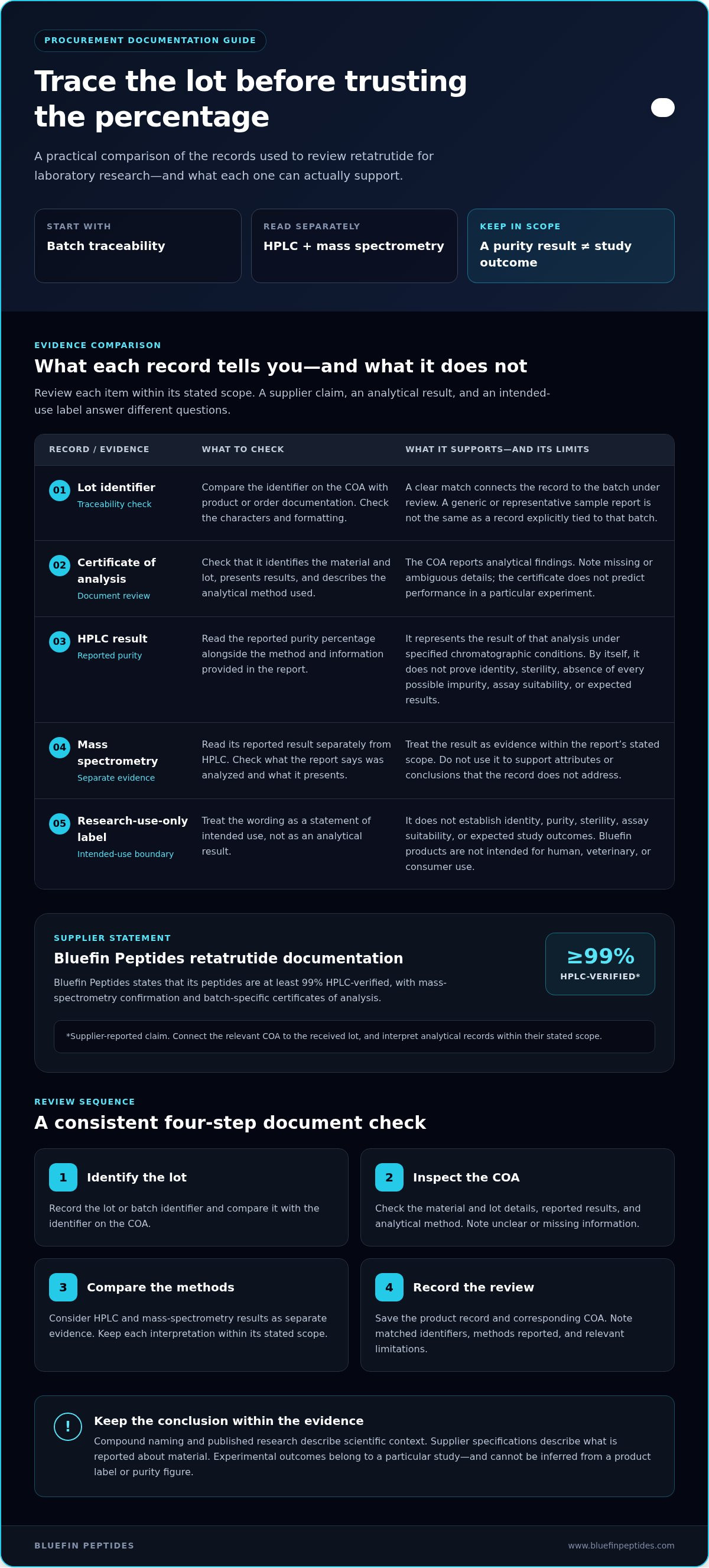
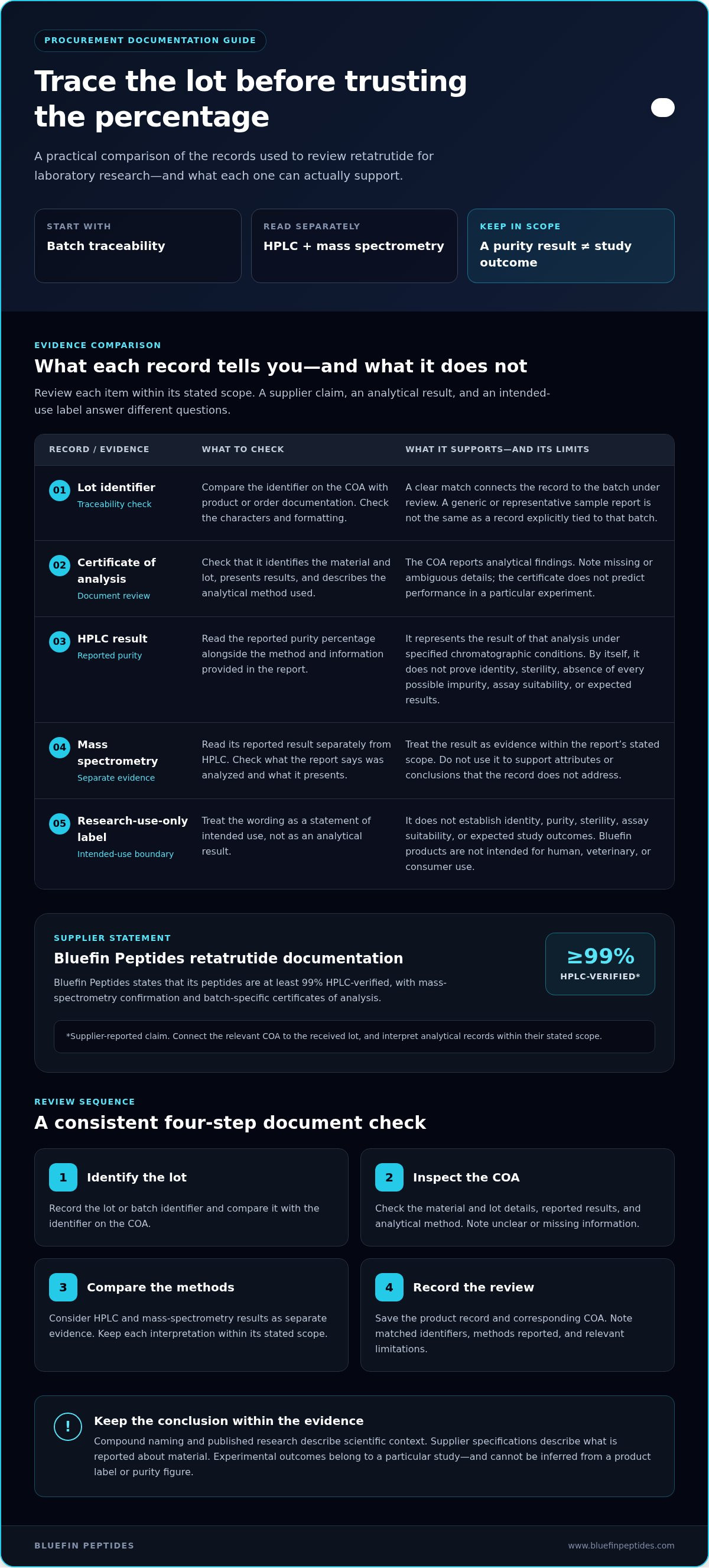
A purity percentage can look decisive, but it does not establish that a certificate belongs to the vial received or predict experimental performance. For retatrutide for laboratory research, start procurement with batch traceability, not a headline purity claim.
Researchers need documentation they can connect to the material in hand. A research-use-only label states an intended-use boundary; it is not evidence by itself of identity, purity, or suitability for a specific experiment. Bluefin Peptides sells retatrutide research peptide exclusively to qualified researchers and states that its peptides are at least 99% HPLC-verified, with mass-spectrometry confirmation and batch-specific certificates of analysis.
This guide offers a practical framework for reviewing those records: match the certificate to the received lot, distinguish what HPLC and mass spectrometry can show, and compare analytical data with broader supplier claims. It also explains why purity results are not experimental outcomes. Bluefin products are not intended for human, veterinary, or consumer use.
Key Takeaways
- Use a consistent review sequence for retatrutide for laboratory research: identify the lot, inspect its certificate, compare analytical methods, and record your assessment.
- Interpret HPLC results within their stated scope. A reported purity measurement does not establish every quality attribute or predict experimental performance.
- Compare suppliers using observable evidence, including lot linkage, reported HPLC data, mass-spectrometry confirmation, and intended-use wording.
- Build a procurement record that connects study requirements, order documentation, and received-lot records without relying on promotional language.
- Review what Bluefin Peptides states about its retatrutide research peptide documentation and keep the research-only boundary clear.
Retatrutide for Laboratory Research: Scope, Identity, and Intended Use
Retatrutide for laboratory research refers to the compound being procured for qualified, controlled laboratory or preclinical investigation, not for personal or clinical use. Keeping that scope explicit helps separate three questions: What compound is named? What does the supplier report about a particular lot? Is the material appropriate for a defined research application? Each question calls for different evidence.
What retatrutide means in a laboratory procurement context
Retatrutide, also identified as LY3437943, is an investigational peptide studied for activity at the GIP, GLP-1, and glucagon receptors. This describes its reported research context, not a supplier’s specific material or its performance in an experiment. The Retatrutide Wikipedia overview provides general background on its mechanism and development. Procurement decisions still require lot-specific documentation.
The name and identifier help researchers establish what compound a supplier says it offers, but they do not confirm the identity of a delivered sample. That assessment requires analytical evidence connected to the material or batch. Likewise, receptor activity reported in scientific research describes a biological research rationale. It does not establish that a purchased lot will produce a particular result or support extrapolating laboratory findings to human outcomes or therapeutic claims.
Keep the evidence categories separate. Compound nomenclature and published research describe the molecule and its scientific context. A product specification describes what a supplier reports about its material. A study result belongs to a particular experimental design and cannot be inferred from a product label or purity figure.
What research-use-only labeling does and does not establish
Research-use-only wording defines the intended-use boundary; it is not an analytical result. The label alone does not establish compound identity, purity, sterility, assay suitability, or expected study outcomes. Those attributes require relevant evidence, and each document should be interpreted within the scope of the method and material it covers.
Bluefin Peptides sells retatrutide research peptide exclusively to qualified researchers. The company states that its peptides are at least 99% HPLC-verified, with mass-spectrometry confirmation and batch-specific certificates of analysis. These supplier-specific documentation claims are distinct from retatrutide’s general identity and research context. To use the records in a procurement review, connect them to the relevant lot.
Boundary. Bluefin products are not intended for human, veterinary, or consumer use. Research-use-only labeling does not change that boundary or make a laboratory product a clinical or consumer product. Treat the wording as a statement of intended use, then assess supporting documents separately and within their stated scope.
How to Assess Retatrutide Research Documentation Before Procurement
A useful document review follows a consistent sequence. First connect the material under consideration to its analytical records, then document what those records do and do not support. For retatrutide for laboratory research, this makes procurement decisions easier to trace and reduces the risk of treating a headline purity claim as a complete quality assessment.
- Identify the lot. Record the lot or batch identifier shown in the product information and compare it with the identifier on the certificate of analysis (COA). A generic sample report without a clear link to the relevant batch provides less traceability than a batch-specific record.
- Inspect the COA. Check that it identifies the material and lot, presents results, and describes the analytical method used. Note missing or ambiguous details rather than assuming a headline claim covers them.
- Compare the reported methods. Read HPLC and mass-spectrometry results as separate evidence. Check what each report says was analyzed and what result it presents. Do not treat either method as evidence for attributes outside its stated scope.
- Record your review. Save the product record and corresponding COA with the procurement file. Note the identifiers matched, methods reported, and any limitations relevant to your assessment.
Match the certificate to the documented batch
Batch linkage is the first traceability check. Compare the identifier on the COA with the identifier in the product or order documentation, checking the characters and formatting. If records refer only to a representative or generic sample, distinguish that from a report explicitly tied to the batch under review. Keep the documents together so the basis for accepting a record remains clear. A COA reports analytical findings; it does not predict performance in a particular experiment.
Read purity and identity evidence as separate questions
HPLC separates components under specified chromatographic conditions. A reported purity percentage represents the result of that analysis as described in the report. On its own, it does not prove identity, sterility, the absence of every possible impurity, or suitability for a particular assay. Interpretation depends on the method and the information provided, so do not extend a percentage beyond what the underlying record supports.
Mass spectrometry provides a complementary analytical signal that can support assessment of molecular identity. It does not automatically establish every structural or quality attribute. Review the HPLC and mass-spectrometry records independently, noting sample identification, method descriptions, and reported results. Do not infer thresholds or conclusions that the documentation does not state.
For more detail on how method and result information informs review, consult the retatrutide analytical specifications guide. Bluefin Peptides states that its retatrutide research peptide is at least 99% HPLC-verified, with mass-spectrometry confirmation and batch-specific COAs. Qualified researchers can review its retatrutide research peptide documentation as part of a lot-based procurement record.
Compare Retatrutide Supplier Claims Using Evidence, Not Marketing
Supplier pages often place analytical details beside persuasive language. Separate the two before comparing options. For retatrutide for laboratory research, record what can be inspected in the documentation, what remains a supplier statement, and what the available evidence cannot establish. A high purity percentage may be relevant, but it is not a complete supplier assessment.
Compare verifiable records before promotional language.
| Comparison field | Evidence to review | What it can support |
|---|---|---|
| Lot linkage | Whether a COA shows an identifier matching the offered material or its product records | Traceability between the report and the stated batch |
| HPLC data | Whether the reported result and chromatographic method are described | A stated chromatographic purity result, within the report’s scope |
| Mass-spectrometry confirmation | Whether the record identifies the analysis and reports a result for the relevant material | Complementary analytical evidence relevant to identity assessment |
| Intended-use wording | Whether product language clearly defines the research-use boundary | Clarity about stated intended use, not analytical quality |
Signals that support transparent research procurement
Useful signals are specific and reviewable: batch-level records, identifiers that connect documents to the material, plainly described analytical methods, and clear intended-use wording. A report that shows what was analyzed and what result was reported is more informative than a broad quality adjective. Accessible, consistent records support a disciplined review, but they do not guarantee a particular outcome or establish suitability for every study.
Claims that need careful interpretation
Terms such as “trusted,” “premium,” or “best” are promotional unless accompanied by evidence that can be evaluated. A purity figure addresses a reported analytical result, not necessarily identity, full composition, or experimental performance. Likewise, “third-party tested” describes a testing arrangement; the phrase alone does not show the method, result, or whether the report corresponds to the material being offered. Review the underlying record rather than treating the label as proof.
Apply the same standard across suppliers. If one page reports a percentage while another provides a method description and a lot-linked report, record them as different levels of documentation rather than ranking them by the size of the number. Mark unreported details as unavailable instead of assuming them. This keeps conclusions proportionate to the evidence and makes the decision easier to revisit when records change.
Bluefin Peptides states that its retatrutide research peptide is at least 99% HPLC-verified, with mass-spectrometry confirmation and batch-specific COAs. Consider these claims within the same evidence framework: match the relevant batch record, review the methods and results, and interpret each claim within its scope. Qualified researchers can explore the retatrutide research peptide offering as part of a traceable procurement review.
A Retatrutide Procurement Workflow for Laboratory Records
A traceable procurement record connects the research need to the material received. For retatrutide for laboratory research, keep the process administrative: define the documentation your institution requires, preserve order and batch identifiers, and record how the delivered material was reconciled with its paperwork. This creates an auditable trail without treating a supplier document as a substitute for institutional review or study oversight.
Before ordering: align procurement records with the study
Start with the qualified research team’s approved study requirements. Document the material identity under consideration and the study-specific criteria relevant to procurement. Then identify the analytical records needed for review, such as a batch-linked COA and reported identity or purity methods. Follow your institution’s purchasing, safety, and recordkeeping procedures, which may differ by organization and research context.
- Review the requirement. Record the study or project reference and the team’s stated material and documentation needs. Do not assume one purchase quantity suits every study.
- Identify the records to retain. Note which product details and analytical documents support the procurement review. Tie the criteria to the intended research context.
- Document the order. Save the order confirmation and record the product name as shown, supplier, order reference, and date. Preserve the product or batch information associated with the order.
- Reconcile the receipt. On arrival, compare the received label information with the order record and associated batch documentation. Record the receipt date and the identifier shown on the material.
- Close the record trail. File the relevant documents together under the laboratory’s established system, linking the order, COA, and receipt entry to the applicable internal study record.
At receipt: preserve batch-level traceability
Use a consistent record entry so another authorized reviewer can follow the chain without reconstructing it from scattered files. Include the product name, lot identifier, COA reference, receipt date, and order reference. If the label and paperwork do not align, or a document is missing, record the discrepancy through the laboratory’s established procurement procedures before treating the file as complete. Do not substitute a generic report for a batch-specific record without noting the difference.
Retain product and COA records with internal study documentation according to institutional procedures and applicable requirements. A clear file shows which material was ordered, what identifying information arrived with it, which analytical record was reviewed, and when receipt was documented. It should not imply that the certificate predicts results or confirms suitability for every research application.
Bluefin Peptides states that its retatrutide research peptide is supplied with batch-specific COAs, HPLC verification, and mass-spectrometry confirmation. Qualified researchers can review Bluefin Peptides’ retatrutide research peptide as part of a procurement process that links product documentation to laboratory records.
Bluefin Peptides Retatrutide: Documentation and Research-Only Next Steps
A procurement decision is strongest when a supplier’s stated documentation can be included in the laboratory’s own review and recordkeeping process. Bluefin Peptides sells retatrutide research peptide to qualified researchers and states that its peptides are at least 99% HPLC-verified, with mass-spectrometry confirmation and batch-specific certificates of analysis (COAs). Assess these specific documentation claims alongside the material’s stated research-only purpose.
Bluefin’s stated documentation and fulfillment
Bluefin’s documentation framework includes three elements: a stated HPLC verification result, mass-spectrometry confirmation, and a COA specific to the batch. For procurement review, consider how each record supports your assessment and preserve the batch reference with the relevant product and order records. Read the reported 99% figure as an HPLC-related claim, not as a guarantee of suitability for a particular assay or of experimental results.
Bluefin Peptides also states that its products are stocked in the United States and shipped quickly after ordering. Record order and receipt dates as they occur, then connect the received material’s identifying information to its associated batch documentation. This keeps the logistics record distinct from analytical claims.
Next steps for qualified research procurement
Qualified researchers can review the retatrutide product information and assess the documentation against institutional purchasing and study requirements. A focused review can capture the product name, lot identifier, COA reference, and reported analytical methods without treating supplier statements as a substitute for the laboratory’s own assessment. Keep the intended-use boundary clear: Bluefin products are exclusively for qualified researchers and are not intended for human, veterinary, or consumer use.
For broader context on interpreting analytical claims across research peptides, the research peptide quality standards guide can help frame document review. Use it as general background, then assess the specific records associated with the material. Clear documentation supports a traceable decision, while the laboratory remains responsible for applying its established procedures and relevant requirements.
Review Bluefin Peptides retatrutide research materials for qualified research use only.
Make Each Procurement Decision Easier to Reproduce
Turn your review criteria into a consistent reference for future purchasing decisions. A shared standard helps research teams assess documentation on the same basis, retain the reasoning behind procurement choices, and update records when new lot information becomes available. That discipline keeps retatrutide for laboratory research decisions grounded in evidence rather than changing marketing language.
Set the next step within your laboratory’s established purchasing process. Qualified researchers can review Bluefin Peptides’ retatrutide research materials and assess the available documentation alongside institutional requirements. The product is intended exclusively for qualified researchers, not for human, veterinary, or consumer use.
Review Bluefin Peptides retatrutide research materials and apply your documentation standards to the next procurement decision.
Frequently Asked Questions
Is research-use-only labeling evidence of peptide purity?
No. Research-use-only labeling identifies the stated audience and use boundary, not analytical findings. In a procurement file, record the label separately from evidence used to assess a specific material, such as its applicable COA and method reports. Bluefin Peptides products are intended exclusively for qualified researchers and are not intended for human, veterinary, or consumer use. Keeping intended use distinct from test results prevents a label from being mistaken for quality verification.
Can a COA predict how retatrutide will perform in a specific assay?
No. A COA reports information about tested material and stated analytical results; it cannot guarantee performance in a particular assay or research model. For retatrutide for laboratory research, treat the certificate as part of the material record, not as evidence of an expected result. Study design, assay conditions, and laboratory procedures shape experimental findings. Keep supplier documentation distinct from study data generated by your research team.
Does an HPLC purity result establish molecular identity?
No. An HPLC purity result and an identity assessment address different analytical questions. A reported purity percentage alone, for example, does not establish that the compound has the identity named on the label. Review the methods and results presented, including any mass-spectrometry evidence, and note the scope of each. Do not use one figure to infer additional attributes or interpret experimental performance.
What should a laboratory do if a vial identifier and its COA do not match?
Pause the documentation review and follow the laboratory’s established procurement and quality procedures before using the material. Preserve the packaging and related records, then document the identifier shown on the vial, the certificate reference, and the order details. Do not assume the COA applies to a vial bearing a different identifier. This creates a clear record for the appropriate institutional reviewer to assess.
Can research-grade retatrutide be used for human or veterinary purposes?
No. Bluefin Peptides products are supplied exclusively for qualified research use and are not intended for human, veterinary, or consumer use. This procurement guide does not provide medical advice, treatment recommendations, or administration instructions. Keep purchasing and use within authorized laboratory research and applicable institutional requirements. A research-use label does not change the stated boundary or make a product appropriate for use outside that context.
How should a laboratory cite retatrutide in internal research records?
Use the compound name consistently and include an applicable identifier, such as LY3437943, when it fits your laboratory’s nomenclature conventions. Link the material entry to its lot identifier and associated supplier documents, then distinguish those records from data produced by the study. For example, a methods file can reference the material record without presenting a supplier’s analytical report as validation of the experiment’s findings.
For laboratory research use only. Not for human or veterinary use. This content is educational and does not constitute medical, dosing, or usage guidance.
Browse the BLUEFIN catalog