Research Materials COA: How to Read and Verify a Batch Certificate
A COA can report a precise purity result and still leave one critical question unanswered: does the document match the batch in your possession? A research materials COA is useful only when you can interpret its identifiers, methods, and results together.
A certificate can help establish what a material is and how pure it appears, but those conclusions depend on the evidence. The lot number must match the product, HPLC data can indicate chromatographic purity, and mass spectrometry can support an identity assessment. No single result establishes every quality attribute. This guide explains what a useful COA should contain, how to confirm it corresponds to a batch, and what analytical findings can and cannot demonstrate. You’ll also learn to interpret HPLC and mass-spectrometry results without overreaching, distinguish a Certificate of Analysis from a Certificate of Conformance, and keep batch documentation organized in laboratory procurement records.
Key Takeaways
- Use a research materials COA to review reported batch testing, not as a universal guarantee of every material property.
- Check the material and batch fields first. Confirm that the document matches the product before interpreting test results.
- Consider the distinct roles of HPLC and mass spectrometry, and review method details before drawing conclusions.
- Use a consistent verification process, from retrieving the certificate to linking it to laboratory records.
- Bluefin Peptides provides batch COAs, ≥99% HPLC verification, and mass-spectrometry confirmation. These results address specific analytical measures, not every quality attribute.
Research Materials COA: What the Certificate Documents
A Certificate of Analysis (COA) records analytical findings for a material or a specific batch. It documents the reported testing, methods, and conditions. On its own, it does not guarantee every property, such as composition, stability, sterility, or suitability for a particular research protocol.
Definition: A batch-specific COA is a record of analytical results linked to an identified material lot. It is not a general claim that a product meets every quality expectation.
A product specification describes target characteristics or acceptance criteria. A test report presents findings from particular analyses. A batch-specific COA connects reported results to the material or lot identified on the document. Formats and terminology vary, so assess the information provided rather than relying on the title alone. This Certificate of Analysis (COA) overview provides additional background on the document’s general purpose.
What information should a research-materials COA contain?
Use this checklist to guide your review:
- Material identifier: A name or description that shows what was tested.
- Batch or lot number: A legible identifier to compare with the product label and accompanying records.
- Testing laboratory: The laboratory responsible for the analysis, when named.
- Methods and results: The analytical techniques used and the corresponding findings.
- Report date: A date showing when the analysis was documented.
Missing information limits what you can conclude. A result without a method is difficult to assess. A report date without a batch identifier does not show which lot the result concerns. Since there is no single layout used by every supplier, focus on whether the essential details are present and interpretable rather than whether the certificate follows a particular template.
Why does batch-specific documentation matter?
The batch identifier links the report to the material under review. Compare it character by character with the vial, label, or procurement record before interpreting the results. A certificate for the same material name but a different lot does not document the specific batch in your possession.
A generic sample certificate may report findings for a representative sample, while a product-page claim may summarize a general specification. Neither necessarily shows that the analysis applies to a particular lot. Matching batch-level documentation supports traceable purchasing and recordkeeping, especially when results need to be associated with a specific material in a study. For more on this practice, see batch-specific COAs in laboratory studies.
How to Read COA Identity, Purity, and Batch Fields
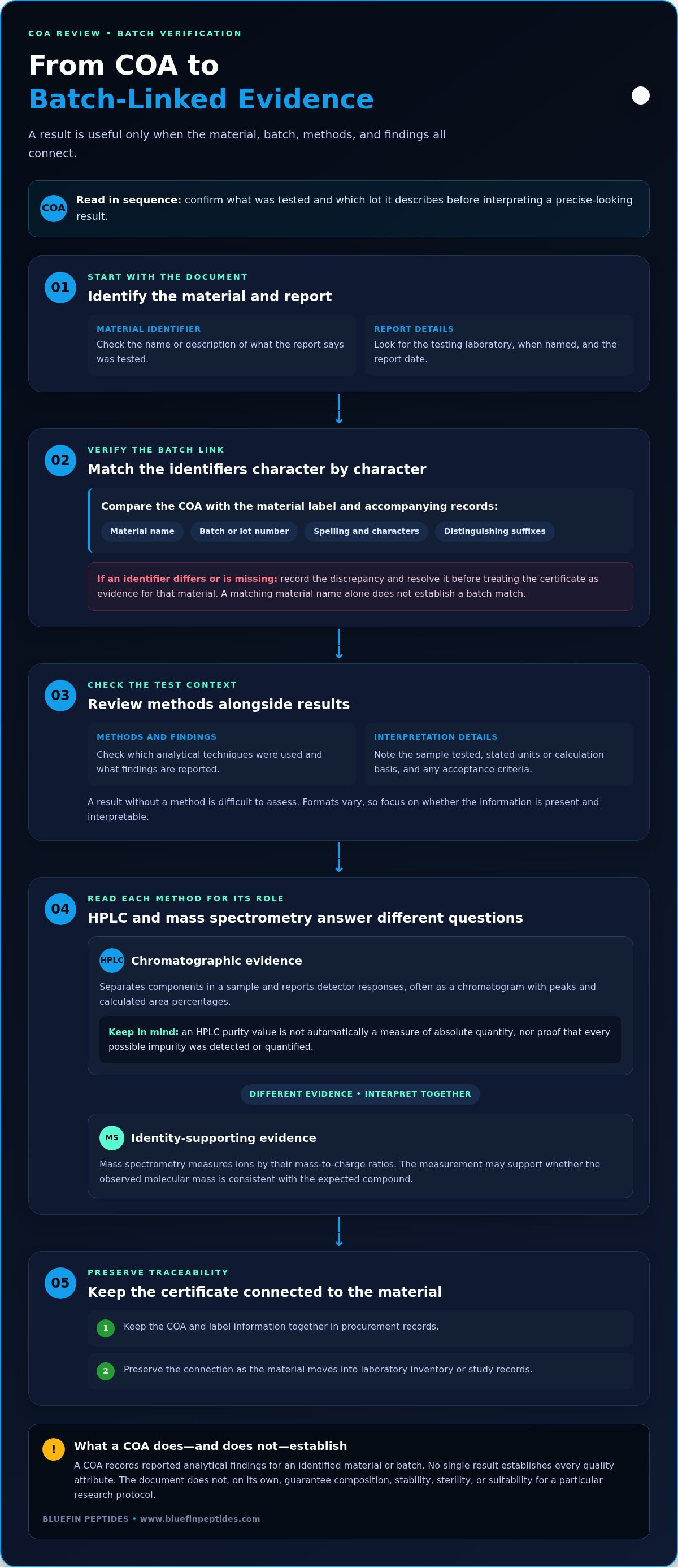
Review a COA in sequence. First identify the material named in the report. Then match its batch identifier to the label on the material. Only after those checks should you assess the methods and results. This order keeps a precise-looking purity value from distracting you from a more basic problem: the report may describe a different material or lot.
How should researchers match a COA to a batch?
Compare the material name and batch or lot number on the COA directly with the product label and accompanying records. Check spelling, characters, and any distinguishing suffixes. If an identifier differs or is missing, record the discrepancy and resolve the mismatch before treating the certificate as evidence for that material. A product-page certificate without the relevant lot identifier cannot establish a batch match.
Keep the COA and label information together in procurement records. This preserves the connection between the physical material and its documentation as it moves into laboratory inventory or study records.
What do purity and result fields mean?
Identity and purity fields answer different questions. A material name identifies what the report says was tested. An identity result, such as a mass-spectrometry measurement, may support whether the observed molecular mass is consistent with the expected compound. An HPLC purity value generally describes the reported chromatographic result, often calculated from detected peak areas under the stated method. It is not automatically a measure of absolute quantity, and it does not show that every possible impurity was detected or quantified.
Interpret each value in context. Note the method, the sample tested, the reported units or calculation basis, and any stated acceptance criteria. An illustrative result such as “98% HPLC area” refers to a chromatographic calculation, not necessarily 98% by mass. Method details affect what the number supports. For additional analytical context, review analytical quality standards for research peptides.
Regulatory scope matters, too. The 21 CFR 211.84 regulations address component controls in pharmaceutical manufacturing, including conditions for relying on supplier testing. Do not assume that framework governs materials designated for research use only.
For qualified researchers reviewing research peptides, Bluefin Peptides’ research materials come with batch COAs, HPLC verification, and mass-spectrometry confirmation. These methods provide specific analytical evidence, not a guarantee of every material attribute.
HPLC and Mass Spectrometry: What COA Results Can Establish
HPLC and mass spectrometry provide different kinds of evidence. HPLC separates components in a sample and reports detector responses, often as a chromatogram with peaks and calculated area percentages. Mass spectrometry measures ions by their mass-to-charge ratios, producing data that can support an identity assessment. The methods complement one another, but neither result alone establishes every characteristic of a sample.
Purity and identity evidence answer different analytical questions: chromatographic results describe detected components under a specified separation method, while mass-related results can support whether an analyzed sample is consistent with an expected identity.
| Method | Typical analytical role | Common reported output |
|---|---|---|
| HPLC | Separates detectable sample components under defined conditions | Chromatogram, retention times, peak areas, or area percentages |
| Mass spectrometry | Measures ions to provide mass-related evidence relevant to identity | Spectrum or measured mass-to-charge data, sometimes interpreted as molecular mass |
What does an HPLC result show on a COA?
In HPLC, components pass through a chromatographic system at different rates and produce peaks when detected. A reported area percentage generally compares the integrated area of a peak with the total area of selected detected peaks. It describes the chromatographic result under that method, not necessarily the sample’s absolute concentration by mass.
Peak-area reporting does not guarantee comprehensive contaminant screening. A substance may not be detected or represented accurately under a particular separation and detection setup. Before comparing HPLC values across documents, review the method details, including the conditions and calculation basis. A percentage without that context is difficult to interpret.
What does mass-spectrometry confirmation add?
Mass spectrometry provides mass-related evidence that can support whether the analyzed sample is consistent with an expected molecular identity. Interpretation depends on the instrument, sample preparation, and reported data. Mass confirmation alone does not prove a complete sequence, purity, sterility, or suitability for any use.
On a research materials COA, read HPLC and mass-spectrometry findings as complementary evidence, not interchangeable tests. The mass spectrometry verification background provides related method context. The analytical principles apply beyond the specific example in that resource.
Documentation also varies by purpose. The USP documentation standards explain how USP reference-standard documentation differs from a typical COA. This distinction is useful in a formal quality system, where document type and intended use matter alongside analytical data.
A Practical Workflow for Verifying Research Materials COAs
A consistent review sequence makes a COA easier to evaluate and its findings easier to trace later. Review the document alongside the material. Match identifiers before judging analytical methods or values, because a technically detailed report cannot resolve a mismatch between the report and the container.
What should researchers check before relying on a report?
- Retrieve the report. Save the COA associated with the material under review rather than relying on a general product-page statement.
- Match identifiers first. Compare the material name and batch or lot number on the COA with the label and procurement record. Check each character, including any suffix or formatting difference.
- Review the report details. Check the named laboratory, report date, analytical methods, and results for completeness and internal consistency. Interpret each value in light of the method and sample described.
- Flag gaps or conflicts. Record missing, illegible, or inconsistent information using the laboratory’s documentation process. Keep the discrepancy visible rather than assuming the fields agree.
Identifier agreement comes first. If the batch number differs or the certificate does not clearly identify the lot, pause the review and document the issue before treating the COA as applicable to that material.
How should COA findings enter laboratory records?
Link the reviewed document to the relevant procurement or sample record so the material and its certificate remain connected. Record the key details consistently:
- Material name and batch or lot identifier
- COA report date and document version, if shown
- Analytical method or methods reviewed
- Review date and any documented discrepancy or qualification
Preserve the exact version assessed, such as a downloaded report or a controlled record reference, according to your laboratory’s procedures. This lets colleagues distinguish the certificate originally reviewed from a later revision and follow the evidence trail without relying on memory. For a closer look at chromatogram interpretation, see how to interpret HPLC peptide purity reports.
A COA supports document review; it does not replace laboratory controls, sample-handling procedures, or checks required by a research protocol. Treat it as one record in a controlled workflow, not as a substitute for the laboratory’s own requirements.
For qualified researchers, review research peptides with batch COAs from Bluefin Peptides.
Bluefin Peptides Research Materials COAs and Batch Verification
The same review principles apply to Bluefin Peptides’ research peptides: connect the documentation to the material and batch, then interpret each analytical claim according to what the method can establish. Bluefin Peptides states that its peptides are ≥99% HPLC-verified, confirmed by mass spectrometry, and accompanied by batch-specific COAs. These are distinct forms of analytical evidence, not a universal guarantee of every quality attribute.
How Bluefin’s stated testing documentation fits the review workflow
Start with the batch COA and the product’s material and lot identifiers. Confirm that they correspond before assessing the reported documentation. A batch-specific record connects analytical information with the material being reviewed; matching identifiers anchors that record to the lot in question.
HPLC verification and mass-spectrometry confirmation have different roles. HPLC provides chromatographic evidence under a stated separation method, while mass spectrometry provides mass-related evidence that can support an identity assessment. Neither result alone establishes every characteristic of a sample. Bluefin’s reported ≥99% HPLC verification relates to that analytical measure; it is not proof of sterility, stability, or the absence of all possible impurities.
For a product-specific example of analytical specifications in context, see Retatrutide analytical specifications and laboratory standards. As with any research materials COA, use the actual batch identifier and report details in your review rather than treating a general statement as a substitute for batch-level documentation.
Research-use scope and next steps
Bluefin Peptides’ products are intended for qualified researchers and laboratory research use only. They are not for human, veterinary, or consumer use. Keep the documentation within the laboratory’s research procurement and recordkeeping processes, and apply the same method-specific interpretation used for any analytical record.
Explore the research-peptide catalog and accompanying documentation at Bluefin Peptides research materials.
Make COA Review Part of Your Research Workflow
A research materials COA is most useful when it matches the exact batch under review and its results are interpreted within the limits of the stated methods. Confirm the material and lot identifiers first. Then assess HPLC findings as chromatographic evidence and mass-spectrometry results as support for an identity assessment. Neither method establishes every quality attribute on its own.
Consistent recordkeeping strengthens the review. Preserve the COA version, batch identifier, methods reviewed, and review date with the relevant procurement or sample record. This creates a clearer trail from documentation to laboratory material and keeps the COA in its proper role: useful evidence, not a replacement for laboratory controls.
For qualified researchers, Bluefin Peptides states that its research peptides are ≥99% HPLC-verified, confirmed by mass spectrometry, and accompanied by batch COAs. These results support method-specific review, not a universal guarantee. Explore the documentation alongside the research-peptide catalog at Bluefin Peptides research materials. A disciplined verification process helps keep records clear and research decisions grounded in evidence.
Frequently Asked Questions
What is a COA for research materials?
A Certificate of Analysis (COA) records analytical findings associated with a material or batch. A useful research materials COA identifies the material and lot, names the testing methods, and reports results with a date. It documents the testing described in the report, not a universal guarantee of every property. Interpret its findings within the stated method and sample scope, and distinguish measured results from general product specifications or quality claims.
How do I match a COA to a research peptide batch?
Compare the material name and batch or lot identifier on the COA with the label on the peptide container and related procurement records. Check every character, including suffixes, rather than relying on a matching product name alone. If identifiers differ, are illegible, or are missing, record the discrepancy and resolve it through your documentation process before treating the report as evidence for that batch.
What should a peptide COA include?
A peptide COA should identify the material, show a legible batch or lot number, state the analytical methods used, report the results, and include a report date. The testing laboratory should also be identified when named. Formats vary, so assess whether the fields are clear and relevant rather than expecting one universal layout. Missing method or batch details can limit what the results establish.
Does an HPLC purity result prove a peptide’s identity?
No. HPLC separates detectable components and can report chromatographic findings, such as peak-area percentages, under specified conditions. Those results address chromatographic purity, not identity by themselves. A high area percentage also does not automatically establish absolute quantity or show that every possible impurity was detected. Review the method details and interpret HPLC findings alongside other relevant analytical evidence, such as mass-spectrometry data.
What does mass spectrometry confirm on a peptide COA?
Mass spectrometry measures ions by their mass-to-charge ratios, providing mass-related evidence that can support an identity assessment for the analyzed sample. Interpretation depends on the method and reported data. Mass-spectrometry confirmation alone does not establish a peptide’s complete sequence, purity, sterility, or suitability for a particular use. Read it as one analytical result, not a substitute for other testing or laboratory controls.
Can a COA guarantee the quality of every vial in a batch?
No. A COA documents reported results for the sample and batch identified in the report, but it does not automatically prove that every vial was individually tested or has identical characteristics. The certificate’s scope depends on the sample and testing described. Use it as part of a broader review, and follow laboratory procedures for receiving, handling, storing, and evaluating research materials.
How often should a research-materials COA be updated?
There is no universal update interval for every research-materials COA. A certificate reports findings tied to a particular sample or batch, so documentation for a new batch should identify that batch. If a report is revised or additional testing is documented, retain the applicable version and note when it was reviewed. Follow your laboratory’s procedures to determine whether existing documentation remains suitable for its records.
For laboratory research use only. Not for human or veterinary use. This content is educational and does not constitute medical, dosing, or usage guidance.
Browse the BLUEFIN catalog