Preventing Peptide Degradation in Storage: A Laboratory Guide
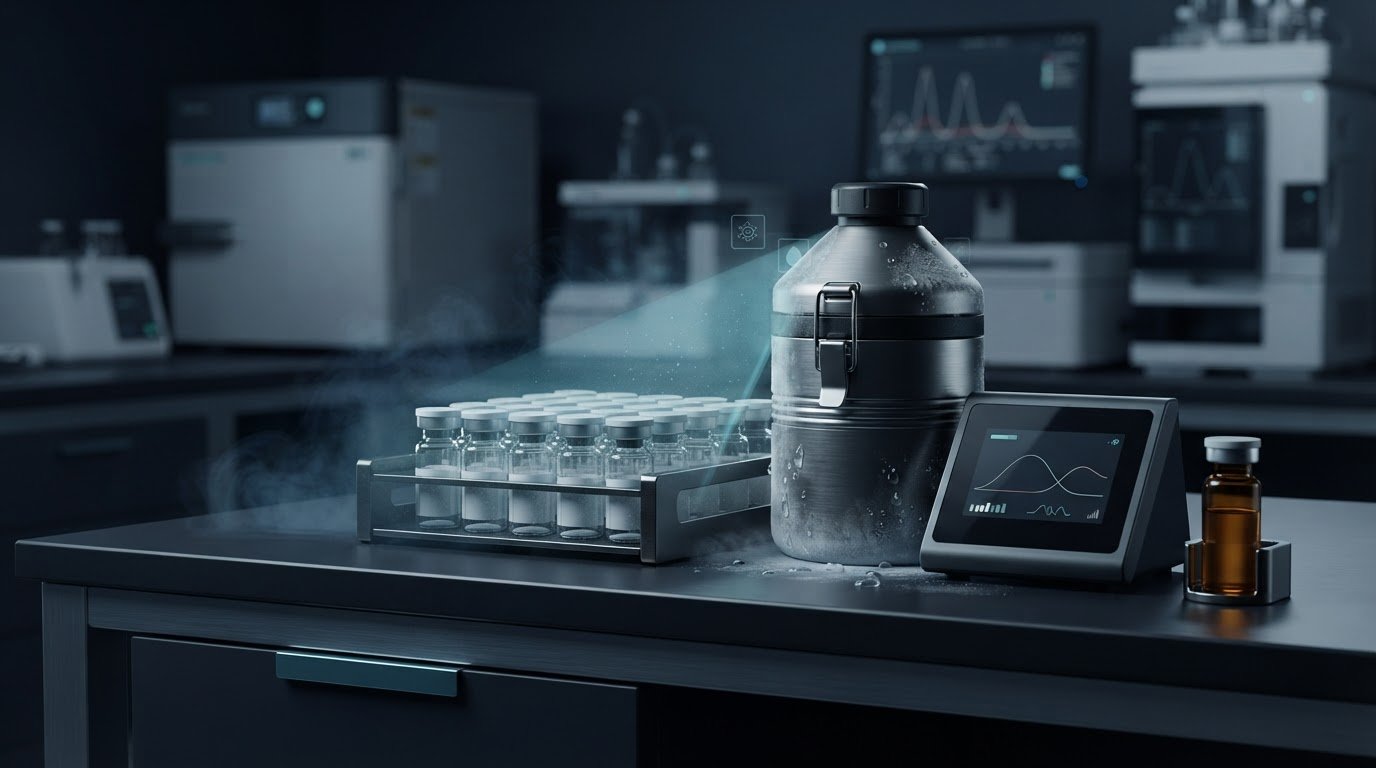
A freezer setting alone does not make a storage protocol reliable. Preventing peptide degradation in storage means controlling several exposures, and the right approach can differ between lyophilized material and a reconstituted solution. Temperature shifts, moisture, light, oxygen, and repeated handling can all affect stability. General rules should not replace evidence for the specific peptide and its formulation.
When a sample’s requirements are unclear, avoid unnecessary handling or temperature changes until you can review the applicable instructions. This guide explains common degradation pathways and storage risks, then outlines a repeatable workflow for labeling, handling, and documenting storage conditions. It also clarifies what batch documentation can establish: an HPLC result or certificate of analysis (COA) provides information about a material at a defined point, but does not by itself establish shelf life. Distinguishing practical storage controls from product-specific stability claims helps keep decisions grounded in evidence.
Key Takeaways
- Preventing peptide degradation in storage starts with recognizing that risk varies by sequence, formulation, physical state, and environment.
- Use product-specific labels and validated stability data to guide storage conditions rather than applying generic thresholds.
- Distinguish lyophilized material from reconstituted solutions. Removing water can slow some degradation pathways, but does not establish indefinite stability.
- Build a traceable workflow that records incoming-material review, storage conditions, and sample access.
- Use batch-specific HPLC and mass-spectrometry documentation to support material review, and stability studies for shelf-life evidence.
What causes peptide degradation during storage?
Peptide degradation is a chemical or physical change that can alter a material’s composition or properties. It may affect identity, purity, solubility, or behavior in a research procedure, but a possible risk is not proof that a sample has changed. Sequence, formulation, physical state, packaging, and environmental exposure all influence the outcome.
In brief: Degradation is a change in the peptide; storage controls limit exposures that may cause or accelerate that change. A recommended condition is not, by itself, evidence of a guaranteed shelf life, and no single storage setting applies universally. Preventing peptide degradation in storage starts with identifying plausible risks and then relying on evidence specific to the material.
Which chemical pathways can alter a peptide?
Depending on the peptide and its surroundings, several reactions may occur during storage:
- Hydrolysis involves bond cleavage through reaction with water. Its likelihood can depend on the sequence, formulation, and conditions of exposure.
- Oxidation can modify susceptible residues through reactions involving oxidizing agents or oxygen-related exposure. Light and other environmental factors may also affect risk, depending on the material.
- Deamidation converts susceptible amide-containing side chains into acidic forms, changing the peptide’s chemical structure. The pathway depends on the sequence and conditions. Deamidation of peptides provides further background on the reaction.
These are possible pathways, not a universal ranking. Without product-specific evidence, you cannot assign a dominant pathway, rate, or timeline. A change in one peptide cannot be assumed to predict the behavior of another, even when their formulations or storage environments appear similar.
How can physical changes affect stored material?
Physical instability can matter alongside chemical reactions. Peptides may associate into aggregates or adsorb onto a vial or other contact surface, potentially changing the amount or form available for a procedure. Moisture exposure can also alter a material’s physical state and create conditions that favor chemical change. The extent of these risks depends on the peptide, formulation, container, and handling conditions.
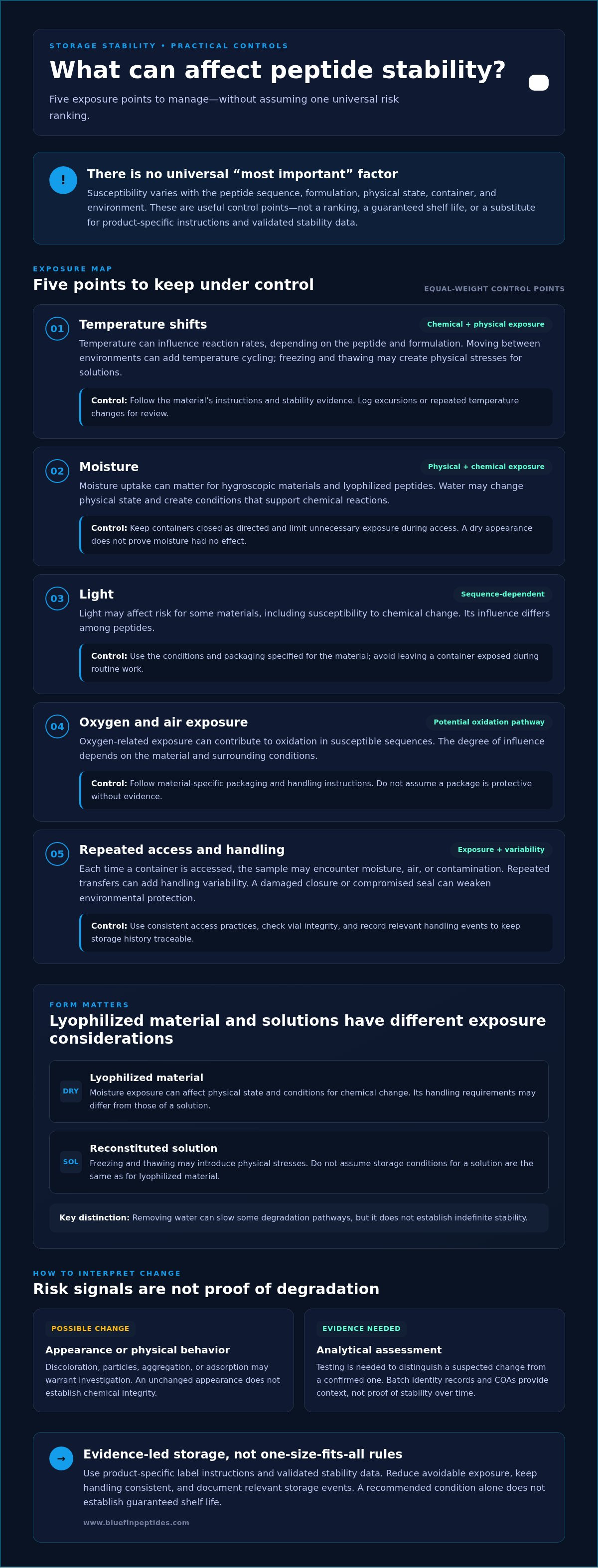
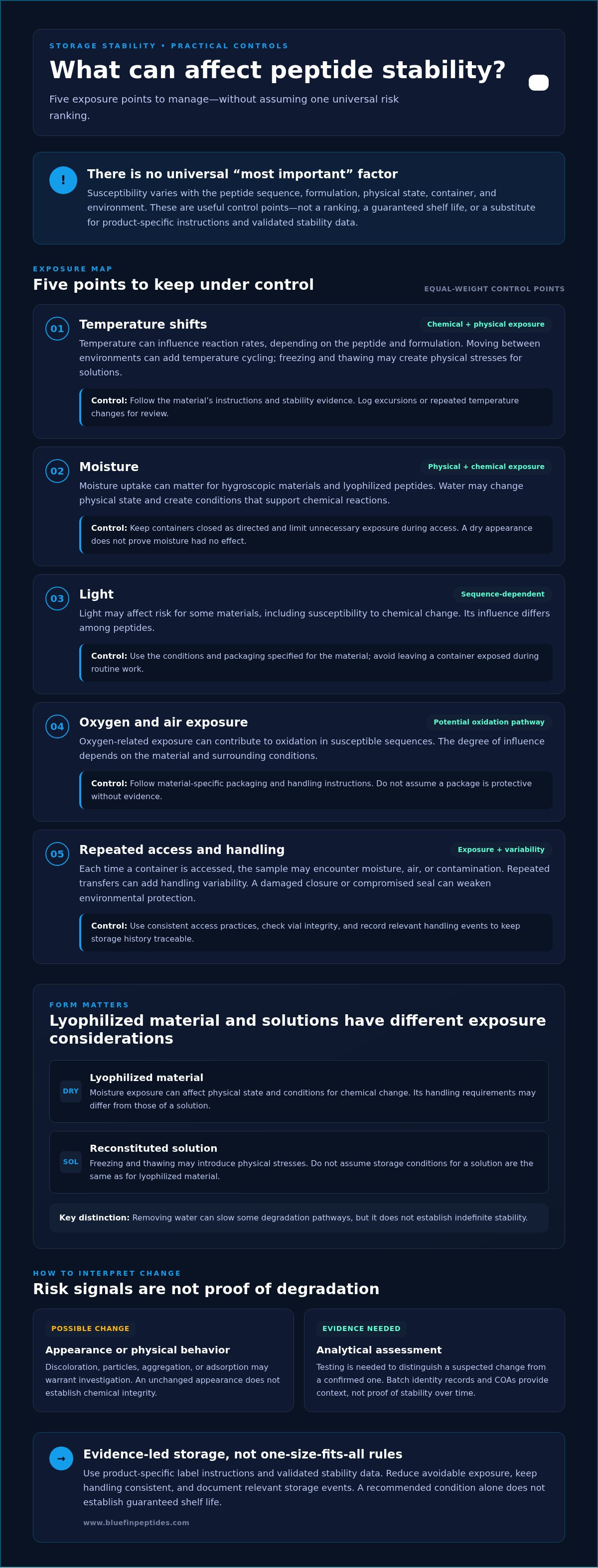
Vial integrity is part of the control system. A damaged closure or compromised seal can weaken protection from the surrounding environment. Each time a container is accessed, the sample may be exposed to moisture, air, or contamination; repeated transfers can add handling variability. Use consistent access practices and record relevant handling events so the storage history remains traceable.
Do not treat a visible change as a complete stability assessment. Discoloration, particles, or altered appearance may warrant investigation, but an unchanged appearance does not establish chemical integrity. Likewise, aggregation or adsorption should be treated as possible risks unless demonstrated for the material. Analytical testing is needed to distinguish a suspected change from a confirmed one. Batch identity records and COAs provide context, not proof of stability over time.
How temperature, moisture, light, and oxygen influence peptide stability
Environmental exposure can affect stability, but susceptibility is peptide-specific. A condition appropriate for one peptide or formulation may not suit another. Sequence, physical state, container, and surrounding environment all shape the risk. Product-specific label instructions and validated stability data take precedence over generic advice. Lyophilized material and a solution also present different exposure considerations, so handling decisions should reflect the form being stored.
Temperature, moisture, light, and oxygen are useful control points, not universal predictors of shelf life. Follow material-specific instructions, reduce avoidable variation, and document relevant exposures rather than assuming one setting protects every sample.
Temperature changes and freeze-thaw exposure
Temperature can influence the rate of chemical reactions, but the effect depends on the peptide and formulation. Moving a sample between environments may also introduce temperature cycling. For solutions, freezing and thawing can cause physical stresses; lyophilized material may have different handling requirements. Do not select a universal storage temperature based on peptide category alone. Follow the applicable product instructions and stability evidence, and log excursions or repeated temperature changes for review.
Moisture exposure
Moisture uptake can matter for hygroscopic materials and lyophilized peptides because water may change the material’s physical state and create conditions that support chemical reactions. Keep containers closed as directed and limit unnecessary exposure during access. A dry appearance does not show that moisture has had no effect. The appropriate controls depend on the formulation, container, and product-specific instructions, including any directions for desiccants or handling after opening.
Light and oxygen exposure
Light and oxygen can contribute to chemical changes in susceptible sequences, including oxidative pathways, but their influence differs among peptides. Keep samples in the conditions and packaging specified for the material, and avoid leaving a container exposed during routine work. Consistent practices are more useful than assuming a particular package is protective. If light or oxygen sensitivity is claimed, look for evidence tied to that peptide and formulation.
For preventing peptide degradation in storage, make exposure control repeatable:
- Record the storage condition specified by the applicable label or stability documentation.
- Minimize unnecessary container opening and handling.
- Log temperature excursions, transfers, and other deviations from routine conditions.
- Keep instructions for lyophilized material separate from those for reconstituted solutions.
These records help distinguish a controlled storage history from an assumption about what a sample experienced. They also give researchers a practical basis for reviewing unexpected analytical results without treating every possible exposure as confirmed degradation.
For qualified laboratory researchers reviewing incoming materials, Bluefin Peptides research peptides are accompanied by batch-specific certificates of analysis. These documents support material review; product-specific stability data remains the basis for storage and shelf-life decisions.
Lyophilized versus reconstituted peptides: what storage decisions differ?
Physical state changes the storage question. A lyophilized peptide is freeze-dried, with much of its water removed. A reconstituted peptide is in solution, where water and other formulation components create a different environment for chemical and physical change. The applicable product documentation must guide handling in each state. Instructions for the original material cannot automatically be applied after it has been dissolved.
The comparison below identifies considerations to review, not universal storage conditions. To prevent peptide degradation in storage, follow product-specific directions and use stability evidence that applies to the material’s current form.
| Physical state | Relevant exposure concerns | Documentation to consult |
|---|---|---|
| Lyophilized, or freeze-dried | Moisture uptake, container or closure integrity, and conditions during storage and access | Applicable label, batch documentation, and stability data for the lyophilized form |
| Reconstituted, or in solution | Solution-specific chemical and physical changes, handling events, and conditions after preparation | Validated instructions and stability evidence for the specific prepared material |
What lyophilization changes, and what it does not
Lyophilization removes water through a freeze-drying process, reducing moisture available for some chemical reactions. That can support stability, but it does not make every peptide indefinitely stable or establish a universal shelf life. Sequence, formulation, packaging, and storage conditions still matter. A compromised seal or repeated exposure during access can also undermine the intended storage environment. Follow the applicable instructions for the specific product and retain its storage history.
Why solution-state storage needs separate evidence
Dissolving a peptide changes its physical environment. Water, solvent composition, concentration, and other formulation details may affect which degradation pathways are relevant, as well as the potential for physical changes. Stability information for the lyophilized material alone does not establish how the resulting solution behaves. Use validated instructions that apply to the specific prepared material, and document when its physical state changed and the conditions that followed.
Before changing a sample’s form, check which records cover that state. A batch COA can support review of material identity and measured attributes at the time of testing, but it is not a substitute for stability evidence over time. Keep these records distinct:
- Identity and batch records: help trace the material received and its documented analytical results.
- Handling instructions: specify conditions applicable to the product and its current form.
- Stability evidence: supports conclusions about how that form behaves under defined conditions and over time.
This separation prevents an assumption from becoming a protocol. Treat every change in physical state as a new handling context, and base decisions on documentation that follows the material through that change.
Build a documented workflow for preventing peptide degradation
A reliable storage process starts before a sample enters a storage unit. Record what arrived, establish which instructions apply, and make access traceable. This creates a consistent record from receipt onward without assuming that one condition fits every peptide or physical state. Set storage conditions from applicable product instructions and stability evidence, not from a general protocol.
At receipt: verify identity and applicable documentation
Before storage, match the material identifier and batch details on the container to the accompanying documentation. Review the label and handling directions, noting whether they apply to the material as received or to a later prepared form. Record the receipt date and package condition. If there is damage, an unclear identifier, or another deviation, document it and follow the laboratory’s established review process before routine storage.
During storage: control access and record handling
Assign a clearly identified location consistent with the applicable instructions. Keep the sample’s identity and batch traceable at its storage location, and limit avoidable handling. Record relevant transfers, temperature excursions, package concerns, and changes in physical state. Aliquot only when an approved laboratory procedure supports it, since additional transfers add handling steps and can complicate traceability.
Use this numbered workflow as a repeatable baseline:
- 1. Receive and identify. Enter the receipt date, material identifier, batch details, and package condition in the laboratory record.
- 2. Review documentation. Locate the applicable label, batch records, and handling instructions. Distinguish information for the material as received from instructions for any prepared form.
- 3. Assign storage. Record the designated location and the product-specific conditions that govern it. Do not substitute a generic setting for documented requirements.
- 4. Control access. Use consistent handling practices and note access or transfer events that could affect the sample’s exposure history.
- 5. Document deviations. Record the date, nature, and known duration of an excursion or package concern, along with the action taken under laboratory procedures.
- 6. Review the record. Check that the sample, batch, location, and handling history remain linked, especially before interpreting later analytical results.
Consistent storage records give later analytical results an exposure history, helping researchers distinguish a measured change from an undocumented handling event. At minimum, record receipt and access dates, storage-location changes, relevant handling events, package observations, and deviations from applicable instructions. Keep entries factual: document what was observed rather than inferring degradation from an exposure alone.
For qualified laboratory research, Bluefin Peptides research peptides can be reviewed alongside their batch-specific documentation as part of incoming-material review.
How analytical documentation supports better storage decisions
Analytical records help establish what was tested and what the results showed at a defined point. They do not, on their own, show how a peptide will behave throughout storage. When preventing peptide degradation in storage, interpret test results alongside the material’s identity, applicable handling instructions, and documented exposure history. Each record answers a different question.
What HPLC, mass spectrometry, and a COA can establish
High-performance liquid chromatography (HPLC) separates components in a sample and can be used to assess chromatographic purity under a specified method. Mass spectrometry measures molecular mass, supporting confirmation that the detected material is consistent with the expected identity. A certificate of analysis (COA) reports defined results for a particular batch. Its meaning depends on the tests performed, the methods used, and when the sample was analyzed.
A COA is a snapshot, not a forecast. It does not guarantee future stability or establish a shelf life unless supported by relevant stability evidence. A longitudinal, product-specific stability study evaluates a material over time under defined conditions. That evidence helps connect storage conditions to changes in measured attributes. Results for one peptide, formulation, or physical state should not automatically be applied to another.
Apply documentation to research procurement and storage
At receipt, compare the container’s material identifier and batch details with the COA and other accompanying records. Confirm that the documents refer to the same material and note which form and test attributes they cover. Then link those records to the laboratory’s storage and access log. If later testing shows a difference, researchers can assess it against the sample’s documented identity and handling history rather than relying on memory.
Bluefin Peptides states that its research peptides are ≥99% HPLC-verified and include mass-spectrometry confirmation and batch-specific COAs. These records support incoming-material review, but should not be interpreted as evidence of a particular shelf life. Distinguish identity and purity results from stability data, and look for evidence that matches the specific peptide, formulation, physical state, and conditions being evaluated.
Analytical quality standards guidance can help readers interpret what a test method reports, while product-specific analytical specifications provide context for reviewing a particular material. Keep the scope of each source clear: analytical specifications describe defined attributes, whereas storage conclusions require applicable stability evidence. Combining documentation with consistent storage records strengthens traceability without overstating what any single test can establish.
For qualified laboratory research, research peptides and batch documentation can be included in a documented procurement and storage workflow. These materials are for qualified research use only.
Make the next storage decision evidence-led
A storage protocol is most useful when it remains reviewable. For each new sample or change in physical state, verify that the relevant instructions, records, and planned handling still align. This keeps decisions about preventing peptide degradation in storage grounded in evidence for the material, rather than assumptions carried over from another peptide or workflow.
Bluefin Peptides’ research peptides are ≥99% HPLC-verified, with mass-spectrometry confirmation and batch-specific certificates of analysis. These records support material review; they do not replace product-specific stability evidence or establish shelf life. Keep that distinction clear when planning procurement and storage.
Review Bluefin Peptides’ research-grade catalog and batch documentation to support your incoming-material review. Products are for qualified research use only. A consistent, evidence-led process helps your laboratory make storage decisions with greater traceability and confidence.
Frequently Asked Questions
Can peptides degrade even when they are lyophilized?
Yes. Lyophilization reduces water content, but it does not make every peptide chemically inert or indefinitely stable. Susceptibility depends on sequence, formulation, packaging, and storage conditions. An intact-looking powder, for example, cannot establish that its chemical profile is unchanged. Follow documentation that applies to the specific material and its storage history. A shelf-life claim requires relevant stability evidence, not an assumption based solely on the peptide’s freeze-dried form.
How can a laboratory tell whether a stored peptide has degraded?
Appearance alone cannot reliably determine whether a peptide has degraded. Use an analytical method suited to the suspected change, such as chromatography to assess a separation profile or mass spectrometry to investigate molecular mass. Compare findings with suitable baseline results and predefined acceptance criteria, using consistent methods where possible. Record the sample’s storage and handling history alongside the analytical result. An initial batch COA can provide context, but cannot show what happened during later storage.
Does freezing prevent peptide degradation?
No. Freezing may be appropriate for some materials, but it does not guarantee that degradation will stop. A sample’s response can depend on its sequence, formulation, packaging, and temperature history. Record a freezer interruption followed by return to storage rather than treating it as irrelevant. Follow the applicable instructions for that material, and do not transfer a condition validated for one peptide to another without supporting evidence.
Can repeated temperature changes affect peptide stability?
They can introduce additional exposure and make the storage history harder to interpret, although the significance depends on the peptide and its physical state. There is no universal allowable number of temperature cycles. If a sample is moved between locations, record when the transfer occurred, the reason, and any known excursion. This context helps researchers assess unexpected analytical findings without assuming a temperature change alone proves degradation.
Is an HPLC purity result proof that a peptide will remain stable in storage?
No. An HPLC result describes the sample under the test conditions at the time of analysis. It does not establish future stability. A stability claim needs relevant measurements collected over time under defined conditions, with results interpreted against suitable criteria. Review the report’s test date, method, and stated scope before using it to inform storage decisions. Preventing peptide degradation in storage requires evidence for the material and conditions being considered, not just an initial purity result.
What should a laboratory record when storing research peptides?
Record enough detail to reconstruct the sample’s path through the laboratory: material and batch identifiers, receipt date, storage location, applicable instructions, and dates of access or transfer. Also note who handled the sample, its package condition, and any observed deviation. A location change without a date, for example, can leave a gap in the exposure history. Follow institutional procedures and keep records linked to the corresponding analytical results.
Can storage guidance for one peptide be applied to another?
Not automatically. Two peptides may differ in sequence, formulation, physical state, packaging, or available stability evidence, so one material’s documented conditions do not establish another’s requirements. Treat each product’s applicable instructions as specific to that material. If a laboratory is considering an unaddressed condition, record it as an unvalidated choice rather than presenting it as established guidance. This distinction helps keep protocols and later interpretations evidence-based.
For laboratory research use only. Not for human or veterinary use. This content is educational and does not constitute medical, dosing, or usage guidance.
Browse the BLUEFIN catalog