Peptide Reconstitution Best Practices in 2026: A Research Laboratory Guide
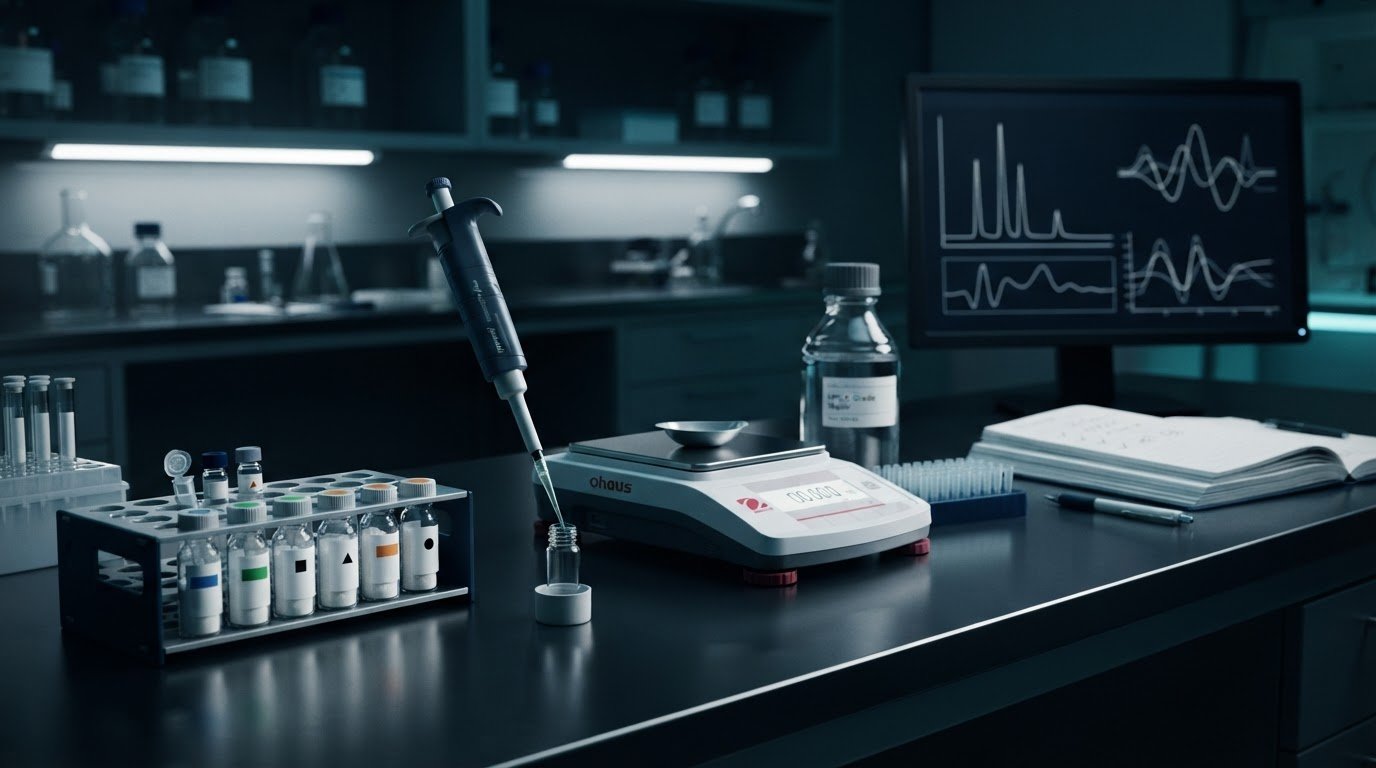
A universal reconstitution recipe can introduce more uncertainty than it removes. This peptide reconstitution best practices 2026 guide starts with a more reliable principle: base decisions on the specific compound, study design, and validated laboratory procedure, not generic online directions.
Solvent selection, handling controls, and storage conditions can vary. Incomplete records can also make it difficult to trace a sample from its incoming vial to experimental use. A consistent, documented workflow helps researchers evaluate these decisions and identify when an approved SOP or qualified laboratory review is needed.
This guide covers what to consider before, during, and after reconstitution, including product-specific procedure review, contamination controls, stability considerations, and recordkeeping. It also explains how batch documentation supports incoming-material traceability. Bluefin Peptides provides research-use-only materials with batch certificates of analysis, HPLC purity verification, and mass-spectrometry confirmation. These records support material identification, but they do not validate a reconstitution procedure. Keep every handling decision grounded in appropriate documentation and research-only safeguards.
Key Takeaways
- Use the exact compound identity, batch record, and applicable validated SOP to guide each reconstitution decision.
- Distinguish identity confirmation, chromatographic purity, and study suitability. An HPLC result alone does not establish sterility or experimental fitness.
- Apply peptide reconstitution best practices 2026 by documenting authorized actions and deviations within your laboratory’s quality system.
- Build traceability from incoming material to experimental use by linking batch-specific records with preparation documentation.
- Use COAs, HPLC verification, and mass-spectrometry confirmation to review research materials, not to validate a preparation procedure.
Peptide Reconstitution Best Practices: Define the Research Scope First
Reliable peptide reconstitution starts with the research scope, not a generic recipe. In a laboratory context, reconstitution means preparing a lyophilized material for a defined study. Lyophilization produces a dried material, and reconstitution changes its physical state. It does not change the material’s designation or permitted use. Research-use-only materials are for qualified researchers and laboratory use, not human, veterinary, consumer, or treatment use.
This section presents planning principles, not a universal or operational preparation protocol. The peptide reconstitution best practices 2026 approach is to base handling decisions on the exact compound, formulation, study design, and applicable validated SOP. These factors determine what a laboratory can authorize and evaluate. Do not assume that a procedure for one material or assay applies to another.
What does peptide reconstitution mean in a research context?
Lyophilized peptides are in a dried physical state. Reconstitution describes preparing that material in a form intended for a defined laboratory study. The change is physical, not a change in research-use status. For background on how peptide composition relates to the material, see Peptide synthesis. Identify the compound and batch in study records so observations remain traceable to the incoming material.
Why is there no universal peptide reconstitution recipe?
No single recipe accounts for every peptide’s solubility, formulation, intended assay, and stability profile. Generic online directions may not reflect the material or experimental conditions in a particular study. Before work begins, review approved product-specific documentation and the institution’s validated SOP. Refer unresolved questions or deviations for qualified laboratory review. This keeps decisions within the study’s authorized controls rather than relying on assumptions.
Define the research scope before handling begins. Confirm that the planned work is qualified laboratory research, identify the applicable study and material records, and establish which approved procedure governs the work. If the compound identity, formulation, or assay requirements do not align with the procedure, pause and resolve the discrepancy through the laboratory’s review process. This documented link between material and authorized use also gives researchers a clear basis for assessing reproducibility.
Plan Peptide Reconstitution Around the Batch Record and Validated SOP
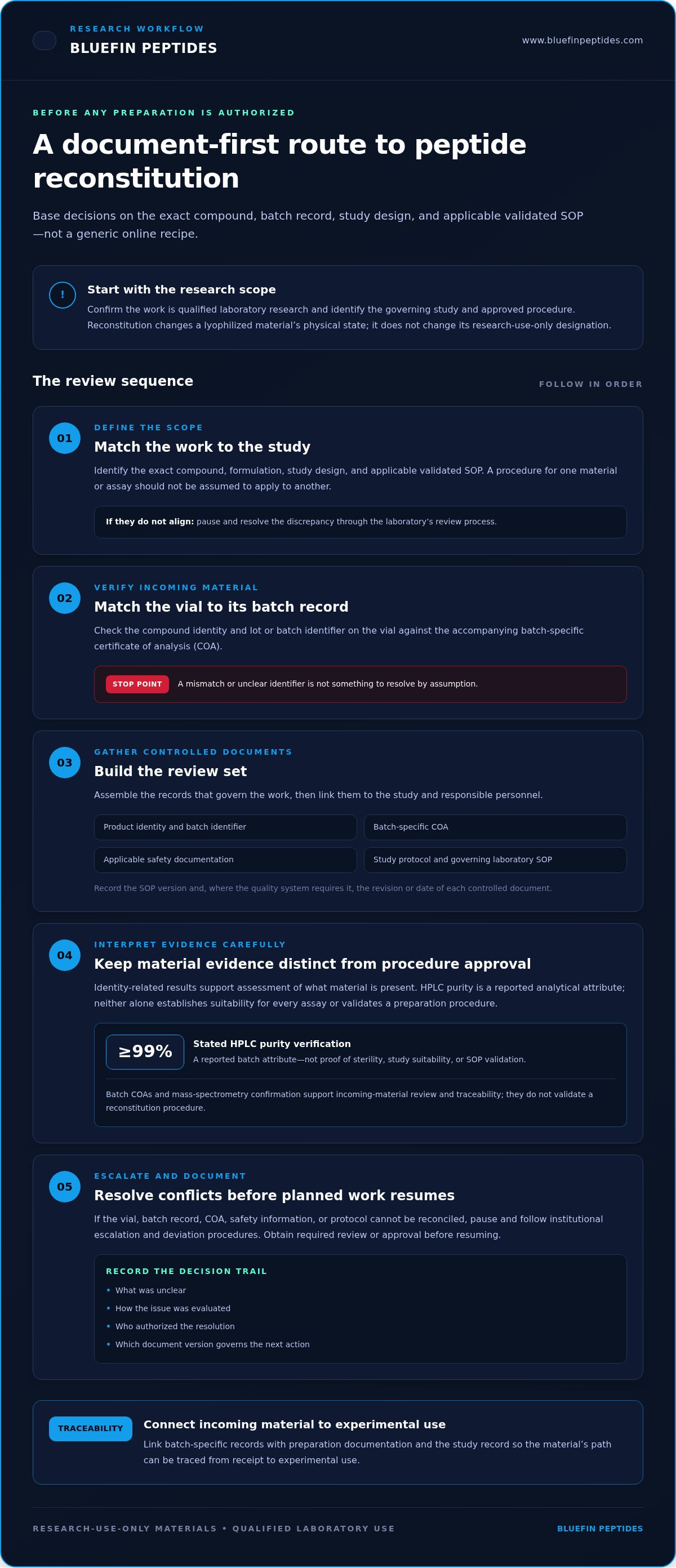
Before preparation is authorized, link the material to its batch documentation and study procedure. Confirm the compound identity and lot or batch identifier on the vial, then compare them with the accompanying certificate of analysis (COA). A mismatch or unclear identifier is a stop point, not a detail to resolve by assumption.
Review the COA for the specific batch. Identity evidence and purity reporting answer different questions. Identity-related results support assessment of what material is present, while a chromatographic purity result describes a reported analytical attribute. Neither proves that the material suits every assay or that a particular preparation procedure has been validated.
Which documents should researchers review before preparation?
Gather the product identity, batch identifier, batch-specific COA, applicable safety documentation, study protocol, and the laboratory SOP governing the work. Record the SOP version and, where the quality system requires it, the revision or date of each controlled document. Link these records to the study and responsible personnel so the material’s path can be traced from receipt to experimental use.
Identify the study-specific acceptance criteria and the designated escalation route for unresolved issues before work begins. These controls belong to the approved protocol and institutional quality system. General online guidance should not replace them, and acceptance limits should not be assumed to apply universally.
How should a laboratory resolve missing or conflicting information?
Pause if the vial identity, batch record, COA, safety information, or applicable protocol cannot be reconciled. Follow institutional escalation and deviation procedures, and obtain the required review or approval before resuming planned work. As required by laboratory procedures, record what was unclear, how it was evaluated, who authorized the resolution, and which document version governs the next action.
This document-first sequence is central to peptide reconstitution best practices 2026. It preserves a clear decision trail without prescribing universal preparation parameters. For example, if a batch identifier on the container differs from the COA, hold the material and route the discrepancy through the laboratory’s established process. Do not choose one record informally.
Bluefin Peptides supplies research-use-only materials with batch COAs, mass-spectrometry confirmation, and stated HPLC verification of at least 99% purity. These records support incoming-material review and traceability. They do not establish study suitability or validate a laboratory SOP. Researchers sourcing documented research-use-only peptides should keep material evidence distinct from procedural approval.
Assess Peptide Quality, Handling Risks, and Reproducibility
Quality review involves distinct questions: does the evidence support the material’s identity, what purity result is reported, and is the material appropriate for the specific study? A COA contributes to this assessment, but interpret it within its stated scope. It is not a complete measure of experimental readiness.
What can HPLC and mass spectrometry tell researchers?
High-performance liquid chromatography (HPLC) provides analytical evidence related to chromatographic purity. Mass spectrometry can support molecular-mass assessment and identity review. The methods answer different questions, so read their results alongside the batch record and study requirements. Neither validates a reconstitution method or establishes suitability for every assay.
| COA evidence may document | A COA alone cannot establish |
|---|---|
| Reported batch identity results and analytical methods or findings included in the document | That the material is sterile, unless sterility is specifically assessed and documented |
| A reported chromatographic purity result for the tested sample | Suitability for a particular study, assay, or experimental purpose |
| Batch-specific information that supports incoming-material traceability | That a laboratory preparation procedure is validated or that handling has remained controlled after testing |
Reported purity is not evidence of sterility, and neither purity nor identity results alone establish suitability for a specific study. For example, a high reported HPLC purity result does not replace the laboratory’s separate evaluation of assay requirements or applicable controls.
Which handling risks can undermine reproducibility?
Contamination, material mix-ups, inappropriate storage, and undocumented handling changes are risks to assess, not inevitable outcomes. If they occur, they can complicate interpretation or make a study harder to reproduce. Follow the laboratory’s validated SOP and facility requirements for controls, and record and review deviations through the applicable quality process.
For the peptide reconstitution best practices 2026 workflow, distinguish supplier evidence from study-level control. Batch records and analytical results help identify and assess incoming material, but they do not document what happens afterward. Maintain traceability by linking the batch to the study record and recording relevant authorized actions, reviews, and deviations as required by the laboratory’s quality system.
Bluefin Peptides states that its research-use-only peptides are at least 99% HPLC-verified, with mass-spectrometry confirmation and batch COAs. These attributes support material review. They do not show that a particular preparation method has been validated or that a material is suitable for every experimental application.
Document Preparation and Storage Decisions for Reproducible Research
A preparation record should preserve the chain of custody from incoming material to study use. Follow a defined sequence: identify the material, cite the governing SOP, record authorized actions, and review deviations. This makes the record useful for routine traceability and later assessment of unexpected results.
What should a research preparation record capture?
Use the study’s approved naming and labeling conventions, and include the fields required by the laboratory’s quality system and approved protocol. Depending on those requirements, the record may link:
- Material identity, lot or batch, and source documentation.
- The study protocol and applicable SOP, including its version or revision.
- Responsible personnel and relevant dates.
- Authorized actions, deviations, approvals, and final disposition.
These details help distinguish samples that may otherwise appear similar and connect the material to the work performed. If a required record is incomplete, follow the institution’s review process rather than filling gaps with assumptions. Aim for a clear, attributable account, not a larger record for its own sake.
How should researchers approach storage after preparation?
Base storage conditions and stability limits on product-specific documentation or laboratory validation applicable to the material and study. Do not carry a duration or condition from one peptide or formulation to another without documented support. Label prepared materials under institutional procedures, apply access controls as required, and maintain traceability between the stored sample and its source batch.
The same principle applies to lyophilized material. Consult the separate guide on long-term storage of lyophilized research vials for that topic, while treating applicable product documentation and institutional SOPs as the governing references for study decisions.
In peptide reconstitution best practices 2026, storage is a documented decision tied to material identity, supporting evidence, and the laboratory’s approved workflow. If conditions change or a deviation occurs, record and review it through the established quality process so later researchers can interpret the sample history.
For qualified laboratory research, explore Bluefin Peptides’ documented research peptides and use batch-specific records to support incoming-material traceability. Supplier documentation informs material review; it does not replace an approved study protocol or validate storage conditions.
Choose Documented Research Materials and Keep the Workflow Within Scope
Supplier documentation is one input to a laboratory’s quality review, not a substitute for its own acceptance criteria or study controls. Batch-specific certificates of analysis (COAs), HPLC results, and mass-spectrometry confirmation can help researchers assess incoming material and connect it to relevant records. The laboratory must still determine whether the evidence meets protocol requirements and whether the material is appropriate for the intended research assay.
How do supplier documents fit into laboratory quality review?
HPLC verification provides reported chromatographic purity information, while mass-spectrometry results can support molecular-mass or identity assessment. A COA brings batch-related information together for review. These records do not independently validate the complete study workflow, establish suitability for every assay, or confirm that a laboratory’s handling procedure is effective.
Batch-specific documentation improves traceability by linking incoming material to its analytical records and the study decisions made about its use. Researchers can assess that evidence alongside the approved protocol, institutional SOP, and applicable acceptance criteria. For further context, consult the article’s analytical quality standards guide and the relevant compound specifications article, keeping each source within its stated scope.
Bluefin Peptides states that its research-use-only peptides are at least 99% HPLC-verified, with mass-spectrometry confirmation and batch COAs. These documented attributes support incoming-material review; they do not validate a particular reconstitution procedure. In laboratory records, keep the distinction clear: supplier evidence describes the material, while the laboratory’s approved documents govern its research workflow.
What is the next step for qualified research teams?
Review product documentation alongside the applicable study protocol and institutional procedures before making material-acceptance or handling decisions. Keep procurement, preparation, and experimental use within qualified laboratory research. These materials are not for human, veterinary, consumer, or treatment use.
For qualified researchers seeking documented research peptides for laboratory work, Review Bluefin Peptides research materials.
Build a More Traceable Research Workflow
Reliable reconstitution depends on compound-specific planning, not a universal recipe. Anchor decisions to the batch record and validated SOP, distinguish analytical results from study suitability, and document authorized actions and deviations. Base storage decisions on product-specific evidence and institutional procedures.
These are the core peptide reconstitution best practices 2026: keep material identity traceable, interpret supplier documentation within its scope, and involve qualified laboratory review when records or procedures do not align. Bluefin Peptides supplies research-use-only peptides with stated purity of at least 99% verified by HPLC, mass-spectrometry confirmation, and batch-specific COAs. These records support incoming-material review, not validation of a preparation procedure.
For qualified researchers sourcing documented materials for laboratory use, review Bluefin Peptides research materials. Apply the same documented approach at each stage to support a more reproducible research workflow.
Frequently Asked Questions
What does peptide reconstitution mean in laboratory research?
Peptide reconstitution is the preparation of a lyophilized research material for a defined laboratory study. Lyophilization produces a dried material, and reconstitution changes its physical state. It does not change the material’s research-use designation. Identify the compound and batch in laboratory records, then link them to the applicable study and approved procedure so the material can be traced through experimental use.
Is there one reconstitution method that works for every research peptide?
No. Solubility, formulation, study design, and stability considerations can differ among peptides and assays, so a generic method may not suit a specific material. Follow product-specific documentation and the laboratory’s validated SOP rather than adopting an online recipe. If those sources do not address a study requirement or appear inconsistent, pause and use the institution’s review process before proceeding.
What information should a peptide COA provide to a research laboratory?
Review the COA for the batch identifier and the identity and analytical findings it reports, including any stated methods and purity results. Contents can vary, so compare the document with the vial label and the laboratory’s acceptance requirements. Link the batch-specific COA to the incoming-material record. It supports material review, but does not replace the study protocol or validate handling procedures.
Can an HPLC purity result establish that a peptide is suitable for a specific study?
No. An HPLC purity result provides chromatographic information reported for the tested material, but does not by itself establish sterility, validate a preparation method, or show suitability for every assay. Study suitability depends on the research question and the laboratory’s approved acceptance criteria. Evaluate the result alongside identity evidence, product documentation, protocol requirements, and other controls specified by the laboratory.
How should researchers document peptide preparation for reproducibility?
Use the laboratory’s quality system and approved protocol to define required records. These may link material identity and batch, source documentation, study and SOP references, responsible personnel, relevant dates, authorized actions, approvals, and deviations. Apply approved sample names and labels to help prevent mix-ups. Complete required documentation as work occurs, then retain it under institutional procedures so the material’s history can be reviewed.
How should a laboratory determine storage conditions after reconstitution?
Use storage conditions and stability limits supported by product-specific documentation or laboratory validation for the material and study. Do not assume a condition or time window applies across different peptides or formulations. Follow the applicable SOP, use approved labeling and access controls, and record storage decisions as required. If the supporting documentation does not address the planned conditions, seek qualified laboratory review before relying on an assumption.
What should a laboratory do when product documentation and an SOP conflict?
Pause the planned work and do not resolve the conflict by choosing whichever direction seems more convenient. Check that the material and batch records match, then follow the institution’s escalation, deviation, and approval procedures. Document the discrepancy and its resolution as required by the quality system. Resume only when the applicable procedure and required authorization are clear, and link the decision to the relevant study records.
Are research peptides intended for human or veterinary use?
No. Bluefin Peptides’ products are exclusively for qualified researchers and laboratory use, not for human, veterinary, consumer, or treatment use. Reconstitution or other laboratory preparation does not change that designation. Keep procurement and handling within the scope of qualified laboratory work and follow institutional procedures. These materials are not a substitute for products or guidance intended for clinical or veterinary care.
For laboratory research use only. Not for human or veterinary use. This content is educational and does not constitute medical, dosing, or usage guidance.
Browse the BLUEFIN catalog