Legal Guidelines for Buying Research Chemicals in the USA

A research-use-only label is not legal clearance. The legal guidelines for buying research chemicals USA depend on the specific substance, applicable federal and state controls, and the intended use. A product description cannot resolve those questions, and a certificate of analysis does not establish that a purchase is legally authorized.
For qualified researchers, uncertainty often arises at the boundaries: a compound may be unscheduled federally but subject to state restrictions, while institutional procurement rules may require additional review. Use a repeatable pre-purchase process to identify the rules and approvals that may apply, then assess whether supplier records support the product’s identity and batch traceability. The sequence matters: classify the substance, confirm institutional requirements, then evaluate supplier documentation. Batch-specific records, including a COA, can support procurement quality and reproducibility, but they do not replace legal or institutional checks. This distinction is essential when evaluating research chemicals for laboratory use.
Key Takeaways
- The legal guidelines for buying research chemicals USA depend on the substance, intended purpose, purchaser, and jurisdiction, not on a label alone.
- Assess chemical identity, research purpose, and buyer or institutional status before reviewing the relevant federal, state, and institutional rules.
- Use an ordered pre-purchase checklist that separates legal classification, institutional authorization, supplier review, and receipt records.
- Evaluate batch-specific analytical documentation as evidence supporting identity and quality, not as proof of legal status or regulatory approval.
- Bluefin Peptides sells research-grade peptides exclusively to qualified researchers for laboratory research use, with HPLC verification, mass-spectrometry confirmation, and batch-specific COAs.
Legal guidelines for buying research chemicals in the USA: what determines compliance?
A compliant research-chemical purchase is not determined by a product name or checkout screen alone. Assess the substance’s identity and legal classification, the proposed research purpose, the purchaser’s status, and the rules that apply where the material will be received and used. These factors provide a practical starting point for applying the legal guidelines for buying research chemicals USA.
Four separate questions matter: May this buyer purchase the substance? May the buyer possess it? Are there specific requirements for storing or handling it? Is the proposed research use permitted? An answer to one does not automatically answer the others. A supplier’s willingness to accept an order, for example, does not establish that the purchaser or institution has met every applicable requirement.
Why there is no single rule for every research chemical
Legal classification turns on the particular chemical, not the broad label “research chemical.” Some substances may be subject to federal controlled-substance requirements; others may not be. Other chemical controls can apply independently. The Controlled Substances Act provides general background on federal scheduling, but a general overview cannot determine a specific compound’s current status or whether a particular research activity is authorized.
Federal status is only one layer. State statutes and regulations may impose separate restrictions, and requirements can vary by jurisdiction. Institutional procurement, safety, and compliance policies may add review steps even when a general rule does not require a particular institutional process. Identify the exact compound and destination, then verify the applicable requirements through current official sources and your institution’s procedures.
Compliance depends on the substance, purpose, purchaser, and jurisdiction, with federal law, state requirements, and institutional controls assessed as distinct layers.
What research-use labeling does, and does not, mean
“Research use only” describes the seller’s stated use boundary. It is not a blanket legal exemption, evidence that a substance is unrestricted, or proof that a buyer is authorized to procure it. Nor does the label establish agency approval. Assess legal status independently, based on the material’s identity and applicable rules.
Research materials should not be confused with medicines intended for human use or consumer products. A research-use designation does not convert a substance into a human-use medicine or authorize use outside the stated laboratory purpose. Intended use matters: a label cannot override the facts of how a product is represented, purchased, or used.
Keep the records distinct. Legal review addresses whether the transaction and proposed handling are permitted; institutional authorization documents internal approval; supplier records support product identity and batch traceability. These records serve different purposes. A certificate of analysis may help evaluate analytical characteristics, but it does not establish legal authorization or substitute for review by the responsible institutional office.
Which federal, state, and institutional rules should a U.S. buyer check?
Use a layered review rather than treating one agency, state statute, or supplier policy as a complete answer. The relevant checks depend on the chemical and planned work. Start with current official sources, then document which requirements apply to the purchaser, facility, and destination. This is a compliance-screening framework, not a legal determination. Take unresolved questions to institutional compliance staff or qualified legal counsel.
Federal controls, DEA requirements, and precursor chemicals
Where a substance is federally controlled, the Controlled Substances Act and DEA rules may affect procurement, possession, storage, recordkeeping, and research activity. Check the current schedule in eCFR Title 21, Part 1308 and consult relevant DEA guidance. Verify the precise identity and current classification rather than inferring status from a similar name or category.
Some chemicals may also be subject to federal controls as listed chemicals or precursors, depending on the substance and circumstances. Reviewing precursor controls is distinct from checking controlled-substance schedules. Confirm whether the material and proposed transaction trigger applicable requirements. Do not assume that every research lab needs the same registration or documentation.
State rules and institutional oversight
Federal classification does not settle state requirements. Review current laws and regulations for the state where the material will be received, possessed, stored, and used. State rules may address substances or conduct differently from federal law. Use that state’s official legislative or regulatory sources rather than relying on a vendor description or a summary written for another jurisdiction.
Institutional environmental health and safety, research compliance, or controlled-substance offices can identify local requirements. These may include internal approval, investigator training, facility procedures, access controls, inventory records, or designated storage. Apply the procedures relevant to the substance and project, and record the responsible office’s guidance. Institutional authorization supports internal compliance but does not replace applicable federal or state obligations.
When a research program has its own ordering process
Some research programs impose procurement steps beyond ordinary commercial purchasing. The NIDA Drug Supply Program is one example: its request process is specific to that program and may call for investigator credentials, project information, and delivery details. Follow the program’s current instructions when applying through it. Do not generalize those requirements to purchases from commercial suppliers or treat them as a national rule for all research chemicals.
Before placing an order, record the outcome of each review separately: federal classification, state requirements, institutional approvals, and any program-specific conditions. If one item remains unclear, pause the purchase until the responsible authority resolves it. Qualified researchers can then assess procurement records, such as the batch-specific documentation available with Bluefin Peptides research peptides. Analytical records support product evaluation, not legal authorization.
Is a research chemical legal to buy? Assess the substance, purpose, and buyer
Assess a proposed purchase through three connected filters: the exact chemical, the intended activity, and the purchaser’s eligibility. A product appearing in an online catalog does not establish that it is lawful for a particular person or institution to buy, possess, or use. The legal guidelines for buying research chemicals USA require substance-specific and jurisdiction-specific verification, not assumptions based on availability or product labeling.
Start with the exact chemical identity
Begin with the full chemical identity supplied for the material, then compare it with current authoritative regulatory listings. Record the name and other identifying details used in the procurement documentation. Synonyms can refer to the same substance, while similar names do not necessarily mean two materials have the same legal status. Formulation, salt form, or combination may also affect what needs review. Do not assign a classification to a named peptide or blend without checking current official sources for that specific material.
Match intended use and purchaser status to applicable rules
Next, document the project’s actual purpose and the purchaser’s identity. Laboratory research is distinct from human, veterinary, or consumer use, but stating a research purpose does not override a legal restriction. Depending on the substance and applicable requirements, eligibility may also turn on investigator credentials, registrations, institutional oversight, or facility procedures. Confirm that the proposed purchaser and receiving location meet the requirements that apply to the transaction.
Category
What to verify
Decision point
Ordinary laboratory chemical
Identity, state requirements, and institutional handling or procurement rules.
Proceed only after local requirements and intended use are reviewed.
Potentially controlled substance
Current federal and state classification, plus any applicable purchaser or research authorization.
Pause until status and authorization are clear.
Precursor chemical
Whether specific controls apply to the chemical and proposed transaction.
Check current official requirements; do not infer status from the product category.
Use a pause-and-review decision point
Stop before ordering if the chemical identity is incomplete, the applicable classification is uncertain, or required approvals cannot be documented. Route unresolved questions to institutional compliance staff or qualified legal counsel, and retain the outcome with the procurement file. This framework supports an informed review; it is not an individualized legal opinion. Verify the current classification of any specific Bluefin Peptides product using compound-specific official sources.
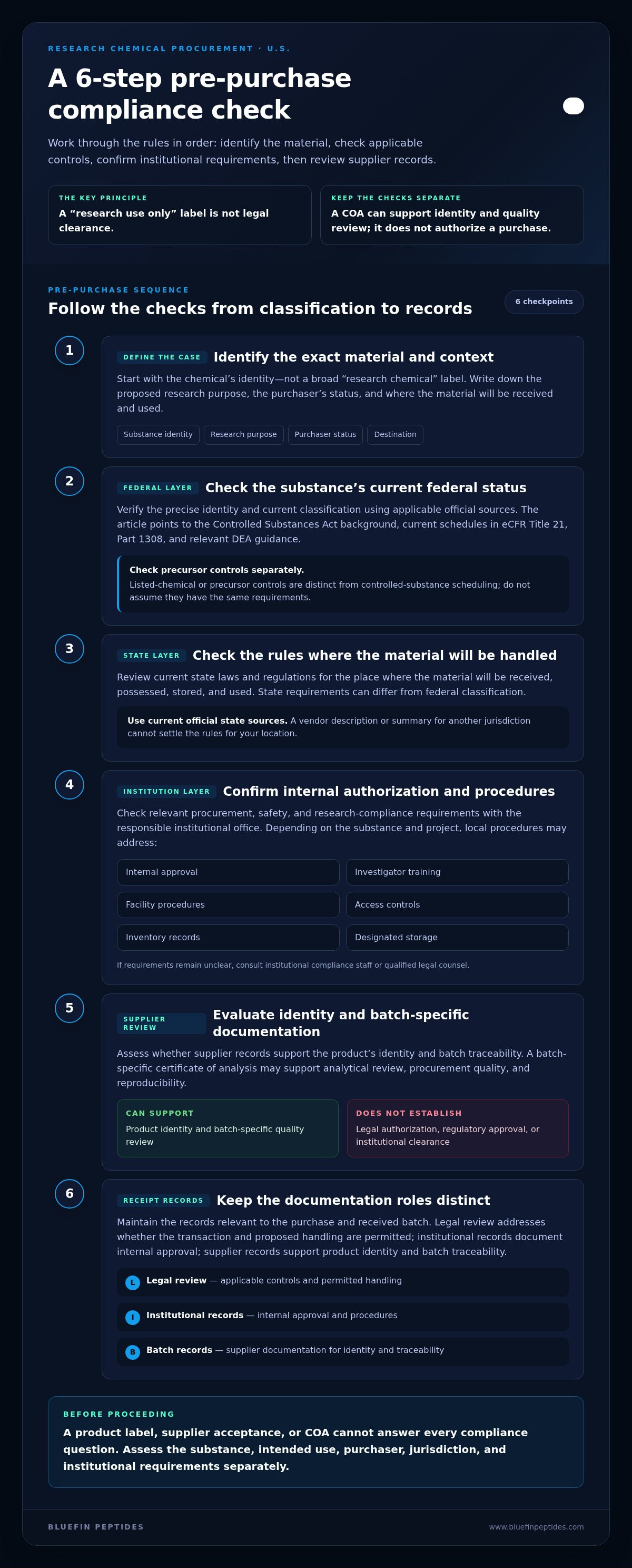
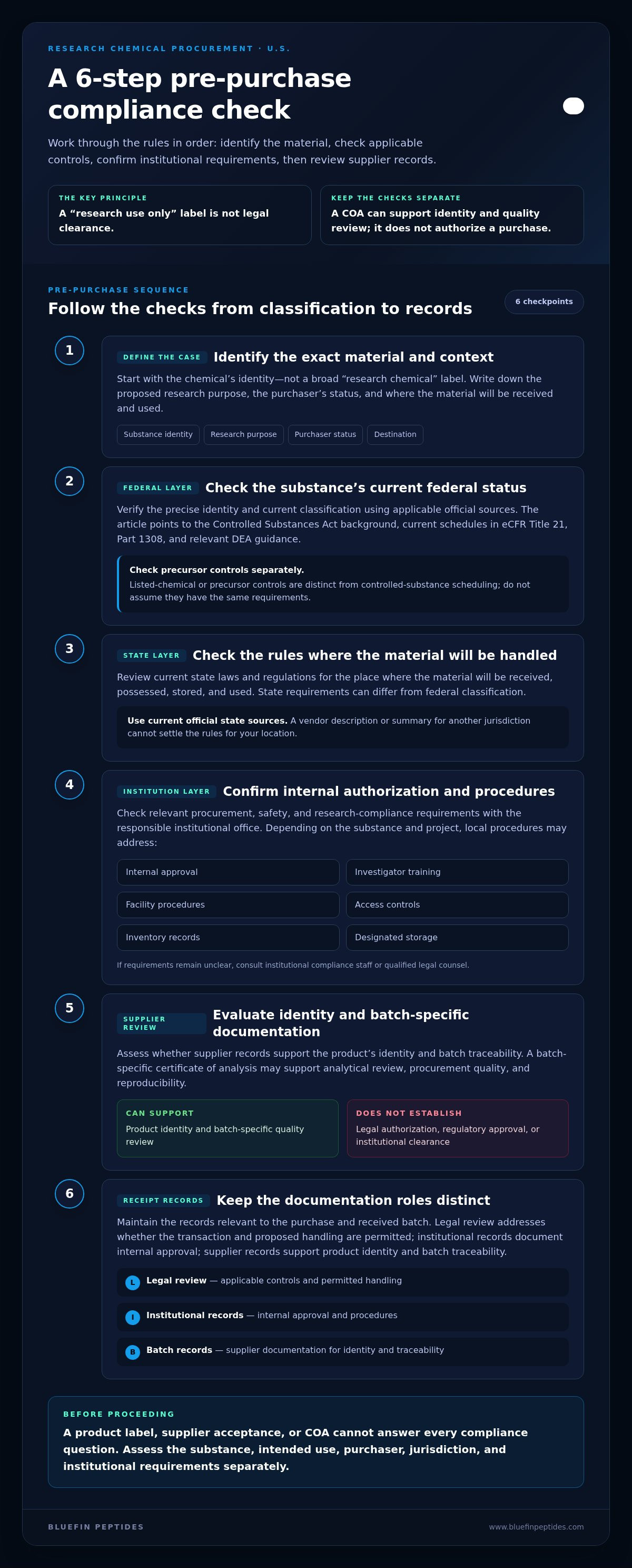
Use this pre-purchase compliance checklist before placing an order
A defensible purchase review should move in sequence from identifying the material to documenting its receipt. Keep legal classification, institutional authorization, supplier evidence, and shipment records distinct; each answers a different question. At minimum, verify the chemical’s identity and current status, applicable legal and institutional requirements, purchaser and project authorization, supplier documentation, and receipt records before proceeding.
The legal guidelines for buying research chemicals USA are not satisfied by a product-page statement alone. Pause if the compound’s identity is ambiguous, a required approval is missing, or the proposed order’s purpose conflicts with its stated research-use boundary.
Five checks to complete before ordering
- Identify and classify the exact material. Match the product name and available identifying details to authoritative sources, then check current federal and state listings relevant to the compound. Do not infer a classification from a similar name or rely only on a seller’s description. If identity or status remains unclear, stop and seek review.
- Complete the legal review. Determine which requirements apply to the substance, transaction, destination, and proposed handling. Record the official sources consulted and any direction received from the responsible authority. A general research-use label or online availability is not a substitute for this review.
- Confirm institutional authorization. Document the approved laboratory purpose, responsible investigator or purchaser, and receiving institution where applicable. Confirm relevant internal approvals, training, registrations, and facility procedures with the institution’s designated compliance or safety office before submitting an order.
- Review the supplier and batch documentation. Check that the supplier’s identity and product description match the intended procurement, and review the shipping terms and available batch records. A COA can report analytical information for a specific lot. HPLC and mass spectrometry provide analytical evidence; they do not establish legal status, regulatory approval, or buyer authorization. Bluefin Peptides’ research-grade peptides are at least 99% HPLC-verified, with mass-spectrometry confirmation and batch-specific COAs. These records support procurement-quality review, not legal clearance.
- Plan shipment and document receipt. Verify receiving procedures against applicable requirements and institutional policy before the material ships. On receipt, retain order and shipment records, batch documents, approvals, and relevant correspondence as required by policy. Follow the institution’s applicable procedures for receiving, storage, access, and disposal.
What to do when a check is incomplete
Do not proceed based on a seller’s label, a reassuring product-page statement, or a certificate of analysis if classification or authorization remains unresolved. Pause the order and route the question to institutional compliance staff or qualified legal counsel. Bluefin Peptides sells research-grade peptides exclusively to qualified researchers for laboratory research use. Once legal and institutional checks are complete, qualified researchers can review Bluefin Peptides research peptides as part of supplier due diligence.
How qualified researchers can assess Bluefin Peptides documentation
Supplier documentation is useful after the substance, jurisdiction, purchaser, and institutional checks are complete. It helps qualified researchers evaluate product identity and reported analytical characteristics for procurement and experimental recordkeeping. It does not determine whether a purchase is lawful. That separation is central to applying the legal guidelines for buying research chemicals USA without confusing analytical evidence with regulatory authorization.
Review batch-specific evidence without overreading it
A certificate of analysis (COA) should identify the product lot to which its reported results apply. Compare the lot information on the COA with the material received, and retain the record with the procurement file. Bluefin Peptides’ research-grade peptides are at least 99% HPLC-verified, with mass-spectrometry confirmation and batch-specific COAs.
These methods provide different analytical evidence. HPLC is used to assess chromatographic characteristics, while mass spectrometry can support evaluation of molecular identity. Review the available batch record in context, including the material and lot it describes. A test result does not establish that a purchase is lawful, that an agency has approved the material, or that it is suitable for human, veterinary, or consumer use.
Apply the compliance sequence to a supplier order
Before ordering, confirm the exact substance and relevant jurisdictional requirements, then document the purchaser’s eligibility and institutional approvals where applicable. Only after those checks should supplier records inform the quality review. Keep the evidence streams separate: legal and institutional records support authorization, while analytical documentation supports evaluation of the specific product lot.
For a Retatrutide research peptide order, for example, the batch documentation can be reviewed as evidence associated with that lot. It should not be used to infer the compound’s legal classification or bypass official-source verification. The same distinction applies to other research-grade peptides and blends.
Keep the intended-use boundary clear
Bluefin Peptides sells exclusively to qualified researchers for laboratory research use. Product descriptions and analytical records should be interpreted within that boundary, not as claims of human, veterinary, or consumer use. A research-use designation describes the intended-use limit; it does not independently confer legal status or regulatory approval.
For a complete procurement file, retain the relevant COA alongside approvals, order details, and receipt records under applicable institutional procedures. This creates a traceable record of both the analytical evidence reviewed and the separate compliance decisions made before purchase.
Qualified researchers can review research peptides and batch documentation as part of a documented laboratory procurement process. Use the available analytical information to assess product records, while relying on current official sources and institutional authorities for legal and authorization questions.
Make your next procurement review repeatable
Turn each planned purchase into a documented workflow. A reusable file can capture identity verification, jurisdictional review, institutional sign-off, supplier evidence, and receipt records. Assign responsibility for each check and preserve its outcome, so future procurement starts from a clear record rather than assumptions.
Revisit the review when the substance, research purpose, receiving location, or applicable rules change. The legal guidelines for buying research chemicals USA are best treated as an active part of laboratory governance, not a one-time box to check. Keep analytical records alongside, but distinct from, legal and institutional approvals.
For qualified researchers evaluating laboratory-use peptides, Bluefin Peptides’ products are at least 99% HPLC-verified, with mass-spectrometry confirmation and batch-specific COAs. Those records can support a product-quality review; they do not establish legal eligibility or regulatory approval.
When your compliance review is complete, review research peptides and batch documentation for your laboratory procurement process. A consistent, well-documented approach helps keep each step clear and verifiable.
Frequently Asked Questions
Is it legal to buy research chemicals in the USA?
It depends on the specific substance, its intended use, the purchaser, and applicable federal and state rules. The phrase “research chemical” does not identify a legal category, so the legal guidelines for buying research chemicals USA require a compound-specific review. For example, a chemical sold online may still be subject to controls that affect its purchase or possession. Verify its current status through official sources before ordering.
Can anyone buy chemicals labeled for research use only?
No. A research-use label does not mean every buyer is eligible or that every proposed purchase is permitted. A supplier may restrict sales to qualified researchers, while laws or institutional procedures may impose separate conditions. An individual without an approved laboratory project should not assume that selecting “research” at checkout establishes eligibility. Confirm purchaser requirements and keep the documented research purpose consistent with the material’s stated laboratory-use boundary.
Do research chemicals require a DEA license or registration?
Not every research chemical requires DEA registration. Requirements depend on whether the specific substance is federally controlled and on the research activity, purchaser, and applicable rules. A researcher working with a controlled substance may need specific authorization or to work under an institution’s approved arrangements; the details cannot be inferred from the word “research.” Check current DEA requirements and consult the institution’s controlled-substance or compliance office before procurement.
What happens if a research chemical is classified as a controlled substance?
Its purchase, possession, storage, records, and research activity may be subject to additional controls. Do not place an order until the applicable requirements and purchaser authorization are clear. A laboratory may need to confirm that its investigator, facility, and proposed protocol meet relevant conditions before acquiring the substance. Exact obligations depend on current federal and state rules, so seek guidance from the responsible compliance authority.
Does a certificate of analysis prove that a research chemical is legal?
No. A COA reports analytical information for the identified product lot; it does not establish that the compound may lawfully be purchased or possessed, or that the buyer is authorized. A COA may help a lab compare a lot’s reported identity and purity data with procurement records, while legal classification must be checked separately. Keep analytical records and legal approvals as distinct parts of the procurement file.
Can state laws differ from federal rules for research chemicals?
Yes. A chemical’s federal status does not resolve every state requirement, and state rules may impose separate restrictions. Check the law that applies where the material will be received and handled, not only the rules where a supplier operates. A laboratory receiving a shipment across state lines should confirm the destination jurisdiction’s requirements and institutional procedures before submitting the order.
What records should a laboratory keep when buying research chemicals?
Keep records that let the laboratory reconstruct the procurement decision and identify the material received. Depending on applicable law and institutional policy, the file may include order and shipment records, the supplier product description, batch-specific COA, approvals, training or authorization records, and relevant compliance correspondence. At receipt, match the lot details on the supplied documentation to the material received, then follow institutional retention, storage, access, and disposal procedures.
For laboratory research use only. Not for human or veterinary use. This content is educational and does not constitute medical, dosing, or usage guidance.
Browse the BLUEFIN catalog