Ipamorelin and CJC-1295 Research Blend: Molecular Mechanisms and Analytical Standards
The assumption that single-pathway stimulation provides sufficient data for growth hormone signaling is increasingly obsolete in modern endocrinology research. Achieving a 3 to 5 fold increase in growth hormone release requires the simultaneous activation of the GHRH and ghrelin receptors. This synergistic effect defines the Ipamorelin CJC-1295 blend research landscape. Precision. Verification. Reliability. These are the non-negotiable requirements for any laboratory investigating non-desensitizing growth hormone secretion. You require reagents that maintain chemical integrity from the moment of synthesis to the point of final reconstitution.
We recognize the frustration caused by inconsistent batch quality and the absence of transparent HPLC data from standard suppliers. This technical reference serves as your analytical anchor. It explores the biochemical mechanisms of dual-reagent signaling and the specific laboratory protocols needed for optimal stability. We'll examine the July 2026 regulatory environment, detail standardized reconstitution methodologies, and establish the rigorous mass spectrometry standards required for ≥99% purity verification in high-stakes research environments.
Key Takeaways
- Analyze the biochemical synergy of dual-pathway reagents targeting the GHRH and ghrelin receptors to maximize growth hormone secretion.
- Identify the critical analytical specifications for Ipamorelin CJC-1295 blend research, focusing on ≥99% HPLC-verified purity and mass-spectrometry confirmation.
- Establish precise laboratory protocols for reconstitution and storage to prevent peptide degradation and ensure the chemical stability of the lyophilized powder.
- Verify batch-specific documentation and COAs to eliminate uncertainty regarding the chemical integrity of multi-peptide research reagents.
- Understand the logistical importance of US-based inventory for anchoring research momentum and securing high-fidelity laboratory data.
The Ipamorelin and CJC-1295 Research Blend: A Dual-Pathway Reagent
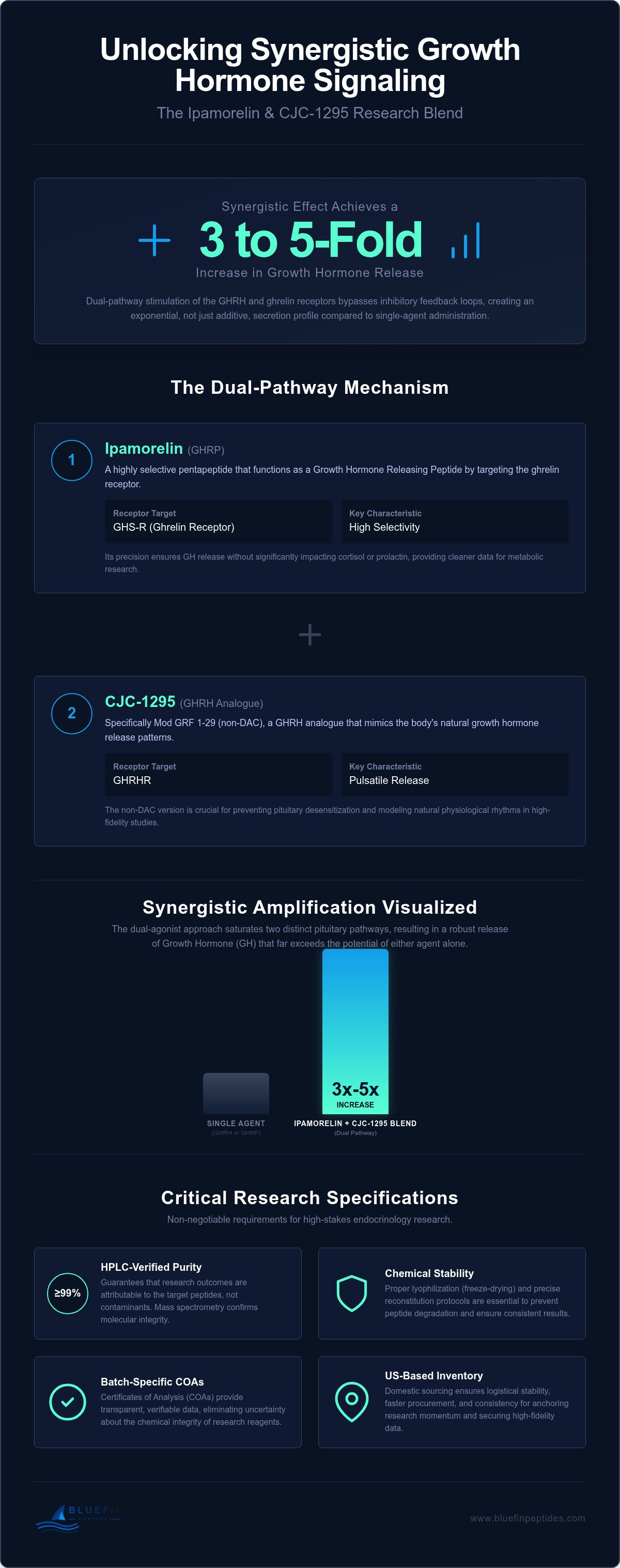
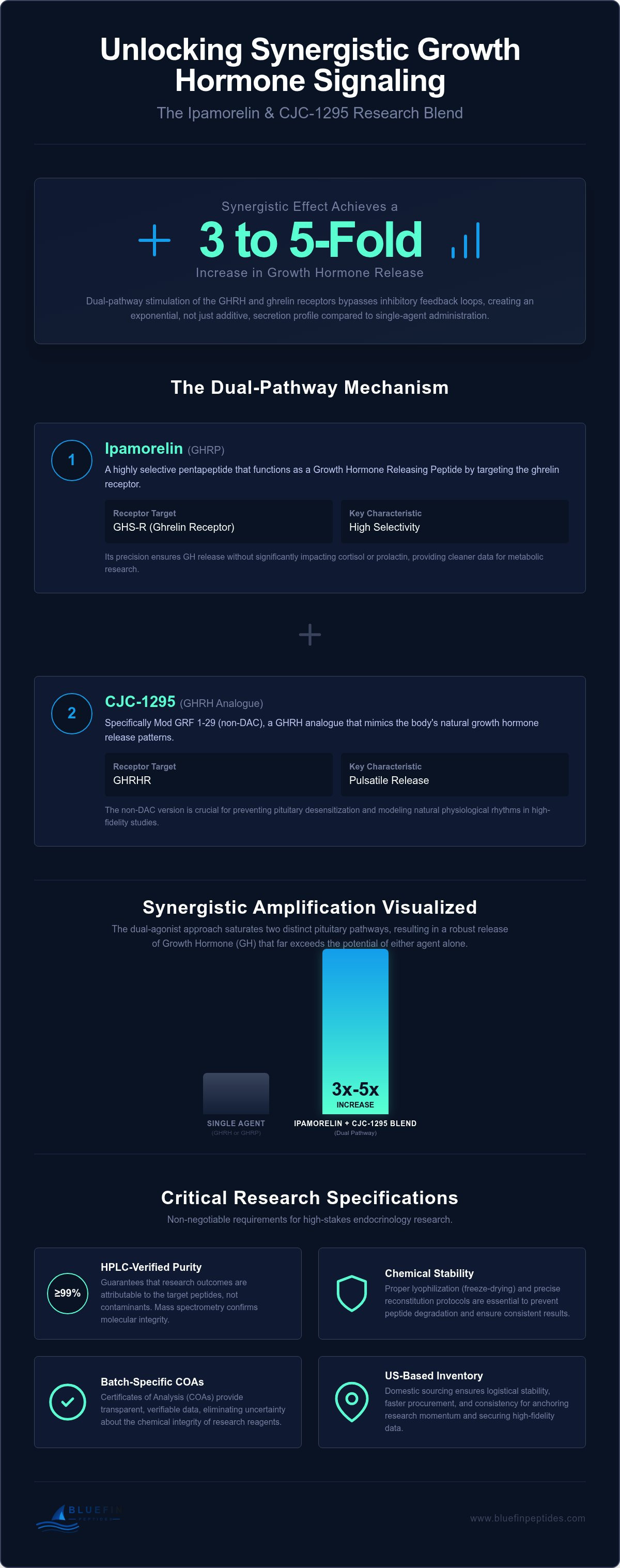
The Ipamorelin CJC-1295 blend research focuses on the simultaneous targeting of two distinct receptors within the anterior pituitary. This combination pairs a Growth Hormone Releasing Peptide (GHRP) with a Growth Hormone Releasing Hormone (GHRH) analogue. Standard laboratory formulations often utilize a 1:1 ratio to achieve receptor saturation across both pathways. By utilizing two distinct signaling mechanisms, this blend effectively bypasses the inhibitory influence of somatostatin. In experimental models, somatostatin often acts as a chemical anchor, preventing the full release of growth hormone. The dual-pathway approach ensures a more robust and reliable secretion profile. It's vital to maintain the legal distinction that these reagents are intended exclusively for in vitro and in vivo laboratory research. They aren't for human or veterinary use.
The chemical stability of this dual-reagent system depends heavily on the quality of the lyophilized cake. When these peptides are co-lyophilized, they must maintain their molecular integrity without cross-reactivity. This requires a high degree of precision during the manufacturing process. Researchers rely on these blends to provide a consistent baseline for metabolic and endocrinology studies. The synergy isn't just additive; it's exponential. Data shows a 3 to 5 fold increase in GH release compared to single-agent administration. This efficiency allows for deeper exploration of the growth hormone axis without the need for excessive dosages of isolated compounds.
Biochemical Profile of Ipamorelin
Ipamorelin is a pentapeptide that functions as a highly selective ghrelin receptor agonist. Its molecular structure allows for the stimulation of growth hormone release without the common secondary effects associated with older GHRP generations. In controlled research settings, Ipamorelin demonstrates a significant lack of impact on the secretion of prolactin, ACTH, and cortisol. This selectivity provides a cleaner data set for researchers investigating pulsatile growth hormone release. Its precision ensures that observed metabolic shifts are attributable to growth hormone axis activation rather than systemic stress responses. The peptide's ability to stimulate a "pulse" mimics natural biological rhythms, which is essential for accurate longitudinal studies.
Biochemical Profile of CJC-1295 (Mod GRF 1-29)
CJC-1295, specifically the tetrasubstituted 29-amino acid peptide known as Mod GRF 1-29, serves as the GHRH component of the blend. It's critical to differentiate between CJC-1295 with Drug Affinity Complex (DAC) and the non-DAC version. Studies on half-life and pharmacokinetics indicate that the non-DAC variant is essential for mimicking natural physiological pulses. While the DAC version extends the peptide's presence in the system, it results in a constant bleed of hormone release that lacks the rhythmic precision required for high-fidelity modeling. The non-DAC version ensures that the pituitary remains responsive to natural feedback loops, preventing the desensitization often seen with long-acting analogs.
Molecular Mechanisms: Investigating GH Axis Synergy
The efficacy of the Ipamorelin CJC-1295 blend research hinges on the convergence of two distinct signal transduction pathways within the pituitary somatotroph. While CJC-1295 initiates signaling through the Growth Hormone-Releasing Hormone Receptor (GHRHR), Ipamorelin targets the Growth Hormone Secretagogue Receptor (GHS-R). This dual-pathway approach facilitates a synergistic elevation of intracellular cyclic adenosine monophosphate (cAMP) and the mobilization of calcium ions. These secondary messengers work in tandem. The cAMP pathway primarily enhances growth hormone synthesis and storage; meanwhile, calcium mobilization triggers the immediate exocytosis of GH vesicles into the bloodstream. This coordinated mechanism ensures a more efficient release than either agent could achieve in isolation.
Single-agent protocols often encounter a pharmacological ceiling. At this point, increasing the concentration of a single ligand fails to yield a proportional increase in secretion due to receptor saturation or compensatory feedback loops. Dual-agonism bypasses this limitation. By stimulating the pituitary from two different biochemical angles, researchers can maximize secretagogue potential without overloading a single receptor type. This synergy is particularly relevant in models of somatopause, where the pituitary's sensitivity to endogenous GHRH is often diminished. Investigating these mechanisms requires reagents with absolute molecular precision. For high-fidelity results, laboratories often utilize analytical-grade blends that ensure consistent receptor binding across all experimental batches.
GHRH Receptor Activation via CJC-1295
CJC-1295 exhibits a high binding affinity for the GHRH receptor, initiating a G-protein coupled response that activates adenylyl cyclase. This process leads to the sustained elevation of cAMP, which is a critical driver for GH gene transcription and the long-term proliferation of somatotroph cells. By increasing the pool of available growth hormone, CJC-1295 provides the necessary substrate for the pulsatile release triggered by ghrelin mimetics. CJC-1295 sustains the growth hormone signal by maintaining a consistent baseline of GHRH receptor occupancy.
Ghrelin Receptor Modulation via Ipamorelin
As a selective ghrelin receptor agonist, Ipamorelin targets the GHS-R with surgical precision. Unlike GHRP-2 or GHRP-6, which can stimulate collateral pathways leading to increased cortisol or prolactin, Ipamorelin maintains a narrow focus on growth hormone secretion. This selectivity is vital for laboratory models where hormonal purity is essential for data integrity. In research settings, Ipamorelin influences the frequency and magnitude of pulsatile GH secretion, mimicking the natural rhythmic release patterns observed in healthy physiological states. This makes it an ideal tool for studying age-related hormonal decline and metabolic regulation.
Analytical Specifications and Purity Verification
High-fidelity laboratory data depends on chemical absolutes. Purity levels below the ≥99% threshold introduce uncontrolled variables that can compromise the integrity of an Ipamorelin CJC-1295 blend research project. Contaminants like residual Trifluoroacetic acid (TFA) or synthesis salts often skew metabolic readings. TFA is commonly utilized as a counter-ion during the purification process. However, excessive concentrations can alter the pH of the reconstituted solution, potentially destabilizing the peptide chains or causing localized cellular stress in vivo models. Precision in synthesis is the only way to ensure that the observed biological responses are purely the result of receptor agonism.
The analytical verification of multi-peptide formulations is more complex than single-compound reagents. It requires a dual-layered approach to confirm both the purity and the identity of each constituent. Without transparent documentation, researchers are forced to rely on blind trust, which is a liability in professional laboratory environments. Secure research outcomes start with reagents that have been verified through rigorous testing protocols. This level of scrutiny ensures that every vial maintains the exact molecular ratio required for synergistic signaling.
HPLC Analysis for Research Blends
In a multi-peptide formulation, High-Performance Liquid Chromatography (HPLC) serves as the primary tool for purity verification. A standard blend chromatogram must display two distinct, sharp peaks with minimal baseline noise. Any "shoulders" or secondary peaks around these main signals indicate the presence of impurities or degradation products. Researchers must calculate the Area Under the Curve (AUC) for each peak to ensure the combined purity meets the required standard. For a deeper understanding of these metrics, consult our Analytical Quality Standards for Research Peptides: A Laboratory Guide. This documentation is the baseline for verifying that the reagents won't introduce synthesis byproducts into your experimental model.
Mass Spectrometry Confirmation
While HPLC confirms purity, Mass Spectrometry (MS) confirms identity. It verifies the precise molecular weight of both species within a single vial. This is critical for detecting truncated sequences where amino acids were omitted during synthesis. For CJC-1295, verifying the specific molecular weight is essential to ensure the tetrasubstituted modification is present. This modification was a key focus in the foundational clinical trial on CJC-1295 efficacy, which established its pharmacokinetic profile. Every batch must be accompanied by a Certificate of Analysis (COA). These documents provide the analytical verification necessary for institutional compliance and research reproducibility, allowing you to treat the reagent as a known constant in your data sets.
Laboratory Protocols: Reconstitution and Stability
Precision in the laboratory doesn't end with synthesis verification; it extends to the meticulous handling of the reagent during reconstitution. The transition from a lyophilized cake to a bioactive solution represents a critical point of potential degradation. Within the context of Ipamorelin CJC-1295 blend research, maintaining the molecular integrity of these peptides is paramount. Mechanical shearing, caused by aggressive agitation or rapid diluent injection, can physically disrupt the peptide bonds. This results in a loss of receptor affinity and compromised experimental data. Researchers must treat the lyophilized matrix as a fragile crystalline structure that requires a controlled, fluid transition into its liquid state.
Standard protocols require the use of either bacteriostatic water (0.9% benzyl alcohol) or sterile saline, depending on the requirements of the specific research model. Bacteriostatic water is preferred for multi-use vials due to its ability to inhibit bacterial growth. However, for in vivo studies requiring physiological pH, sterile saline may be more appropriate despite its lack of antimicrobial properties. Calculating molar concentrations is essential for stoichiometric accuracy. Since these blends often arrive in 10mg vials containing 5mg of each constituent, the diluent volume directly dictates the concentration per aliquot. A 2mL reconstitution yields a concentration of 2.5mg/mL for each peptide species. To ensure consistency across all trials, you should source research-grade blends from suppliers who provide exact batch weights.
Reconstitution Methodology for Researchers
The diluent must be introduced slowly, allowing it to trickle down the interior glass wall of the vial rather than impacting the lyophilized cake directly. This prevents the formation of bubbles and limits mechanical stress. Once the liquid is introduced, use a gentle swirl technique. Do not shake the vial. Once reconstituted, the Ipamorelin/CJC-1295 blend maintains optimal chemical stability for approximately 14 to 21 days when stored at a consistent temperature of 2 to 8°C.
Storage and Preservation in 2026
For long-term preservation, lyophilized vials should be stored at -20°C in a light-shielded environment. Peptides are highly sensitive to UV exposure and thermal fluctuations, both of which can catalyze deamidation or oxidation. Maintaining a stable pH is equally vital; shifts in the environment can lead to peptide precipitation or aggregation. For more detailed data on maintaining reagent integrity, refer to the Ipamorelin CJC-1295 Research Blend USA: Analytical Specifications and Laboratory Guide. These protocols ensure that the chemical momentum of your research remains uninterrupted by preventable reagent failure.
Procuring Research-Grade Blends in the United States
Research continuity depends on a reliable, domestic supply chain. International procurement introduces unacceptable variables. Customs delays. Thermal spikes. Documentation gaps. These hazards compromise the momentum of multi-year studies and threaten the integrity of longitudinal data. Securing a US-based inventory is the only way to ensure that the chemical specifications of your reagents remain a known constant. Bluefin Peptides operates with a commitment to clinical-grade precision. We prioritize the tools of verification over marketing abstractions. Every vial is a data point. Every shipment is a commitment to research integrity. Consistency. Precision. Reliability.
The Ipamorelin CJC-1295 blend research environment requires reagents that can withstand the rigors of institutional scrutiny. Batch-to-batch consistency isn't just a goal; it's a requirement for high-fidelity modeling. When a supplier maintains rigorous US-based manufacturing and logistics, the risk of molecular degradation during transit is significantly mitigated. This stability allows laboratories to anchor their experimental designs on reagents that arrive with their chemical integrity fully intact. We treat the procurement process as a disciplined operation, focusing on the "how" of our logistics to guarantee the "what" of your results.
Logistics and Fulfillment for Lab Supplies
Laboratory supplies require more than just speed; they require disciplined handling. Lyophilized powders are highly sensitive to environmental stressors during transit. Rapid domestic shipping serves as a safeguard, ensuring the Ipamorelin CJC-1295 blend research material maintains its crystalline structure. Secure, vacuum-sealed packaging acts as a definitive barrier against oxidation and humidity. We function as a disciplined logistics specialist, ensuring that reagents navigate the supply chain with deep-sea precision. This momentum allows laboratories to maintain tight experimental timelines without the risk of reagent failure or atmospheric contamination.
Verification and Transparency Standards
Transparency is the only currency in professional research. We provide a peer-level academic register in all communications, treating every laboratory as a high-performance partner. Researchers have direct access to batch-specific HPLC and Mass-Spec reports for every vial. This documentation is essential for institutional compliance and ensures that the reagents integrate seamlessly into complex protocols. For comparative analysis with other high-purity reagents, researchers should review our guide on Retatrutide Research Peptide: Analytical Specifications and Laboratory Standards. Verification is non-negotiable. We provide the data, so you don't have to rely on blind trust.
Advancing Analytical Precision in Peptide Research
The transition from theoretical modeling to empirical validation requires reagents that function as constants. This exploration of the Ipamorelin CJC-1295 blend research landscape emphasizes that dual-pathway synergy is only as reliable as the underlying chemical purity. By utilizing high-purity reagents, researchers can accurately investigate the convergence of GHRH and ghrelin receptor signaling without the interference of synthesis byproducts. Stability, verification, and precision are the anchors of high-fidelity data. Every experimental variable must be controlled to ensure that metabolic observations are scientifically sound.
Bluefin Peptides provides the infrastructure for this level of scientific rigor. We offer ≥99% HPLC-verified purity and batch-specific mass spectrometry confirmation for every research vial. Our US-based inventory ensures that your laboratory protocols aren't interrupted by logistical delays or thermal degradation during transit. This commitment to transparency allows you to focus on the data rather than the reagent's integrity. Your commitment to rigorous methodology deserves reagents that meet the same professional standard.
Secure HPLC-Verified Ipamorelin / CJC-1295 Research Blends at Bluefin Peptides and anchor your experimental design in analytical certainty.
Frequently Asked Questions
What is the primary mechanism of action for the Ipamorelin CJC-1295 blend?
The primary mechanism of action involves the simultaneous activation of the Growth Hormone-Releasing Hormone (GHRH) receptor and the ghrelin receptor. This dual-pathway agonism occurs on the pituitary somatotrophs, leading to a coordinated elevation of cAMP and calcium ion mobilization. It creates a synergistic signaling environment that bypasses somatostatin inhibition. This efficiency is why Ipamorelin CJC-1295 blend research focuses on maximizing secretagogue potential through receptor convergence rather than isolated stimulation.
How should the Ipamorelin CJC-1295 blend be stored for long-term research?
For long-term stability, lyophilized vials must be stored in a freezer at -20°C. This temperature prevents the degradation of the peptide bonds and maintains the chemical integrity of the lyophilized cake. Once you've reconstituted the blend, it's necessary to store the vial in a refrigerator at 2 to 8°C. At these temperatures, the solution remains stable for 14 to 21 days before significant deamidation or oxidation begins to occur.
Is Ipamorelin CJC-1295 research blend intended for human use?
No, the Ipamorelin CJC-1295 blend research reagent is intended exclusively for laboratory use and is not for human consumption. These compounds haven't received FDA approval for medical use. They're sold under the legal classification of research chemicals for in vitro and in vivo modeling. Any application outside of a controlled laboratory environment is strictly prohibited. Researchers must adhere to institutional safety protocols and legal boundaries regarding the handling of these reagents.
What is the difference between CJC-1295 with DAC and without DAC in a research context?
The difference lies in the pharmacokinetic profile and the ability to mimic physiological pulses. CJC-1295 without DAC, also known as Mod GRF 1-29, has a half-life of roughly 30 minutes, which facilitates rhythmic growth hormone release. In contrast, the DAC version includes a Drug Affinity Complex that extends the half-life to several days. This creates a constant bleed of hormone secretion that can lead to receptor desensitization in certain research models.
Can Ipamorelin and CJC-1295 be reconstituted in the same vial safely?
Yes, Ipamorelin and CJC-1295 are chemically compatible and can be reconstituted in the same vial without cross-reactivity. Professionally manufactured blends are co-lyophilized to ensure a precise 1:1 or specific molar ratio. When you introduce a diluent like bacteriostatic water, both peptides enter the solution simultaneously. This combined state is stable under refrigeration, allowing for the concurrent investigation of both GHRH and ghrelin signaling pathways in a single experimental aliquot.
What purity level is required for the Ipamorelin CJC-1295 blend in laboratory studies?
A purity level of ≥99% is required to ensure the accuracy and reproducibility of laboratory data. Purity is verified through High-Performance Liquid Chromatography (HPLC), which identifies the percentage of the target peptide relative to synthesis byproducts. Lower purity levels introduce uncontrolled variables, such as residual TFA or truncated sequences, which can skew metabolic results. High-fidelity laboratory studies rely on these analytical absolutes to maintain experimental integrity across all batches.
How does the blend affect pulsatile growth hormone release compared to single peptides?
The blend significantly enhances the frequency and magnitude of pulsatile growth hormone release compared to single-peptide protocols. Data suggests that the combination can produce a 3 to 5 fold increase in GH secretion. This occurs because the GHRH analog increases the pool of available growth hormone; meanwhile, the ghrelin mimetic triggers the immediate release of those stores. This synergy allows for a more robust investigation of the growth hormone axis.
Why is mass spectrometry necessary for verifying this specific peptide blend?
Mass spectrometry is necessary to confirm the molecular identity and sequence accuracy of both peptides in the formulation. While HPLC measures purity, it doesn't verify that the amino acid sequence is correct. Mass spectrometry measures the precise molecular weight, detecting synthesis errors or truncated chains that might share a similar retention time on a chromatogram. It's a critical tool for verifying that the reagent contains the exact molecular species intended for the study.
For laboratory research use only. Not for human or veterinary use. This content is educational and does not constitute medical, dosing, or usage guidance.
Browse the BLUEFIN catalog