How to Properly Store Lyophilized Peptides: A 2026 Laboratory Guide
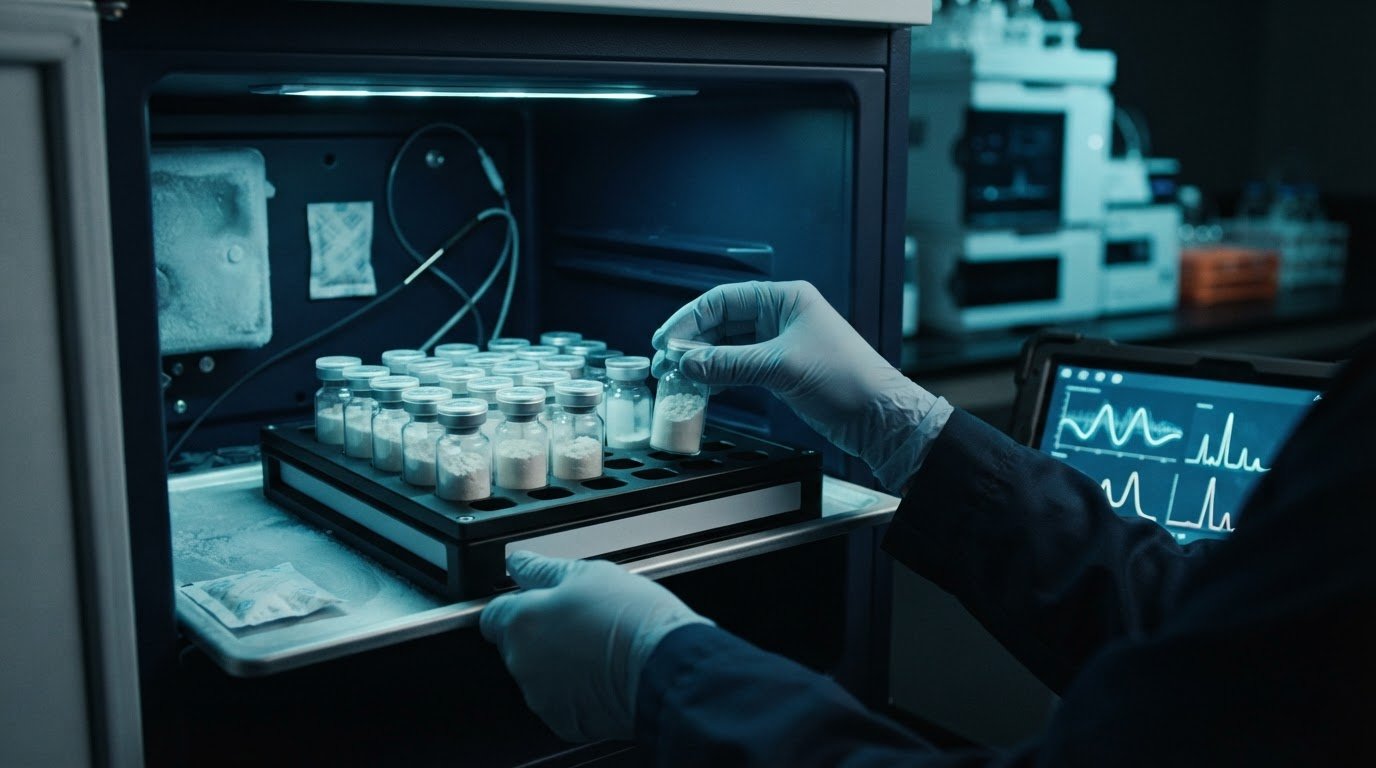
A frozen vial isn’t automatically a protected sample. Low temperature matters, but it isn’t a complete storage plan. How to properly store lyophilized peptides depends on documented, material-specific stability and how the vial is handled between storage and use. Moisture, light, temperature shifts, and repeated access can all create avoidable risks to sample integrity.
For laboratory teams, the challenge is separating general guidance from instructions for a particular peptide or batch. This guide outlines a repeatable, traceable workflow for receipt, storage, and vial access. It distinguishes broad handling principles from conditions that require verification in current product documentation, rather than treating one temperature or shelf life as universal.
You’ll learn how to reduce exposure, distinguish lyophilized from reconstituted material, and record storage decisions consistently. Bluefin Peptides’ research-use-only products are supported by batch-specific certificates of analysis, mass-spectrometry confirmation, and at least 99% HPLC verification. These records support traceability, but they don’t replace product-specific storage instructions.
Key Takeaways
- How to properly store lyophilized peptides starts with the current label and batch documentation, not a one-size-fits-all rule.
- Use a consistent sequence to review instructions, assign storage conditions, and record each vial’s location.
- Protect samples from avoidable moisture, light, contamination, and physical damage during storage and access.
- If a storage change or excursion occurs, document it and assess the available evidence before deciding how to handle the sample.
- Connect product identity, batch records, storage instructions, and monitoring in a traceable workflow. Analytical documentation does not guarantee stability.
How to properly store lyophilized peptides: what preservation depends on
Lyophilized material is a peptide prepared as a dry solid by freeze-drying, while a reconstituted peptide is dissolved in a liquid solvent. This difference matters: removing water can support preservation, but it doesn’t establish a universal storage condition or shelf life. How to properly store lyophilized peptides depends on the specific material and its documented stability, not appearance alone.
What lyophilization changes, and what it does not guarantee
Lyophilization removes water through a controlled freeze-drying process. A general explanation of what preservation depends on helps clarify the method, but the process itself doesn’t prove that every peptide will remain stable under the same conditions.
Stability can depend on the peptide sequence, formulation, packaging, and conditions evaluated in validated stability data. A vial that looks dry provides no reliable visual measure of its remaining stability. General powder-storage principles also can’t establish the appropriate conditions or usable period for a particular vial. Use the label and current batch documentation as the reference for product-specific handling.
Which environmental exposures can affect a dry peptide sample?
Assess the full storage environment, not temperature alone. Lyophilized materials may be hygroscopic, meaning they can absorb moisture from surrounding air. Moisture exposure during opening or handling can therefore matter even when a vial appears dry. Keep the container and packaging protected from unnecessary exposure, and follow the product’s instructions for closure and storage.
Light and heat are also relevant risks to evaluate. Some amino acid residues can be susceptible to light-related changes or oxidation, but sensitivity varies by peptide. Oxygen exposure, repeated temperature changes, and rough handling may also affect a sample or its packaging. These are reasons to limit avoidable exposure, not to assume a fixed degradation rate or universal tolerance.
Use a controlled, documented approach. Record the product identity and batch, follow the specified storage conditions, and minimize unnecessary vial access. If conditions change or the sample is exposed, document what happened and review the available product-specific evidence. A recorded excursion signals uncertainty; by itself, it doesn’t prove that the sample has degraded.
How to choose storage conditions from the label and batch documentation
Generic storage advice can help identify questions to investigate, but it can’t establish the right conditions for a specific peptide. The label, current manufacturer instructions, product-specific stability data, and applicable laboratory SOP should guide the decision. For how to properly store lyophilized peptides, make the basis for each storage assignment traceable.
Which records should a laboratory review before storage?
Review the vial label, batch-specific certificate of analysis (COA), supplied handling notes, and relevant laboratory SOP. These records serve different purposes: a COA provides batch analytical information, while storage instructions or stability data address handling conditions. Don’t treat one document as a substitute for another.
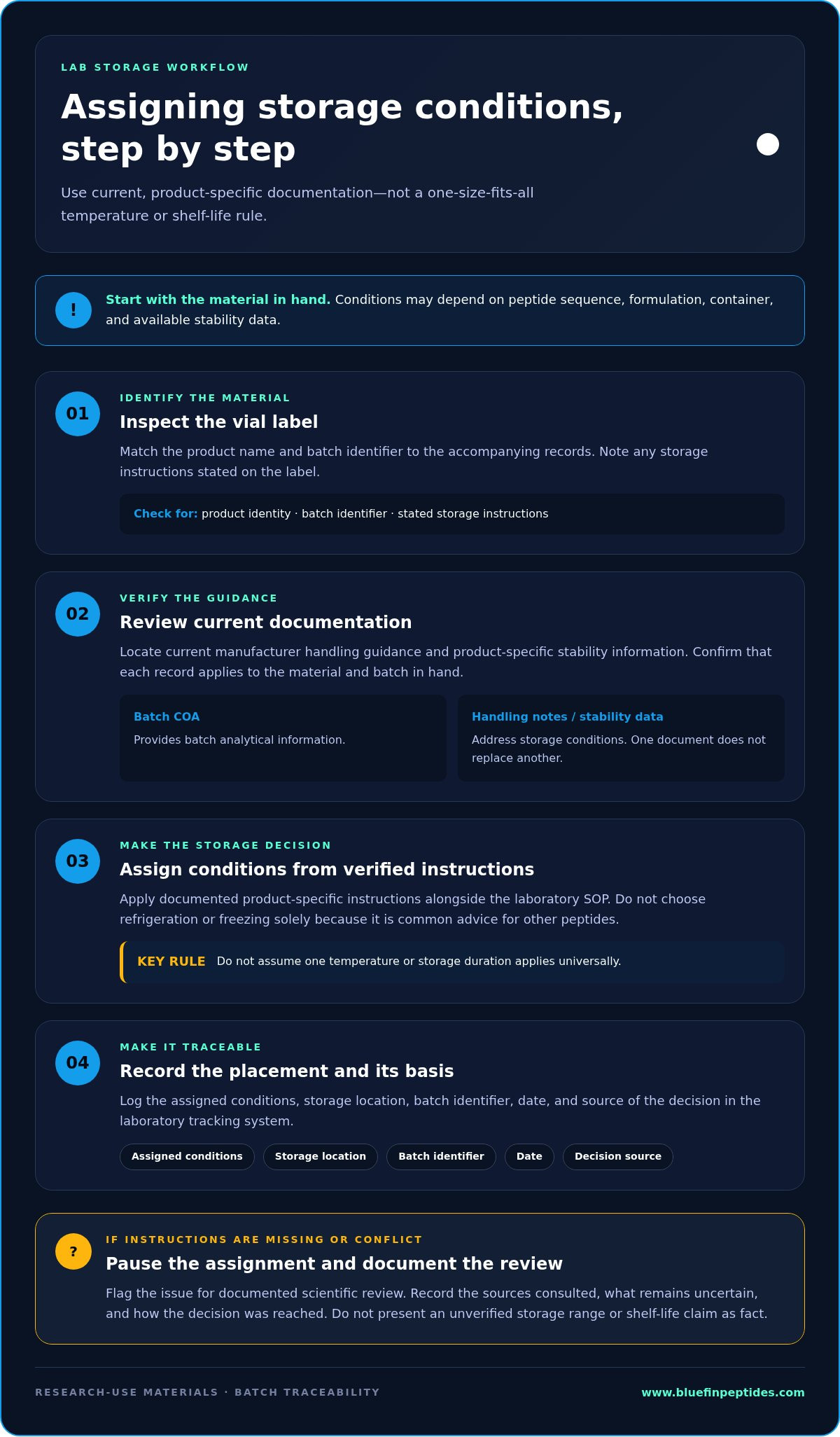
Use this decision sequence:
- 1. Inspect the label. Match the product name and batch identifier to the accompanying records, and note any stated storage instructions.
- 2. Review the documentation. Locate current manufacturer handling guidance and any product-specific stability information. Confirm that the records apply to the material and batch in hand.
- 3. Assign conditions. Apply the documented instructions alongside the laboratory SOP. Don’t select refrigeration or freezing solely because it is common advice for other peptides.
- 4. Record placement. Log the assigned conditions, storage location, batch identifier, date, and source of the decision in the laboratory’s tracking system.
Does every lyophilized peptide require refrigeration or freezing?
No single temperature or storage duration should be assumed to apply universally. Requirements may vary with peptide sequence, formulation, container, and the stability data available for that material. A generic online range can’t resolve those differences.
If instructions are missing or records conflict, flag the issue for documented scientific review before assigning a condition. Record which sources were consulted, what remains uncertain, and how the decision was reached. Don’t present a storage range or shelf-life claim as fact unless it has been verified against current product-specific documentation.
Storage conditions must follow verified, product-specific guidance. This keeps general handling principles separate from claims about a particular vial and makes later review more reliable. Batch traceability supports that process; analytical results alone don’t establish storage stability.
For research-use materials, batch-specific COAs and product documentation provide a practical starting point for a traceable workflow. The research-use peptide catalog includes Bluefin Peptides’ research materials for laboratory procurement review.
How to protect lyophilized peptides during routine laboratory storage
Once product-specific conditions are assigned, make the storage location and handling process consistent with them. Use an organized, access-controlled area that limits unnecessary movement and protects vials from avoidable moisture, light, contamination, and physical damage. These controls support reliable handling; they don’t establish chemical stability for a particular peptide.
How should vials be organized and monitored?
Keep each vial identifiable and linked to its batch documentation. Labels and inventory records should make it possible to distinguish similar materials, locate a sample, and trace its storage history without relying on memory. A practical record can include:
- Product identity and batch identifier
- Receipt date and the source documentation associated with the batch
- Assigned storage location and the documented conditions
- Placement, transfer, access, and relevant condition-excursion events
Follow the laboratory SOP for monitoring and recording storage conditions, including how to document an excursion. Store packaging to protect it from avoidable exposure and damage, while keeping inventory legible and accessible to authorized personnel. Desiccants or additional packaging may suit some workflows, but shouldn’t be treated as necessary for every product unless its instructions or laboratory procedure specify them.
How can a laboratory limit exposure when accessing a vial?
Plan retrieval before opening the storage area. Identify the correct vial and batch, prepare the materials needed for the procedure, and avoid leaving samples outside their documented conditions longer than necessary. Keep the container closed except during the controlled procedure that requires access.
Use the laboratory’s clean-handling practices to reduce contamination and prevent contact between unrelated samples or materials. Return the vial to its assigned location promptly, then update the inventory if the access, transfer, or condition change is relevant under the SOP. These steps create a consistent handling record; they don’t replace peptide-specific stability evidence.
In practice, how to properly store lyophilized peptides involves two linked controls: maintaining the documented environment and preserving a clear record of where each batch has been. Keep those operational controls separate from chemical-stability claims. An organized freezer or storage area can support a disciplined workflow, but only product-specific documentation can substantiate conditions for an individual material.
Handling storage changes or accessed vials
A storage excursion creates uncertainty, not an automatic conclusion about sample integrity. Respond consistently: document the event, isolate the affected material from routine use while it’s assessed, review applicable product-specific evidence, then record the disposition decision. Don’t assume a vial remains suitable if its integrity can’t be established.
How should a laboratory document a temperature or handling excursion?
Capture the details while they’re available. Record when the event began and ended, the known conditions, the affected product and batch, and how the information was obtained, such as a monitoring record or staff observation. If the duration or conditions are unknown, state that clearly rather than filling gaps with estimates.
Keep the vial identifiable and its history linked to the batch record while responsible laboratory personnel review the manufacturer’s current instructions, relevant stability evidence, and laboratory SOP. An excursion entry documents what happened; it doesn’t prove degradation. The evidence may also be insufficient to establish that the material remains suitable. Don’t apply a universal acceptance threshold or automatic discard rule when product-specific guidance and laboratory procedures don’t support one.
Does opening a vial change its storage requirements?
Access can introduce moisture or contamination, so use the controlled handling procedure specified by the laboratory and product documentation. Keep the container closed except during the procedure that requires access, and record relevant opening or handling events according to the SOP. The appropriate controls depend on the vial and research workflow.
Keep the material’s physical state clear in records. An accessed vial that still contains dry material isn’t the same as a reconstituted solution. Once material is dissolved, its handling and stability considerations change. Use the separate reconstitution protocol and applicable post-reconstitution data rather than carrying over dry-vial assumptions.
For a decision that affects a study, preserve traceability from event record to review and disposition. If available evidence doesn’t resolve uncertainty, follow the laboratory’s established scientific review process before using the material. This is a core part of how to properly store lyophilized peptides: manage changes with records and evidence, not assumptions.
Bluefin Peptides’ research peptide catalog presents research-use materials with batch-specific documentation for procurement records.
Build a traceable peptide-storage workflow around verified research materials
A reliable storage workflow connects each vial to its identity, batch record, assigned conditions, and handling history. The aim isn’t to create more paperwork. It’s to make storage decisions reproducible and reviewable, especially when a sample changes location or an unexpected event occurs.
What belongs in a laboratory storage record?
Use a consistent record for every material, whether it’s maintained in an electronic inventory or a controlled laboratory log. Include:
- Product identity: Name or identifier shown on the vial.
- Batch traceability: Batch number linked to its certificate of analysis and associated documentation.
- Receipt and placement: Receipt date, assigned storage location, and documented storage conditions.
- Instruction source: The document supporting the selected conditions and the date it was reviewed.
- Storage history: Relevant monitoring records, access or transfer events, deviations, and disposition decisions, recorded under the laboratory’s controlled procedures.
This record lets another qualified team member follow the decision trail without relying on informal notes or memory. Update it when instructions are reviewed or conditions change, and preserve prior entries so the sample’s history remains clear.
How do batch records support a defensible storage process?
A batch-specific certificate of analysis (COA) links analytical information to the material received and supports identity and quality review. Bluefin Peptides’ research-use-only peptides are at least 99% HPLC-verified and mass-spectrometry confirmed, with batch-specific COAs. These analytical records provide traceability, but they don’t establish storage conditions or guarantee a shelf life.
Keep the roles of records distinct. Use analytical documentation to review batch information, and current product-specific handling instructions or stability data to assign and assess storage conditions. For a broader explanation of analytical quality standards for research peptides, consult the relevant quality guide alongside the batch records when it’s available in your laboratory’s reference set.
Workflow check: Match the vial to its batch, link the batch record, document the source of storage instructions, record placement and monitoring, and use controlled procedures for access or deviations. That is the practical foundation for how to properly store lyophilized peptides without turning general handling principles into unsupported product-specific claims.
Qualified researchers can include Bluefin Peptides’ research-use catalog in a documented procurement process.
Make every storage decision traceable
Reliable peptide preservation starts with product-specific instructions, not a universal temperature or shelf-life assumption. Review the label and batch documentation, assign conditions from verified guidance, and record where each vial is stored. Protect samples during routine access, and document excursions so uncertainty can be reviewed rather than mistaken for proof of degradation.
To apply how to properly store lyophilized peptides in daily laboratory practice, connect product identity, batch records, storage instructions, and monitoring in one repeatable workflow. Keep analytical evidence in its proper role: Bluefin Peptides’ research-use-only products are at least 99% HPLC-verified, mass-spectrometry confirmed, and accompanied by batch-specific certificates of analysis. These records support identity and quality review, not a storage guarantee or shelf-life claim.
For qualified research, explore Bluefin Peptides’ research-use catalog, including Retatrutide Research Peptide, and review the batch documentation as part of your procurement process. Start with product-specific instructions, then keep each storage step traceable.
Frequently Asked Questions
How should lyophilized peptides be stored?
Store each lyophilized peptide according to its current label, manufacturer instructions, and product-specific stability data. General guidance often distinguishes short-term refrigeration from colder conditions for longer storage, but these are not universal prescriptions. Link the selected conditions to the vial’s batch documentation, record its storage location, and protect it from avoidable moisture, light, and handling exposure. A dry appearance alone doesn’t establish suitable conditions or shelf life.
Do lyophilized peptides need to be refrigerated?
Not necessarily. Refrigeration may suit some materials and storage periods, but the appropriate conditions depend on the peptide, formulation, packaging, and available stability data. Don’t refrigerate a vial solely because a general online guide recommends it, and don’t assume refrigeration is adequate for every material. Review the current product documentation and laboratory SOP, then record the source for the assigned condition.
Can lyophilized peptides be stored at room temperature?
Lyophilized peptides may tolerate room temperature for a limited period, such as during shipping, but that doesn’t make room temperature a suitable long-term storage condition. General guidance describes short periods ranging from days to a couple of weeks, though the actual tolerance depends on the material and its documentation. For a specific vial, follow its current instructions and assess any extended exposure using product-specific evidence.
How long do lyophilized peptides remain stable?
There’s no single shelf life for all lyophilized peptides. General guidance reports that many can remain stable for one to five years at -20°C, but this range isn’t a guarantee for a specific sequence, formulation, or batch. Use a shelf life or stability period only when supported by current product-specific data. If that information isn’t available, avoid assigning an assumed expiry from a generic range.
Should lyophilized peptides be protected from moisture and light?
Yes. Control avoidable moisture and light exposure, especially because some dry materials can absorb moisture and certain peptide residues may be light-sensitive. Keep vials closed when not in use and protect them from unnecessary exposure in line with product instructions and laboratory procedures. These are prudent handling controls, not proof that every peptide has identical sensitivities or that protection guarantees stability.
Does opening a lyophilized peptide vial affect its storage?
Opening a vial can introduce moisture or contamination, so access should follow the laboratory’s controlled handling procedure and the product documentation. Keep the vial closed except when the procedure requires access, and record relevant handling events under the applicable SOP. An opened vial that still contains dry material is distinct from a reconstituted solution. Use separate instructions and stability data for material after it has been dissolved.
Can lyophilized peptides be frozen?
Freezing is used as a storage approach for some lyophilized peptides, but it shouldn’t be assumed necessary or appropriate for every product. General recommendations commonly refer to -20°C or colder for longer-term storage, yet the correct condition depends on product-specific evidence and manufacturer instructions. Verify the guidance for the batch, use a monitored storage location consistent with it, and document placement. Freezing alone doesn’t establish a sample’s stability or shelf life.
What should a laboratory do after a storage excursion?
Document the event, identify and isolate the affected batch from routine use while it’s reviewed, assess the applicable product-specific evidence, and record the disposition decision. Include the timing, known conditions, affected vial or batch, and information source. An excursion record doesn’t prove degradation, but uncertainty also doesn’t establish sample integrity. Follow the laboratory’s review procedures, and don’t use material if its integrity can’t be established.
For laboratory research use only. Not for human or veterinary use. This content is educational and does not constitute medical, dosing, or usage guidance.
Browse the BLUEFIN catalog