Handling and Disposal of Research Peptides: A Laboratory Guide
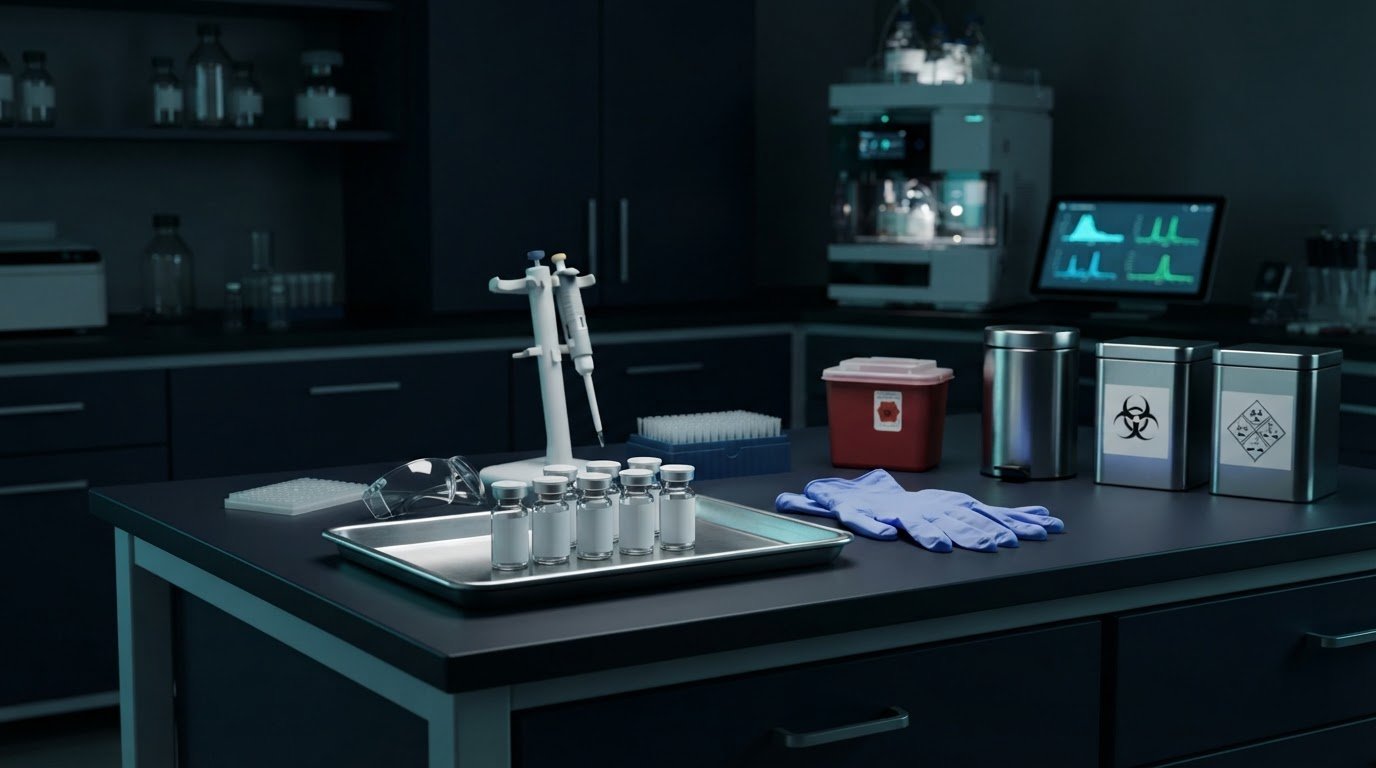
A peptide vial isn't ordinary laboratory trash. The appropriate handling and disposal of research peptides depend on the material’s documented hazards, formulation, and any solvents or sharps involved. If exposure risks, contamination, or the correct waste stream are unclear, pause and verify rather than assuming the peptide itself determines the disposal route.
This guide explains how to review product-specific safety documentation and laboratory procedures before work begins, choose controls for routine handling, and respond consistently to a spill. It also covers how to segregate peptide-containing materials and route them through a documented waste process. Batch-specific certificates of analysis can support inventory traceability, but they do not replace an SDS or hazard assessment. The aim is a clear, repeatable process grounded in documentation and your laboratory’s requirements.
Key Takeaways
- Assess each peptide using its specific formulation, concentration, use conditions, and current safety documentation. Don’t assume hazards from the peptide name alone.
- Before routine work, review laboratory procedures, prepare the workspace, and choose PPE and engineering controls based on the SDS and institutional risk assessment.
- For an unknown, significant, or uncontrolled spill, isolate the area and follow the site emergency plan instead of attempting an improvised cleanup.
- Effective handling and disposal of research peptides depends on identifying all components, segregating waste correctly, and using the laboratory’s documented disposal route.
- Include receipt, training, incident response, waste handling, and recordkeeping in a written SOP. Review it when materials or procedures change.
Research Peptide Handling Starts With a Material-Specific Hazard Review
Research peptide handling covers receiving, inspecting, using, containing, and managing waste from peptide materials. Each stage starts with the material in hand, not a general assumption about peptides as a class. Identity, formulation, concentration, physical form, and intended laboratory conditions all inform the hazard assessment. Foundational information on peptide structure and classification is available in What are Peptides?, but general background cannot determine the controls for a specific product.
Review the SDS and complete a material-specific assessment before routine handling. These are the starting points for understanding what is known about the material and which procedures apply. Use the current Safety Data Sheet (SDS), container label, institutional risk assessment, and local Environmental Health and Safety (EHS) procedures as working references. Research-grade status, HPLC purity, or mass-spectrometry confirmation may inform identity or analytical quality, but none establishes a safety classification or waste route. A batch certificate of analysis can connect a container to inventory records, but it does not replace the SDS.
Which documents should researchers review before opening a peptide?
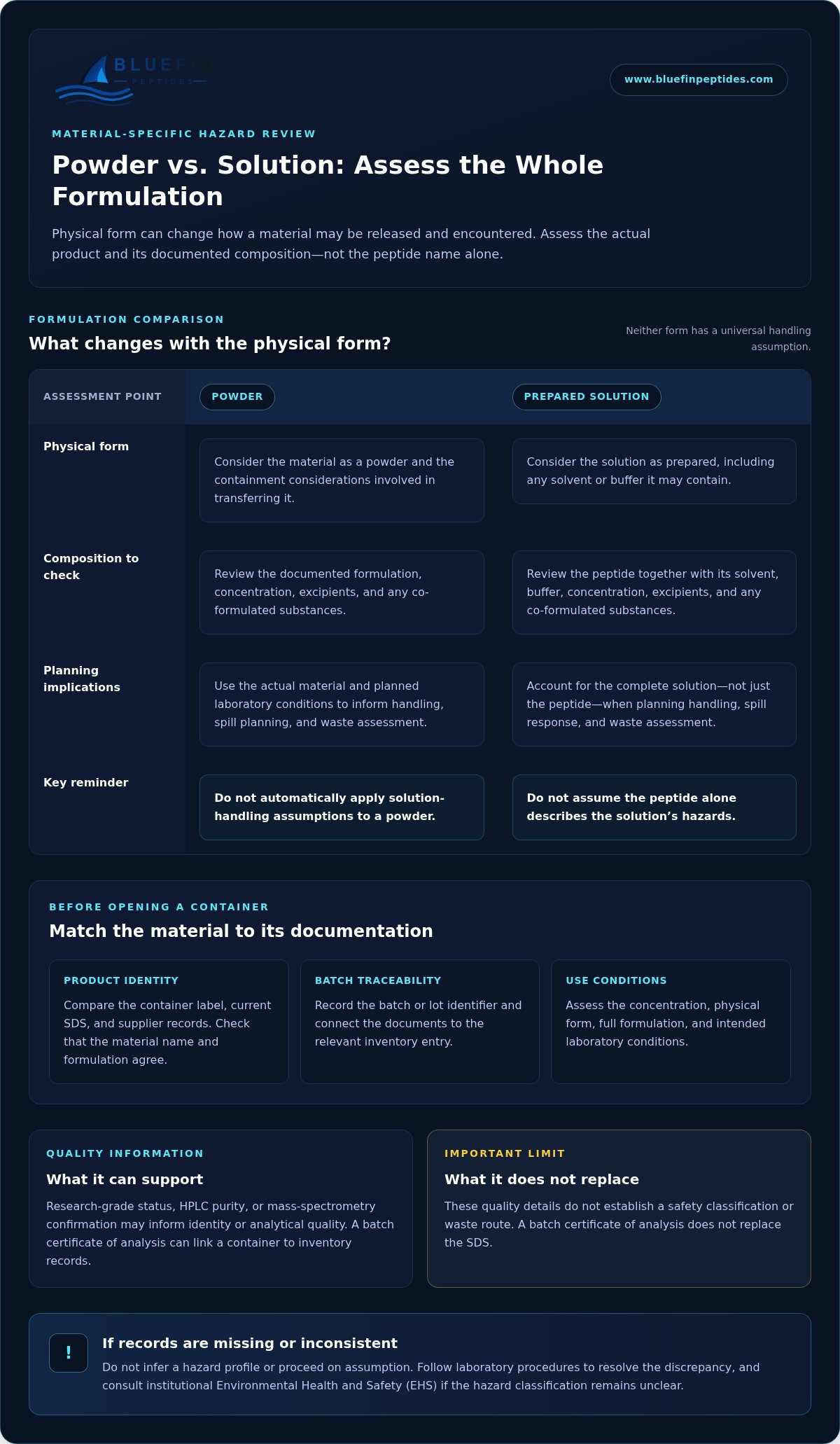
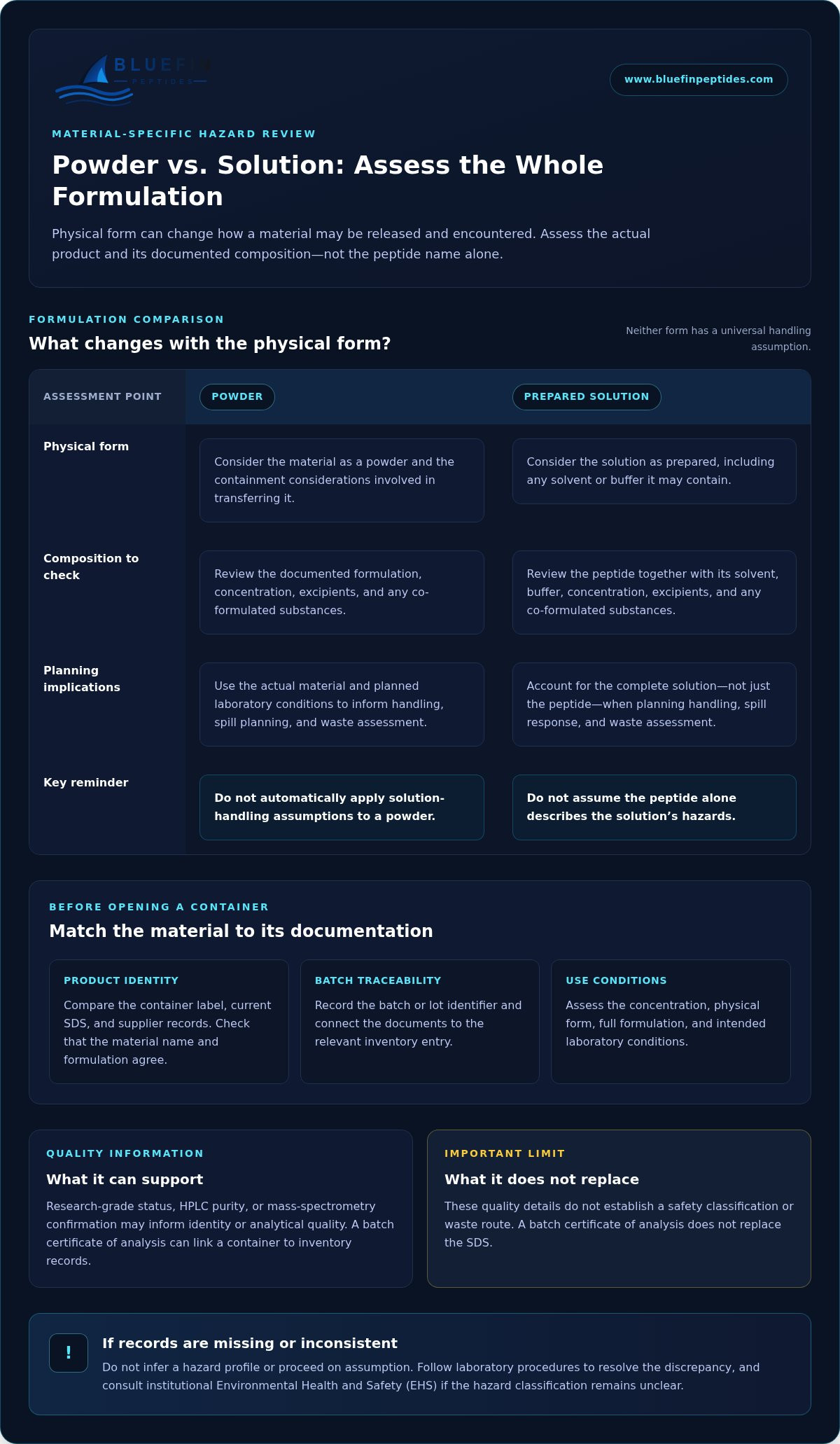
Before opening a container, compare its label with the current SDS and supplier documentation. Check that the material name, formulation, and batch or lot identifier match across the records. If a document is missing, outdated, or inconsistent with the label, don’t infer a hazard profile or proceed on assumption. Follow laboratory procedures to resolve the discrepancy, and consult institutional EHS if the hazard classification remains unclear.
- Match the product identity and formulation across the label, SDS, and supplier records.
- Record the batch identifier so the material can be traced to its documentation.
- Escalate unresolved differences through the laboratory’s established EHS process.
Why do peptide powders and solutions require separate assessments?
Physical form affects how a material may be released and encountered, so a powder and a prepared solution shouldn’t automatically share the same handling assumptions. A solution may include a solvent or buffer, while transferring a powder can raise different containment considerations. Review the actual composition, concentration, excipients, and any co-formulated substances. These details also inform spill planning and waste assessment. The peptide name alone is not enough.
- Identify whether the container holds a powder, solution, or mixture.
- Check the solvent, buffer, excipients, and concentration stated in the documentation.
- Assess the full formulation and planned use conditions, not just the peptide component.
This review provides a documented starting point for handling and disposal of research peptides. Link the records to the relevant inventory entry. If product information doesn’t resolve a hazard or classification question, use institutional procedures to determine the next step.
Set Up Research Peptide Handling Controls Before Routine Work
Once the material-specific review is complete, turn it into a repeatable pre-work sequence. Confirm staff training and current laboratory procedures, identify the material against its label and records, prepare the designated work area, assemble the required controls, and label receiving containers before transfer. Select PPE and engineering controls according to the SDS and institutional risk assessment. No single glove, enclosure, or handling method suits every formulation and task.
Plan the work to minimize dust, aerosols, splashes, and unnecessary transfers, using methods specified by laboratory procedures. Keep food, drink, personal belongings, and unrelated materials outside designated work areas. Written controls, suitable containment, and task-specific training make expectations clear before a container is opened and help reduce preventable exposure.
- Review: Verify training, current procedures, material identity, and required controls.
- Prepare: Clear and organize the designated work area. Gather compatible containers and equipment.
- Control: Apply the PPE and engineering controls identified in the SDS and risk assessment.
- Close out: Follow laboratory procedures for hand hygiene, surface decontamination, inventory checks, and securing materials.
What should a routine handling checklist include?
A useful checklist makes readiness verifiable rather than assumed. Confirm that the person performing the task is trained, the applicable procedure is current, and the material and batch identifiers match the records. Prepare compatible, clearly labelled containers before work begins, and confirm that the workspace is designated for the task. Include post-work hygiene, surface decontamination, and inventory checks as directed by laboratory procedures.
How should researchers prevent cross-contamination?
Use dedicated tools when required, or clean reusable equipment according to the laboratory SOP. Keep peptide materials separate from unrelated samples, and maintain legible labels during every transfer. Record movements so container contents remain traceable. Then close and secure materials promptly, following documented storage instructions. These steps support reliable inventory records and help prevent mix-ups between materials or batches.
Consistency matters throughout the workflow. A clearly marked work zone, prepared containers, and a completed closeout check help keep routine handling aligned with the risk assessment and make deviations easier to spot. Bluefin Peptides offers research-grade peptides for laboratory research with batch-specific documentation to support inventory traceability. That documentation does not replace the SDS or institutional controls.
Choose the Right Response for Peptide Spills and Exposure
A spill response should follow a prepared sequence, not an improvised cleanup. Use the current SDS, the site emergency plan, and instructions from personnel trained for the incident. Formulation and other components, including solvents, may affect the response. Don’t assume a peptide spill can be treated like a routine powder or liquid spill.
Protect people first. Stop work, alert nearby personnel, and restrict access as directed by site procedures. Then determine whether the event meets the laboratory’s criteria for a minor incident that trained staff may manage. If the material or quantity is unknown, the release is significant or uncontrolled, or the situation exceeds staff training, prioritize isolation and escalation. Evacuate or request emergency response when the site plan calls for it.
What should staff do immediately after a spill?
Follow the local spill plan and consult the SDS before selecting cleanup methods or protective equipment. Don’t apply a universal neutralizer, disinfectant, or cleanup technique. Suitability depends on the material and formulation. If the risk is uncertain, keep others clear and contact EHS or emergency responders through the established channel.
- Stop work and alert people in the affected area.
- Prevent access and isolate the area as directed by the site procedure.
- Check the SDS and spill plan to determine whether trained staff can respond.
- Escalate if the release is unknown, significant, uncontrolled, or beyond staff training.
How should exposure or contamination be reported?
For suspected exposure, promptly follow site-specific first-aid and emergency instructions. Don’t substitute a general online procedure for the institution’s instructions. Notify the designated reporting channel so the event can be assessed and documented. Report promptly even if the exposure route or amount is uncertain. Accurate early details support appropriate follow-up.
Record information while it is available. Include the material identity and batch identifier, if known, its formulation, the approximate amount released, the location, and the circumstances. Note who was affected or potentially exposed, what immediate actions were taken, and which personnel or institutional groups were notified. Keep the record in the institution’s incident-reporting system and follow instructions for any additional documentation.
After the area is controlled, don’t return to routine work until the site plan permits it and any required assessment or cleanup is complete. Record relevant findings for the laboratory’s incident procedures. This closes the response loop and helps keep handling and disposal of research peptides aligned with material documentation, staff training, and institutional requirements.
Dispose of Research Peptides Through a Documented Waste Route
There is no universal disposal route for peptide-containing waste. Its classification depends on what else is present, how the material was used, and which requirements apply. A peptide alone, a peptide solution with solvent, and material contaminated during laboratory work may need different assessments. Don’t assume any of them can go down a sink or into ordinary trash, and don’t use a universal treatment method.
Use a documented decision sequence: identify the contents and formulation, review the SDS and relevant records, assess the complete waste stream, segregate and label it, then follow institutional procedures for disposal. Classification depends on composition, contamination, applicable federal, state, and local requirements, and institutional determinations. If the classification is unclear, pause and consult institutional Environmental Health and Safety (EHS).
- Identify: Record the peptide, formulation, and other known components.
- Review: Consult the current SDS and applicable laboratory procedures.
- Assess: Consider solvents, contaminants, and how the waste was generated.
- Segregate and label: Follow site requirements for compatible containers and waste labels.
- Route: Use the institution’s designated collection and disposal process.
How should peptide-containing waste be segregated and labelled?
Separate waste streams according to institutional procedures and the assessed characteristics of their contents. Use compatible, closed containers and the labels required by the site. Make the waste description clear and accurate. Record contents and known hazards without assigning a classification that hasn’t been determined through the appropriate institutional process. Batch or inventory records can help trace material identity, but they don’t establish the waste classification.
What determines whether a waste stream is regulated?
An assessment may consider the material’s identity, solvents, contaminants, quantity, and requirements that apply in the jurisdiction. The Resource Conservation and Recovery Act (RCRA) may be relevant, but its applicability to a particular waste stream must be determined through appropriate institutional procedures. Don’t classify a peptide as inherently hazardous or nonhazardous based on its name or research-grade status alone.
Keep the decision and route traceable. Document what was discarded, the basis for the institutional determination, the container or waste stream used, and any required transfer or collection record. If information is incomplete, seek EHS guidance before combining materials or moving waste into another stream. Purity or identity testing, including an HPLC result or mass-spectrometry confirmation, does not replace a waste assessment.
Responsible handling and disposal of research peptides depends on a clear record from material identity through final waste routing. For qualified laboratory research, explore Bluefin Peptides research-grade peptides and their batch documentation as part of a traceable inventory process.
Make Peptide Handling and Disposal Part of the Laboratory SOP
A written standard operating procedure turns individual safety decisions into a consistent laboratory workflow. Cover receipt and inventory, document review, staff training, routine handling, incident response, waste assessment and routing, and recordkeeping. Assign responsibility for each step so staff know who verifies documentation, who authorizes waste decisions, and where records are maintained.
Build review triggers into the SOP. Reassess it when a new formulation enters the laboratory, an SDS is revised, or institutional procedures change. Review it after an incident, too, or whenever the documented workflow no longer matches routine practice. This keeps procedures aligned with current materials and local requirements instead of outdated assumptions.
- Define how materials are received, identified, documented, and entered into inventory.
- Specify training, handling controls, and the approved process for reporting incidents.
- Describe how waste is assessed, segregated, labelled, and routed under institutional procedures.
- Set responsibilities for recordkeeping and periodic SOP review.
What records make the process auditable?
Maintain product identity, batch details, SDS version, receipt date, and assigned storage location. Preserve records of staff training, procedural revisions, incidents, waste decisions, and authorized handoffs. Link records where practical so an inventory entry can be traced to supporting documentation and subsequent handling or disposal records. Follow institutional requirements for record retention and access.
How can supplier documentation support responsible research?
A batch-specific certificate of analysis (COA) helps connect received material with its analytical documentation and supports inventory traceability. Bluefin Peptides offers research peptides that are at least 99% HPLC-verified, with mass-spectrometry confirmation and batch-specific COAs. These details describe analytical quality and identity support. They don’t establish a hazard classification or determine a waste route. Those decisions rely on the laboratory’s assessment and procedures.
Keep the distinction clear in the SOP: COAs support traceability, while the SDS, risk assessment, and institutional determinations guide safety and disposal decisions. For further context, review the article on analytical quality standards for research peptides and the batch COA guide alongside the laboratory’s own procedures. This helps staff use each document for its intended purpose.
A complete SOP makes the handling and disposal of research peptides traceable from receipt through waste routing. Assign an owner to monitor review triggers, document revisions, and ensure staff can access the current procedure before work begins. The result is a controlled process that can be followed, recorded, and reviewed.
Keep Laboratory Procedures Current
Schedule a review of how your laboratory puts its written procedure into practice. Confirm that staff can find current documents, know where to record decisions, and understand who handles questions when a material or waste stream falls outside routine work. A short, documented review can reveal gaps before a change in formulation, personnel, or institutional process.
Use supplier records as one part of the traceability chain, alongside your laboratory’s own assessment and controls. Bluefin Peptides offers research peptides that are at least 99% HPLC-verified, with mass-spectrometry confirmation and batch-specific COAs. These analytical records support traceability, but they don’t replace the SDS, hazard assessment, or institutional waste determination.
For the handling and disposal of research peptides, consistency comes from connecting each decision to its documentation and procedure. Review Bluefin Peptides’ research-grade peptide documentation as you maintain your laboratory’s inventory records. A clear process helps your team work with greater confidence and accountability.
Frequently Asked Questions
How should research peptides be handled in a laboratory?
Handle each research peptide under a procedure based on its current documentation and the task being performed. Before work, verify that the container and inventory record match, prepare the designated area, and confirm the required controls are available. For example, opening a powder vial and transferring a prepared solution may raise different containment concerns. Keep materials identified during work, and record transfers so their contents remain traceable.
Can research peptides be thrown in the regular trash?
Don’t place peptide-containing material in regular trash unless your institution’s waste procedure specifically permits that route after assessment. Used containers, contaminated wipes, and unused material may have different waste characteristics, especially if solvents or other substances are present. Keep items contained and identified while the waste determination is made. If the correct stream is unclear, ask institutional Environmental Health and Safety before discarding or combining anything.
Can research peptides be poured down the drain?
Don’t pour a peptide solution down the drain based solely on its appearance or the identity of the peptide. The solvent, buffer, concentration, contaminants, and applicable local requirements can affect the decision. Keep the solution in a suitable, identified container while following your laboratory’s waste procedure. Use a drain route only if the institution has explicitly assessed and authorized it for that specific material and circumstance.
What should I do if a research peptide spills?
Stop work, alert nearby staff, and follow the site spill plan. A small release may be manageable only if the procedure covers that material and trained personnel can use the specified controls. If the material is unidentified, the release is uncontrolled, or someone may have been exposed, keep people away and escalate through the institutional emergency channel. Record what happened and follow site instructions before resuming work.
Do lyophilized peptide powders require special handling?
Yes. Treat a lyophilized powder as a distinct physical form, and follow its SDS and the laboratory’s assessment rather than assuming it has the same exposure profile as a solution. To reduce condensation during opening, allow a cold vial to reach room temperature in a desiccator before opening, as specified in the product handling guidance. Plan containment for the task and avoid actions that could disperse powder.
Does a high-purity COA tell me how to dispose of a peptide?
No. A certificate of analysis documents analytical information, not a waste classification or disposal route. It can help trace a received batch, but disposal decisions require a separate assessment of the full waste composition and the institution’s applicable procedures.
Are all research peptides hazardous materials?
No universal hazard conclusion applies to every research peptide. Classification depends on the specific substance, formulation, concentration, and conditions of use, as well as the relevant assessment process. A peptide’s research-grade status or analytical purity does not establish that it is hazardous or nonhazardous. Review the current SDS and institutional determination for the material in hand, including any solvent, excipient, or contaminant in the formulation.
For laboratory research use only. Not for human or veterinary use. This content is educational and does not constitute medical, dosing, or usage guidance.
Browse the BLUEFIN catalog