Guide to Buffer Selection for Peptide Reconstitution
The buffer that dissolves a peptide isn’t automatically the right buffer for the experiment. That’s the central challenge in buffer selection for peptide reconstitution: a choice that improves apparent solubility may also affect peptide stability or interfere with a downstream assay. No single formulation suits every sequence and research context.
A defensible choice starts with the peptide’s chemistry and the conditions it will encounter. Charge, hydrophobicity, target pH, ionic strength, concentration, and assay compatibility all matter. Published methods can offer useful starting points, but a reported buffer may not transfer reliably without a close match in sequence and experimental context.
This guide explains which variables to assess and how to compare candidate buffer systems without treating any one recipe as universal. It also covers controls and documentation, helping you distinguish solubility effects from assay effects and make results easier to interpret and reproduce.
Key Takeaways
- Define the intended laboratory workflow before choosing a buffer, and distinguish reconstitution from later dilution or assay preparation.
- Use sequence features, including charge, hydrophobicity, and terminal modifications, to guide solubility assessment. pH and ionic strength alone don’t establish stability.
- Evaluate buffer selection for peptide reconstitution by comparing candidate properties with assay requirements, not by popularity or presumed universal suitability.
- Check published methods for the same peptide and experimental endpoint, then document the rationale, conditions, and controls used in your evaluation.
- Interpret supplier documentation within its scope: HPLC and mass spectrometry address different analytical questions, while a certificate of analysis doesn’t establish assay-specific buffer compatibility.
Buffer selection for peptide reconstitution starts with the experimental question
Reconstitution isn’t a universal preparation step with a fixed recipe. It means preparing a lyophilized research material in a liquid system for a defined laboratory workflow. The conditions must suit the intended use, not simply produce a clear-looking solution.
Buffer selection for peptide reconstitution is the process of choosing and evaluating a solution system against a peptide’s properties and the requirements of a specified experiment. It isn’t a matter of applying one recipe to every sequence. This distinction keeps the decision evidence-led and makes the resulting conditions easier to interpret.
What the word reconstitution means in peptide research
In this context, reconstitution means preparing research material for laboratory investigation, not preparing it for administration. It’s also distinct from dilution, which adjusts the concentration of a solution that has already been prepared, and assay preparation, which may involve additional reagents or conditions needed for a particular measurement.
The term can also describe specialized processes. For example, biological reconstitution of a peptide-loading complex concerns assembling a multi-component system for study. That’s a different objective from dissolving an isolated lyophilized peptide. Keep the scope clear before applying a method or interpreting its reported conditions.
Why the experiment must lead the decision
Start by defining the target assay, the measurement it will produce, and the conditions the sample must meet. A candidate system may support dissolution yet still alter the assay signal, interact with a detection method, or fail to preserve the sample under the planned conditions. Solubility may be necessary for a workflow, but it doesn’t establish assay compatibility.
Buffer properties matter in context. A buffer solution resists pH changes over a working range, and its pKa helps determine whether that range fits the experiment. Neither buffer capacity nor a suitable pH, considered alone, guarantees peptide stability or a valid readout.
Published methods can help narrow the options, but they’re evidence to assess, not recipes to transfer automatically. Check whether a study used the same peptide, concentration, assay endpoint, and relevant sample conditions. Differences in sequence or workflow can change what a preparation system needs to accomplish.
- Define the endpoint: Identify the assay and the measurement criteria.
- Specify sample conditions: Record the required concentration and relevant experimental conditions.
- Assess compatibility: Consider both peptide solubility and possible effects on the assay.
These steps establish a defensible starting point. Next, assess how the peptide’s chemistry and the buffer’s properties interact.
How peptide chemistry and buffer properties shape reconstitution
Once the workflow is defined, assess the peptide and the solution together. Sequence composition, net charge, hydrophobicity, and terminal modifications can guide solubility screening, but none specifies a universally suitable buffer. Peptide identity and assay conditions jointly determine which reconstitution systems are worth evaluating.
Assess peptide-specific properties before comparing buffers
Review the sequence and any documented modifications, then check product documentation and relevant literature for peptide-specific handling information. Charged residues and modifications can affect ionization, while hydrophobic regions may complicate behavior in aqueous solutions. These features are reasons to evaluate candidate conditions, not grounds to assume that a particular solvent or pH will work.
Describe observations precisely. Incomplete dissolution means visible material remains. Precipitation refers to material separating from solution after preparation. Aggregation involves associated peptide species and may require an analytical method to detect. These observations aren’t interchangeable. Record the conditions and evidence, and verify sequence-specific solubility claims against a suitable source before relying on them.
Bachem’s peptide handling and storage guidelines provide background for considering peptide properties during solubilization. Treat such guidance as a starting point, then assess whether its conditions apply to the material and workflow under study.
Evaluate pH, ionic strength, and buffer components
pH affects the ionization state of peptide groups and can change observed solubility or other behavior under defined conditions. Ionic strength can also influence molecular interactions. Neither variable establishes stability on its own. Results depend on the peptide, concentration, temperature, duration, and experimental matrix.
Assess buffer capacity across the pH range relevant to the assay, not just at the nominal starting pH. Then review every component for possible assay effects. Salts may alter ionic conditions, chelators can bind metal ions, and detergents or other additives may influence interactions or detection. Compatibility depends on the endpoint and measurement method.
- Peptide: Check sequence, net charge, hydrophobicity, and known modifications.
- Solution: Evaluate pH, ionic strength, buffer capacity, and additives.
- Assay: Confirm that the system won’t confound the readout or required sample conditions.
Published methods help establish context, but compare peptide identity, matrix, concentration, and assay before adapting their conditions. Supplier information can also help identify material-specific documentation for laboratory research. Review research peptide information as one input, not a substitute for experimental validation.
Compare candidate buffer systems by compatibility, not by popularity
No buffer family is preferred independently of the peptide and workflow. For buffer selection for peptide reconstitution, compare candidate systems against the target pH range, required buffering capacity, ionic conditions, sample matrix, and assay constraints. The buffer families below are examples to evaluate, not interchangeable options or recommendations.
Build a conditional comparison of common buffer families
| Buffer family | Properties to assess | Assay fit to verify | Unresolved risks |
|---|---|---|---|
| Phosphate | Target pH range, capacity, and contribution to ionic conditions | Compatibility with the assay matrix and detection method | Potential effects on binding, enzymatic activity, or measurement must be checked for the specific method |
| Tris | Target pH range and buffering behavior under the planned conditions | Whether the assay or instrument specifies composition or pH constraints | Confirm that the system remains suitable across the workflow’s relevant conditions |
| HEPES | Target pH range, capacity, and ionic contribution | Compatibility with assay components and readout | Don’t infer peptide stability or assay performance from buffer identity alone |
These entries are comparison prompts, not claims that a buffer is compatible or incompatible with a particular peptide or assay. Verify buffer-specific properties and limitations in primary literature, validated protocols, and relevant assay documentation. Record the source and its experimental context.
Check downstream assay and instrument compatibility
Trace each component through to the final measurement. Salts or other additives may affect binding or enzyme activity, while buffer constituents can influence optical signals or chromatographic behavior. These are risks to investigate, not automatic exclusions. Check the assay method and instrument documentation for composition constraints, and consult the laboratory’s analytical quality standards guide when documenting measurement conditions and acceptance criteria.
Keep solvent choice distinct from buffer choice. A solvent is the liquid used to dissolve or carry the material. A buffer is formulated to resist pH change within a working range. Some methods discuss these separately, while others describe a complete preparation system. Follow the source’s terminology and verify whether its reported conditions refer to the initial solvent, the buffered sample, or the final assay mixture.
A defensible comparison makes uncertainties visible. If the peptide, matrix, or endpoint differs from a published method, treat its buffer conditions as a candidate to test, not a protocol to adopt unchanged.
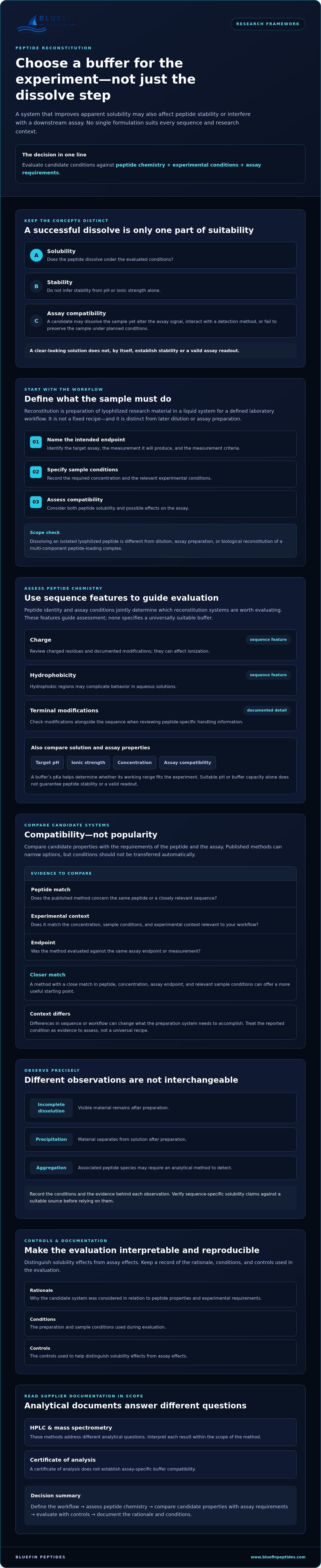
Use a documented workflow to select and evaluate a reconstitution buffer
A transparent decision process makes buffer selection for peptide reconstitution easier to review, repeat, and refine. It also helps prevent a published condition from being mistaken for proof of compatibility in a different experimental system.
A decision sequence for narrowing candidate conditions
- Define the experiment. Record peptide identity, intended endpoint, sample matrix, target concentration, and assay or instrument constraints. Include known sequence modifications that could affect how you assess candidate conditions.
- Search for relevant precedent. Review primary literature and validated method documentation, prioritizing studies that use the same peptide and endpoint. Compare concentration, matrix, measurement method, and other conditions before treating a reported buffer as relevant.
- Build a candidate rationale. For each system under consideration, document the supporting source, relevant properties, and possible assay conflicts. Note why a candidate advances or is excluded, and make unresolved compatibility questions explicit.
- Plan a limited evaluation. Use an appropriately scoped pilot to assess selected candidates under the laboratory’s established procedures. Define observations and acceptance criteria in advance, and choose controls based on the specific assay method rather than a generic template.
- Review and update. Compare results with the predefined criteria, record deviations, and revise the rationale when evidence warrants. Retain enough detail for another researcher to understand what was evaluated and why.
Literature precedent identifies a candidate. Evaluation in the intended experimental system determines whether it fits that system. A close match between a published method and the planned work strengthens the rationale, but it doesn’t remove the need to assess performance in context.
Controls, records, and interpretation
Controls should help distinguish effects of the peptide, buffer, and assay itself. Their form depends on the endpoint and laboratory requirements, so consult the validated method and relevant quality procedures when planning them. Don’t assume one set of controls answers every compatibility question.
Record buffer composition and preparation metadata, sample observations, assay conditions, deviations, and the source documents used to choose candidate conditions. Link relevant batch documentation to the experimental record where applicable, while keeping supplier analytical results distinct from evidence of buffer performance.
Unexpected observations are signals to investigate, not proof of a single cause. A change in readout could reflect buffer components, sample handling, peptide behavior, or another feature of the assay. Preserve the observations and evaluate plausible explanations systematically.
For research planning, review research peptide information alongside primary literature and your laboratory’s method documentation.
Apply the framework responsibly to research peptides and supplier documentation
Supplier records can inform material assessment, but they don’t determine buffer compatibility. A certificate of analysis (COA) reports specified analytical results for a product or batch. It doesn’t establish that a peptide will dissolve under a particular condition, remain stable throughout a workflow, or perform as required in a specific assay. Those questions require experimental evaluation.
Read supplier documentation without overstating what it proves
Check that the documentation corresponds to the product and batch under consideration, then review which methods and results it actually reports. HPLC and mass spectrometry answer different analytical questions. HPLC can characterize a sample’s chromatographic profile and support a purity assessment under the stated method. Mass spectrometry provides mass evidence that can support identity assessment. Neither result alone demonstrates solubility, stability, or assay performance.
For buffer selection for peptide reconstitution, use supplier documentation as one part of the evidence trail, alongside relevant literature and method-specific evaluation. A purity result doesn’t select a buffer, and an identity result doesn’t validate an experimental endpoint. Read the guide on interpreting HPLC peptide purity reports for more context on what chromatographic results can and can’t establish. Confirm the scope and batch linkage of any documentation you rely on.
Keep research-use boundaries explicit
Bluefin Peptides supplies research-grade peptides exclusively to qualified researchers for laboratory research. These materials aren’t intended as human, veterinary, or consumer products. Supplier testing and documentation also don’t replace institutional procedures, assay controls, or validation in the intended experimental system.
Keep the evidence categories distinct in your records:
- Supplier documentation: What analytical results are reported, by which methods, and for which product or batch.
- Experimental rationale: Why candidate buffer conditions are relevant to the peptide and assay.
- Validation evidence: What your own method and controls show under the defined laboratory conditions.
This separation makes conclusions easier to trace and prevents analytical documentation from being treated as a reconstitution protocol. If sourcing research material is relevant to your work, qualified researchers can review Bluefin Peptides’ catalog and verify current product-level documentation before use. The buffer decision remains specific to the experiment.
Make the next buffer decision evidence-led
Reliable buffer selection for peptide reconstitution begins with the experiment, then accounts for peptide chemistry, buffer properties, and assay compatibility. Compare candidate systems with the intended endpoint rather than choosing by familiarity. Use published conditions as context, and document the rationale, controls, and observations from evaluation in your own system.
Supplier documentation can support material assessment, but it doesn’t establish a reconstitution protocol or predict assay performance. Bluefin Peptides states that its peptides are at least 99% HPLC-verified, with mass-spectrometry confirmation and batch-specific certificates of analysis. Confirm current product-level documentation for the material under consideration and interpret each result within its stated scope.
Qualified researchers sourcing materials for laboratory research can review research peptide specifications and documentation. Apply the same careful verification to your experimental conditions, and build a selection record that others can understand and assess. A methodical decision is a stronger starting point for interpretable research.
Frequently Asked Questions
What factors determine buffer selection for peptide reconstitution?
Buffer selection depends on the peptide’s sequence and modifications, the intended experimental endpoint, required pH and ionic conditions, and downstream assay compatibility. Solubility is only one consideration. Compare conditions reported for a similar peptide and method, then consult validated assay documentation for relevant constraints. Treat a candidate condition as specific to its study context unless its suitability has been independently established for your experimental system.
Is phosphate buffer suitable for every peptide?
No. A phosphate-based system may be a candidate if its pH range, ionic conditions, and components fit the research method, but suitability must be assessed for the peptide and downstream assay. Popularity isn’t evidence of compatibility. A published example also isn’t a universal recommendation, particularly if it used a different sequence, concentration, sample matrix, or experimental endpoint.
Can Tris or HEPES be used for peptide reconstitution?
Tris and HEPES are buffer systems researchers may evaluate, not universal recommendations. Assess each against the intended pH, experimental conditions, peptide properties, and assay requirements. Check relevant method literature and assay or instrument documentation for composition constraints. If a source uses a different peptide or endpoint, treat its conditions as background evidence rather than proof that the buffer is validated for your system.
How does pH affect peptide reconstitution?
pH affects the ionization state of peptide groups and may influence observed solubility or behavior under specific conditions. The effect depends on the sequence, modifications, sample matrix, and experimental context, so no general pH target applies to every peptide. Consult relevant literature, then assess pH in relation to the assay and the documented purpose of the preparation.
What is the difference between reconstitution and dilution?
Reconstitution generally means preparing a lyophilized material in liquid form for a defined laboratory use. Dilution lowers the concentration of an already liquid preparation by adding a compatible liquid. Methods may use these terms differently, so define each operation in the study record and follow relevant assay documentation. Neither term, by itself, shows that the resulting preparation is suitable for a particular endpoint.
Does a peptide COA tell me which buffer to use?
No. A certificate of analysis (COA) reports specified analytical information for a product or batch. It doesn’t automatically validate a buffer or experimental protocol. Check which tests were performed and what their results establish. Buffer selection requires a separate assessment of peptide properties, experimental conditions, and assay compatibility. Purity or identity documentation shouldn’t be interpreted as proof of performance in a particular research experiment.
What should I do if a peptide doesn’t dissolve as expected?
Don’t assume a single cause or change conditions without a documented rationale. Review the material identity and relevant batch documentation, then check the literature for comparable peptides and experimental conditions. Consider whether the preparation system or downstream assay could be contributing, and record observations clearly. Consult appropriate institutional procedures or qualified laboratory expertise. This guide offers a selection framework, not a universal corrective protocol.
For laboratory research use only. Not for human or veterinary use. This content is educational and does not constitute medical, dosing, or usage guidance.
Browse the BLUEFIN catalog