Growth Hormone Releasing Peptide Research: A Technical Guide to Secretagogue Classification
The assumption that all GH-secretagogues function through identical pathways is a fundamental oversight that compromises the integrity of modern growth hormone releasing peptide research. While the 2026 regulatory landscape for these compounds remains in a state of flux following recent HHS policy shifts, the requirement for absolute chemical precision has never been more critical. You're likely aware that inconsistent batch quality and outdated synthesis data often obscure the technical distinctions between GHRP variants and GHRH analogs. This lack of clarity creates significant friction in the laboratory, where the difference between a successful trial and a failed protocol rests on the molecular weight and purity of the peptide.
This guide provides an analytical deep-dive into the specific mechanisms and comparative profiles of GHRP-2, GHRP-6, and Ipamorelin. We'll establish a rigorous framework for secretagogue classification, moving beyond marketing abstractions to focus on HPLC-verified standards and mass-spectrometry confirmation. By the end of this technical review, you'll possess the data necessary to navigate current synthesis protocols and secure research compounds that meet the highest benchmarks of laboratory verification.
Key Takeaways
- Differentiate GHRPs from GHRH analogs by understanding their specific binding affinity to the GHS-R1a receptor and subsequent calcium mobilization.
- Compare the distinct metabolic signatures of GHRP-2, GHRP-6, and Ipamorelin to optimize laboratory protocols based on potency and secondary hormonal stimulation.
- Implement rigorous analytical standards by requiring ≥99% HPLC verification and mass-spec confirmation for every research batch.
- Enhance the reliability of growth hormone releasing peptide research by utilizing batch-specific Certificates of Analysis to verify chemical identity and purity.
- Leverage domestic US procurement and cold-chain logistics to ensure peptide stability and rapid fulfillment for high-stakes laboratory environments.
Understanding Growth Hormone Releasing Peptides (GHRP) in Laboratory Research
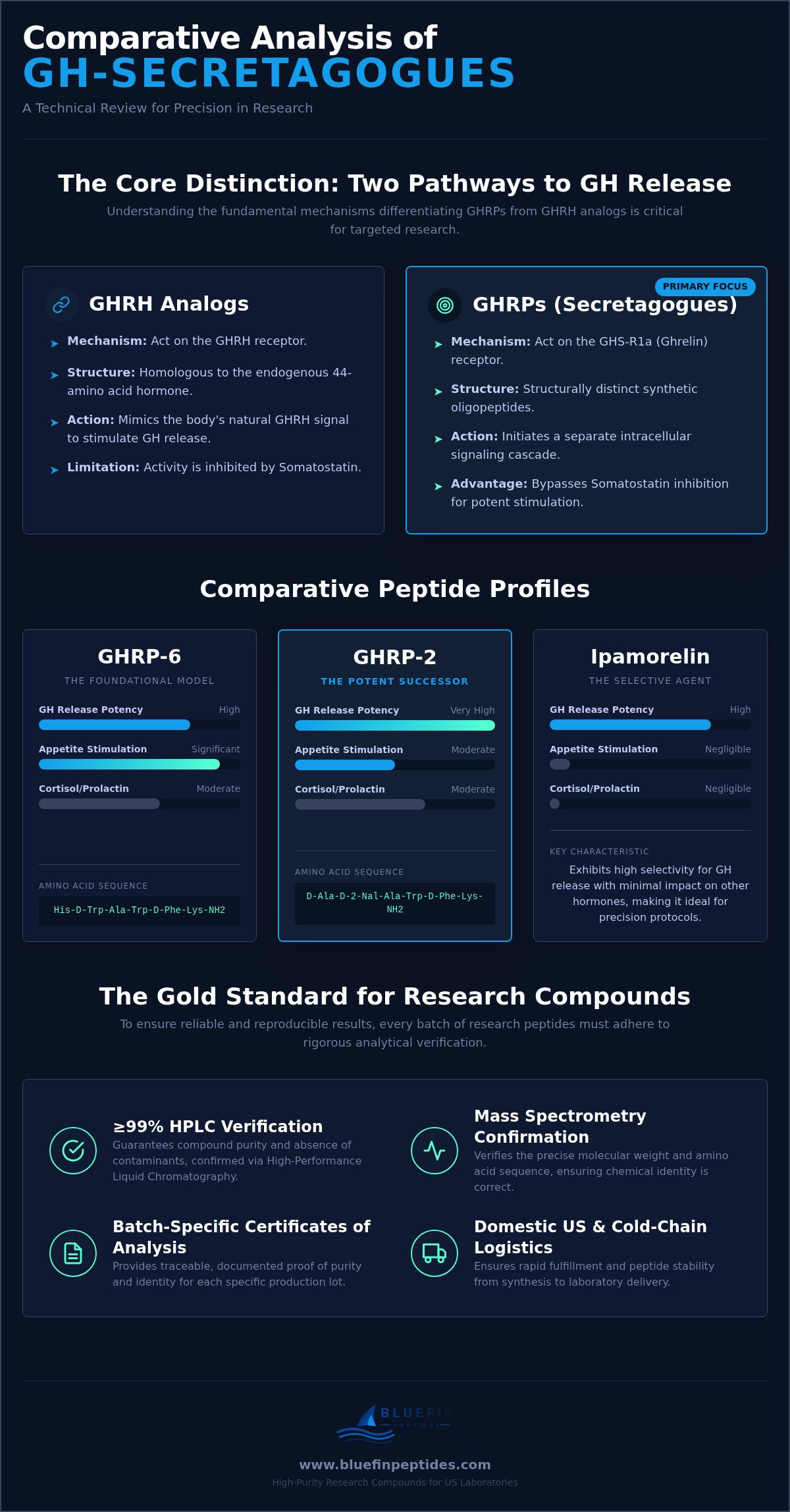
Growth Hormone Releasing Peptides (GHRPs) are synthetic oligopeptides engineered to stimulate the pulsatile release of endogenous growth hormone (GH). Analytical. Verifiable. Precise. Unlike Growth Hormone Releasing Hormones (GHRH), which exhibit structural homology to the 44-amino acid endogenous hormone, GHRPs are structurally distinct. They function as potent agonists of the growth hormone secretagogue receptor (GHS-R1a), commonly referred to as the ghrelin receptor. This structural divergence is a cornerstone of modern growth hormone releasing peptide research. GHRPs are classified as Growth Hormone Secretagogues (GHS). They aren't hormones. They're exogenous ligands. Their clinical significance in neuroendocrinology is anchored in their ability to bypass the inhibitory effects of somatostatin. This provides a unique, targeted pathway for somatotroph stimulation within the pituitary gland.
The Evolution of GHRP Discovery
The lineage of these compounds is rooted in the study of met-enkephalin analogs. Early research identified that certain opioid-like peptides possessed weak GH-releasing properties without opioid receptor affinity. This discovery shifted the scientific focus toward hexapeptides. Growth Hormone-Releasing Peptide 6 (GHRP-6) emerged as the foundational model in this class. It demonstrated high selectivity for the hypothalamic-pituitary axis. The transition from early models to more refined analogs like GHRP-2 and Ipamorelin allowed for greater potency and reduced collateral hormonal stimulation. Researchers also utilize non-peptidyl secretagogues as benchmarks. These small-molecule mimetics provide a comparative baseline for assessing binding kinetics. This evolutionary path reflects a move toward deep-sea precision in molecular targeting.
Chemical Structure and Non-Glycosylated Chains
Precision in synthesis defines the utility of GHRPs. The typical amino acid sequences for GHRP-2 (D-Ala-D-2-Nal-Ala-Trp-D-Phe-Lys-NH2) and GHRP-6 (His-D-Trp-Ala-Trp-D-Phe-Lys-NH2) reveal the strategic inclusion of D-amino acids. These isomers are critical. They resist enzymatic degradation by proteases. This structural modification extends the half-life of the peptide within the research medium. Most GHRPs are non-glycosylated chains. Their molecular mass typically ranges between 700 and 900 Daltons. This specific mass profile has direct implications for lyophilized peptide stability. Proper lyophilization ensures the physical state of the compound remains stable during long-term storage and the fluid movement of logistical transit. Stoic reliability in chemical nature is the standard. Every batch requires mass-spec confirmation to ensure these sequences remain intact and free from truncated fragments.
Mechanisms of GHRP-Induced Somatotroph Stimulation
Growth hormone releasing peptides function as highly specific ligands for the G-protein-coupled receptor GHS-R1a. This binding affinity is the primary catalyst for somatotroph activation. Once the GHRP molecule occupies the receptor site, it initiates a robust intracellular signaling cascade. This process involves the activation of phospholipase C (PLC), which subsequently catalyzes the hydrolysis of phosphatidylinositol 4,5-bisphosphate. The resulting production of inositol trisphosphate (IP3) and diacylglycerol (DAG) triggers the rapid mobilization of calcium ions from intracellular stores. Increased cytosolic calcium concentrations facilitate the exocytosis of pre-formed growth hormone vesicles. This sequence is a foundational element of growth hormone releasing peptide research. It represents a precise, verifiable pathway for inducing GH secretion without relying on the GHRH receptor.
The action of these secretagogues isn't localized to a single tissue. It's a dual-site mechanism involving both the anterior pituitary gland and the hypothalamus. In the pituitary, GHRPs act directly on somatotrophs to induce depolarization. In the hypothalamus, they stimulate GHRH-releasing neurons while simultaneously suppressing somatostatin, the primary inhibitor of GH release. This multi-faceted approach ensures a potent, pulsatile GH response. For researchers requiring absolute batch-level consistency, utilizing HPLC-verified research compounds is essential to ensure these molecular interactions remain predictable across all laboratory protocols.
Pituitary vs. Hypothalamic Pathways
Direct somatotroph stimulation provides the immediate GH spike, but the hypothalamic pathway governs the duration and intensity of the pulse. The "U factor" hypothesis suggests that an unidentified hypothalamic mediator may amplify the effect of GHRPs beyond direct pituitary action. By inhibiting somatostatin, GHRPs effectively lower the threshold for GH release. They bypass the traditional GHRH negative feedback loop. This allows for continued somatotroph responsiveness even when systemic GH levels are elevated. It's a disciplined bypass of standard endocrine regulation.
Synergy with GHRH Analogs
The mechanistic rationale for utilizing an ipamorelin CJC-1295 research blend USA lies in the complementary nature of these two peptide classes. GHRH analogs primarily increase the pool of growth hormone by stimulating GH synthesis and somatotroph proliferation. In contrast, GHRPs trigger the immediate release of these stored reserves. When paired, the two compounds work in tandem to amplify the GH pulse amplitude significantly. This synergistic effect is a major focus in modern growth hormone releasing peptide research. Data indicates that the combination creates a GH response that's larger than the sum of its individual components. It's a high-performance strategy for maximizing somatotroph output in controlled research environments.
Comparative Analysis of GHRP-2, GHRP-6, and Ipamorelin
Systematic classification is the bedrock of growth hormone releasing peptide research. Not all secretagogues are created equal. Their utility in a laboratory setting is defined by a triad of variables: potency, selectivity, and secondary hormonal impact. While the previous sections established the shared GHS-R1a pathway, the divergence in their molecular structures leads to significantly different experimental outcomes. Precision is paramount. Researchers must distinguish between a broad-spectrum agonist and a surgical, selective ligand. This distinction dictates the validity of the data collected during somatotroph stimulation trials. Metabolic stability also varies. The fluid movement of metabolic clearance for these peptides typically occurs within a 30 to 120-minute window, requiring disciplined timing in pulse amplitude measurement.
Ipamorelin: The Selective Pentapeptide
Analytical. Refined. Surgical. Ipamorelin stands apart as a selective pentapeptide. Unlike its hexapeptide counterparts, it demonstrates a high degree of specificity for the GH secretory pathway. It's unique. It doesn't induce the secretion of ACTH, cortisol, or prolactin at standard research dosages. This lack of off-target effects makes it the gold standard for studies requiring an isolated GH response. Structurally, it's a non-glycosylated polypeptide. Its stability in lyophilized form is exceptional. Mass-spec confirmation consistently shows that Ipamorelin maintains its integrity through rigorous handling protocols. For deep-sea precision in neuroendocrine modeling, this selectivity is an indispensable asset.
GHRP-2 vs. GHRP-6: Potency and Appetite Signaling
The comparison between GHRP-2 and GHRP-6 reveals a clear trade-off between absolute potency and multi-receptor binding. GHRP-6 is the foundational model. It's known for its significant ghrelin-mimicry. This makes it a primary tool for appetite stimulation research and studies involving gastric motility. However, it's less potent than its successor. GHRP-2 exhibits a higher GH-releasing capacity. It's the heavy hitter of the class. But this potency comes with a cost. GHRP-2 facilitates a measurable rise in prolactin and cortisol levels. It's a more complex biological model. Researchers must account for these secondary hormonal spikes when analyzing data. Multi-receptor binding is a double-edged sword. It provides a broader physiological picture but introduces more variables into the experimental matrix. Stoic reliability in growth hormone releasing peptide research requires choosing the analog that matches the specific investigative objective.
- Ipamorelin: Highest selectivity, zero impact on cortisol/prolactin.
- GHRP-2: Highest GH-releasing potency, moderate secondary hormonal stimulation.
- GHRP-6: Moderate potency, high appetite signaling via ghrelin receptor mimicry.
Selecting the correct variant is a matter of logistical and scientific alignment. Each peptide offers a different metabolic signature. Verification of these signatures through HPLC-verified batches is the only way to ensure laboratory results remain reproducible and accurate.
Analytical Verification Standards for GHRP Research Compounds
Modern growth hormone releasing peptide research demands absolute chemical fidelity. Surface-level claims of purity are insufficient. While legacy data often cites purity thresholds of 97%, contemporary standards require ≥99% verification. Anything less introduces uncontrolled variables. Impurities in a peptide batch can alter binding kinetics or trigger unintended cellular responses; this effectively compromises the entire dataset. Reversed-Phase High-Performance Liquid Chromatography (RP-HPLC) serves as the primary diagnostic tool for determining this purity. It separates the target peptide from synthesis byproducts based on hydrophobicity. This ensures only the intended molecule remains. Without this level of analytical rigor, laboratory results lack the stoic reliability required for peer-reviewed publication.
Interpreting HPLC Purity Reports
Peak analysis is the objective proof of quality. In an RP-HPLC report, the "area under the curve" (AUC) represents the relative concentration of the target peptide compared to the total detected substances. A single, sharp peak indicates a homogeneous sample. Secondary peaks suggest the presence of truncated sequences or residual solvents. These contaminants interfere with receptor affinity studies. Understanding these nuances is critical for any principal investigator. For a detailed breakdown of peak identification, researchers should consult the guide on how to interpret HPLC peptide reports to ensure their data remains untainted by synthesis artifacts. Using research chemicals without this batch-specific documentation is a risk that high-performance laboratories don't take.
Mass Spectrometry and Sequence Confirmation
Purity alone doesn't confirm identity. Mass Spectrometry (MS) provides the necessary verification of molecular weight and sequence. By analyzing the mass-to-charge (m/z) ratios, MS confirms that the synthesized GHRP analog matches the theoretical molecular mass of the target sequence. This step is vital. It detects peptide fragments or synthesis byproducts that might share an HPLC retention time but possess different chemical properties. It's a "show, don't tell" philosophy. Reliable suppliers provide batch-specific MS data to prove the compound's chemical nature. This deep-sea precision in documentation allows researchers to proceed with confidence. This level of documentation is the only way to ensure the integrity of growth hormone releasing peptide research. To maintain these rigorous standards in your own laboratory, you can source HPLC-verified research peptides with comprehensive batch documentation.
Procuring High-Purity GHRP Compounds for US Laboratory Studies
The transition from theoretical modeling to active laboratory execution requires a supply chain of absolute integrity. Precision matters. The logistics of procurement are as vital as the synthesis itself. For growth hormone releasing peptide research, the physical state of the compound upon arrival determines the baseline of all subsequent data. Choosing a domestic US partner isn't just a matter of convenience. It's a strategy for stability. International transit often exposes sensitive polypeptides to extreme temperature fluctuations and prolonged customs delays. These variables compromise the chemical nature of the offering. A high-performance laboratory partner prioritizes transparency and verification over marketing claims, providing the tools for independent validation before the first vial is ever reconstituted.
Strict legal boundaries govern these transactions. Every compound is designated for laboratory research use only. They're not for human or veterinary consumption. This isn't a suggestion; it's a fundamental regulatory requirement. Stoic adherence to these boundaries ensures the longevity of the research field. High-purity GHRPs are specialized chemical tools. They require a specialized partner who understands the high-stakes nature of the laboratory environment and provides the documentation to prove it.
Logistics and Batch Transparency
US-stocked inventory facilitates rapid fulfillment and minimizes the window for transit-induced degradation. Speed is reliability. When researchers look to buy ipamorelin CJC-1295 USA, they're investing in a logistics model designed for chemical stability. Batch-specific Certificates of Analysis (COAs) are non-negotiable. A COA provides the HPLC and mass-spec data necessary for reproducible research. It's the "show, don't tell" standard of quality. Without batch-level transparency, the researcher is navigating blind, risking the integrity of their entire protocol on unverified supplies.
Storage and Handling of Lyophilized Vials
Lyophilization is the gold standard for peptide preservation. This freeze-drying process removes moisture while maintaining the molecular structure, ensuring transit resilience and long-term storage viability. Lyophilized powders are significantly more stable than reconstituted solutions. For optimal results in growth hormone releasing peptide research, vials should be stored in a temperature-controlled environment, typically at -20°C for long-term archives or 4°C for immediate use. Once the seal is broken, the fluid movement of reconstitution must be handled with care. The use of bacteriostatic water is required to inhibit microbial growth and maintain the peptide's integrity during the trial period. Precision in handling is the final step in ensuring the "what" of your results matches the "how" of your methodology.
Advancing Analytical Precision in Somatotroph Modeling
The integrity of modern growth hormone releasing peptide research depends on the transition from broad observation to specific, batch-level verification. We've established that the distinction between selective pentapeptides like Ipamorelin and potent hexapeptides like GHRP-2 is fundamental to experimental accuracy. Data reliability isn't a variable; it's a requirement. This level of precision is only achievable through the implementation of rigorous analytical standards, specifically the use of compounds verified through RP-HPLC and mass spectrometry.
Securing high-purity secretagogues is the final logistical hurdle in any professional protocol. You don't have to guess about the chemical nature of your materials. Bluefin Peptides provides the disciplined infrastructure required for high-stakes laboratory environments. Every batch is supported by ≥99% HPLC-verified purity and mass-spec confirmed COAs to ensure your results remain reproducible. With fast US-based shipping, your research maintains its momentum without the risk of transit-induced degradation. View HPLC-Verified GHRP Research Compounds at Bluefin Peptides and secure the tools necessary for precise neuroendocrine analysis. Your commitment to quality is the catalyst for scientific discovery.
Frequently Asked Questions
What is the primary difference between GHRP and GHRH in research?
GHRPs and GHRH analogs differ fundamentally in their receptor targets and molecular structures. GHRH analogs mimic the endogenous 44-amino acid hormone to activate the GHRH receptor directly. GHRPs are synthetic ligands that target the GHS-R1a (ghrelin) receptor. This distinction is critical because GHRPs can bypass somatostatin inhibition, whereas GHRH effectiveness is often limited by it in certain models.
Why is Ipamorelin considered more selective than GHRP-6?
Ipamorelin exhibits higher selectivity due to its specific pentapeptide structure. Unlike GHRP-6, which is a hexapeptide, Ipamorelin doesn't stimulate the release of ACTH, cortisol, or prolactin at standard dosages. It provides a more isolated growth hormone pulse. GHRP-6 acts on a broader range of receptors, including those governing appetite and gastric motility, which introduces additional variables into a study.
How should GHRP research peptides be stored for maximum stability?
Lyophilized GHRP vials should be stored at -20°C for long-term stability or 4°C for immediate laboratory use. Maintaining the physical state as a dry powder prevents peptide degradation and hydrolysis during storage. Once reconstituted with bacteriostatic water, the solution's half-life drops significantly. Researchers should avoid repeated freeze-thaw cycles to preserve the molecular integrity of the peptide chain over time.
What does HPLC-verified purity actually mean for a laboratory study?
HPLC-verified purity indicates the percentage of the target peptide relative to all detected substances in a sample. This is determined via the area under the curve (AUC) in a chromatogram. For high-precision growth hormone releasing peptide research, a purity of ≥99% is the required standard. It ensures that synthesis byproducts or truncated sequences don't interfere with binding kinetics or cellular signaling outcomes.
Is a Mass Spectrometry report necessary if I have an HPLC report?
A Mass Spectrometry report is essential because it verifies the chemical identity of the compound. While HPLC measures the purity of a substance, it doesn't confirm that the substance is the correct peptide sequence. MS analyzes the mass-to-charge ratio to ensure the molecular weight matches the theoretical sequence exactly. This dual-verification protocol is the only way to confirm both the identity and the concentration of a batch.
Can GHRP-2 and GHRP-6 be used interchangeably in experimental models?
GHRP-2 and GHRP-6 are not interchangeable due to their differing potency and secondary effects. GHRP-2 is a more potent stimulator of growth hormone release but also causes a moderate rise in prolactin and cortisol levels. GHRP-6 is less potent for GH secretion but has a much stronger effect on ghrelin receptors and appetite signaling. These differences lead to distinct metabolic signatures in growth hormone releasing peptide research.
What are the risks of using peptides with less than 99% purity?
Using peptides with less than 99% purity introduces uncontrolled chemical variables into an experimental model. Synthesis artifacts or residual solvents can trigger unintended biological responses or cellular toxicity. This compromises the reproducibility and validity of the study. In modern laboratory environments, using lower-grade compounds is a fundamental oversight that can lead to skewed results or failed protocols.
Does Bluefin Peptides provide COAs for every GHRP batch?
Bluefin Peptides provides batch-specific Certificates of Analysis for every GHRP compound in its inventory. These reports include both HPLC and mass spectrometry data to confirm ≥99% purity and molecular identity. This "show, don't tell" approach ensures that researchers have the documentation necessary to verify the chemical nature of their offerings. Every shipment is backed by these verifiable standards to ensure stoic reliability in fulfillment.
For laboratory research use only. Not for human or veterinary use. This content is educational and does not constitute medical, dosing, or usage guidance.
Browse the BLUEFIN catalog