Calculating Peptide Molar Concentration: Formula, Units, and Worked Examples
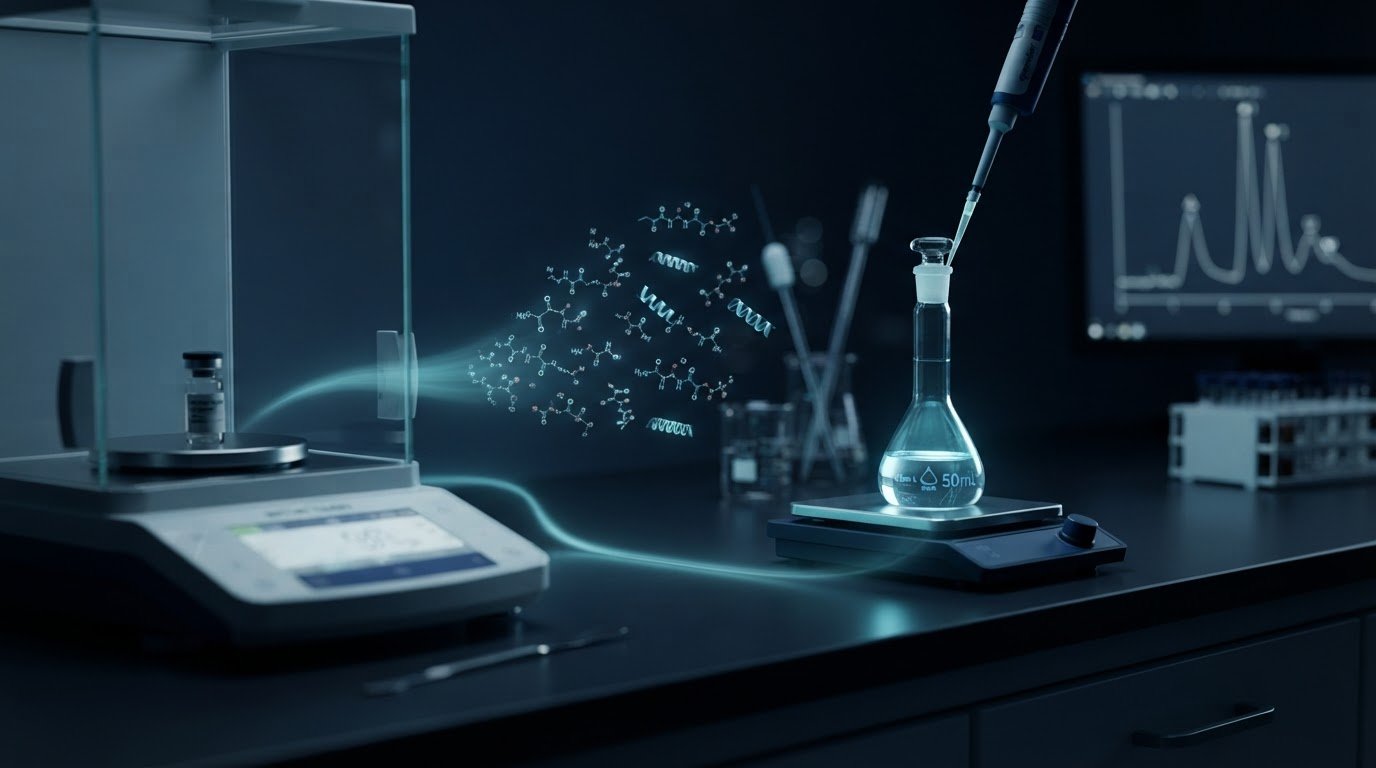
A precise-looking molarity can still be wrong if the molecular-weight value or units do not match the material weighed. When calculating peptide molar concentration, convert peptide mass into moles, then divide by the final solution volume. Mass concentration alone does not show how many moles are present.
The calculation is straightforward, but its assumptions need care. This guide shows how to use peptide mass, molecular weight, and final volume in a consistent formula. Worked examples and unit conversions make each step easier to check.
You’ll also learn which molecular-weight value to use and how salt form, water content, and purity information can affect the result. A batch-specific certificate of analysis can help verify identity and molecular mass, but an HPLC purity percentage is not automatically a validated mass fraction for correcting the weighed amount. The goal is a reproducible calculation with clearly documented inputs and assumptions.
Key Takeaways
- Distinguish molar concentration from mass concentration before comparing or reporting peptide solutions.
- Use consistent units in the mass-based formula: convert peptide mass to grams and final volume to litres.
- When calculating peptide molar concentration, confirm that the molecular weight matches the peptide’s supplied chemical form.
- Assess salt form, water content, and purity basis before applying any correction to the weighed mass.
- Document identity, inputs, units, and assumptions, and label the result as calculated rather than measured.
What peptide molar concentration means and what the calculation tells you
Peptide molar concentration is the amount of peptide, in moles, divided by the final solution volume in litres; it is expressed in mol/L. Also called molarity, it tells you how many moles of the specified peptide form are present per litre of prepared solution. The Molar concentration reference outlines the general definition and units.
For research, this calculation describes a prepared solution based on its inputs and assumptions. It is not a biological dose, a potency measure, or a direct assessment of experimental effect. The calculated value is only as reliable as the mass, molecular weight, and final volume used.
Molarity, molality, and mass concentration are not interchangeable
Molarity uses the volume of the final solution, typically in litres. Molality expresses moles of solute per kilogram of solvent. Because these measures have different denominators, they cannot be substituted without changing the meaning of the result.
Mass concentration, such as mg/mL, reports peptide mass per solution volume, not the number of peptide molecules. To convert it to molar concentration, you also need the molecular weight. The same mg/mL value can correspond to different molarities for peptides with different molecular weights. This guide focuses on solution molarity, expressed as moles per litre.
What information a peptide molarity calculation requires
Calculating peptide molar concentration requires three primary inputs: the mass used, the applicable molecular weight, and the final volume after the peptide has been dissolved. Make the units consistent before calculating. In particular, distinguish the volume of solvent added from the final solution volume, which is the denominator in molarity.
The molecular-weight value must correspond to the material actually weighed. A theoretical sequence mass may differ from the mass of a supplied chemical form if the material includes modifications or counterions, such as those in a salt form. Hydration or residual water can also affect how much of the weighed material is peptide rather than associated water.
Check applicable batch documentation for identity and molecular-form information before selecting a molecular-weight input. Mass-spectrometry confirmation can support identity or mass verification, while a batch-specific certificate of analysis provides relevant analytical context. Neither replaces a clearly stated calculation basis. In particular, do not automatically treat an HPLC purity percentage as a validated mass fraction for correcting the weighed amount.
If an exact batch-specific value is unavailable, state the value and form assumed, then label the result as an estimate based on those assumptions. This keeps the calculation traceable and makes it easier to review later.
The peptide molar concentration formula, with units shown at every step
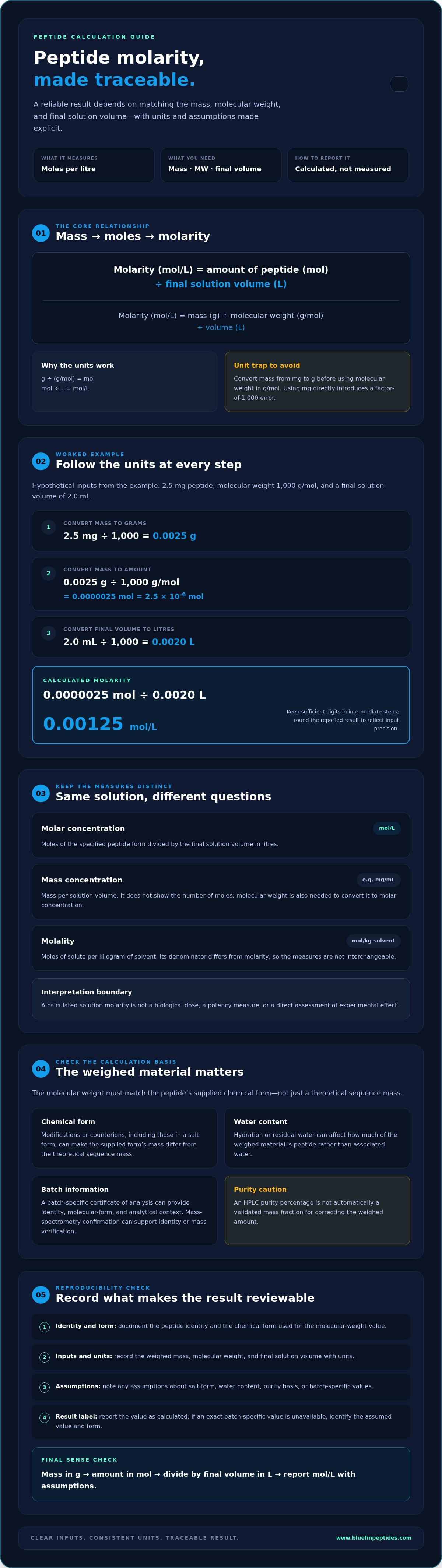
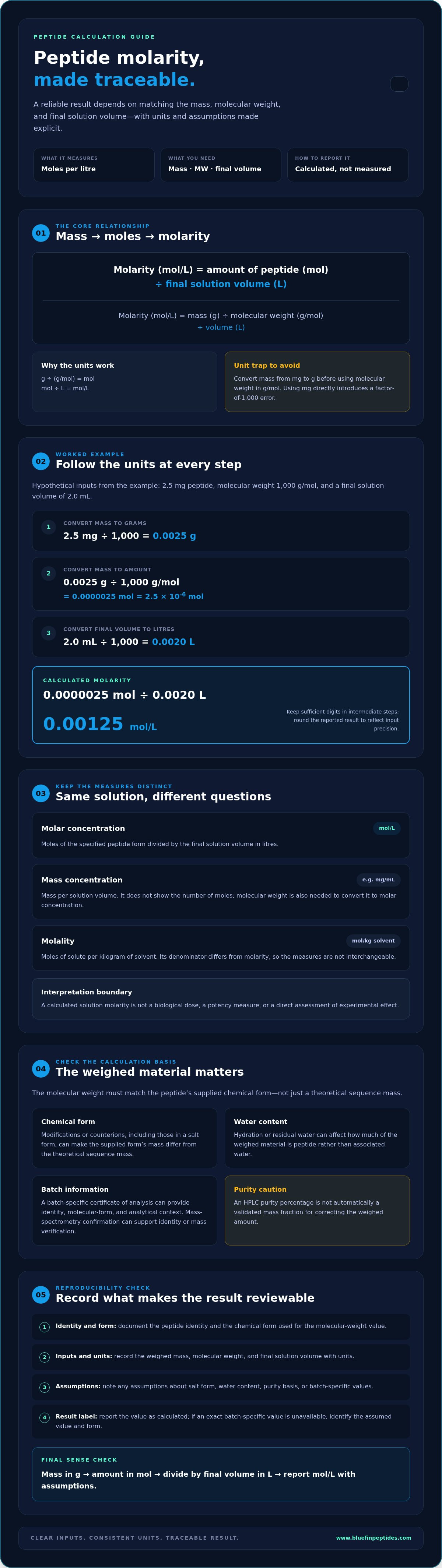
Use a consistent sequence: convert peptide mass to moles, then divide by the final solution volume in litres. The core relationship is molarity (mol/L) = amount of peptide (mol) ÷ final solution volume (L). For a mass-based calculation, it becomes molarity (mol/L) = mass (g) ÷ molecular weight (g/mol) ÷ volume (L).
The units confirm the calculation: grams ÷ (grams per mole) gives moles, and moles ÷ litres gives mol/L. Keep molecular weight in g/mol and convert the weighed mass to grams before dividing. Using a mass in milligrams directly with molecular weight in g/mol introduces a factor-of-1,000 error.
Convert peptide mass into moles before calculating molarity
Convert milligrams to grams by dividing by 1,000. For example, 2.5 mg = 0.0025 g. Then divide the mass in grams by the molecular weight in g/mol; the grams cancel, leaving the amount in moles. This intermediate value is a useful check before calculating molarity.
For instance, with a hypothetical molecular weight of 1,000 g/mol, 0.0025 g ÷ 1,000 g/mol = 0.0000025 mol, or 2.5 × 10⁻⁶ mol. Keep sufficient digits during intermediate steps, then round the reported result to reflect the precision of the inputs.
Use final solution volume, not solvent volume
The denominator is the final volume of the solution after the solute has dissolved, not necessarily the volume of solvent initially added. Dissolved material can affect the total volume, so recording only the solvent volume may not represent the prepared solution’s actual volume.
Convert millilitres to litres by dividing by 1,000: 2.0 mL = 0.0020 L. Continuing the hypothetical calculation above, if the final volume is 2.0 mL, then 0.0000025 mol ÷ 0.0020 L = 0.00125 mol/L.
- Mass: mg ÷ 1,000 = g
- Volume: mL ÷ 1,000 = L
- Concentration: 1 mol/L = 1,000 mmol/L = 1,000,000 µmol/L
These conversions make calculating peptide molar concentration easier to audit. Before choosing a molecular-weight input for research materials, check the applicable chemical form and batch documentation. Peptide research materials are one place to begin reviewing that information.
Molecular weight, peptide form, and purity: assumptions that change the result
The formula is only as accurate as the molecular-weight input and the mass that input represents. A theoretical sequence mass describes a peptide based on its amino acid sequence and specified modifications. The material weighed in the laboratory may instead be a salt or another chemical form, so its applicable molecular mass can differ.
This matters because calculating peptide molar concentration converts weighed mass into moles. If the molecular weight does not match the supplied form, the calculated amount in moles, and therefore the concentration, may be inaccurate.
Select a molecular weight that matches the material being calculated
Check whether the listed value refers to the peptide sequence alone or the supplied chemical form. Counterions associated with a salt can add mass, and modifications can also change molecular weight. Water associated with a lyophilized material may affect the peptide fraction of the weighed mass, even if the water is not part of the peptide molecule itself.
Use batch-specific documentation and verified analytical specifications where available. Mass spectrometry can help verify molecular mass and identity, while the certificate of analysis can provide batch context. Confirm the form described in the documentation before applying a value. If you cannot verify the applicable molecular weight, identify the assumed form and report the result as an estimate rather than presenting the input as a product-specific fact.
When purity correction is appropriate, and when it is not
A purity adjustment is appropriate only when a validated measurement supports treating the stated value as a mass fraction of the weighed material. In that case, the calculation is conceptually: corrected peptide mass = weighed mass × validated mass fraction. Use the corrected mass in the molarity formula and document the analytical basis for the fraction.
An HPLC area percentage alone does not necessarily establish a mass fraction. It describes the relative detector response across chromatographic peaks, not automatically the proportion by mass of peptide in the entire sample. Non-peptide components, including water or residual salts, may affect the total weighed mass without being represented as peptide-related peaks in the same way.
For example, if a hypothetical sample has a validated peptide mass fraction of 0.90, its corrected peptide mass would be 0.90 times the weighed mass. This is an illustration, not a default correction. Do not use an HPLC purity percentage as a mass-fraction correction unless the analytical method supports that interpretation. If no validated mass fraction is available, calculate using the weighed mass and state that no purity correction was applied.
How to calculate peptide molar concentration: a reproducible worked example
Follow a fixed sequence: document the inputs, convert units, calculate moles, then divide by the final volume. The example below is entirely hypothetical. Every value is illustrative, not a product specification or preparation recommendation.
Follow the calculation in a fixed sequence
Illustrative inputs: peptide mass = 1.00 mg; assumed molecular weight = 1,000 g/mol; final solution volume = 1.00 mL. For a real calculation, record the molecular-weight value and its source, such as applicable batch documentation, and confirm that it describes the material’s chemical form.
- Convert mass: 1.00 mg ÷ 1,000 = 0.00100 g.
- Convert final volume: 1.00 mL ÷ 1,000 = 0.00100 L.
- Calculate amount: 0.00100 g ÷ 1,000 g/mol = 0.00000100 mol, or 1.00 × 10⁻⁶ mol.
- Calculate molarity: 1.00 × 10⁻⁶ mol ÷ 0.00100 L = 0.00100 mol/L.
The result is 0.00100 mol/L, equivalent to 1.00 mmol/L or 1.00 mM. Convert to mmol/L or µmol/L only after calculating the base concentration in mol/L. Keeping the intermediate amount in moles makes each step easier to inspect.
Check the result before recording it
Confirm that the units cancel correctly: grams divided by grams per mole yields moles, and moles divided by litres yields mol/L. If the final unit is not mol/L, check for a missed mass or volume conversion.
Use a calculator or spreadsheet to verify the arithmetic independently. In a spreadsheet, keep mass, molecular weight, and final volume in separate cells, with their units documented. Calculate molarity as mass in grams divided by molecular weight in g/mol, then divided by volume in litres. An independent check can catch a misplaced decimal, but it cannot validate an incorrect molecular-weight assumption.
Record the inputs and their sources, the assumed peptide form, any purity adjustment or the fact that none was applied, and the rounding used. Label the result as a calculated concentration, not a measured concentration. This preserves the assumptions for later review.
For qualified research use, review available peptide information and batch documentation before selecting calculation inputs: review research peptide information.
Verify and document peptide molarity for reproducible laboratory research
A calculation is reproducible only when another researcher can trace each input to its source. Keep the record with the relevant sample and batch information, and label the result as calculated concentration. A calculated value follows from mass, molecular weight, and final volume; a measured concentration is determined using a separate analytical measurement. These labels are not interchangeable.
Build an auditable calculation record
For each calculation, record the details another researcher needs to follow the same steps and check the result:
- Identity: peptide name or sample identifier, plus the batch reference.
- Molecular form: the form used for the calculation, including any relevant counterion or modification.
- Inputs: weighed mass, final solution volume, units, and the source of the molecular-weight value.
- Calculation: converted values, intermediate moles, final concentration, and rounding.
- Assumptions: whether a purity adjustment was applied. If so, document the mass-fraction value and its analytical basis.
- Record details: calculation date and, where applicable, the researcher or record identifier.
Preserve intermediate values rather than recording only the final molarity. This makes unit conversions and arithmetic easier to review. If no validated mass fraction is available, state that no purity correction was applied instead of treating a chromatographic area percentage as a mass fraction.
Use analytical documentation to verify inputs
A batch-specific certificate of analysis (COA) and associated analytical records can help confirm sample identity and inform the molecular-weight input. Check that the documentation corresponds to the batch in hand and clarifies whether the stated mass applies to the peptide sequence or its supplied chemical form. Bluefin Peptides states that its research peptides are HPLC-verified, with mass-spectrometry confirmation and batch-specific COAs. Use the applicable batch records to verify relevant inputs.
Analytical documentation supports input selection. It does not establish the concentration of a solution prepared later, because the COA does not document the exact mass and final volume used in that preparation. A separate concentration measurement is needed if the research requires a measured rather than calculated value.
For broader documentation context, consult an analytical quality standards guide or a compound-specific guide, such as one for retatrutide analytical specifications. Confirm exact page addresses before linking to or recording them. Review the available batch-specific research documentation before finalizing molecular-weight assumptions.
Make each concentration calculation traceable
Reliable molarity depends on more than the arithmetic. Convert mass and final solution volume to consistent units, use a molecular-weight value that matches the peptide’s supplied form, and document assumptions that affect the result. Apply a purity correction only when its analytical basis supports treating the value as a mass fraction.
When calculating peptide molar concentration, preserve intermediate values and label the result as calculated unless a separate analytical measurement establishes concentration. Batch-specific records can help verify identity and molecular-weight inputs, but they do not confirm the concentration of a solution prepared from the material.
Bluefin Peptides states that its research-use peptides are ≥99% HPLC-verified, with mass-spectrometry confirmation and batch-specific certificates of analysis. Review the applicable documentation and confirm the peptide’s exact molecular form before selecting calculation inputs. Review Bluefin Peptides’ research-use documentation.
With verified inputs and a clear record, your calculation is easier to check, reproduce, and refine.
Frequently Asked Questions
How do you calculate peptide molar concentration?
Molarity equals the amount of peptide in moles divided by the final solution volume in litres. For mass-based inputs, convert peptide mass to grams, divide by molecular weight in grams per mole to obtain moles, then divide by final volume in litres. When calculating peptide molar concentration, confirm that the molecular weight matches the supplied peptide form and state any purity assumptions. This is a research calculation, not dosing or administration guidance.
What information is needed to calculate peptide molarity?
The core inputs are peptide mass, applicable molecular weight, and final solution volume. Verify whether the molecular weight describes the peptide sequence or the supplied chemical form, since counterions, modifications, or associated water may affect the relevant mass basis. If considering a purity correction, use a defensible mass-fraction value supported by suitable analytical information. Do not assume an HPLC area percentage is equivalent to a mass fraction.
How do you convert peptide concentration from mg/mL to mM?
Use the molecular weight in g/mol to convert mass concentration to molar concentration. A compact relationship is mM = [concentration in mg/mL × 1,000] ÷ molecular weight in g/mol. For example, 1 mg/mL of a substance with a molecular weight of 1,000 g/mol corresponds to 1 mM. The same mg/mL value can represent different mM concentrations for peptides with different molecular weights.
Does peptide purity affect a molar concentration calculation?
It can, if the calculation is intended to account for the peptide fraction of the weighed material and a validated mass-fraction value is available. In that case, corrected peptide mass equals weighed mass multiplied by the supported mass fraction. Chromatographic area purity does not automatically establish mass purity, because detector response and non-peptide components may affect interpretation. Report whether the calculated concentration is nominal or purity-adjusted, and document the adjustment basis.
Should you use the peptide sequence molecular weight or the salt-form molecular weight?
Use the molecular weight that corresponds to the material whose mass was weighed. A supplied salt form or another chemical form may have a different molecular mass from the peptide sequence alone because of counterions or modifications. Check applicable product or batch documentation, including the exact molecular form, before choosing the input. Record whether the calculation uses sequence mass or supplied-form mass so another researcher can reproduce the result.
Should final volume or solvent volume be used in a molarity calculation?
Use the final solution volume, because molarity is moles of solute per litre of solution. The volume of solvent initially added may differ from the total volume after the solute has dissolved. Convert the final volume to litres before calculating. Clearly recording which volume was used helps prevent a denominator error and makes the research calculation easier to review and reproduce.
Can an HPLC purity result confirm the molar concentration of a peptide solution?
No. HPLC purity data provide analytical information about the sample, but do not by themselves establish the molar concentration of a prepared solution. A mass-based calculation uses peptide mass, applicable molecular weight, and final solution volume. Any purity adjustment requires a suitable, validated mass-fraction basis. A batch-specific certificate of analysis can help verify identity and molecular-weight inputs, but it does not replace a separate solution concentration measurement.
For laboratory research use only. Not for human or veterinary use. This content is educational and does not constitute medical, dosing, or usage guidance.
Browse the BLUEFIN catalog