Buy Tirzepatide: Lab Procurement Guide

A “99% purity” claim is a starting point, not a complete procurement record. For qualified researchers looking to buy tirzepatide research chemical for laboratory work, supplier claims can be difficult to compare. A purity figure alone does not show which tests were performed or whether the results relate to the specific batch being considered.
That makes documentation and intended use central to a responsible review. Tirzepatide sold for research is not a pharmaceutical product for human or veterinary use, and research-use language should not be confused with approval for either. A batch-specific Certificate of Analysis can help researchers assess reported identity and purity results, but it does not establish suitability for uses beyond laboratory research or guarantee experimental outcomes.
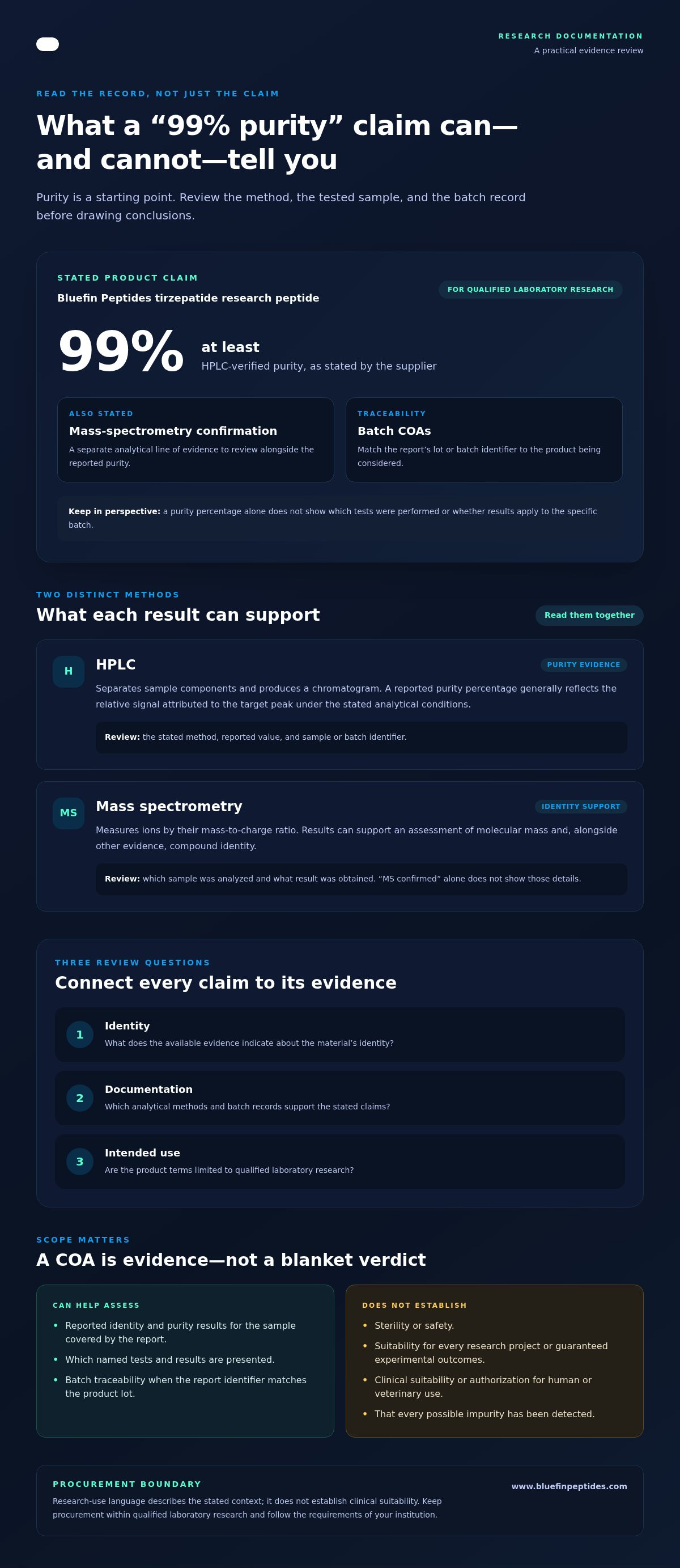
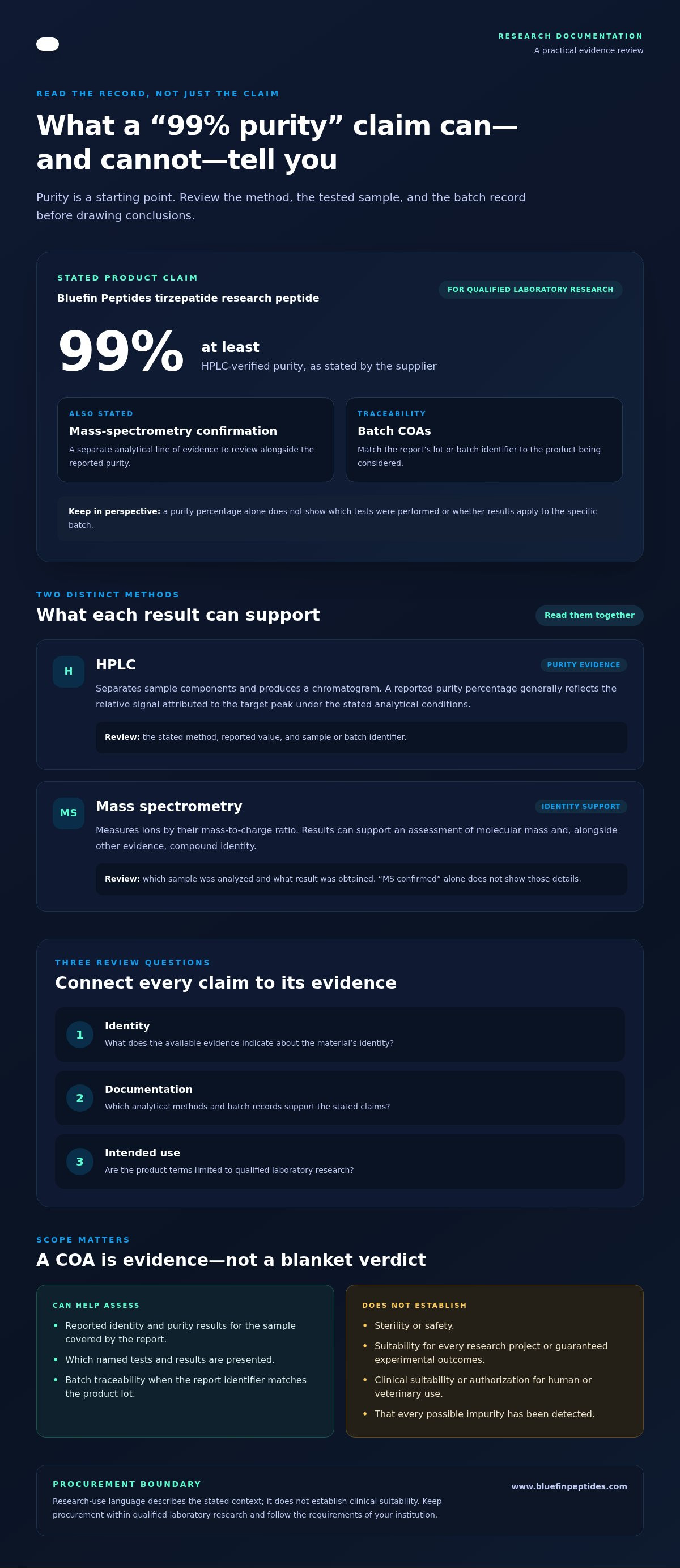
This guide explains how to assess supplier transparency, interpret HPLC and mass-spectrometry documentation, and identify procurement requirements before sourcing. Bluefin Peptides’ tirzepatide research peptide is stated to be at least 99% HPLC-verified, with mass-spectrometry confirmation and batch COAs. The sections below explain what those records can tell you, what they cannot, and how to keep procurement aligned with qualified laboratory research.
Key Takeaways
- Keep research procurement within a qualified laboratory purpose; a research-use label does not establish suitability or authorization for human or veterinary use.
- Read HPLC and mass-spectrometry results as distinct evidence: one assesses chromatographic purity, while the other can support molecular-mass or identity assessment.
- Compare suppliers using consistent criteria, including identity evidence, purity method, batch linkage, and clear intended-use terms.
- Before you buy tirzepatide research chemical, confirm the research purpose, review batch documentation, check institutional requirements, and retain procurement records.
- Bluefin Peptides states that its tirzepatide research peptide is at least 99% HPLC-verified, with mass-spectrometry confirmation and batch COAs for qualified laboratory researchers.
Buying tirzepatide as a research chemical: define the laboratory-use boundary
Before you buy tirzepatide research chemical, define the purpose of the procurement. A research chemical is material acquired for controlled laboratory investigation under an appropriate research plan. The term describes the stated context of use. It does not make a product a treatment option or suitable for personal experimentation.
This boundary matters because consumer-facing language can blur separate questions. A product’s identity, its analytical documentation, and its intended-use terms must each be considered on their own. Evidence about one does not answer the others. For example, a report may provide data about a sample’s composition, but that information does not establish clinical suitability, authorize human or veterinary use, or replace institutional review.
What does research-use tirzepatide mean?
Research-use tirzepatide is presented for laboratory research, not treatment or self-experimentation. Product descriptions are not medical advice and do not establish clinical suitability. For general background on the compound, including its development and approved medical uses, consult the Tirzepatide Wikipedia page. Keep that background separate from the stated purpose and conditions for a research material.
A research-use label sets a boundary; it is not a quality grade. It communicates the product’s stated purpose but does not demonstrate that the material is appropriate for use outside that purpose. Keep the distinction clear in purchasing records and internal discussions. Marketing language is not permission for personal use, and analytical claims are not evidence of clinical suitability.
Who should procure research chemicals?
Procurement is intended for qualified researchers and laboratories with a defined research purpose and established purchasing processes. Qualification and approval procedures can differ across organizations. A laboratory may have internal rules for vendor approval, purchasing authorization, documentation retention, or review by a responsible department. Follow the requirements that apply to your institution rather than assuming one process fits every setting.
Keep three questions distinct during review:
- Identity: What does the available evidence indicate about the material’s identity?
- Documentation: Which analytical methods and batch records support the stated claims?
- Intended use: Are the product terms limited to qualified laboratory research?
These checks support a disciplined procurement decision, but they do not replace current institutional or regulatory review. If purchasing requirements are unclear, consult the appropriate compliance or procurement office and verify applicable requirements against authoritative sources. Do not draw legal conclusions from a product label or a supplier’s general description.
Bluefin Peptides sells tirzepatide research peptide exclusively to qualified researchers for laboratory research. This scope is deliberate. Evaluate the product’s stated research context alongside its documentation, while considering each record only for the information it provides.
What tirzepatide research-chemical documentation can, and cannot, establish
Analytical documents are useful when read as evidence with a defined scope, not as a blanket quality verdict. A Certificate of Analysis (COA) may report results for particular tests on a particular sample. It does not, by itself, establish that the material is sterile, safe, suitable for every research project, or guaranteed to perform in a particular way.
For researchers comparing suppliers before they buy tirzepatide research chemical, connect each result to the method used, the sample tested, and the relevant product lot. A prominent purity percentage is only one part of that review.
How to review an HPLC purity statement
High-performance liquid chromatography (HPLC) separates components in a sample and produces a chromatogram. A reported purity percentage generally reflects the relative signal attributed to the target peak under the stated analytical conditions. Review the reported value alongside the method and sample or batch identifier. A number without those details gives limited context.
Chromatographic purity is not the same as concentration, sterility, or research performance. It also does not establish that every possible impurity has been detected. Treat the percentage as one analytical result, not a complete assessment of the material.
What mass-spectrometry confirmation and a batch COA add
Mass spectrometry measures ions by their mass-to-charge ratio. Results can support an assessment of molecular mass and, alongside other evidence, compound identity. The method’s value depends on the data and its interpretation. The words “MS confirmed” alone do not show which sample was analyzed or what result was obtained.
Batch linkage adds traceability. Match the COA’s lot or batch identifier to the product under consideration, and check that the report names the tests and results rather than presenting only a general purity claim. A report for a different lot cannot establish the reported results for the lot being reviewed. For a broader framework for reading analytical records, use this research peptide quality standards guide.
As a practical review, look for:
- Method: Is HPLC or mass spectrometry identified?
- Result: Are measured findings reported, not just a headline claim?
- Traceability: Does the document identify the matching batch?
- Scope: Is it clear what the test does and does not establish?
Bluefin Peptides states that its peptides are at least 99% HPLC-verified, with mass-spectrometry confirmation and batch COAs. These records support quality review; they do not guarantee research outcomes or establish sterility or suitability for every study. Qualified laboratory researchers can review the tirzepatide research peptide information with those limits in mind.
How to compare tirzepatide research chemical suppliers objectively
A consistent comparison is more useful than a collection of impressive-sounding claims. Before you buy tirzepatide research chemical, apply the same criteria to each supplier and record what the available evidence shows. Separate documented details from assumptions and promotional language. Mark information that is not provided as unknown rather than filling the gap with an inference.
Use the matrix below as a reusable worksheet. Enter the same details for each supplier. Missing information is an information gap, not proof of poor quality or evidence that a claim is false.
A practical supplier-evaluation matrix
Columns: Documentation | Lot traceability | Research-use terms | Fulfillment information
Identity evidence: Supplier A: ____ | Supplier B: ____. Record whether identity evidence is described and what method or result is stated.
Purity method: Supplier A: ____ | Supplier B: ____. Note the analytical method and reported result; don’t treat a percentage as complete characterization.
Batch linkage: Supplier A: ____ | Supplier B: ____. Record whether the documentation identifies the lot associated with the product being considered.
Use and fulfillment: Supplier A: ____ | Supplier B: ____. Capture the stated research-use boundary and any specific stock or shipping information without inferring unstated terms.
Separate direct evidence from interpretation. “A batch COA identifies HPLC and mass-spectrometry results” is a documentable observation. “The product is guaranteed to work” is a broader conclusion that those analytical results alone cannot support. Likewise, phrases such as “premium quality” or “independently tested” are marketing language unless available documentation substantiates the specific claim. Do not assume third-party testing unless the supplier identifies it.
Avoiding misleading comparisons
Purity figures are not automatically comparable. The stated method, sample or lot reference, and information included in the report all matter. A percentage without accessible supporting documentation should be recorded as an advertised claim, not treated as equivalent to a documented result. For compound-specific context on analytical claims, consult this tirzepatide analytical specifications guide.
Keep fulfillment in its own category. Information about stock location or shipping can help with procurement planning, but speed does not establish analytical quality. The absence of a stated shipping detail is an information gap, not a laboratory test result. Record facts precisely, then compare like with like.
Bluefin Peptides states that its peptides are at least 99% HPLC-verified, with mass-spectrometry confirmation and batch COAs. Products are stocked in the United States and shipped quickly after ordering. This is fulfillment context, not a promised delivery date or a substitute for reviewing batch documentation. Qualified researchers can view the tirzepatide research peptide information as one entry in the same evidence-based assessment.
A pre-order checklist for qualified laboratory procurement
A pre-order review helps ensure that a purchase follows the laboratory’s documented purpose and procedures. It is an administrative checkpoint, not experimental guidance. Keep procurement approval separate from decisions about study design or material-use procedures. This checklist does not provide instructions for dosing, administration, or preparation.
Use the sequence below before placing an order to buy tirzepatide research chemical. If a step raises an unresolved question, pause the purchase and route it to the responsible institutional office rather than relying on assumptions.
- Confirm the research purpose and qualification. Record the laboratory purpose and identify the researcher or department responsible for the procurement. The stated purpose must be laboratory research by qualified researchers, not personal, consumer, or veterinary use.
- Review product documentation. Examine the product description and available batch documentation for details relevant to your purchasing review. Keep the product identity and batch information connected in your records, and distinguish stated analytical results from assumptions about broader suitability.
- Check institutional requirements. Before ordering, follow the organization’s purchasing, safety, and approval processes. Requirements can vary by institution and project. Consult the appropriate procurement, compliance, or safety office, and verify applicable requirements with authoritative sources when needed. This step concerns purchasing oversight; it does not replace institutional review of research design.
- Retain procurement records. File the product description, batch-specific documentation, supplier details, and order records according to institutional procedures. A clear record trail documents what the laboratory considered and purchased, and supports later reference to the relevant lot.
Confirm purpose, qualification, and purchasing authority
Make the purchasing role explicit. The person initiating an order may not be the person authorized to approve it, so identify the responsible approver before proceeding. Record the research purpose in the format your organization requires, and complete any applicable internal review before purchase. Keep the scope narrow: research procurement is not guidance for treatment, self-experimentation, or other non-laboratory use.
Retain product and batch records
Store the product description and matching batch documentation together with supplier and order details. Follow institutional rules for record location, access, and retention rather than assuming a personal inbox or downloaded file is sufficient. If records are maintained in separate systems, preserve a clear reference between the product, order, and batch documents.
These checks establish a disciplined purchasing trail; they do not determine experimental procedures or guarantee research outcomes. Bluefin Peptides’ tirzepatide research peptide is for qualified researchers and laboratory research only. After completing your laboratory’s procurement checks, review the research-use peptide catalog as part of your sourcing process.
Bluefin Peptides tirzepatide research peptide: documentation and next steps
For qualified laboratory researchers, Bluefin Peptides offers tirzepatide research peptide with stated analytical documentation and a defined research-use boundary. The company states that its peptides are at least 99% HPLC-verified, with mass-spectrometry confirmation and batch Certificates of Analysis (COAs). These are quality-review records, not guarantees of experimental outcomes or evidence of suitability beyond laboratory research.
Bluefin Peptides also states that products are stocked in the United States and shipped quickly after ordering. This information can help with procurement planning, but it is not a promised delivery date and should be considered separately from analytical evidence. A sound purchasing decision weighs documentation, intended-use terms, and institutional approval as distinct factors.
What Bluefin Peptides states about verification
The company describes HPLC verification and mass-spectrometry confirmation as part of its analytical documentation. A batch COA supports review of the corresponding lot, allowing researchers to connect reported results with the material under consideration. As with any analytical record, its value depends on reviewing what it identifies and reports, not treating a headline statement as a complete assessment.
For compound-specific context, consult the tirzepatide research peptide specifications. Use that information alongside the relevant product and batch records. Analytical documentation can inform procurement review, but it does not guarantee results or establish suitability for every research project.
Move from evaluation to research-use procurement
Before proceeding, make sure the material is being sourced for qualified laboratory research and that the person placing the order has the appropriate institutional authority. Review the product information and its research-use terms, assess the documentation, and complete the purchasing approvals required by your organization. Retain the product and lot records according to institutional procedures.
This process is for laboratory procurement only. Bluefin Peptides’ products are not intended for human, veterinary, or consumer use. Product descriptions and analytical documents do not provide medical advice or instructions for use outside laboratory research.
If your laboratory’s checks are complete, review Bluefin Peptides’ research catalog and its tirzepatide research peptide information as part of your sourcing review. Keep the decision anchored to qualified status, documented research purpose, batch records, and institutional purchasing approval before you buy tirzepatide research chemical.
Make your next procurement decision with a clear record
Turn your review criteria into a repeatable record for future laboratory purchases. Consistent documentation makes it easier for your team to compare product information, route approvals to the right people, and preserve the reasoning behind a procurement decision. Keep the record aligned with your institution’s procedures, and revisit it whenever those procedures or the research purpose changes.
For qualified researchers ready to buy tirzepatide research chemical, procurement should remain tied to a defined laboratory purpose and the organization’s approval process. Review the relevant product information, retain the records your laboratory requires, and proceed only within the stated research-use boundaries.
Review Bluefin Peptides’ research catalog to continue your sourcing review. A clear process keeps procurement focused, traceable, and ready for responsible laboratory work.
Frequently Asked Questions
Is tirzepatide research chemical intended for human use?
No. Bluefin Peptides sells its research peptides exclusively to qualified researchers for laboratory research, not human, veterinary, or consumer use. A research-use label does not establish that a compound is appropriate, safe, or authorized for personal use. Treat product descriptions as procurement information only. They are not medical advice, treatment guidance, or instructions for administering a substance. For health decisions, consult a qualified healthcare professional.
Can a certificate of analysis guarantee that tirzepatide is suitable for every research study?
No. A Certificate of Analysis reports results for identified tests and a particular sample; it cannot establish suitability for every protocol. For example, a report may help you assess a stated analytical result, while your laboratory must independently decide whether that evidence meets its study requirements. Bluefin Peptides states that its peptides have batch COAs, HPLC verification, and mass-spectrometry confirmation. These records support review, not guaranteed outcomes.
What does at least 99% HPLC-verified mean for a research peptide?
It describes a stated chromatographic purity assessment, not a complete measure of every quality attribute. The figure alone does not establish sterility, concentration, safety, or performance in a particular experiment. Review the documentation associated with the material, including the reported method and results, then interpret those findings against your laboratory’s defined requirements. Do not use a single percentage as a substitute for a broader, study-specific quality review.
How can a laboratory tell whether a COA matches its tirzepatide batch?
Compare the lot or batch identifier on the product documentation with the identifier on the COA. For instance, if your procurement record names one lot but the report identifies another, the documents do not establish results for the same batch. Do not fill in missing information by assumption. Preserve the product record and corresponding COA together under your institution’s recordkeeping procedures so the relationship remains clear.
Does fast U.S. shipping demonstrate the analytical quality of tirzepatide?
No. Fulfillment and analytical evidence answer different procurement questions. Shipping information can help a laboratory plan an order, while test methods and batch records provide analytical information to review. Bluefin Peptides states that products are stocked in the United States and shipped quickly after ordering, but that does not establish a specific arrival date or prove analytical quality. Keep logistics and documentation as separate entries in your purchasing assessment.
What should a laboratory verify before ordering a research chemical?
Confirm that the intended work is laboratory research and that the purchaser meets the institution’s qualification and approval procedures. Before you buy tirzepatide research chemical, review the product description, relevant batch records, stated use terms, and purchasing authorization. Requirements may vary by organization and jurisdiction, so consult your institution and authoritative sources where applicable. Online product information is not legal or medical advice, and it does not replace internal review.
For laboratory research use only. Not for human or veterinary use. This content is educational and does not constitute medical, dosing, or usage guidance.
Browse the BLUEFIN catalog