BPC-157 and TB-500 Blend: In Vitro Research Study Protocol

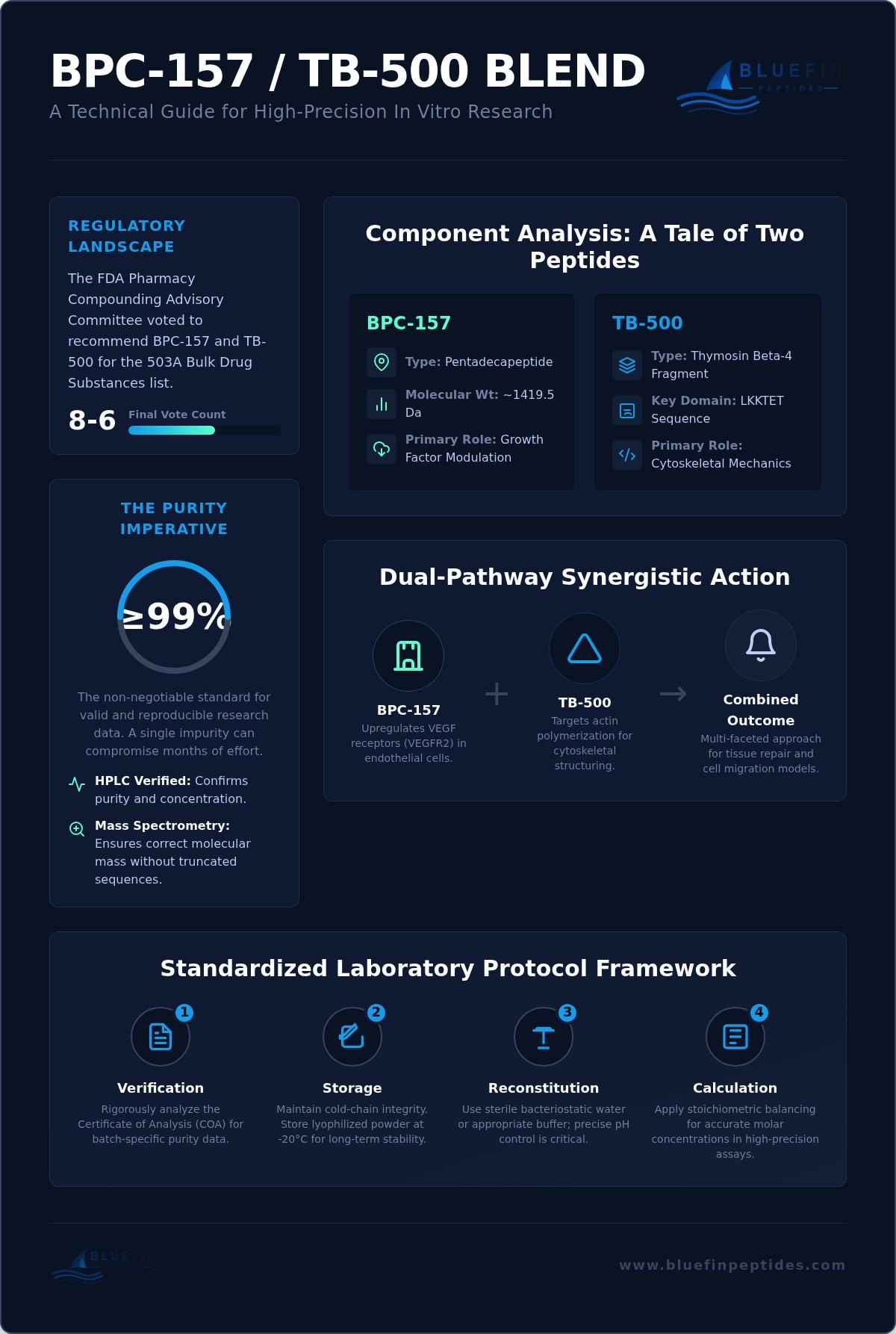
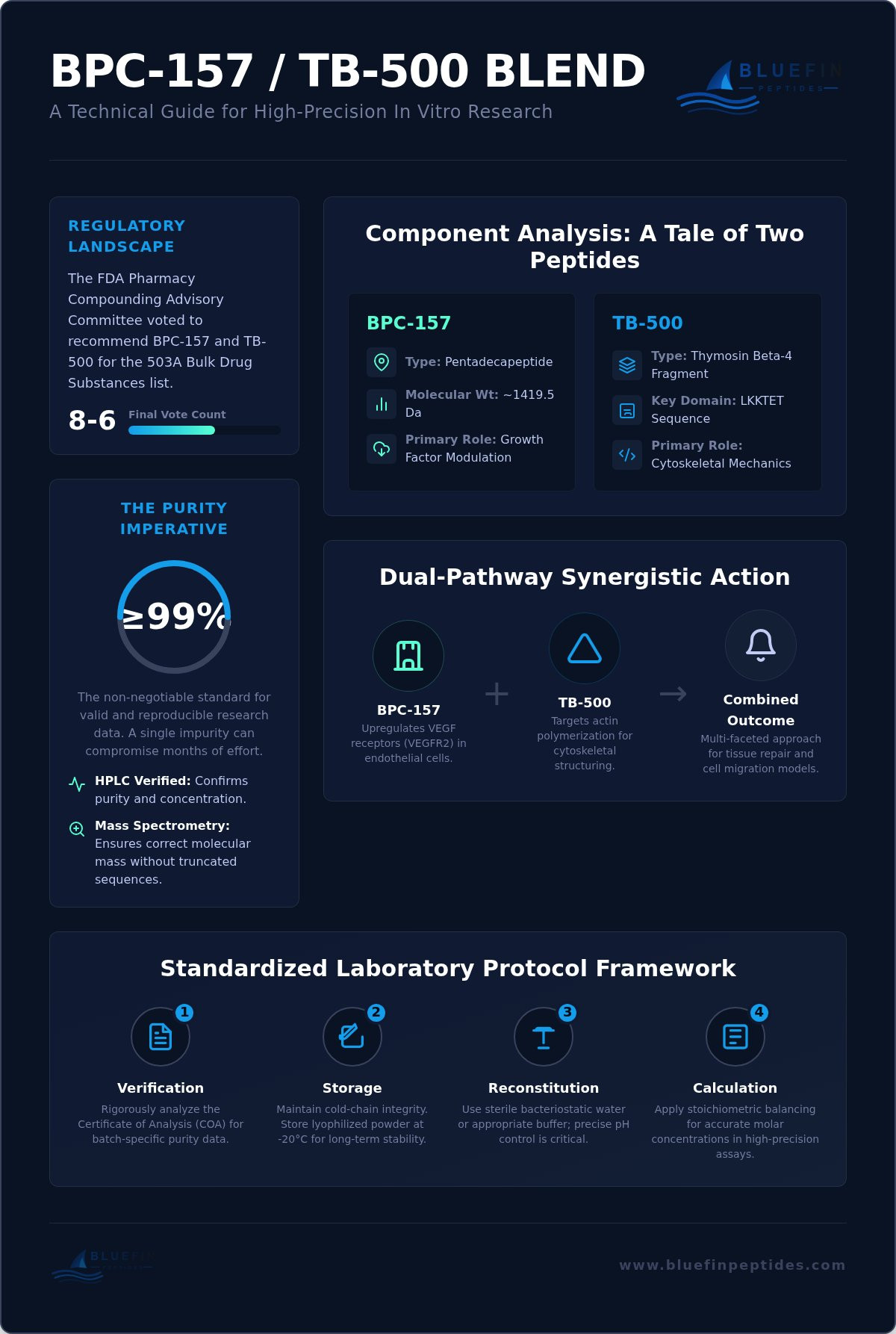
On July 23, 2026, the FDA Pharmacy Compounding Advisory Committee voted 8-6 to recommend BPC-157 and TB-500 for the 503A Bulk Drug Substances list. This decision marks a pivot toward regulated access, yet it places an even higher burden of proof on the scientific community to produce valid, reproducible data. For those exploring BPC-157 TB-500 blend research applications, the primary barrier isn't interest; it's the lack of standardized protocols and the prevalence of inconsistent, low-purity materials. You know that a single impurity spike on an HPLC report can compromise months of laboratory effort. Precision is the only currency that matters in high-performance research.
This technical guide establishes a rigorous framework for in vitro study protocols. It focuses on the verification of ≥99% purity and the standardization of reconstitution workflows. We provide the tools to interpret complex analytical reports and ensure your laboratory operates with the deep-sea precision of a disciplined logistics partner. You'll gain a clear methodology for stoichiometric balancing and purity verification. We'll cover everything from initial batch-level documentation to the final execution of standardized assays; this ensures your results stand up to the most demanding academic scrutiny.
Key Takeaways
- Define the precise molecular stoichiometry of BPC-157 and TB-500 to ensure consistency across comparative in vitro models.
- Evaluate dual pathways of angiogenesis and growth factor expression to identify high-impact BPC-157 TB-500 blend research applications.
- Navigate complex analytical reports to verify ≥99% HPLC purity, which is essential for establishing valid and reproducible research data.
- Apply a standardized protocol for sterile laboratory preparation and the accurate calculation of molar concentrations for high-precision assays.
- Leverage domestic, US-based logistics to maintain cold-chain integrity and ensure the precision of batch-specific verification for every research compound.
Chemical Profile and Stoichiometry of the BPC-157 / TB-500 Research Blend
Stoichiometric precision serves as the anchor for all BPC-157 TB-500 blend research applications. When these two distinct peptides are combined into a single lyophilized unit, the molar ratio becomes a critical variable in the experimental design. Most standardized blends utilize a 1:1 mass ratio, though the differing molecular weights of the components mean the molar concentrations aren't identical. Maintaining this specific balance is essential for researchers looking to observe the combined influence of these compounds on cellular signaling pathways. Lyophilized powders provide a stable physical state, yet their integrity depends on the exclusion of moisture and thermal fluctuations. Any deviation in the chemical environment can trigger premature degradation, particularly in the more complex sequence of TB-500.
To maintain the chemical stability of lyophilized powders in a laboratory environment, researchers must manage several variables:
- Hygroscopic nature of the peptide powder, requiring airtight seals.
- Thermal sensitivity, necessitating storage at -20°C for long-term preservation.
- Buffer pH during the reconstitution process to avoid precipitation or hydrolysis.
Molecular Characteristics of BPC-157
BPC-157 is a synthetic fragment of the gastric body protection compound with a molecular weight of approximately 1419.5 Da. This 15-amino acid sequence, often referred to as a pentadecapeptide, demonstrates high solubility in aqueous solutions and standard laboratory buffers such as phosphate-buffered saline (PBS). For a comprehensive BPC-157 Chemical Profile, one must look at its inherent stability even in the presence of gastric juices in vivo, though in vitro studies focus on its influence on growth factor expression. Precise molecular handling is required to prevent aggregation during the reconstitution phase, as the solubility parameters can shift depending on the ionic strength of the research-grade buffer used.
TB-500 (Thymosin Beta-4) Fragment Specifications
TB-500 is a synthetic version of the endogenous Thymosin Beta-4, characterized by its 43-amino acid structure: Ac-Ser-Asp-Lys-Pro-Asp-Met-Ala-Glu-Ile-Glu-Lys-Phe-Asp-Lys-Ser-Lys-Leu-Lys-Lys-Thr-Glu-Thr-Gln-Glu-Lys-Asn-Pro-Leu-Pro-Ser-Lys-Glu-Thr-Ile-Glu-Gln-Glu-Lys-Gln-Ala-Gly-Glu-Ser. Unlike the full-length protein, the TB-500 fragment emphasizes the G-actin binding domain, specifically the LKKTET sequence. This domain is the primary focus of BPC-157 TB-500 blend research applications involving cell migration and actin polymerization models. While endogenous Thymosin Beta-4 is produced naturally in response to tissue stress, the synthetic TB-500 fragment allows for a controlled, measurable interaction within a laboratory setting.
The necessity of ≥99% HPLC-verified purity can't be overstated. In molecular studies, even a 1% impurity can introduce unknown variables that skew results or cause cross-contamination between cell lines. Navigating the analytical currents of a Certificate of Analysis (COA) is essential; verification via mass spectrometry ensures that the molecular mass aligns perfectly with the theoretical profile. This confirms that the synthesis hasn't introduced truncated sequences or residual solvents. High-purity standards ensure that the observed biological responses are attributable solely to the peptide blend, providing the clarity required for peer-reviewed documentation.
Synergistic Mechanisms in Molecular Biology Research
Synergistic interactions between BPC-157 and TB-500 are best characterized by their overlapping yet distinct influences on the vascular and connective tissue microenvironments. While many commercial descriptions rely on vague terminology, BPC-157 TB-500 blend research applications anchor the study of cellular signaling in verifiable mechanistic data. BPC-157 operates primarily through the modulation of growth factor pathways. TB-500 targets the structural mechanics of the cytoskeleton. Together, they create a multi-faceted approach to tissue repair models. This dual-pathway interaction provides a more comprehensive view of biological recovery processes than isolated peptide studies can offer.
Angiogenesis and Vascular Endothelial Growth Factor (VEGF) Modulation
BPC-157 has been observed to upregulate VEGF receptors, particularly VEGFR2, in endothelial cells. This upregulation increases the sensitivity of these cells to endogenous growth signals, effectively lowering the threshold for angiogenic activation. TB-500 complements this by promoting endothelial cell migration and tube formation. This is a critical step in the development of new microvasculature. In research models, the blend appears to accelerate the transition from the inflammatory phase to the proliferative phase. This shift is essential for establishing a stable vascular supply to regenerating tissues. By analyzing these pathways, researchers can observe the synchronized movement of vascular precursors as they organize into functional networks within the laboratory environment.
Fibroblast Activity and Collagen Deposition
Connective tissue research often focuses on the proliferation of tendon-derived fibroblasts and their role in structural integrity. BPC-157 influences the expression of type I collagen synthesis. This provides the necessary structural framework for the extracellular matrix (ECM). TB-500 acts as a primary regulator of cell migration. It utilizes its G-actin binding domain to drive fibroblasts toward the site of experimental injury with high precision. The combined presence of these peptides in a high-purity BPC-157 / TB-500 research blend allows for the simultaneous study of ECM remodeling and cellular motility. This dual-action mechanism is more representative of the complex biological repair seen in vivo. It provides a robust platform for investigating how cells navigate the dense architecture of the ECM during the remodeling phase.
The resulting data from these blended models offers a clearer picture of how signaling molecules and structural proteins cooperate. Researchers can monitor the rate of fibroblast proliferation alongside the deposition of new collagen fibers. This creates a holistic view of the tissue's physical state. High-performance labs prioritize these blended models to capture the nuance of cellular interaction that single-agent studies often miss. Relying on verified stoichiometry ensures that the observed synergy is reproducible across multiple experimental batches.
Purity Verification: Interpreting HPLC and Mass-Spec for Blended Peptides
Reproducible research data depends entirely on the chemical integrity of the starting material. In BPC-157 TB-500 blend research applications, the presence of two distinct molecular entities increases the risk of co-eluting impurities. Purity of ≥99% isn't an arbitrary target; it's a requirement to ensure that observed cellular responses aren't artifacts of synthesis byproducts. Residual solvents or truncated peptide sequences can interfere with receptor binding or induce unintended cytotoxic effects. A rigorous verification process acts as the anchor for laboratory trust, separating disciplined inquiry from speculative observation.
High-Performance Liquid Chromatography (HPLC) Analysis
HPLC provides the first layer of defense by separating components based on their hydrophobic properties. In a two-peptide blend, the resulting chromatogram should display two distinct, well-resolved peaks. BPC-157 and TB-500 possess different elution times due to their unique amino acid sequences and molecular weights. Identifying these peaks requires a clear understanding of research peptide quality standards to ensure that the area under each peak corresponds to the intended stoichiometry. Overlapping peaks or "shoulders" on the primary signals indicate the presence of closely related impurities that could compromise the study's validity. Precision is not an option. It's the standard.
Mass Spectrometry (MS) Confirmation
Mass Spectrometry provides the definitive identity of each peptide by measuring its mass-to-charge ratio. While HPLC confirms purity, MS confirms that the substance in the vial is actually the intended sequence. A batch-specific COA must show the theoretical mass versus the measured mass for both BPC-157 and TB-500. Generic "peptide" claims lack the necessary depth to satisfy high-performance laboratory requirements. By verifying the specific molecular mass of each fragment, researchers can proceed with the confidence that the synthesis was accurate and that no significant degradation occurred during the lyophilization process.
Identifying common impurities, such as residual trifluoroacetic acid (TFA) or acetonitrile, is a critical step in interpreting a COA. These substances are often used during the purification process but must be removed to levels that don't skew in vitro results. High-purity verification ensures that the "currents" of your research remain clear, allowing for the precise measurement of biological outcomes without the interference of chemical contaminants. You can't build a valid model on a foundation of unknown variables.
Step-by-Step In Vitro Study Protocol for Peptide Blends
Standardizing the laboratory environment is the baseline for reproducible data. For all BPC-157 TB-500 blend research applications, maintaining a sterile field within a laminar flow hood prevents microbial contamination that would otherwise invalidate cellular assays. Precision starts before the first pipette tip is seated. You'll need to calculate molar concentrations based on the specific batch purity and molecular weight. Aiming for concentrations in the 10 nM to 100 µM range is typical for observing dose-dependent responses in cell culture models. Consistency in these initial calculations ensures that the stoichiometry defined in previous sections remains intact throughout the experiment.
Reconstitution and Solution Preparation
Reconstitution demands a methodical approach. Selecting the correct solvent, such as sterile phosphate-buffered saline (PBS) or bacteriostatic water, depends on the specific requirements of your assay. Reconstitution requires a steady hand. Gentle dissolution is mandatory. Never vortex your peptide vials. High-frequency mechanical stress can lead to the mechanical degradation of the fragile peptide chains. Instead, allow the solvent to flow down the side of the vial and use a gentle swirling motion. For those managing more complex systems, the GHK-Cu BPC-157 TB-500 research blend provides a blueprint for handling multi-peptide nuances without compromising molecular stability.
Cell Culture Application and Assays
Establishing a clear baseline requires a control group treated with vehicle alone. Once you've applied the peptide blend, use an MTT assay or BrdU labeling to quantify cellular metabolic activity and DNA synthesis. These metrics provide a snapshot of proliferation rates over 24 to 72 hours. To evaluate the blend's impact on cell migration, a scratch assay remains the gold standard for wound healing models. By creating a "wound" in a confluent monolayer of cells and monitoring the rate of closure via microscopy, you can measure the synergistic influence of the peptides on cellular motility. Data collection intervals should be frequent enough to capture the peak of the proliferative phase, typically every 6 to 12 hours. For consistent results, ensure you use verified research peptides with a documented COA for every batch.
Incubation parameters must remain rigid. Maintaining a standard 37°C environment with 5% CO2 is essential for cell viability and consistent growth factor expression. Any fluctuation in the incubator's atmosphere can introduce variables that obscure the peptide's true biological effect. By adhering to these strict protocols, your laboratory can produce the high-fidelity data required for peer-reviewed publication. Discipline in the "how" of the process is what ultimately secures the "what" of your results.
Procuring High-Purity Research Blends for Laboratory Applications
Procurement is the final logistical anchor in the experimental lifecycle. For BPC-157 TB-500 blend research applications, the transition from theoretical design to physical assay requires a source that mirrors the discipline of the laboratory itself. Quality isn't a variable to be negotiated. It's a binary state. Identifying US-based sources for high-purity research peptides reduces the variables associated with international transit, such as prolonged thermal exposure and inconsistent customs handling. Domestic fulfillment ensures that the chemical integrity established at the point of synthesis remains intact upon arrival at your facility. These compounds are strictly for laboratory research and not for human or veterinary use.
Evaluating Supplier Transparency
Transparency is often claimed but rarely documented with maritime precision. In the context of peptide procurement, this precision is defined by the availability of batch-specific documentation. A reputable vendor provides more than just a product; they provide the tools for verification. Every vial must be tethered to a specific HPLC and Mass-spec report that confirms both purity and molecular identity. This level of detail separates elite laboratory partners from high-volume retail shops. For instance, the analytical standards required for a Tirzepatide research peptide provide a benchmark for the rigorous testing protocols that should be expected across all offerings. Without batch-level data, a researcher is navigating without a chart.
Bluefin Peptides: A Disciplined Logistics Partner
Bluefin Peptides operates as a high-performance laboratory partner rather than a simple vendor. We provide a BPC-157 / TB-500 Research Blend with a guarantee of ≥99% purity, verified through independent HPLC analysis. This commitment to quality ensures that your BPC-157 TB-500 blend research applications are built on a foundation of chemical certainty. Our US-based shipping infrastructure is designed for speed and reliability. We facilitate uninterrupted research cycles by maintaining a steady supply of verified compounds stocked within the United States. This logistical efficiency prevents the "drift" often seen in global supply chains, keeping your data clean and your workflow moving forward.
Verification is mandatory. Trust is earned through documentation. By prioritizing academic and professional research integrity, we ensure that every batch meets the high-stakes requirements of the modern laboratory. Our focus remains on the "how" of our processes-the testing, the fulfillment, the security-to ensure the "what" of your results. When the stoichiometry is exact and the purity is absolute, the science can speak for itself. Secure your laboratory's momentum with a partner that values precision as much as you do.
Advancing Laboratory Standards in Peptide Research
Scientific progress in molecular biology depends on the elimination of variables. Standardizing your in vitro protocols ensures that observed cellular interactions are the result of biochemical synergy rather than chemical contamination. By anchoring your work in stoichiometric precision and rigorous purity verification, you establish a baseline for reproducible, peer-reviewed data. Exploring BPC-157 TB-500 blend research applications requires a disciplined approach to both methodology and procurement. High-performance research is only as reliable as the compounds that fuel it.
Bluefin Peptides serves as your high-precision laboratory partner. We provide the documentation and logistical speed necessary to maintain your experimental momentum. Every batch undergoes rigorous testing to ensure it meets the highest standards of analytical clarity. ≥99% HPLC-Verified Purity. Mass-Spec Identity Confirmation. USA-Based Rapid Fulfillment. Secure the tools required for absolute verification.
Secure HPLC-Verified BPC-157 / TB-500 Blends for Your Lab
Maintain your focus on the data while we handle the precision of the supply chain. Your laboratory's success is defined by the integrity of its results.
Frequently Asked Questions
What is the recommended storage temperature for lyophilized BPC-157/TB-500 blends?
Lyophilized peptides must be stored at -20°C for long-term preservation to minimize thermal degradation. At this temperature, the physical state of the powder remains stable for up to 24 months. For short-term use within 1-4 weeks, storage at 4°C is acceptable. Once reconstituted, the solution's half-life drops significantly. This necessitates storage at 4°C and utilization within several days to maintain the molecular integrity required for precise research.
How do I calculate the concentration of each peptide in a 10mg/10mg blend vial?
Concentration is determined by dividing the mass of each peptide by the total volume of the solvent. In a 10mg/10mg blend reconstituted with 2mL of diluent, the concentration of each component is 5mg/mL. For BPC-157 TB-500 blend research applications, converting these values to molarity is essential. This requires using the specific molecular weights of BPC-157 (1419.5 Da) and TB-500 (approx. 4963 Da) for accurate assay calculations.
Is BPC-157 stable in a cell culture medium for extended periods?
BPC-157 exhibits relative stability in aqueous environments but is subject to enzymatic degradation in serum-supplemented cell culture media. While it remains active for several hours, the presence of proteases can trigger fragmentation. Researchers typically refresh the media every 24-48 hours during longitudinal studies to ensure a consistent concentration of the active peptide. Maintaining a controlled pH environment is critical to preventing premature chemical hydrolysis during incubation.
Can I use bacteriostatic water for in vitro peptide research?
Bacteriostatic water is generally avoided in cell culture research because the preservative, benzyl alcohol, can induce cytotoxic effects. For in vitro studies, sterile phosphate-buffered saline (PBS) or sterile water for injection is the standard. These solvents maintain the required osmotic balance and chemical neutrality without introducing toxic variables. Selecting the appropriate solvent ensures that the observed cellular responses are not skewed by preservative interference in the laboratory.
How does TB-500 differ from Thymosin Beta-4 in a laboratory setting?
TB-500 refers to a synthetic fragment that emphasizes the active G-actin binding domain of the full-length Thymosin Beta-4 protein. In a laboratory setting, this fragment is utilized for its specific influence on cellular motility and actin polymerization. Thymosin Beta-4 is the endogenous 43-amino acid protein. TB-500 offers a more focused research tool for investigating specific mechanistic pathways without the broader signaling complexity of the entire endogenous protein structure.
What are the common signs of peptide degradation in a research vial?
Common indicators of peptide degradation include changes in solubility, the formation of visible aggregates, or a shift in the powder's color. Analytically, degradation is identified by a decrease in peak resolution on an HPLC chromatogram or the appearance of secondary peaks representing truncated fragments. These changes signify that the physical state of the molecule has been compromised, which can lead to inconsistent data in BPC-157 TB-500 blend research applications.
Why is HPLC verification more critical for blends than for single peptides?
HPLC verification is critical for blends to ensure the precise stoichiometry of the two components. In a single-peptide vial, impurities are easier to identify. In a blend, co-eluting impurities can hide beneath the primary peaks, requiring deep-sea precision in resolution to detect. Rigorous HPLC analysis provides the resolution necessary to verify that each peptide is present in the correct ratio and that no cross-contamination occurred during synthesis.
Are Bluefin Peptides products intended for human administration?
No, Bluefin Peptides products are strictly intended for laboratory research use only. These compounds are not for human or veterinary administration. They haven't been approved for clinical use or the treatment of any medical condition. Every procurement is tethered to the legal requirement that the material will be utilized solely within a controlled laboratory environment by qualified professionals for the purpose of scientific inquiry and documentation.
For laboratory research use only. Not for human or veterinary use. This content is educational and does not constitute medical, dosing, or usage guidance.
Browse the BLUEFIN catalog