Acetic Acid Peptide Reconstitution Guide (2026)
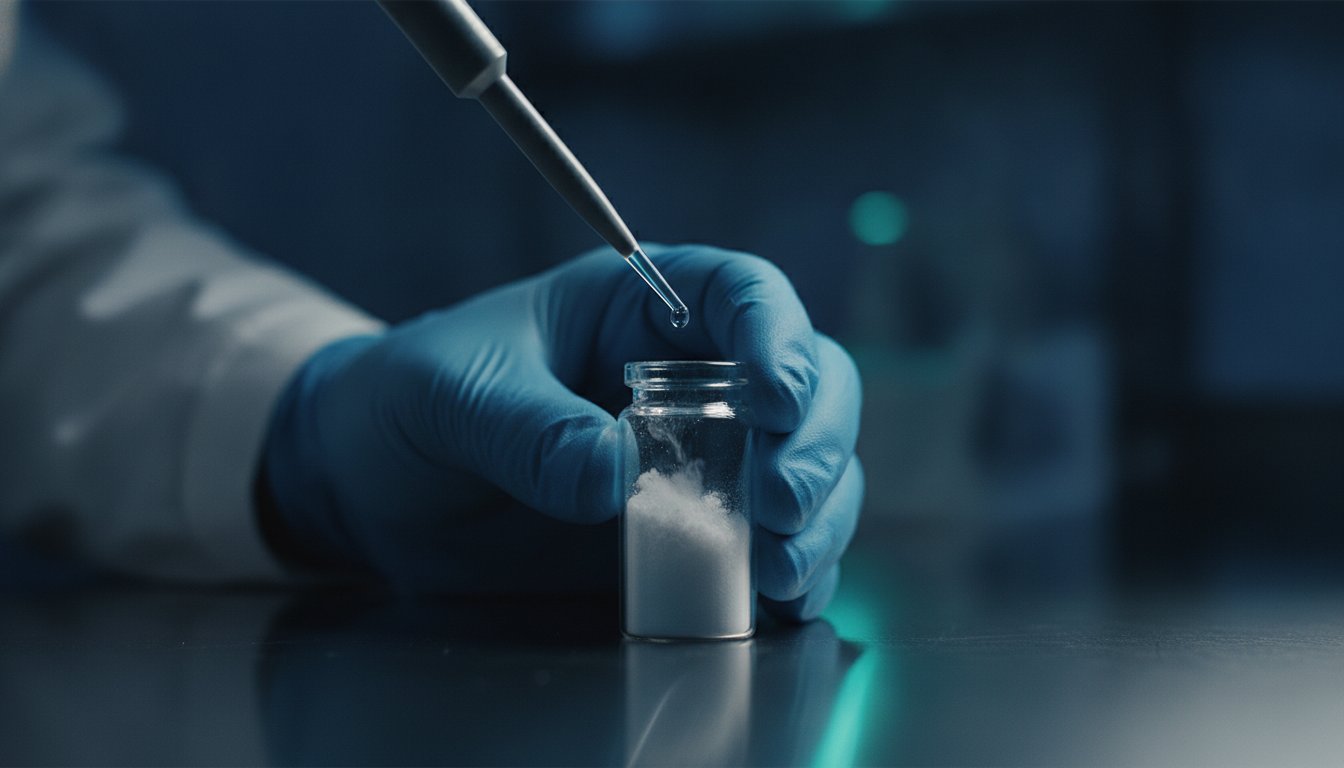
A single vial of "crashed" peptide represents more than a lost sequence; it's a failure of laboratory methodology that compromises an entire research timeline. You understand the frustration when a high-value lyophilized compound clumps or refuses to enter solution despite standard protocols. This resistance often stems from the inherent hydrophobicity of the sequence, where neutral pH solvents simply can't bridge the gap between solid and solution. Utilizing acetic acid for peptide reconstitution serves as the precise chemical anchor needed to achieve fluid transparency without sacrificing structural integrity.
We recognize that inconsistent solubility leads to inconsistent data. This guide provides a disciplined framework to master the use of acetic acid for peptide reconstitution, ensuring you maintain ≥99% HPLC-verified purity throughout the process. You'll gain access to verified 2026 dilution ratios and stability thresholds designed to prevent sequence degradation. We will examine the specific requirements for hydrophobic research compounds and provide a step-by-step methodology to ensure your laboratory results remain both reproducible and analytically sound.
Key Takeaways
- Identify the chemical drivers behind peptide "crashing" and how weak organic acids mitigate solubility failures in hydrophobic sequences.
- Implement a disciplined "solvent-first" protocol using acetic acid for peptide reconstitution to achieve total transparency in resistant research compounds.
- Calibrate solvent pH based on the sequence's isoelectric point to prevent peptide bond hydrolysis and ensure long-term chemical stability.
- Protect the validity of laboratory data by adhering to strict dilution standards that preserve ≥99% HPLC-verified purity.
- Align reconstitution methodology with batch-specific mass-spectrometry documentation to ensure reproducible and analytically sound research outcomes.
The Role of Acetic Acid in Peptide Solubility and Reconstitution
Acetic acid (CH3COOH) serves as a fundamental weak organic acid within the biochemical landscape. Its primary utility lies in its ability to modulate the pH of a solution without the aggressive ionization associated with strong mineral acids. For a peptide sequence to remain stable, the solvent environment must respect its delicate chemical bonds. We strictly utilize analytical-grade reagents for this purpose. Household variants are never acceptable; they contain organic contaminants and inconsistent concentrations that compromise laboratory data. Precision is the baseline for all research protocols.
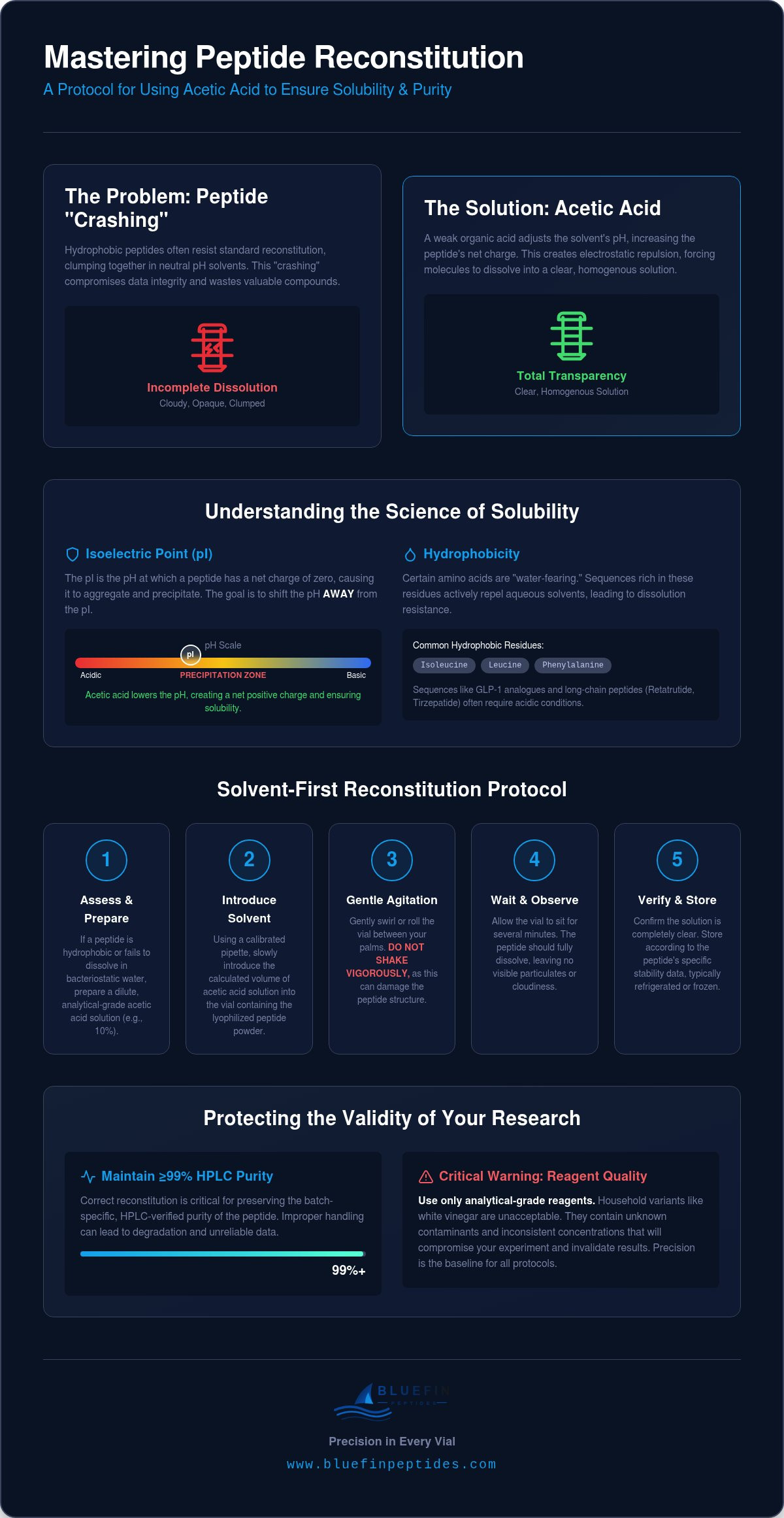
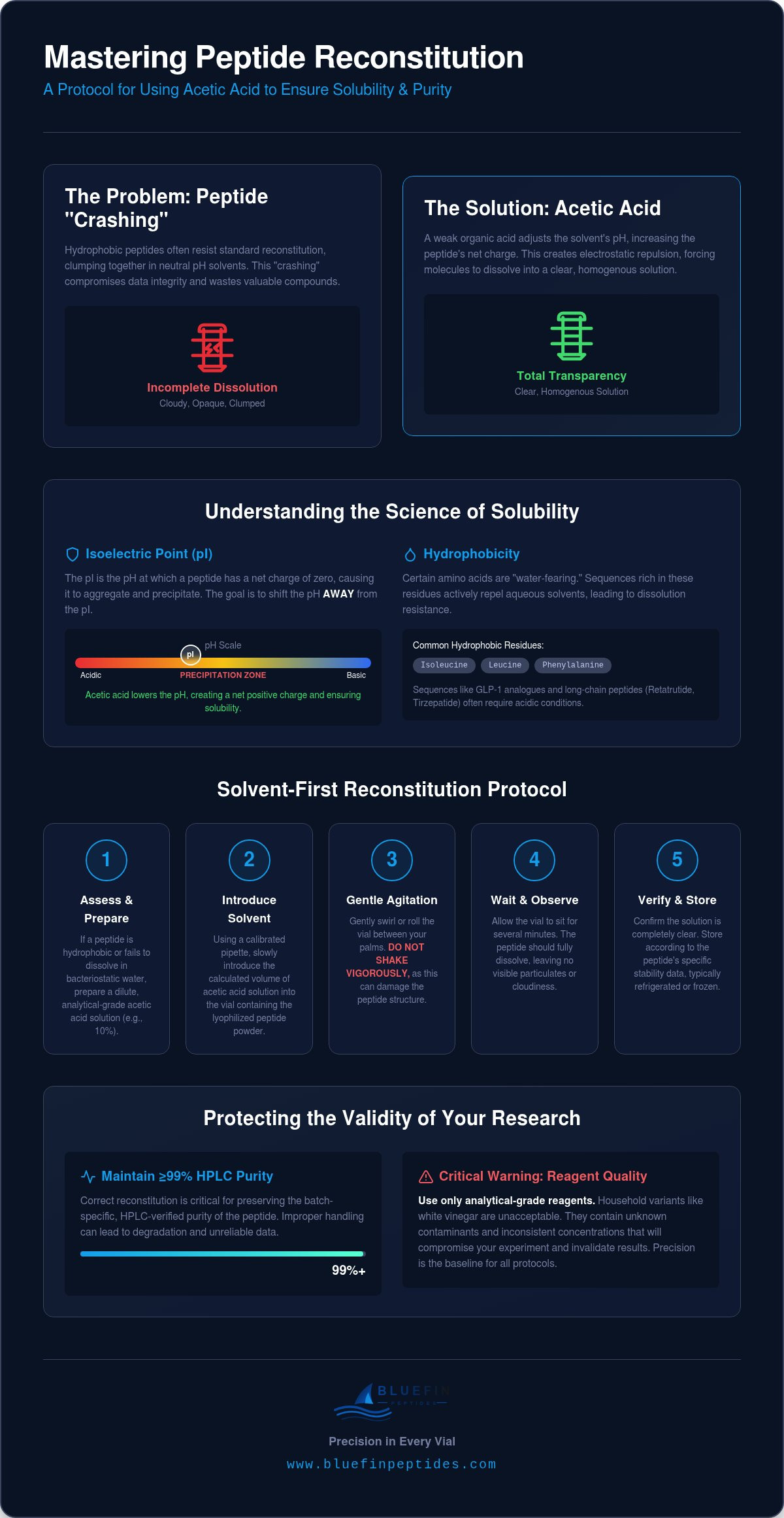
Standard aqueous reconstitution occasionally fails when encountering lyophilized powders. This resistance typically stems from the hydrophobic nature of specific amino acid residues. These residues repel water, creating inter-molecular forces that lead to "clumping" or "crashing" within the vial. Using acetic acid for peptide reconstitution allows the researcher to disrupt these forces by adjusting the ionic environment, facilitating a transition from a solid cake to a clear, homogenous solution. Precision in solvent selection serves as the anchor for reproducible data.
When to Bypass Bacteriostatic Water
Bacteriostatic water is the default diluent for most research, yet it's not a universal solution. If a compound results in a "cloudy" or opaque mixture after gentle agitation, it's a clear signal of incomplete dissolution. Neutral pH environments often encourage peptide aggregation, where individual molecules bind to one another rather than the solvent. This is particularly common in GLP-1 analogues and certain growth hormone-releasing sequences. In these instances, continuing with a neutral diluent risks the integrity of the entire batch. Transitioning to a dilute acidic solvent is a calculated move to ensure total solubility and fluid transparency.
Solvent Compatibility with Research Standards
Maintaining the integrity of mass-spec confirmed compounds requires solvents that don't interfere with the analytical profile. Acetic acid interacts with the lyophilized matrix by protonating specific functional groups, which increases the net charge of the molecule. This charge boost forces the sequence to interact more favorably with water molecules. At Bluefin Peptides, we emphasize that high-purity research requires high-purity solvents. Our commitment to ≥99% purity is only as strong as the methodology used during reconstitution. Adhering to strict acetic acid for peptide reconstitution protocols ensures that the final solution reflects the batch-specific documentation provided with every vial.
Understanding Peptide Hydrophobicity and pH-Dependent Solubility
Peptide solubility is a direct consequence of chemical architecture. It's not a variable to be guessed. Hydrophobic amino acid residues, including Isoleucine, Leucine, and Phenylalanine, possess non-polar side chains that actively repel aqueous environments. When these residues are strategically positioned or constitute a high percentage of the sequence, the compound exhibits significant dissolution resistance. This resistance is often compounded by sequence length. Larger peptides, such as Retatrutide or Tirzepatide, possess increased surface areas and complex folding patterns that can shield polar groups, making them inherently difficult to dissolve in standard bacteriostatic water. Longer chains act as complex vessels in the solvent stream; they require specific conditions to maintain their course without grounding on the vial walls as insoluble precipitate. Achieving total solubility requires fluid precision in molecular navigation.
The Science of the Isoelectric Point
The isoelectric point (pI) is the specific pH value where a peptide molecule carries a net electrical charge of zero. In this state, the absence of electrostatic repulsion between molecules leads to immediate aggregation and precipitation. If a researcher attempts to dissolve a compound in a solvent with a pH near its pI, the material will inevitably "crash" out of the solution. Using acetic acid for peptide reconstitution is a disciplined method to shift the solvent pH away from this precipitation zone. By lowering the pH, usually below the pI for basic peptides, the molecules acquire a net positive charge. This charge creates the necessary repulsion to keep individual molecules suspended and separated. Adhering to a technical Peptide Dissolving Protocol is essential for calculating these shifts accurately and ensuring the compound remains in a clear, usable state.
Hydrophobicity Scales in Research Models
Analytical models often employ the hydropathy index, such as the Kyte-Doolittle scale, to quantify the hydrophobic or hydrophilic properties of a sequence. A high positive score indicates a sequence that'll likely resist standard aqueous diluents. Researchers must evaluate these scales before attempting reconstitution to avoid vial loss. The stoic reliability of acidic solvents becomes apparent when dealing with these non-polar sequences. For high-index compounds, acetic acid for peptide reconstitution provides the necessary chemical bridge to facilitate a homogenous mixture. This precision ensures the resulting solution remains stable for subsequent analysis and HPLC verification. Ensuring your laboratory uses high-purity research peptides from Bluefin ensures that solubility challenges are addressed with compounds verified for ≥99% purity and mass-spec confirmation.
Protocol for Reconstituting Research Peptides with Diluted Acetic Acid
Precision in the laboratory environment demands a rigorous approach to solvent preparation. A successful protocol begins with the preparation of a diluted acidic environment, typically ranging from 0.1% to 1.0% concentration. This range provides the necessary ionic strength to disrupt intermolecular forces without inducing acid-catalyzed hydrolysis. We utilize a "solvent-first" methodology. This involves wetting the lyophilized cake with the minimum required volume of acidic solvent before any volume adjustment occurs. Flooding the vial with neutral diluents before achieving initial solubility often results in irreversible aggregation. By focusing on initial wetting, you ensure every molecule in the matrix is accessible to the solvent stream.
Executing this protocol correctly requires specific volumetric tools. Attempting to estimate ratios leads to inconsistent research results and potential sequence degradation. When utilizing acetic acid for peptide reconstitution, the goal is to create a homogenous environment that remains stable for the duration of the study. This disciplined approach preserves the integrity of the compound and ensures that subsequent analytical tests remain valid.
Calculating Concentration and Ratios
A 1% concentration of acetic acid represents the maximum threshold for most research applications to ensure long-term sequence stability. To achieve this, researchers often dilute glacial acetic acid using the standard C1V1 = C2V2 formula. For example, creating 10mL of a 0.6% solution requires calculating the exact microliter volume of glacial acid needed to reach that target when mixed with sterile diluent. Always align these calculations with the batch-specific COA data provided with your compounds. If the mass-spec report indicates a high hydropathy index, a concentration closer to the 1% ceiling may be required for total dissolution.
The Final Dilution with Bacteriostatic Water
Once the peptide is fully dissolved in the acidic concentrate, the final volume is reached by adding bacteriostatic water. This step requires navigational precision. Rapid volume expansion can trigger a "crash out" effect, where the sudden shift in local concentration causes the peptide to precipitate. Add the water dropwise along the side of the vial. This gradual approach maintains pH stability throughout the transition. Agitation must be strictly controlled; use gentle swirling to encourage mixing. Destructive vortexing introduces mechanical shear forces that can denature sensitive sequences. A clear, homogenous solution is the only acceptable outcome when using acetic acid for peptide reconstitution for high-purity research.
Chemical Stability and pH Considerations for Long-Term Storage
Reconstitution represents a transition from absolute stability to a state of kinetic vulnerability. While using acetic acid for peptide reconstitution is essential for hydrophobic sequences, the resulting low-pH environment directly influences the rate of peptide bond hydrolysis. This chemical reaction, where water molecules cleave the amide bonds, accelerates when the solvent environment deviates from the peptide's optimal stability range. Researchers must monitor for visual indicators of degradation, such as the formation of fine particulates or subtle changes in solution clarity. However, visual inspection serves only as a secondary measure. The primary safeguard is maintaining the compound in its solid state until the exact moment of use. For this reason, lyophilized peptide storage remains the gold standard for preserving sequence integrity over extended durations.
Degradation Pathways in Acidic Media
Low-pH environments introduce specific chemical risks, primarily deamidation and oxidation. Deamidation involves the conversion of asparagine or glutamine residues into aspartic or glutamic acid, effectively altering the peptide's molecular weight and net charge. While acetic acid for peptide reconstitution provides the required solubility for non-polar compounds, it necessitates a strict cold-chain discipline to mitigate these degradation rates. Structural longevity is a calculated balance between achieving a homogenous solution and preventing chemical modification. Maintaining reconstituted vials at 2°C to 8°C slows these kinetic processes, but it does not halt them. Precision in research depends on recognizing that once a peptide enters a liquid acidic medium, its analytical clock begins to tick with increased velocity.
Optimal Storage Environments for Research Vials
Environmental factors act as external catalysts for molecular breakdown. Light sensitivity is a critical concern; UV exposure can trigger radical-mediated oxidation of sensitive residues like tryptophan or tyrosine. We utilize the maritime depth of amber vials to shield these compounds from photon-induced damage, ensuring the internal environment remains dark and stable. When choosing between freezing and refrigeration for reconstituted acidic blends, refrigeration is typically preferred to avoid the physical stress of repeated freeze-thaw cycles, which can denature the sequence through mechanical shear. Your storage protocols must align with established analytical quality standards to ensure the data you generate reflects the peptide's true potential rather than storage-induced artifacts. For high-stakes laboratory work, you can procure HPLC-verified research peptides that meet the most rigorous purity benchmarks before reconstitution.
Ensuring Research Integrity with HPLC-Verified Peptides
The integrity of laboratory data rests on the synergy between product quality and methodological precision. Even a compound with ≥99% purity can yield skewed results if the reconstitution phase introduces aggregation or partial degradation. Using acetic acid for peptide reconstitution is a technical necessity for hydrophobic sequences, but its efficacy is predicated on the baseline quality of the lyophilized powder. If a researcher encounters persistent solubility issues despite using a disciplined acidic protocol, the underlying chemical architecture or impurity profile of the batch must be scrutinized. Data transparency is non-negotiable. Researchers prioritizing the retatrutide research peptide demand verified specifications to ensure their models remain uncompromised. A final checklist for laboratory-grade preparation includes:
- Confirmation of the peptide's hydropathy index and isoelectric point (pI).
- Verification of solvent purity using analytical-grade reagents only.
- Dropwise introduction of the acidic diluent to the lyophilized cake.
- Visual confirmation of a clear, particle-free solution before final volume adjustment.
- Adherence to cold-chain storage protocols post-reconstitution.
Interpreting the Certificate of Analysis (COA)
A batch-specific COA is the primary tool for empirical verification. It aligns the theoretical molecular mass with the experimental results obtained through mass spectrometry, confirming the identity of the sequence. Beyond identity, the HPLC chromatogram reveals the impurity profile. Even minor residual solvents or truncated sequences can alter how a compound interacts with acetic acid for peptide reconstitution. For instance, HPLC verified tirzepatide provides a predictable solubility baseline, allowing researchers to calibrate their solvent ratios with confidence. If the experimental mass deviates from the theoretical target, the research integrity is fundamentally compromised.
Bluefin Peptides: Disciplined Logistics for Modern Science
We operate as a high-performance laboratory partner, prioritizing the "how" of our processes to guarantee the "what" of your results. Our US-stocked inventory ensures that high-purity research chemicals are delivered with the speed required by modern scientific timelines. This logistical efficiency is balanced by a traditionalist adherence to strict testing protocols; every batch undergoes multi-level verification before fulfillment. We provide the empirical data, including HPLC and mass-spec raw data, to empower researchers with the tools for independent audit. Secure your HPLC-verified research peptides today.
Standardizing Precision in Molecular Reconstitution
Mastering the methodology of using acetic acid for peptide reconstitution ensures that hydrophobic sequences remain clear, stable, and analytically viable. You now have the protocols to navigate the complexities of the isoelectric point and the "solvent-first" wetting technique. These disciplined laboratory standards prevent the aggregation of high-value research compounds, preserving the structural integrity required for reproducible results. It's a process where chemical precision meets operational excellence, ensuring that your data remains as clear as the solutions you prepare.
Precision is the baseline for modern science. We provide the empirical foundation for your work through ≥99% HPLC-verified purity and batch-specific mass-spec confirmation on every vial. With rapid US-based fulfillment, your research timeline remains fluid and secure. Procure HPLC-Verified Research Peptides to ensure your next study begins with absolute chemical certainty. Your commitment to rigorous methodology deserves a partner focused on unwavering quality and verified documentation. We are ready to support your analytical objectives.
Frequently Asked Questions
Is acetic acid the same as bacteriostatic water for reconstitution?
Acetic acid is not a substitute for bacteriostatic water; they perform fundamentally different functions in the laboratory. Acetic acid is a weak organic acid used to modulate the pH of a solution to facilitate the dissolution of hydrophobic sequences. Bacteriostatic water is a sterile diluent containing 0.9% benzyl alcohol, which serves as a preservative to inhibit bacterial growth. A disciplined protocol often utilizes both reagents in a strategic sequence to achieve total solubility.
What concentration of acetic acid is safe for research peptides?
The standard ceiling for research applications is 1.0% concentration. Most laboratory protocols utilize a range between 0.1% and 0.6% to achieve solubility without compromising chemical stability. Higher concentrations risk acid-catalyzed hydrolysis, which can degrade the peptide bond and alter the molecular weight. Precision in this dilution is essential for maintaining the integrity of HPLC-verified compounds and ensuring the resulting data reflects the peptide's true analytical profile.
Can I use vinegar if I do not have laboratory-grade acetic acid?
No. Household vinegar contains organic impurities, sugars, and inconsistent acid concentrations that will contaminate your research environment. Laboratory-grade acetic acid is a purified reagent with a verified chemical profile. Using non-analytical grade solvents invalidates mass-spec confirmation and compromises the ≥99% purity standards required for reproducible science. Research integrity depends on the use of high-purity solvents that match the quality of the lyophilized compounds being dissolved.
Does acetic acid affect the results of my laboratory study?
Acetic acid is a standard biochemical reagent that, when used at correct molarity, does not interfere with the peptide's biological activity in research models. However, it does alter the solution's pH, which must be accounted for in your experimental design. Utilizing acetic acid for peptide reconstitution ensures total solubility, which actually improves the accuracy of your results compared to using a "cloudy" or improperly dissolved mixture that lacks homogenous concentration.
Which specific peptides typically require an acidic solvent?
Hydrophobic sequences with a high hydropathy index often require an acidic bridge for dissolution. This includes GLP-1 analogues like Retatrutide and Tirzepatide, as well as certain growth hormone-releasing peptides. These compounds possess non-polar residues that repel neutral water. By shifting the pH away from the isoelectric point, acetic acid creates the electrostatic repulsion necessary for a homogenous, clear solution. This ensures the peptide remains suspended in the solvent stream.
What happens if the peptide precipitates after adding BAC water?
Precipitation, or "crashing out," occurs when the sudden volume expansion shifts the pH back toward the isoelectric point. If this happens, you may need to add a few additional drops of the acidic concentrate to restore solubility. This highlights the importance of the "solvent-first" methodology, where the peptide is fully wetted and dissolved in the acidic medium before the dropwise introduction of bacteriostatic water. Maintaining pH stability is critical during this transition.
How long is a peptide stable in an acetic acid solution?
Stability varies by sequence, but most research peptides remain stable for 14 to 30 days when stored at 2°C to 8°C in an acidic solution. Acidic environments can accelerate hydrolysis over time, so long-term storage should always utilize the lyophilized state. Monitoring for visual changes or using analytical indicators is necessary to ensure the compound still meets the ≥99% purity benchmark. Once reconstituted, the solution's chemical clock begins to tick with increased velocity.
Is it necessary to filter the solution after using acetic acid?
If the protocol is followed with analytical precision, the resulting solution should be clear and free of particulates, making filtration unnecessary. However, if any undissolved "clumps" remain, a 0.22-micron sterile syringe filter may be used to ensure a homogenous liquid. This is a secondary measure; the primary goal of acetic acid for peptide reconstitution is to achieve total solubility through chemical means rather than mechanical filtration, preserving the exact concentration of the vial.
For laboratory research use only. Not for human or veterinary use. This content is educational and does not constitute medical, dosing, or usage guidance.
Browse the BLUEFIN catalog