Retatrutide Research Applications: A Technical Overview of Triple-Agonist Signaling

The transition from dual-agonist to triple-agonist signaling represents a sea change in metabolic research. While existing models rely on the synergistic effects of GLP-1 and GIP, the integration of glucagon receptor activation introduces a third dimension of metabolic regulation. You likely recognize that dual-agonists have reached a ceiling in certain laboratory settings, leaving the glucagon pathway's potential for energy expenditure and lipid oxidation largely unexplored. This technical overview provides an authoritative analysis of retatrutide research applications, focusing on how this single peptide engineered for GIP, GLP-1, and glucagon receptors facilitates deeper investigation into complex metabolic signaling.
Precision. Verification. Security. These are the non-negotiable requirements for high-stakes laboratory environments where inconsistent peptide purity often compromises data integrity. This article delivers a comprehensive breakdown of retatrutide’s chemical structure and the multi-receptor mechanisms that drive its documented 28.3% weight loss in recent TRIUMPH-1 trials. We will establish rigorous protocols for metabolic research models and identify the necessity of batch-specific HPLC and Mass-Spec documentation. By the end of this analysis, you will understand how to manage the logistical challenges of sourcing high-purity compounds with deep-sea precision while maintaining the strict testing protocols required for reproducible scientific results.
Key Takeaways
- Retatrutide functions as a synthetic 39-amino acid peptide that activates GLP-1, GIP, and glucagon receptors. This triple-agonist mechanism allows researchers to explore metabolic pathways that remain inaccessible with dual-agonist models.
- Advanced retatrutide research applications include investigating lipid oxidation and energy expenditure within diet-induced obesity and Metabolic Dysfunction-Associated Steatotic Liver Disease (MASLD) models.
- Maintaining a purity standard of ≥99% through HPLC and Mass-Spec verification is critical for ensuring the integrity of longitudinal laboratory data.
- Utilizing a domestic USA supplier with batch-specific COAs mitigates the risks of chemical instability and contamination often found in unverified international sources.
- Detailed receptor signaling analysis reveals how the glucagon component of retatrutide influences hepatic glucose production and thermogenesis in controlled research settings.
Retatrutide: The Triple-Agonist Frontier in Metabolic Research
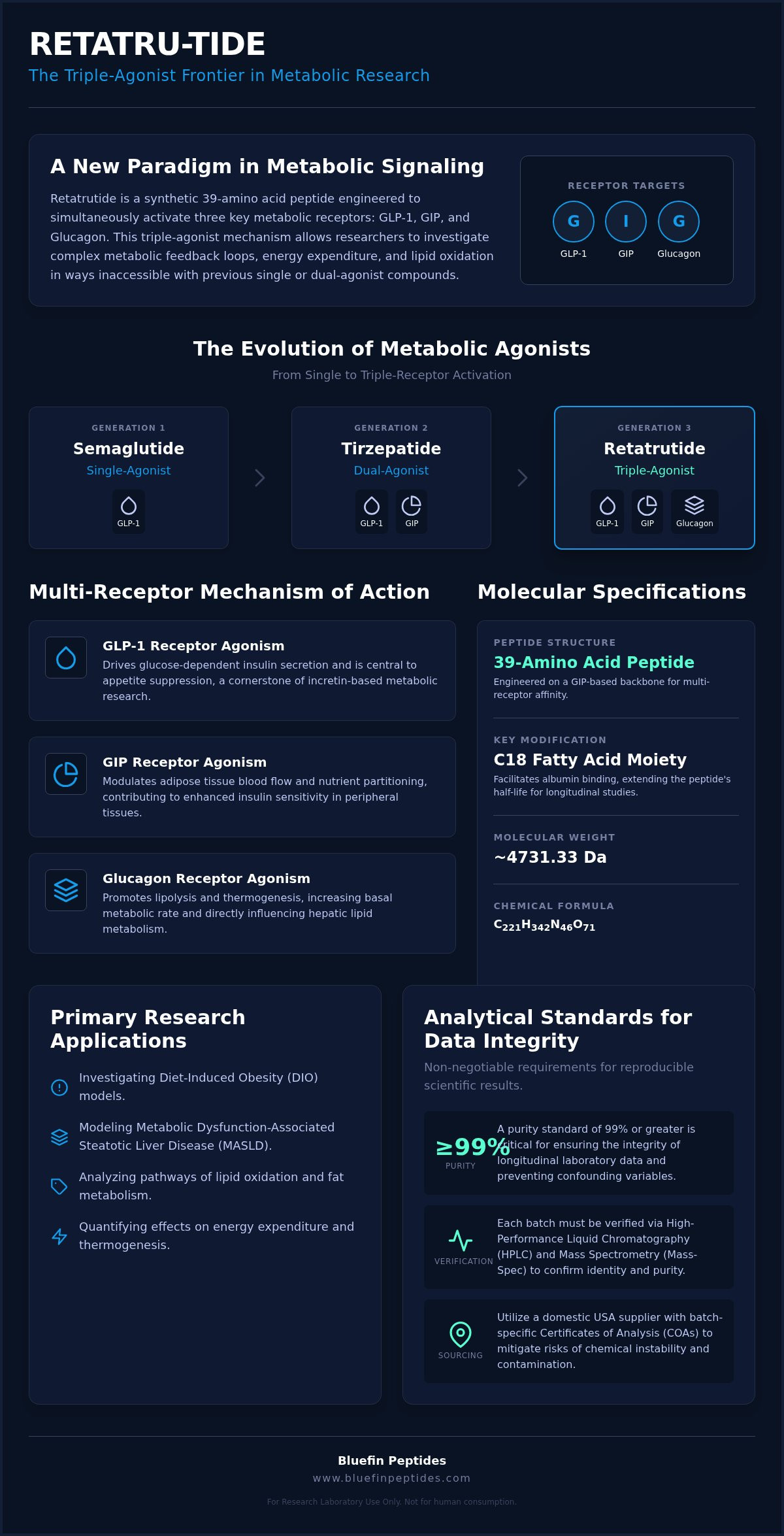
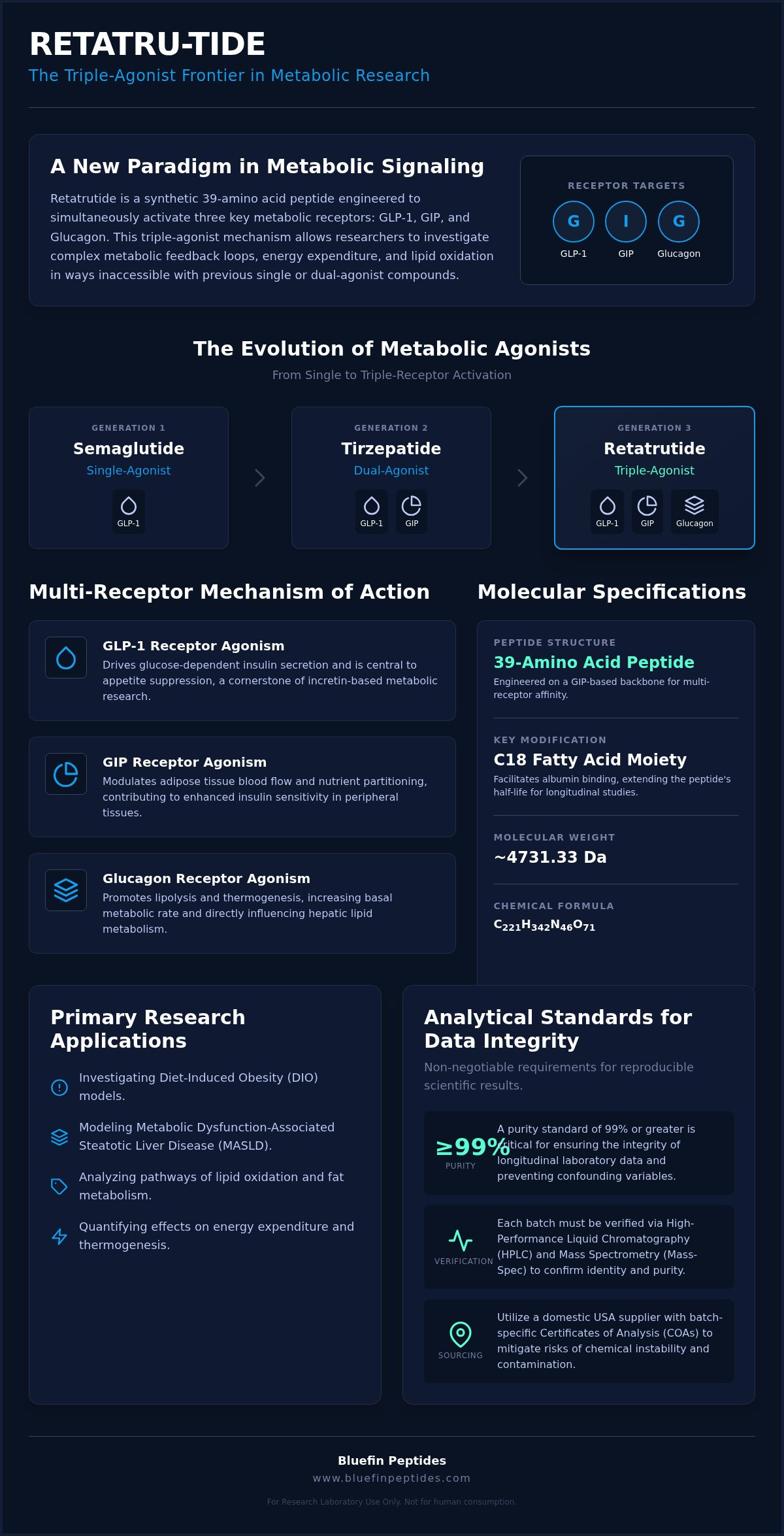
Retatrutide is a synthetic 39-amino acid peptide that represents a significant departure from first and second-generation metabolic research tools. While semaglutide targets the glucagon-like peptide-1 (GLP-1) receptor and tirzepatide acts as a dual GLP-1 and glucose-dependent insulinotropic polypeptide (GIP) agonist, retatrutide introduces a third signaling pathway. It functions as a unimolecular triple agonist. This means it simultaneously activates the GLP-1, GIP, and glucagon receptors. Within the scope of retatrutide research applications, this triad of receptor affinity allows for the investigation of complex metabolic feedback loops that were previously inaccessible using single or dual-agonist models. It's strictly classified as a research chemical, intended for rigorous in vitro and in vivo studies.
The Molecular Architecture of Retatrutide
The peptide's efficacy is rooted in its specific structural modifications. Its 39-amino acid sequence is engineered on a GIP-based backbone, which provides the foundation for its multi-receptor affinity. A critical feature is the attachment of a C18 fatty acid diacid moiety via a linker at the lysine residue at position 17. This modification is not incidental. It facilitates albumin binding, which significantly extends the peptide's half-life in research models, allowing for sustained signaling during longitudinal studies. For laboratory quantification, researchers should note its approximate molecular weight of 4731.33 Da and a chemical formula of C221H342N46O71. These specifications are vital for precise molar calculations in metabolic assays. Precision is paramount.
Distinguishing Triple Agonism from Dual Agonism
The addition of glucagon receptor (GCGR) agonism distinguishes this compound from its predecessors. In dual-agonist models like tirzepatide, the primary focus is on insulin secretion and appetite suppression. However, the inclusion of glucagon signaling in retatrutide research applications shifts the focus toward enhanced energy expenditure and direct hepatic lipid metabolism. Glucagon activation promotes lipolysis and thermogenesis, variables that can drastically alter the results of obesity and fatty liver research. For a more granular look at these differences, laboratories can reference this Comparative Analysis: Retatrutide vs Tirzepatide Research. This structural divergence necessitates a shift in experimental design, as the metabolic output from glucagon signaling must be carefully monitored against GLP-1 and GIP activity. Retatrutide is not a simple iteration; it's a reconfiguration of metabolic signaling.
Molecular Signaling: GLP-1, GIP, and Glucagon Receptor Activation
Retatrutide's mechanism is defined by its simultaneous engagement of three distinct G protein-coupled receptors (GPCRs). In insulinotropic research, GLP-1 receptor (GLP-1R) signaling remains a cornerstone, driving glucose-dependent insulin secretion through the activation of adenylate cyclase. However, the GIP receptor (GIPR) interaction adds a layer of complexity to lipid metabolism studies. Unlike GLP-1 alone, GIPR agonism modulates adipose tissue blood flow and nutrient partitioning, potentially enhancing insulin sensitivity in peripheral tissues. This dual engagement is further augmented by glucagon receptor (GCGR) activity, which targets hepatic and adipose tissues to increase basal metabolic rate. The synergy of these three pathways creates a high-performance profile that allows for the investigation of comprehensive energy homeostasis within retatrutide research applications.
Researchers must differentiate between balanced triple agonism and biased signaling. Retatrutide is engineered to provide potent, near-equal activation across its targets, preventing the metabolic escape often seen when only one or two receptors are engaged. This balance is essential for investigating how simultaneous receptor activation avoids the compensatory mechanisms that typically counteract single-pathway interventions. For laboratories requiring high-stakes accuracy, utilizing verified research peptides ensures that these signaling benchmarks remain consistent across experimental batches.
Downstream Intracellular Signaling Pathways
The primary marker of receptor activation in retatrutide research applications is the intracellular accumulation of cyclic adenosine monophosphate (cAMP). Measurement of cAMP in receptor-expressing cell lines allows for the quantification of agonist potency and efficacy. This signaling cascade is central to investigating hepatic glucose production mechanisms, where the interplay between GLP-1 (inhibitory) and glucagon (stimulatory) creates a dynamic equilibrium. Based on pharmacology data confirmed through 2026, retatrutide exhibits human receptor EC50 values of 0.01 nM for GIPR, 0.03 nM for GLP-1R, and 0.05 nM for GCGR, demonstrating exceptional potency across the triad. These values provide a baseline for calibrating in vitro assays and determining appropriate dosage for in vivo models.
Glucagon Agonism: The Metabolic Differentiator
Glucagon receptor (GCGR) activation modifies the traditional GLP-1 research narrative by introducing direct stimulatory effects on energy expenditure. While GLP-1 and GIP primarily focus on caloric intake and insulin secretion, glucagon signaling drives mitochondrial biogenesis and fat oxidation. This mechanism was a focal point in the pivotal Phase 3 obesity trial, where participants achieved an average weight loss of 28.3% at 80 weeks. In laboratory settings, this allows for the investigation of substrate utilization, specifically the transition from carbohydrate to lipid reliance. Research into these pathways provides insights into how triple agonists bypass the metabolic plateaus often observed in dual-agonist models by maintaining energy balance through increased thermogenesis.
Primary Research Applications in Metabolic and Hepatic Models
The utility of retatrutide in laboratory settings transcends simple weight loss observation. Retatrutide research applications now focus on the complex interplay between triple-receptor signaling and chronic metabolic dysfunction. In rodent models, particularly diet-induced obesity (DIO) mice, researchers use this peptide to investigate the reversal of established adiposity. Unlike single-agonist models that primarily drive weight loss through appetite suppression, triple-agonism allows for the study of active metabolic reprogramming. This includes monitoring glucose homeostasis and insulin sensitivity in specialized Type 2 Diabetes models where dual-agonists have previously shown diminishing returns.
Cardiovascular research represents another critical vector for investigation. Laboratory protocols often utilize retatrutide to analyze shifts in lipid profiles and the progression of atherosclerotic markers. These pre-clinical inquiries provide the necessary data foundation for larger human studies, such as those registered on ClinicalTrials.gov, which evaluate cardiovascular outcomes in populations with severe obesity. By observing changes in high-density lipoprotein (HDL) and very-low-density lipoprotein (VLDL) fractions in vivo, researchers can map the peptide's influence on systemic vascular health with deep-sea precision.
Researching Hepatic Lipid Management
Metabolic Dysfunction-Associated Steatotic Liver Disease (MASLD) research has become a primary focus for retatrutide applications. The peptide is used to study the rapid reduction of liver fat content through glucagon-mediated hepatic lipid oxidation. Glucagon receptor activation in the liver stimulates the breakdown of fatty acids, a process that can be quantified through histological analysis or magnetic resonance spectroscopy in animal models. Obtaining reproducible data in these sensitive hepatic models requires a high-purity retatrutide research peptide. Impurities in the chemical backbone can trigger off-target inflammatory responses, masking the true metabolic effects of triple-receptor signaling on steatosis markers.
Energy Expenditure and Thermogenesis Studies
Retatrutide provides a unique tool for investigating the activation of brown adipose tissue (BAT). Researchers employ indirect calorimetry protocols to measure oxygen consumption and carbon dioxide production, establishing the peptide's impact on basal metabolic rate. This research investigates the cross-talk between GLP-1 and glucagon signaling within the hypothalamus, the central regulator of energy balance. By analyzing the "browning" of white adipose tissue and the subsequent increase in thermogenic gene expression, laboratories can define the mechanisms that drive the significant weight loss observed in clinical trials. These studies are essential for understanding how triple-agonists bypass the metabolic plateaus common in dual-agonist research.
Analytical Standards: Verifying HPLC Purity for Reliable Data
Data integrity in metabolic research hinges on chemical consistency. For retatrutide research applications, a purity threshold of ≥99% isn't a suggestion; it's a non-negotiable requirement for scientific validity. Lower purity levels introduce unknown variables that compromise data. Truncated peptide sequences or residual synthesis solvents can trigger off-target inflammatory responses in animal models. This effectively contaminates the results of lipid metabolism or glucose homeostasis studies, leading to skewed conclusions. High-purity compounds ensure that the observed biological effects are strictly a result of triple-receptor agonism.
High-Performance Liquid Chromatography (HPLC) serves as the primary tool for isolating the target peptide from synthesis byproducts. It quantifies the percentage of the desired compound within the sample. However, HPLC only measures quantity, not identity. Mass Spectrometry (MS) is therefore essential to confirm the exact molecular weight and amino acid sequence. Without both tests, a laboratory can't guarantee that the substance in the vial matches the theoretical 4731.33 Da profile of retatrutide. Maintaining this level of chemical integrity ensures your research doesn't drift off course.
Interpreting HPLC and Mass-Spec Reports
Deciphering analytical reports requires a focus on peak area integration. In a standard HPLC chromatogram, the main peak should represent at least 99% of the total area, with secondary peaks remaining negligible. Mass-Spec reports provide a molecular fingerprint, showing a dominant ion peak that corresponds to the theoretical mass of the peptide. For a deeper understanding of these metrics, researchers should consult this guide on interpreting HPLC peptide reports. Batch-specific Certificates of Analysis (COAs) must be provided with every shipment to ensure the data you generate today remains comparable to future studies.
Lyophilization and Chemical Stability
Stability is the final pillar of analytical quality. Retatrutide is most stable in its lyophilized, or freeze-dried, state. This process removes moisture that could otherwise lead to hydrolysis or oxidation during transit and storage. Vacuum-sealed vials are necessary to maintain this anhydrous environment and prevent atmospheric degradation. For optimal long-term storage of lyophilized retatrutide, laboratories must maintain a constant temperature of -20°C. Adhering to these storage protocols ensures that the peptide's triple-agonist signaling remains intact from the moment of synthesis to the point of reconstitution in the lab.
To ensure your data remains anchored in clinical-grade documentation, you can source verified research peptides from a domestic supplier committed to transparent testing protocols.
Sourcing Research-Grade Retatrutide for Laboratory Use
Selecting a logistical partner for retatrutide research applications requires more than a simple transaction. It demands a rigorous evaluation of the supplier’s analytical infrastructure and fulfillment reliability. Unverified international sources present significant navigational hazards for laboratory directors. These risks include inconsistent batch purity, lack of verifiable documentation, and the absence of domestic accountability. When a study depends on the precise activation of GLP-1, GIP, and glucagon receptors, any deviation in chemical identity can sink an entire project. Bluefin Peptides functions as a high-performance laboratory partner, providing ≥99% HPLC-verified compounds designed exclusively for in vitro and in vivo studies. We prioritize the tools for verification over marketing claims, ensuring every vial meets the high-stakes requirements of a professional environment.
The Importance of Domestic USA Fulfillment
Domestic stocking is a critical safeguard against chemical degradation. Customs delays represent more than just a timeline shift. They are periods of uncontrolled environmental exposure where temperature fluctuations can compromise peptide stability. Rapid turnaround is essential for maintaining the momentum of time-sensitive experiments. Bluefin’s domestic USA shipping ensures that research materials spend minimal time in transit, reducing the cumulative stress on the lyophilized structure. This logistical speed creates a sense of security and trust. It allows researchers to focus on data acquisition rather than troubleshooting the integrity of their starting materials. Our commitment to academic and professional research standards is reflected in a fulfillment process that mirrors the clinical precision of the laboratory itself.
Compliance and Ethical Research Standards
Professional boundaries are absolute. Retatrutide is strictly for laboratory and research use. It's not for human or animal consumption. Responsible procurement requires a clear understanding of these legal and ethical boundaries. Every batch must be anchored by transparent documentation, including mass-spectrometry confirmation and batch-specific HPLC reports. This "show, don't tell" philosophy regarding quality is what separates a disciplined logistics specialist from a simple retail vendor. Researchers should review the analytical specifications to ensure their materials align with the strict testing protocols discussed in previous sections. Stoic reliability in sourcing is the only way to ensure the "what" of your results remains untainted by the "how" of your procurement. Precise data starts with a precise supply chain.
Advancing Metabolic Discovery with Triple-Agonist Precision
The integration of glucagon receptor activation alongside GLP-1 and GIP signaling redefines the parameters of metabolic investigation. You've seen how retatrutide research applications facilitate a deeper understanding of energy homeostasis, thermogenesis, and hepatic lipid management. This triple-receptor synergy allows laboratories to bypass the plateaus common in dual-agonist models. However, the validity of your data depends entirely on the chemical integrity of your starting materials. Precision isn't optional. It's the baseline.
Maintaining rigorous analytical standards requires more than just trust. It requires verification. By prioritizing compounds with ≥99% HPLC-verified purity and batch-specific COAs, you ensure that your findings remain anchored in verifiable data. Domestic USA fulfillment further secures the stability of your materials by reducing transit stress and environmental exposure. Reliability is the cornerstone of reproducible science. It's the difference between a successful study and a compromised dataset.
Procure ≥99% HPLC-Verified Retatrutide for Laboratory Research and establish a foundation of clinical precision for your next study. Your research deserves the security of a disciplined logistical partner. We look forward to supporting your next breakthrough.
Frequently Asked Questions
What is the primary difference between retatrutide and tirzepatide in research?
Retatrutide is a triple-agonist targeting GLP-1, GIP, and glucagon receptors, whereas tirzepatide is a dual-agonist targeting only GLP-1 and GIP. The inclusion of glucagon signaling allows researchers to investigate direct hepatic lipid oxidation and thermogenic energy expenditure. This structural divergence makes retatrutide a more comprehensive tool for studying complex metabolic feedback loops and bypassing the plateaus often observed in dual-agonist models.
How should retatrutide be stored to maintain its chemical integrity?
Retatrutide must be stored in its lyophilized state at a constant temperature of -20°C for long-term stability. Vials should remain vacuum-sealed to prevent moisture ingress, which can lead to hydrolysis or oxidation of the peptide backbone. Once reconstituted, the solution should be refrigerated at 2°C to 8°C and utilized within a short timeframe to avoid degradation. Maintaining these strict storage protocols ensures the integrity of retatrutide research applications throughout the study duration.
What is the standard purity level for retatrutide research peptides?
The industry standard for legitimate laboratory research is ≥99% purity as verified by High-Performance Liquid Chromatography (HPLC). Purity levels below this threshold introduce unquantified variables, such as synthesis byproducts or truncated sequences, which can trigger off-target effects in metabolic models. High-stakes research demands batch-specific verification to ensure that experimental results are a direct consequence of the peptide’s intended triple-agonist signaling rather than chemical contaminants.
Is retatrutide available for human use or clinical prescription?
No, retatrutide is not FDA approved and is strictly intended for laboratory research and in vitro studies. While clinical trials like TRIUMPH-1 have reported significant weight loss data as of 2026, the compound remains an investigational material. It is not for human or animal consumption. Responsible procurement requires adherence to these legal boundaries, ensuring the compound is used only within controlled research environments for scientific discovery.
How do researchers reconstitute retatrutide for in vitro studies?
Researchers typically reconstitute lyophilized retatrutide using bacteriostatic water or sterile saline, depending on the requirements of the specific assay. The diluent should be added slowly to the side of the vial to minimize agitation and prevent foaming, which can denature the peptide structure. Gentle swirling, rather than vigorous shaking, is recommended for complete dissolution. Precision in reconstitution is vital for maintaining accurate molar concentrations in cell-based signaling assays.
What downstream signaling pathways does retatrutide activate in metabolic models?
Retatrutide activates the G protein-coupled receptor (GPCR) signaling cascade, primarily driving the intracellular accumulation of cyclic adenosine monophosphate (cAMP). This activation occurs across the GLP-1, GIP, and glucagon receptors. Downstream effects include the modulation of insulinotropic pathways, adipose tissue blood flow regulation, and hepatic glucose production. Quantifying cAMP levels in receptor-expressing cell lines provides a verifiable metric for assessing the potency and efficacy of the triple-agonist mechanism.
Why is glucagon receptor agonism significant in energy expenditure research?
Glucagon receptor agonism is the primary driver of increased energy expenditure through the stimulation of mitochondrial biogenesis and fat oxidation. While GLP-1 and GIP focus on insulin secretion and appetite regulation, the glucagon component targets the liver and adipose tissue to promote thermogenesis. This mechanism is critical for investigating how triple agonists can overcome metabolic plateaus. It provides a unique variable for researchers studying the "browning" of white adipose tissue.
Does Bluefin Peptides provide HPLC reports for retatrutide batches?
Yes, Bluefin Peptides provides batch-specific Certificates of Analysis (COAs), which include both HPLC and Mass-Spec documentation. These reports verify the ≥99% purity and exact molecular identity of the compound before fulfillment. Providing these tools for verification is a core component of our commitment to clinical precision. This transparency allows researchers to move forward with confidence, knowing their retatrutide research applications are supported by rigorous analytical standards.
For laboratory research use only. Not for human or veterinary use. This content is educational and does not constitute medical, dosing, or usage guidance.
Browse the BLUEFIN catalog