Retatrutide Research Applications: A Technical Overview for Laboratory Studies (2026)

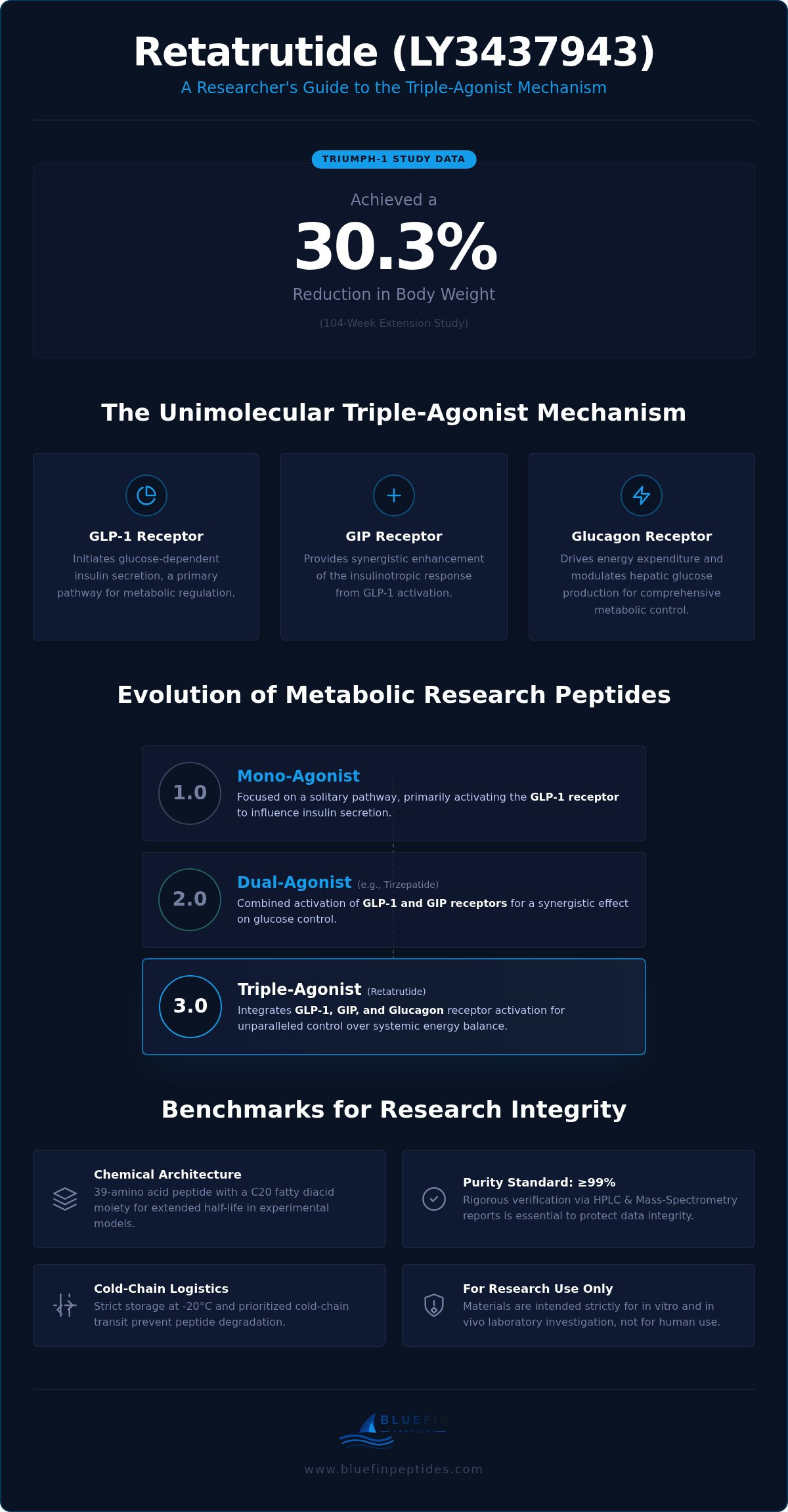
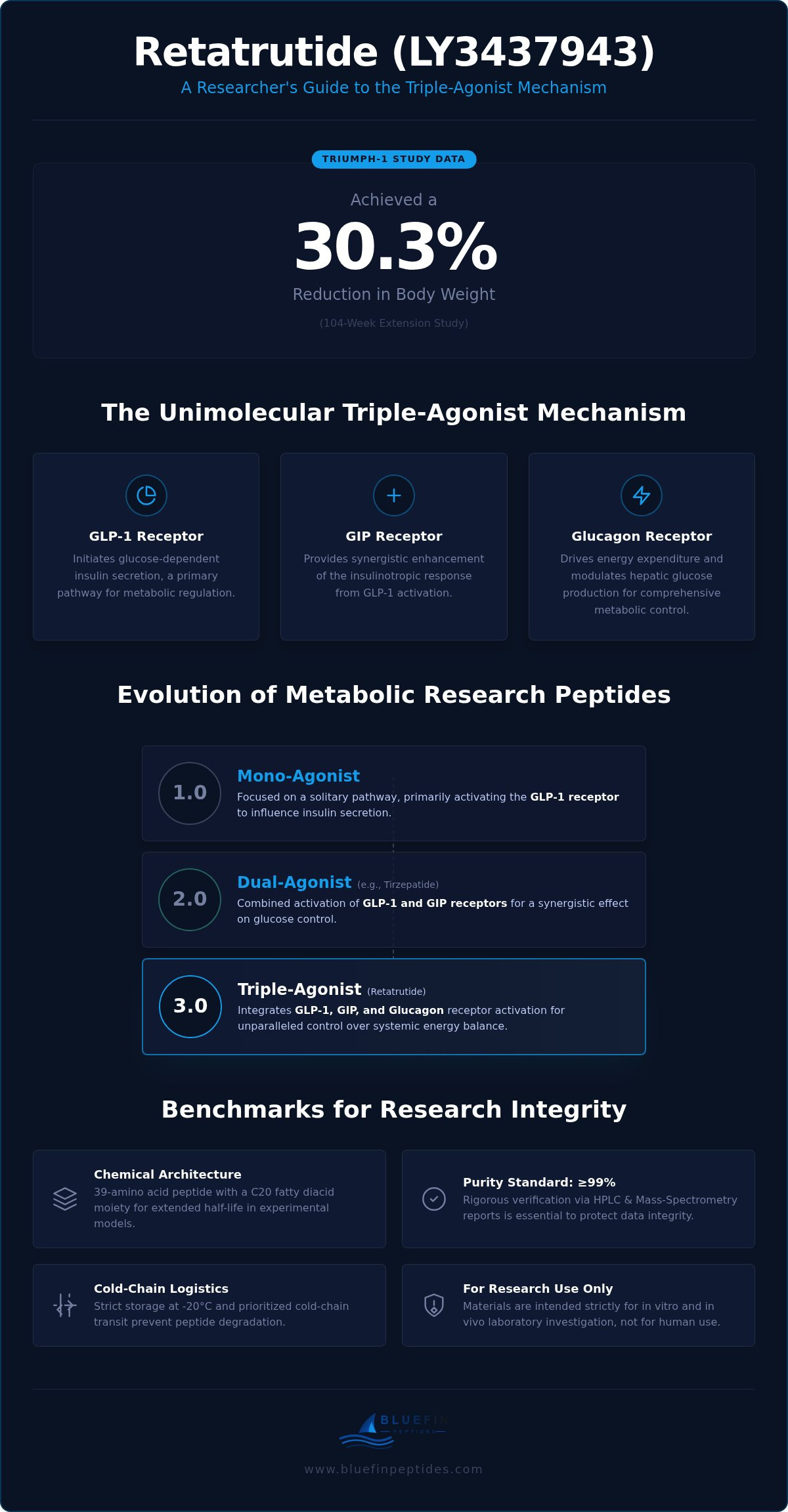
Can a single peptide achieve a 30.3% reduction in body weight across a 104-week extension study? The TRIUMPH-1 phase 3 data suggests the answer is yes, positioning this triple-agonist as a primary focus for modern metabolic studies. However, the surge in interest has created a landscape where marketing claims often outpace scientific reality. Analyzing retatrutide research applications requires more than just a surface-level understanding of its GLP-1, GIP, and glucagon receptor affinity; it demands a rigorous, data-driven approach to material verification.
You recognize that the integrity of your results is only as deep as the purity of your reagents. Inconsistent batch quality and opaque documentation from generic suppliers can easily derail complex experimental models. This technical overview serves as a professional guide for researchers investigating the triple-agonist mechanism. We will examine the precise biochemical interactions of this molecule, establish a protocol for verifying HPLC and Mass-Spec reports, and identify the benchmarks for securing ≥99% pure research materials. By anchoring your methodology in verified data, you ensure your laboratory maintains the highest standards of clinical precision and reliability.
Key Takeaways
- Master the unimolecular triple-agonist mechanism of LY3437943, which provides simultaneous activation of GLP-1, GIP, and glucagon receptors for superior metabolic profiling.
- Analyze specific retatrutide research applications that utilize the "Glucagon Advantage" to investigate thermogenesis and energy expenditure in experimental models.
- Establish a rigorous verification protocol for HPLC and Mass-Spec reports to ensure ≥99% purity and protect the integrity of laboratory data.
- Optimize procurement strategies by prioritizing US-based inventory and strict cold-chain logistics to prevent peptide degradation during transit.
Triple Agonism: Defining Retatrutide in the Landscape of Metabolic Research
Retatrutide (LY3437943) represents a definitive shift in biochemical engineering. It's a unimolecular peptide that acts as a potent agonist at the glucagon-like peptide-1 (GLP-1), glucose-dependent insulinotropic polypeptide (GIP), and glucagon (GCG) receptors. This triple-agonist approach moves beyond the limitations of mono-agonists and dual-agonists. While earlier models focused on solitary pathways, modern retatrutide research applications prioritize the synergy between incretin signaling and glucagon-mediated energy expenditure. It's a calculated orchestration of metabolic flux designed to probe the limits of cellular signaling.
The trajectory of metabolic research has transitioned from simple GLP-1 receptor activation to the sophisticated dual-agonism seen in compounds like Tirzepatide. Retatrutide introduces a third vector: the glucagon receptor. This addition aims to modulate hepatic glucose production while simultaneously increasing thermogenesis. Navigating the depths of metabolic signaling requires tools capable of such multi-channel engagement. Researchers now focus on how this trifecta influences metabolic rate, adiposity, and glucose homeostasis in ways that single-target compounds cannot replicate. Precision is the baseline. These are not merely incremental updates; they're structural evolutions.
The Chemical Architecture of LY3437943
The primary sequence of LY3437943 is a 39-amino acid peptide, backbone-optimized for high-affinity binding across three distinct targets. For a detailed Retatrutide triple-agonist overview, researchers often examine how its structural modifications, including a C20 fatty diacid moiety, extend its stability. This modification ensures a prolonged half-life in experimental models, allowing for consistent signaling without frequent redosing. In the laboratory, this compound is typically provided as a lyophilized powder. Stability is paramount. Stoic adherence to storage protocols, specifically maintaining the peptide at -20°C, is required to prevent degradation and ensure experimental reproducibility.
Research Scope: In Vitro and In Vivo Models
Experimental protocols for retatrutide research applications frequently utilize diet-induced obesity (DIO) murine models to observe shifts in lipid metabolism and glucose sensitivity. These in vivo studies provide critical data on systemic energy balance and brown adipose tissue activation. Complementary in vitro cellular assays focus on receptor recruitment and cAMP signaling pathways to map the compound's affinity profile. Researchers must distinguish these research-grade chemical compounds from clinical pharmaceuticals. These materials are intended strictly for laboratory use to investigate biochemical pathways. They're not for human, veterinary, or consumer use. Clarity in this distinction is vital for maintaining legal and ethical boundaries in scientific inquiry.
Biochemical Mechanisms: Decoding GLP-1, GIP, and GCG Receptor Interactions
Success in retatrutide research applications hinges on a granular understanding of its non-linear receptor binding. Unlike simpler peptides, LY3437943 maintains a fluid affinity across three distinct G protein-coupled receptors. Activation of the Glucagon-Like Peptide-1 (GLP-1) receptor initiates glucose-dependent insulin secretion, while Glucose-Dependent Insulinotropic Polypeptide (GIP) receptor synergy enhances this response. The addition of the Glucagon (GCG) receptor acts as a metabolic anchor, driving energy expenditure through pathways previously inaccessible to mono or dual-agonists. It's a complex, rhythmic interaction. Rigorous quantification is required.
The regulatory landscape for these compounds remains strict. Documentation such as the FDA on retatrutide for research underscores the importance of sourcing materials intended only for laboratory evaluation. In this context, the GCG receptor is particularly significant for investigating thermogenesis. By modulating hepatic glucose production and stimulating lipid oxidation, the glucagon component allows researchers to probe deeper into the mechanisms of metabolic flexibility. This triple-vector approach provides a more comprehensive view of systemic energy balance than earlier research models. Data integrity is the priority.
Synergistic Effects of Triple Agonism
The interplay between GIP and GLP-1 receptors complements the activity of the glucagon receptor to minimize potential hyperglycemic effects. This synergy is central to current investigations into lipid metabolism and hepatic fat reduction in non-human subjects. In DIO murine models, this triple activation has shown a capacity to accelerate weight loss by increasing metabolic rate while preserving glycemic control through insulinotropic signaling. Researchers focusing on these interactions often require high-purity materials to ensure that observed effects aren't skewed by synthesis byproducts or contaminants. For those conducting these high-stakes trials, selecting verified research peptides is essential for maintaining experimental integrity and achieving peer-reviewable results.
Signal Transduction and Cellular Response
Quantifying receptor potency in standardized lab environments involves measuring Cyclic AMP (cAMP) accumulation across multiple cell lines. These assays track the specific downstream signaling pathways activated within metabolic experimental units, providing a map of receptor recruitment. By comparing the cAMP responses across GLP-1R, GIPR, and GCGR, researchers can determine the precise potency of each agonist component. This data is critical for mapping the dose-response curve and ensuring that the peptide maintains its intended triple-agonist profile throughout the study. Every data point must be verifiable; every result must be reproducible. The depth of your analysis depends entirely on the stability and chemical purity of the molecular tools at your disposal.
Comparative Analysis: Retatrutide vs. Dual-Agonist Research Models
Retatrutide's triple-agonist profile represents a more complex metabolic architecture than dual-agonist precursors like Tirzepatide. While Tirzepatide focuses on the synergy between GLP-1 and GIP receptors, Retatrutide introduces a third signaling current: the glucagon receptor. This "Glucagon Advantage" is the primary reason many laboratories are pivoting their retatrutide research applications toward models of active thermogenesis and energy expenditure. It's not just about suppressing intake; it's about increasing the metabolic burn. Choosing between these models requires a precise understanding of the specific metabolic questions being asked.
Experimental reproducibility in these studies depends on the stability of the compound. Triple agonists present a higher level of synthetic complexity than dual-agonist models. Because three distinct receptor affinities must be maintained, any degradation in the peptide sequence can lead to skewed data. Researchers must verify that their materials haven't drifted toward a dual-agonist profile through improper storage or low-quality synthesis. Maintaining this balance is what allows for the clear observation of glucagon's role in modulating energy balance without the hyperglycemic risks typically associated with solitary glucagon activation.
Retatrutide vs. Tirzepatide: A Chemical Profile
The fundamental difference lies in receptor affinity. Tirzepatide is an imbalanced dual agonist with a bias toward GIP receptor activation. In contrast, Retatrutide maintains a balanced engagement across all three targets, though its glucagon component is the variable that alters the experimental outcome. For a deep dive into these differences, see our Comparative Analysis: Retatrutide vs Tirzepatide Research. This chemical profile affects peptide stability and requires more rigorous verification to ensure that the triple-agonist mechanism remains intact throughout the study's duration. Stoic adherence to testing protocols is the only way to confirm this triple-vector presence.
Potency and Efficacy in Adiposity Research
In murine models, the weight loss trajectories for Retatrutide often exceed those of dual agonists. Data from the TRIUMPH-1 trial demonstrated an average weight loss of 28.3% at 80 weeks, a figure that approaches results typically seen only in bariatric surgery research. Comparisons in experimental settings also reveal specific advantages in metabolic flux:
- Enhanced glucose clearance rates due to the combined insulinotropic effects of GLP-1 and GIP signaling.
- Increased lipid oxidation and thermogenesis driven by glucagon receptor activation.
- Shifted dosage-response curves that require careful titration in non-human subjects to avoid metabolic overcompensation.
These variations make Retatrutide the preferred choice for research focusing on brown adipose tissue activation and systemic energy balance. The precision of these results depends on the purity of the compound. Without ≥99% HPLC-verified material, the subtle differences between dual and triple agonism can be lost to chemical noise. It's about securing the data through the quality of the reagent.
Analytical Verification: HPLC and Mass Spectrometry Standards for Retatrutide
Purity is the bedrock of reproducible science. In retatrutide research applications, the margin for error is non-existent because the triple-agonist mechanism is highly sensitive to chemical interference. Synthesis of a 39-amino acid peptide with three distinct receptor affinities requires absolute precision; any deviation in the sequence can lead to unintended binding or metabolic noise. Achieving ≥99% purity isn't merely a goal. It's a requirement for experimental integrity. This level of refinement ensures that your data reflects the compound's true biochemical potential rather than the influence of synthesis byproducts.
Every batch must be anchored by transparent documentation. Certificates of Analysis (COAs) provide the necessary verification that each vial meets these stringent standards. For the serious researcher, a generic COA is insufficient. You require batch-specific data that confirms the exact chemical nature of the material in your hands. This commitment to verification allows you to focus on the "how" of your metabolic models while we handle the "what" of the reagent quality. It's about security. It's about trust.
Interpreting HPLC Reports for Laboratory Use
High-Performance Liquid Chromatography (HPLC) is the primary tool for gauging chemical clarity. When you review a chromatogram, the focus is on the purity peak. This single, dominant spike represents the target peptide, and its area must account for ≥99% of the total peak area. You must learn to distinguish between baseline noise and actual impurities; secondary peaks indicate truncated sequences or residual reagents that could compromise your results. For a detailed breakdown of these metrics, consult our Analytical Quality Standards for Research Peptides. Understanding peak area percentages is the only way to ensure your retatrutide research applications are not skewed by chemical drift.
Mass-Spec Confirmation: Security in Data
While HPLC confirms the quantity of the pure peptide, Mass Spectrometry (MS) verifies its identity. It's the molecular fingerprint. By comparing the theoretical mass of Retatrutide against the batch-specific results, researchers can confirm that the amino acid sequence is exactly as intended. This process is critical for detecting salt content, such as TFA or acetate, and residual solvents that might remain after the lyophilization process. Batch-level verification is non-negotiable for high-stakes laboratory environments. It provides the stoic reliability needed to ensure that every vial is an island of consistency. To secure your next study, buy HPLC-verified Retatrutide and anchor your research in verifiable data.
Procurement and Laboratory Logistics: Ensuring Experimental Reproducibility
Procurement isn't just a transaction; it's the first step in preserving chemical integrity. For retatrutide research applications, the speed of delivery directly impacts the starting quality of your reagents. Selecting a partner with US-based inventory eliminates the variables introduced by international customs delays and unmonitored transit environments. It's a matter of logistical precision. Every hour in transit is a data point that must be controlled. These materials are strictly for laboratory use; they're not for human, veterinary, or consumer applications. Stoic adherence to these boundaries is the baseline for professional research.
Maintaining a consistent cold chain is vital for peptide stability. Lyophilized Retatrutide vials should be stored at -20°C for long-term preservation. During transit, insulated packaging ensures the material remains within a safe thermal range to prevent sequence degradation. This level of environmental control prevents the subtle chemical drift that can invalidate months of metabolic modeling. Reproducibility depends on the state of the molecule when it reaches your bench. Precision is mandatory.
Handling and Reconstitution Best Practices
Triple-agonist research chemicals like LY3437943 require specific handling to maintain their solubility profiles. Reconstitution should be performed using sterile diluents such as bacteriostatic water or 0.9% sodium chloride. When introducing the diluent, aim the stream against the vial wall rather than directly onto the lyophilized cake. Avoid aggressive agitation. Mechanical stress can shear peptide bonds and reduce the effective potency of the agonist components. Swirl the vial gently until the solution is clear. Once reconstituted, store the solution at 2-8°C and use it within a timeframe that ensures peak chemical stability for your specific assay.
Bluefin Peptides: Precision in Fulfillment
Bluefin Peptides operates with aquatic-grade precision in every stage of the fulfillment process. Our US-based inventory allows for rapid transit, ensuring your laboratory receives materials without the degradation risks of long-haul shipping. We prioritize transparency. Every vial of Retatrutide Research Peptide is backed by batch-to-batch consistency that supports long-term metabolic studies. We don't ask for blind trust; we provide the tools for verification. Researchers gain direct access to HPLC and Mass-Spec documentation for every batch, ensuring your retatrutide research applications are anchored in verifiable purity. By combining logistical momentum with traditional testing protocols, we act as a disciplined partner in your scientific inquiry.
Advancing the Frontier of Triple-Agonist Metabolic Studies
The evolution of metabolic research has reached a new depth with the introduction of triple-agonism. Engaging GLP-1, GIP, and glucagon receptors simultaneously allows for a granular investigation of energy expenditure and glucose homeostasis. Success in these retatrutide research applications depends entirely on the chemical integrity of your reagents. Baseline purity and batch-level verification aren't optional; they're the anchors of experimental reproducibility.
Bluefin Peptides provides the technical foundation required for high-stakes laboratory investigations. Every batch of our Retatrutide is ≥99% HPLC-verified and mass-spec confirmed. We maintain US-based inventory to ensure rapid fulfillment and minimize the risks of environmental degradation during transit. Comprehensive COAs are included with every vial to provide the transparency your data deserves. It's about securing the data through the quality of the reagent.
Procure HPLC-Verified Retatrutide for Laboratory Research and ensure your next study is built on a foundation of clinical precision. We're committed to the success of your scientific inquiry.
Frequently Asked Questions
What is the primary research application for Retatrutide?
The primary focus of retatrutide research applications involves investigating the synergy between three distinct metabolic pathways: GLP-1, GIP, and glucagon receptors. Researchers utilize this compound to study chronic weight management, glucose sensitivity, and energy expenditure in non-human experimental models. By activating the glucagon receptor alongside incretin signaling, scientists can probe the mechanisms of thermogenesis and hepatic lipid oxidation. These studies aim to map how triple-agonism shifts systemic energy balance compared to single or dual-agonist models.
How does Retatrutide differ from Tirzepatide in a laboratory setting?
Retatrutide introduces a glucagon (GCG) receptor component that isn't present in dual-agonist models like Tirzepatide. While Tirzepatide activates GLP-1 and GIP receptors to modulate insulin secretion and appetite, Retatrutide’s triple-agonist profile targets energy expenditure more aggressively. In a laboratory setting, this allows for the specific study of brown adipose tissue activation and increased metabolic rate. The glucagon component acts as a metabolic anchor, differentiating its results from dual-agonist signaling profiles observed in earlier research.
Why is HPLC verification critical for Retatrutide research?
HPLC verification ensures that the peptide meets a baseline of ≥99% purity, which is vital for maintaining experimental integrity. Because Retatrutide is a complex 39-amino acid sequence, even minor synthesis byproducts can trigger unintended receptor recruitment or metabolic noise. High-Performance Liquid Chromatography identifies these impurities by measuring peak area percentages. Without this data, researchers risk attributing observed effects to the target compound when they may actually stem from chemical contaminants or truncated sequences found in lower-quality batches.
Can Retatrutide be used for human consumption in research?
No, Retatrutide research chemicals are strictly for laboratory use and are not for human, veterinary, or consumer consumption. These compounds are intended for evaluation in non-human experimental units to investigate biochemical pathways. They aren't FDA-approved pharmaceuticals and lack the regulatory clearance for clinical use outside of authorized trials. Adherence to these boundaries is essential for maintaining the legal and ethical standards of professional laboratory environments and ensuring researcher safety throughout the duration of the study.
What is the recommended storage temperature for lyophilized Retatrutide?
Lyophilized Retatrutide vials should be stored at -20°C for long-term preservation. Maintaining this deep-freeze temperature prevents the degradation of the peptide sequence and ensures the material remains stable for the duration of the study. While lyophilized powders can withstand short transit periods at room temperature, they must be moved to cold storage immediately upon arrival. Once reconstituted, the solution is significantly less stable and should be kept at 2-8°C for immediate use in cellular or animal assays.
How do I interpret a mass spectrometry report for a research peptide?
To interpret a mass spectrometry report, you must verify that the observed mass, measured in daltons, matches the theoretical molecular weight of the peptide. A successful report shows a single, dominant peak at the target mass, confirming the identity and sequence integrity of the compound. Any secondary peaks at different mass-to-charge ratios indicate the presence of impurities, residual solvents, or truncated sequences. This molecular fingerprint is the definitive tool for confirming batch-level consistency and ensuring chemical identity.
Is Retatrutide available for commercial sale to the public?
Retatrutide is not available for commercial sale to the general public or as a retail supplement. It's a research-grade chemical compound restricted to procurement by qualified researchers and laboratory specialists. Suppliers like Bluefin Peptides require adherence to strict laboratory-only sale protocols to ensure the material is used solely for scientific inquiry. It doesn't have a commercial price or availability in the retail market, as it remains an investigational drug intended for controlled experimental environments and biochemical evaluation.
What are the triple-agonist mechanisms investigated in metabolic research?
Metabolic research investigates the activation of GLP-1 for insulinotropic signaling, GIP for metabolic synergy, and the glucagon (GCG) receptor for energy expenditure. These retatrutide research applications allow scientists to study how simultaneous activation influences lipid oxidation and hepatic glucose production. By modulating these three vectors, researchers can observe systemic shifts in adiposity and thermogenesis that are not achievable with mono or dual-agonist signaling. This triple-receptor approach represents the current frontier in metabolic biochemistry and signal transduction research.
For laboratory research use only. Not for human or veterinary use. This content is educational and does not constitute medical, dosing, or usage guidance.
Browse the BLUEFIN catalog