Molecular Mechanisms of the GHK-Cu, BPC-157, and TB-500 Research Blend
The assumption that individual peptide efficacy translates linearly to composite formulations ignores the complex reality of molecular cross-talk. Precision. Documentation. Verification. These are the non-negotiable pillars of laboratory integrity. Many investigators face significant uncertainty regarding the chemical stability of the GHK-Cu BPC-157 TB-500 research blend and the scarcity of transparent, batch-specific HPLC data. It's a challenge to maintain fluid movement in research when the underlying chemical nature of a lyophilized composite remains opaque.
This article delivers an analytical exploration of the synergistic signaling pathways inherent in this triple-peptide composite. You'll gain a technical understanding of how these molecules interact to modulate the extracellular matrix with deep-sea precision. We'll also establish a protocol for verifying blend purity and provide clarity on the shifting regulatory landscape, including the upcoming July 23-24, 2026, FDA advisory meetings. Expect a methodical, data-heavy breakdown of the molecular mechanisms that define this high-performance research tool.
Key Takeaways
- Analyze the specific molecular cross-talk between copper mobilization and actin-sequestering pathways within the extracellular matrix.
- Evaluate the mechanistic interaction of the GHK-Cu BPC-157 TB-500 research blend to understand how these peptides modulate cellular repair signaling.
- Identify the chemical equilibrium challenges inherent in maintaining a triple-peptide lyophilized state, specifically regarding the thermal sensitivity of TB-500 fragments.
- Establish a rigorous protocol for interpreting multi-peak HPLC reports and verifying mass-spectrometry signatures for each individual peptide component.
- Determine the necessity of US-based logistics and batch-specific documentation to ensure the chemical integrity of high-purity research compounds.
Understanding the GHK-Cu, BPC-157, and TB-500 Research Composite
The GHK-Cu BPC-157 TB-500 research blend represents a sophisticated multi-peptide formulation engineered for the rigorous study of cellular repair mechanisms and molecular signaling. This composite isn't a consumer supplement. It's a high-purity laboratory tool designed for professional investigation into tissue regeneration and extracellular matrix stability. By combining three distinct molecular structures, the blend allows researchers to observe complex interactions that single-peptide vials cannot replicate.
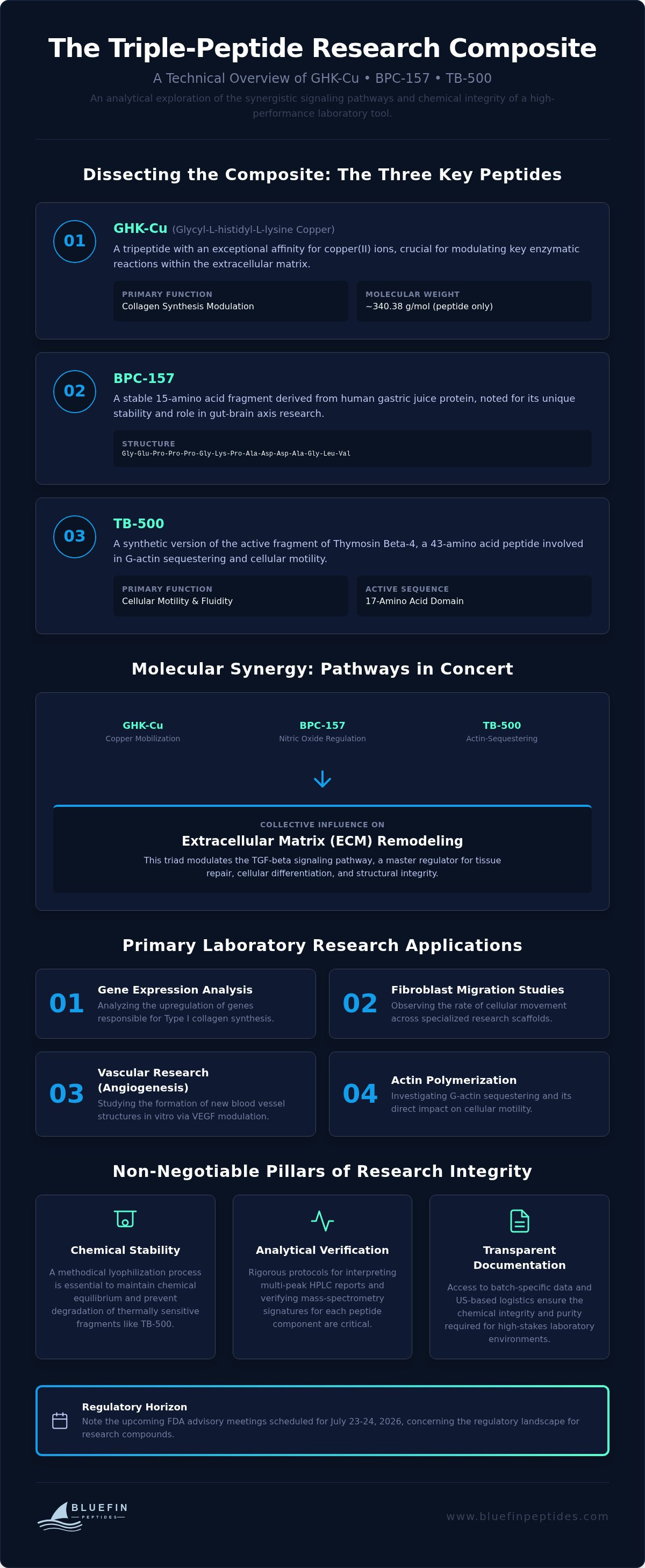
The blend integrates three primary chemical entities with distinct biological profiles. GHK-Cu (Glycyl-L-histidyl-L-lysine copper) is a tripeptide with an exceptional affinity for copper(II) ions, a characteristic that facilitates its role in modulating collagen synthesis. BPC-157 is a 15-amino acid fragment derived from human gastric juice protein. For a technical BPC-157 overview, investigators often cite its unique stability in acidic environments and its potential role in gut-brain axis research. Finally, TB-500 is a synthetic version of the active fragment of Thymosin Beta-4, a naturally occurring 43-amino acid peptide involved in cellular motility.
Chemical Structure and Molecular Weights
Precision in peptide synthesis is non-negotiable. GHK-Cu has a molecular weight of approximately 340.38 g/mol, excluding the copper ion weight. Its structure enables specific copper-binding properties that catalyze essential biochemical reactions. BPC-157 consists of a specific pentadecapeptide sequence: Gly-Glu-Pro-Pro-Pro-Gly-Lys-Pro-Ala-Asp-Asp-Ala-Gly-Leu-Val. TB-500 utilizes the 17-amino acid sequence (Ac-Ser-Asp-Lys-Pro-Asp-Met-Ala-Glu-Ile-Glu-Lys-Phe-Asp-Lys-Ser-Lys-Leu-NH2) representing the active domain of Thymosin Beta-4. To maintain the chemical equilibrium of these structures, a methodical lyophilization process is required. This ensures the lyophilized state remains stable under thermal stress, preventing the degradation of sensitive molecular bonds during transit.
Research Applications in Molecular Biology
Investigators utilize the GHK-Cu BPC-157 TB-500 research blend to examine multi-pathway signaling within the extracellular matrix (ECM). One primary focus is the study of angiogenesis and the modulation of Vascular Endothelial Growth Factor (VEGF). The interplay between these three molecules provides concrete data on fibroblast migration and collagen remodeling. Common research applications include:
- Gene Expression: Analyzing the upregulation of genes responsible for Type I collagen synthesis.
- Fibroblast Migration: Studying the rate of cellular movement across specialized research scaffolds.
- Vascular Research: Observing the formation of new blood vessel structures in vitro.
- Actin Sequencing: Investigating the role of TB-500 in G-actin sequestering and cellular motility.
Bluefin Peptides maintains academic-grade transparency by providing batch-specific HPLC and mass-spectrometry data. This commitment to documentation ensures that the physical state and chemical nature of the offerings meet the high-stakes requirements of modern laboratory environments. It's about providing the tools for verification rather than asking for trust.
Synergistic Signaling Pathways in Extracellular Matrix (ECM) Research
The experimental scope provided by the GHK-Cu BPC-157 TB-500 research blend allows for the observation of multi-pathway signaling that single-peptide isolates cannot replicate. Investigating the extracellular matrix (ECM) requires an understanding of how these molecules function as a cohesive unit. This triad specifically modulates the TGF-beta signaling pathway, which acts as a master regulator for tissue remodeling and cellular differentiation. By utilizing a composite, researchers can observe the collective influence on gene expression rather than isolated metabolic shifts. This interaction is vital for understanding the complex signaling cascades that govern tissue repair.
One critical area of interest is the molecular cross-talk between GHK-Cu copper mobilization and TB-500 actin-sequestering mechanisms. While GHK-Cu facilitates the transport of copper ions necessary for enzymatic activity, TB-500 regulates G-actin polymerization to maintain cellular fluidity. These parallel processes create a dynamic environment for studying cellular structural integrity. Additionally, BPC-157 influences nitric oxide (NO) synthesis, which is essential for maintaining vascular homeostasis and directing cellular migration toward research scaffolds. For researchers focused on the molecular actions of GHK-Cu, the NIH documentation highlights its role in skin remodeling and anti-inflammatory signaling. These effects are often amplified in laboratory settings when studied alongside the vascular-modulating properties of BPC-157 and TB-500.
Collagen Synthesis and Fibroblast Activation
GHK-Cu stimulates the synthesis of glycosaminoglycans (GAGs), which are essential for ECM hydration and structural support. Simultaneously, BPC-157 interacts with growth hormone receptor expression in tendon fibroblasts, potentially altering collagen deposition rates. TB-500 promotes cell motility through its interaction with actin-binding proteins. This combination within the GHK-Cu BPC-157 TB-500 research blend allows investigators to track the collective influence of these peptides on fibroblast activation and collagen remodeling within a controlled environment.
Angiogenic Modulation and Vascular Research
Vascular research benefits from the triad's impact on endothelial cell differentiation. TB-500 influences how these cells organize into tubular structures. GHK-Cu regulates matrix metalloproteinases (MMPs), ensuring tissue remodeling occurs without excessive fibrosis. BPC-157 impacts the VEGFR2 signaling pathway, providing a broader experimental scope for investigating vascular formation. For those requiring batch-specific data, it's vital to source high-purity compounds from verified domestic laboratories to ensure the chemical nature of the offerings remains intact.
Comparative Stability and Lyophilization of Multi-Peptide Formulations
Maintaining chemical equilibrium in a triple-peptide lyophilized state requires deep-sea precision. The GHK-Cu BPC-157 TB-500 research blend isn't a simple mixture; it's a carefully engineered composite where each molecule's physical state must be preserved. Lyophilization, or freeze-drying, is the primary method used to stabilize these distinct amino acid sequences by removing solvent through sublimation. This process prevents the hydrolytic degradation that would otherwise occur in an aqueous environment. However, the stability of each component varies significantly under thermal stress.
GHK-Cu is notably more robust than its counterparts in the blend. The presence of the copper(II) ion provides a degree of structural rigidity that protects the tripeptide from rapid cleavage. Scientific literature regarding the Molecular actions of GHK-Cu peptide notes its resilience across a range of physiological conditions. In contrast, the TB-500 fragment is highly sensitive. As a thymic peptide fragment, it's susceptible to oxidation and peptide bond cleavage if exposed to temperature fluctuations or ultraviolet light. BPC-157 offers intermediate stability, but it's still vulnerable to oxidative stress if the vial's integrity is compromised. To mitigate these risks, research laboratories must adhere to strict storage protocols:
- Atmospheric Control: Vials should be vacuum-sealed and backfilled with inert gases, such as nitrogen or argon, to displace oxygen.
- Thermal Regulation: Lyophilized powders should be stored at -20°C for long-term stability; short-term storage at 4°C is acceptable for active studies.
- Light Shielding: Amber vials or opaque secondary packaging are necessary to prevent UV-induced degradation of the peptide chains.
Reconstitution Protocols for Laboratory Study
Uniform concentration is the cornerstone of reproducible data. When reconstituting the GHK-Cu BPC-157 TB-500 research blend, the choice of solvent and pH is critical. Bacteriostatic water is standard, but investigators must ensure the final solution remains near a neutral pH to prevent copper dissociation from the GHK tripeptide. For a deeper dive into methodology, consult our guide on Analytical Quality Standards for Research Peptides. Avoid vigorous agitation; gentle swirling ensures the lyophilized cake dissolves without mechanical shearing of the delicate TB-500 molecules.
Long-term Storage and Degradation Kinetics
The half-life of a reconstituted blend is measured in days, not months. Once in solution, the peptides are exposed to increased kinetic energy and potential microbial contaminants. Degradation kinetics are accelerated by room-temperature exposure and frequent freeze-thaw cycles. Investigators can identify compromised samples by observing shifts in the characteristic blue hue of the GHK-Cu or the emergence of particulate matter. Stoic reliability in research results depends entirely on the "how" of these storage processes.

Analytical Verification: Challenges in Testing Triple-Peptide Blends
Verifying the chemical integrity of a GHK-Cu BPC-157 TB-500 research blend requires a higher level of analytical rigor than single-peptide validation. In a standard single-peptide vial, a High-Performance Liquid Chromatography (HPLC) report typically features one dominant peak. When analyzing a triple-peptide composite, the chromatogram must display three distinct, well-resolved peaks. This complexity often leads to confusion during data interpretation. Without baseline resolution, impurities can remain submerged within the primary peaks, compromising the reliability of the research data. Precision. Documentation. Clarity. These are the requirements for any professional laboratory environment.
The "Bluefin Standard" dictates that each component within the composite must independently meet the ≥99% purity threshold. We don't accept an average purity score across the blend. Every batch undergoes rigorous testing to ensure that GHK-Cu, BPC-157, and TB-500 are synthesized to exact specifications. When interpreting a Certificate of Analysis (COA) for a multi-peptide formulation, investigators should verify that the report includes individual peak integration data for each peptide. A legitimate COA provides the navigational clarity needed to trust the physical state of the compound. It's about providing the tools for verification rather than asking for blind trust.
HPLC Analysis of Complex Peptide Mixtures
HPLC purity is the ratio of the target peptide peak area to the total peak area. In the context of the GHK-Cu BPC-157 TB-500 research blend, this calculation must be performed for each of the three active fragments. Different peptide fragments possess unique hydrophobicities, leading to varied retention times on the stationary phase. Achieving baseline resolution between these peaks is essential. It allows for the identification of trifluoroacetic acid (TFA) levels, residual solvents, or minor synthesis byproducts that could interfere with cellular signaling studies. We prioritize HPLC-verified results to maintain unwavering professionalism in every shipment.
Mass Spectrometry and Molecular Confirmation
Mass spectrometry provides the final layer of deep-sea precision. This process verifies the molecular mass of each fragment to confirm that the correct amino acid sequences were synthesized. For instance, the mass-spec signature must align with the known molecular weights of GHK-Cu, BPC-157, and TB-500 individually. This step is critical for detecting truncated sequences or "deletion peptides" that might pass through HPLC undetected. For researchers accustomed to high-level documentation, our Retatrutide Research Peptide: Analytical Specifications provides a clear example of the laboratory standards we uphold across all product categories.
Researchers requiring batch-specific data and HPLC-verified compounds can access our full catalog of high-purity research blends to ensure experimental consistency.
Procuring High-Purity Research Blends for Laboratory Application
The transition from molecular analysis to laboratory application hinges entirely on procurement integrity. A GHK-Cu BPC-157 TB-500 research blend is only as reliable as the supply chain that delivers it. Domestic sourcing isn't just a convenience. It's a technical requirement for maintaining the physical state of the compound. International transit often exposes sensitive lyophilized powders to extreme temperature fluctuations and prolonged UV exposure, both of which accelerate peptide cleavage. By utilizing US-based logistics, investigators ensure that the chemical nature of the offerings remains uncompromised by thermal stress or atmospheric contamination during the voyage to the laboratory.
Bluefin Peptides operates with a "show, don't tell" philosophy regarding quality. Our commitment to academic-grade transparency means providing the tools for verification with every shipment. This includes batch-level data that correlates directly to the physical vial in the researcher's hand. Rigorous quality control protocols are applied from the initial synthesis through to final fulfillment. Every step is designed to preserve the ≥99% HPLC-verified purity that high-stakes laboratory environments demand. We adhere strictly to the "Research Use Only" mandate; all compounds must be used within the legal and regulatory boundaries of professional scientific investigation.
Bluefin Logistics: Speed and Security
Logistics at Bluefin Peptides are characterized by urgent precision. Rapid domestic shipping isn't merely about speed; it's about minimizing the window for potential molecular degradation. We maintain secure, temperature-controlled storage environments to safeguard the chemical equilibrium of our multi-peptide composites with deep-sea precision. This direct-to-researcher fulfillment model acts as a vital safeguard for chemical purity. It ensures that the fluid movement of your research isn't stalled by compromised materials or opaque batch histories. We function as a high-performance laboratory partner, focusing on the "how" of our processes to guarantee the "what" of your results.
The Researcher's Checklist for Peptide Procurement
Securing high-purity compounds requires a methodical approach to verification. Before integrating a GHK-Cu BPC-157 TB-500 research blend into an experimental protocol, investigators should perform the following checks:
- Verify HPLC purity is ≥99% for each individual component of the blend.
- Confirm mass-spec confirmation aligns with documented molecular weights for GHK-Cu, BPC-157, and TB-500.
- Ensure the presence of batch-specific COAs that provide individual peak integration data.
- Validate that the supplier adheres to strict laboratory-use-only standards and provides comprehensive analytical documentation.
To maintain the highest standards in your laboratory and ensure experimental consistency, Explore our HPLC-verified research blends at Bluefin Peptides.
Advancing Laboratory Standards for Multi-Peptide Research
Precision is the bedrock of verifiable science. Investigating the GHK-Cu BPC-157 TB-500 research blend requires more than just high-purity compounds; it demands a technical understanding of molecular cross-talk and degradation kinetics. You've analyzed how these molecules modulate the extracellular matrix and the analytical rigor required to verify triple-peptide composites. Maintaining the chemical nature of these offerings ensures that your laboratory data remains robust and reproducible.
Precision. Documentation. Stability. We provide the tools for academic-grade transparency through batch-specific COAs provided with every order. Our commitment to quality is absolute, featuring ≥99% purity verified by HPLC and Mass-Spec confirmation. Domestic US shipping ensures rapid transit, safeguarding the thermal stability of sensitive fragments like TB-500. This logistical speed maintains the momentum of your investigation without compromising the underlying data.
Secure HPLC-Verified Research Blends for Your Laboratory to ensure your next study proceeds with deep-sea precision. We're ready to serve as your high-performance laboratory partner in the pursuit of scientific discovery.
Frequently Asked Questions
What is the primary function of GHK-Cu in a triple-peptide research blend?
GHK-Cu functions as a copper-binding tripeptide that modulates collagen synthesis and extracellular matrix remodeling. It facilitates the transport of copper(II) ions required for enzymatic activity in tissue repair models. This molecule is essential for studying gene expression related to skin and connective tissue integrity. In the context of a GHK-Cu BPC-157 TB-500 research blend, it provides the necessary structural framework for investigating fibroblast activation and copper-dependent signaling pathways.
Is BPC-157 stable when combined with other peptides in a single vial?
BPC-157 remains chemically stable in a lyophilized blend when stored under vacuum-sealed, inert gas conditions. While it's more resilient than the TB-500 fragment, its integrity depends on the absence of moisture and thermal fluctuations. The lyophilization process preserves the pentadecapeptide sequence by preventing hydrolytic degradation. Investigators must ensure the physical state of the cake remains intact to verify the compound's chemical nature before starting any reconstitution protocol.
How should a triple-peptide blend be stored to prevent degradation?
Triple-peptide blends must be stored in a lyophilized state at -20°C for long-term stability or 4°C for short-term active use. Protection from ultraviolet light and temperature oscillations is mandatory to prevent peptide bond cleavage. Once reconstituted, the solution should be used within a measured timeframe, typically days, as the half-life of peptides in liquid form is significantly reduced compared to the freeze-dried state. Proper storage ensures deep-sea precision in experimental results.
What does an HPLC report look like for a multi-peptide blend?
An HPLC report for a multi-peptide blend displays multiple distinct peaks, each representing a specific peptide component with a unique retention time. Unlike single-peptide vials, the chromatogram for the GHK-Cu BPC-157 TB-500 research blend must show baseline resolution between GHK-Cu, BPC-157, and TB-500. Each peak is integrated individually to calculate the purity ratio of the target fragments against any synthesis byproducts, residual solvents, or minor impurities.
Can GHK-Cu, BPC-157, and TB-500 be reconstituted together?
Yes, the peptides in a pre-formulated research blend are reconstituted simultaneously using a single solvent, typically bacteriostatic water. This approach ensures a uniform concentration across all components for experimental consistency. Investigators should avoid vigorous agitation, opting for gentle swirling to prevent mechanical shearing of the delicate TB-500 molecules. The final pH must remain near neutral to maintain the stability of the copper-peptide complex and prevent dissociation of the ions.
Why is 99% purity critical for laboratory research peptides?
≥99% purity is critical because impurities can introduce confounding variables that compromise the integrity of molecular signaling data. Residual solvents, truncated sequences, or deletion peptides can interfere with cellular receptors and skew research outcomes. Academic-grade transparency requires that each component meets this threshold independently. High-purity standards ensure that observed biological effects are attributable strictly to the target peptides rather than synthesis contaminants or external chemical interference.
Are Bluefin Peptides products intended for human consumption?
No, Bluefin Peptides products are strictly for laboratory research use only and are not intended for human consumption or veterinary use. All compounds are sold with the explicit mandate that they be utilized within a controlled professional environment. Marketing these peptides for personal use is a violation of regulatory standards. We prioritize laboratory compliance and the physical state of our offerings for academic investigation and disciplined professional research only.
How does TB-500 differ from full-length Thymosin Beta-4 in research models?
TB-500 is a synthetic 17-amino acid fragment representing the active domain of the naturally occurring 43-amino acid Thymosin Beta-4 peptide. While the full-length protein is larger and more complex, TB-500 is utilized in research models specifically to study G-actin sequestering and cellular motility. This fragment is preferred in laboratory settings for its targeted mechanism of action and its superior stability when included in multi-peptide lyophilized composites.
For laboratory research use only. Not for human or veterinary use. This content is educational and does not constitute medical, dosing, or usage guidance.
Browse the BLUEFIN catalog