Certificate of Analysis for Peptides Explained: A Researcher’s Guide to Verification
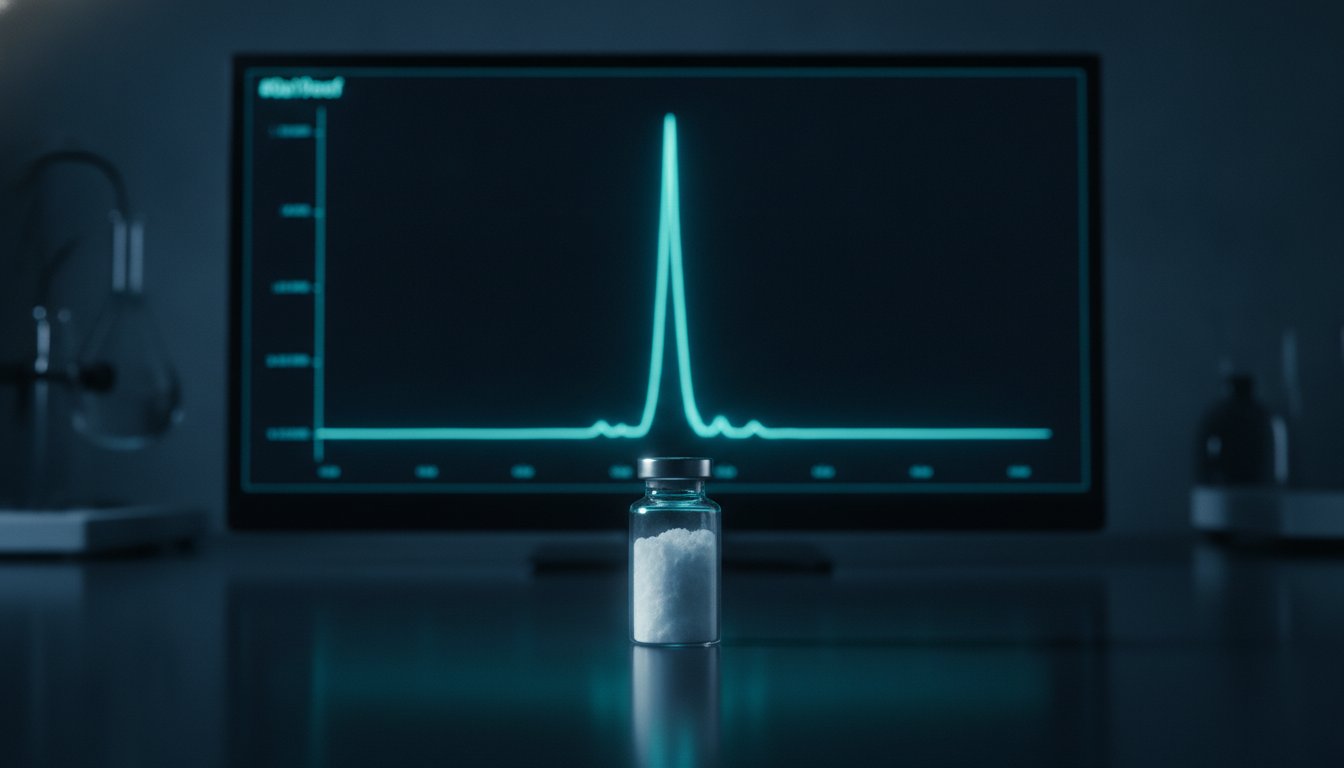
A generic Certificate of Analysis is a liability, not a safeguard. Precision. Verification. Transparency. In a laboratory environment where 99% purity is the 2026 benchmark for high-quality research, relying on representative data instead of batch-specific documentation is a risk to your data integrity. You understand that even a minor deviation in molecular identity can result in hundreds of wasted research hours and irreproducible results. Having the certificate of analysis for peptides explained through a technical lens is no longer optional; it's a fundamental requirement for rigorous science. We agree that blind trust has no place in a professional setting.
This guide provides the analytical framework necessary to master the nuances of High-Performance Liquid Chromatography (HPLC) and Mass Spectrometry (MS) reports. You'll learn to scrutinize chromatograms for baseline stability, verify molecular mass against theoretical values, and confirm that endotoxin levels remain below the critical 5 EU/mg threshold. We'll establish a definitive verification protocol to ensure every reagent entering your facility meets the highest standards of chemical precision. This mastery allows you to anchor your research in verified data, ensuring your results remain steady and your methodology never drifts due to impure reagents.
Key Takeaways
- Analyze HPLC chromatograms to verify the ≥99% purity standard essential for modern laboratory reagents.
- Utilize Mass Spectrometry data to confirm molecular identity, distinguishing what a substance is from how much of it is present.
- This certificate of analysis for peptides explained highlights the critical necessity of batch-specific data over generic, representative reports.
- Translate raw analytical values into actionable laboratory protocols for precise molar reconstitution and dilution.
- Recognize key indicators of reagent quality, including endotoxin thresholds and residual solvent compliance, to safeguard your research data.
The Anatomy of a Peptide Certificate of Analysis (COA)
Precision. Verification. Transparency. A Certificate of Analysis is not a marketing brochure; it is a technical manifest. In the procurement of lyophilized research powders, this document serves as the primary instrument of trust, bridging the gap between a vendor's claim and verifiable reality. For any researcher, having the certificate of analysis for peptides explained is the first step in establishing a rigorous verification protocol. It functions as a navigational chart, ensuring your experimental results aren't compromised by hidden impurities or incorrect molecular sequences.
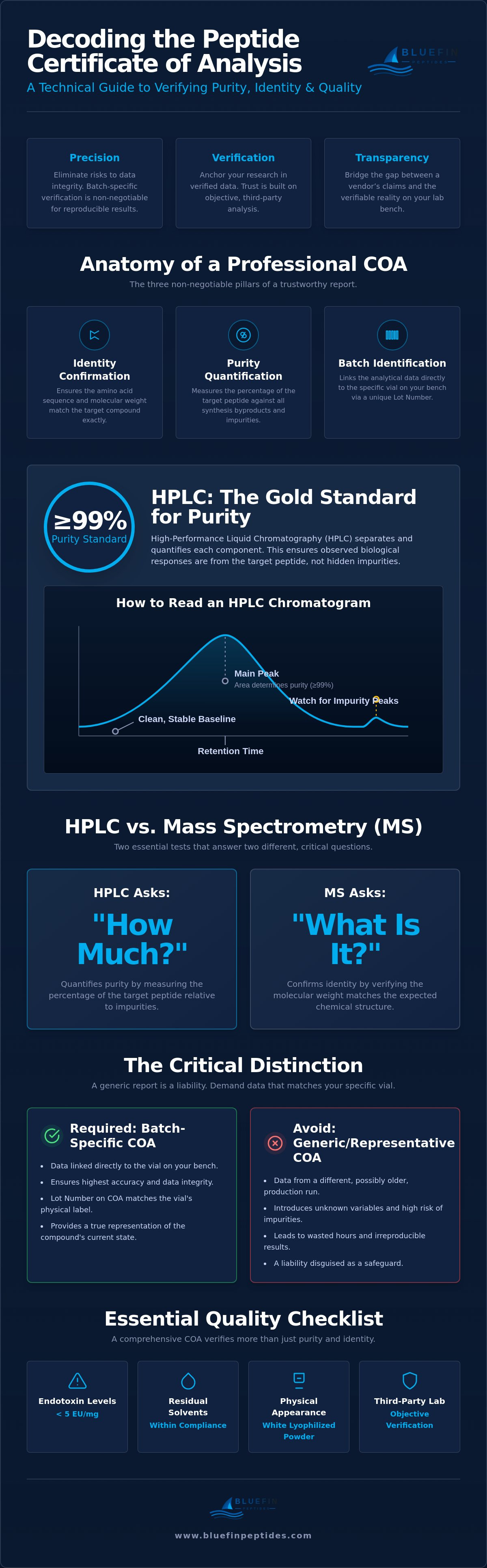
Three components are non-negotiable in a professional COA. First, Identity confirmation ensures the amino acid sequence matches the target compound. Second, Purity quantification measures the percentage of the target peptide against synthesis byproducts. Third, Batch identification links the analytical data to the specific vial on your laboratory bench. Reliance on third-party verification is the gold standard. Internal reports are often susceptible to bias, whereas independent laboratories provide the objective distance required for clinical precision. This transparency is the anchor of a secure supply chain.
Critical Header Information and Lot Matching
Precision begins at the header. You must match the Lot Number on the report to the physical label on the research vial with absolute accuracy. Discrepancies here render the entire analytical report irrelevant. Check the testing date immediately. Peptides are subject to degradation over time, and a report from several years ago doesn't represent the current state of a compound. Finally, verify the credentials of the analytical laboratory. Look for established reputations in the biochemical field to ensure the data was generated using validated methods. This initial audit prevents the use of expired or mismatched reagents.
Physical State and Appearance Specifications
Observation is the first line of qualitative assessment. A standard COA will list the expected appearance, usually a white or off-white lyophilized powder. While this is a basic metric, it's vital for establishing a baseline for quality. The physical form dictates solubility and reconstitution protocols. If a peptide arrives as a gummy mass or shows distinct discoloration, it often indicates environmental degradation or residual moisture. These traits suggest a failure in the lyophilization process, potentially compromising the peptide's stability before you even introduce a diluent. Consistent physical traits are a hallmark of high-performance manufacturing.
Interpreting HPLC Chromatograms and Purity Percentages
High-Performance Liquid Chromatography (HPLC) remains the gold standard for determining chemical purity. It's a separation technique that allows for the isolation and quantification of individual components within a complex mixture. In a certificate of analysis for peptides explained for professional research, purity isn't a vague descriptor; it's the specific percentage of the target peptide relative to other UV-absorbing components detected during the run. This quantification is the bedrock of experimental consistency. It ensures that the biological responses observed in your lab are attributable to the peptide itself rather than synthesis byproducts.
The primary focus of any HPLC report is the Main Peak. Analysts determine the final purity score by calculating the Area Under the Curve (AUC) for this peak compared to the total integrated area of the entire chromatogram. In high-stakes models involving the retatrutide research peptide, a purity level of ≥99% is non-negotiable. Any deviation below this threshold introduces unknown variables that can compromise the integrity of longitudinal data. A clean, singular peak indicates a successful synthesis and purification process, providing the necessary depth of data for rigorous scientific inquiry.
Reading the HPLC Graph: Peaks and Baselines
The temporal anchor of a chromatogram is the retention time. This value represents the exact moment the peptide elutes from the column; it must remain consistent across different production batches to confirm structural stability. When reviewing the graph, scrutinize the baseline. Look for "shoulder peaks" or elevated baseline noise. These visual anomalies often indicate the presence of truncated sequences, residual solvents, or synthesis byproducts. Area integration is the mathematical process used to translate these visual peaks into the final purity percentage, providing a clear window into the chemical composition of the vial. A stable baseline is indicative of a well-calibrated analytical environment.
Setting the Standard: What 99% Purity Actually Means
As of 2026, the industry benchmark for professional laboratory reagents has shifted firmly to a 99% purity standard. This threshold ensures that impurities are minimized to a level that won't interfere with sensitive cellular assays or metabolic studies. Peptides labeled generically as "research-grade" without specific HPLC verification are a significant liability. They lack the documentation required to troubleshoot experimental failures or verify dosing accuracy. For a deeper technical dive, consult our guide on analytical quality standards for research peptides. Securing HPLC-verified reagents is the only way to ensure your research doesn't drift into speculative territory due to reagent instability.
Mass Spectrometry: Confirming Molecular Identity
Purity is only half the equation. Identity is the other. Mass Spectrometry (MS) provides the definitive answer to the question: "What is this substance?" While HPLC quantifies the concentration of the main component, MS confirms its chemical nature. In a professional certificate of analysis for peptides explained, the MS report acts as a molecular fingerprint. It captures the mass-to-charge ratio of the compound, ensuring that the high-purity peak observed in the HPLC chromatogram isn't a highly purified impurity or the wrong sequence entirely. Without this confirmation, your research sits on a foundation of assumptions. Identity is an absolute requirement.
The fragmentation process in MS involves ionizing the peptide and measuring the resulting ions. This creates a distinct pattern. This pattern is unique to the specific arrangement of amino acids. If the sequence is incorrect, the fingerprint changes. This analytical depth ensures that the compound in the vial is exactly what was ordered. It provides the security needed for high-stakes laboratory environments.
Comparing Theoretical vs. Measured Mass
Every peptide has a Theoretical Mass. This is calculated by summing the atomic weights of every atom in the amino acid sequence. You'll find this value prominently on a high-quality COA. The Measured Mass is the actual value recorded by the spectrometer during testing. In professional laboratory standards, these two values must align within a narrow margin of error, typically expressed in Dalton (Da) units. Precision is vital. A discrepancy of even a few Daltons suggests a fundamental error in synthesis. Such a variance is immediate grounds for batch rejection. There's no room for approximation in molecular identification; the data must be verifiable and exact.
The Role of MS in Detecting Sequence Errors
Synthesis is complex. Amino acids can be omitted or substituted accidentally during the chain-building process. MS is the only tool capable of identifying these subtle errors. For compounds like Tirzepatide or BPC-157, sequence accuracy is the sole determinant of bioactivity. A single missing proline or a substituted leucine alters the molecular weight. This change is instantly visible on the mass spectrum. Peer-reviewed research requires this level of documentation. It proves that the biological effects you record are caused by the intended molecule. Mass-spec confirmation is a non-negotiable requirement for any credible scientific publication. It anchors your findings in chemical reality.

Evaluating Batch-Specific Data vs. Representative Reports
Analytical validity is tethered to specificity. A Batch-Specific COA provides a direct data link to the unique synthesis run of the compound in your possession. Conversely, a "Representative COA" is a generic document. It reflects a past result that may or may not correlate with the current lot. In professional research, a representative report is analytically useless. It offers no insight into potential degradation or synthesis errors specific to the vial on your bench. Having the certificate of analysis for peptides explained through the lens of batch-level tracking is the only way to avoid experimental drift and ensure your data remains reproducible.
Logistical tracking must be absolute. The path from synthesis and purification to the final lyophilized vial requires a singular lot number that remains consistent throughout the chain. Verification is your final safeguard. To confirm a report hasn't been digitally altered, cross-reference the data with the testing laboratory's internal records. Legitimate facilities maintain a database of issued reports. If a vendor hesitates to provide the primary raw data, it's a signal of systemic instability in their quality control. Understanding the certificate of analysis for peptides explained as a batch-level requirement is essential for any laboratory focused on data integrity.
Red Flags in Peptide Documentation
Fabricated data has distinct signatures. Perfectly flat baselines in an HPLC chromatogram are a primary red flag. Real-world analytical runs always exhibit minor electronic noise or solvent fluctuations. If a graph looks too clean, it likely didn't come from a spectrometer. Missing lot numbers or testing dates that contradict current inventory cycles also indicate documentation failure. Additionally, a report lacking a clear, identifiable third-party facility name should be discarded immediately. Transparency is the only currency in high-stakes procurement. Researchers should prioritize high-resolution PDF exports rather than scanned images, which can hide manipulation.
The Importance of Transparency in Research Procurement
Bluefin Peptides prioritizes absolute transparency. We provide batch-specific HPLC and MS data for every lot to ensure your research remains anchored in verifiable facts. This commitment to primary data reporting directly impacts laboratory reproducibility. It eliminates the variables introduced by inconsistent reagent quality. If a COA summary is insufficient for your specific experimental parameters, we facilitate access to the underlying raw data. You can verify our latest HPLC-confirmed batches to secure the precision your work requires. Trust is built on data, not claims.
Integrating COA Data into Laboratory Protocols
Analytical data remains stagnant without practical application. Integrating the certificate of analysis for peptides explained into your daily laboratory workflow is the final step in ensuring experimental accuracy. A COA shouldn't merely be filed away; it must serve as the primary reference point for every stage of the reconstitution and dosing process. By standardizing the archiving of these documents, you adhere to Good Research Practice (GRP) and ensure that every data point generated in your study is traceable to a specific, verified batch. This rigorous approach prevents the gradual drift in results that often occurs when reagents are treated as generic commodities.
The relationship between purity levels and the selection of appropriate diluents is a critical consideration. While high-purity peptides (≥99%) are less likely to interact with bacteriostatic or sterile diluents, the presence of even 1% of unknown synthesis byproducts can influence the chemical stability of the solution. Maintaining a clean chain of custody for your analytical data ensures that these variables are accounted for before the compound ever reaches a cellular model. Bluefin Peptides functions as a disciplined logistics specialist, providing the navigational charts required to maintain this fluid precision in your research environment.
Calculating Concentration Based on Purity
Precision requires adjustment. If a vial label states 5mg but the HPLC report indicates 98.5% purity, the actual peptide content is 4.925mg. Neglecting this 0.075mg discrepancy can lead to significant dosing errors, particularly in sensitive cellular models where nanomolar concentrations are critical. You must adjust your reconstitution volumes to account for the exact peptide content reported in the COA. Use verified molarity calculators to ensure that your final solution matches your experimental design with absolute accuracy. This level of detail is what separates high-performance research from speculative observation.
Standardizing Your Verification Workflow
Efficiency. Reliability. Security. We recommend a 3-point checklist for every incoming shipment to maintain the integrity of your laboratory protocols:
- Match: Ensure the lot number on the physical vial aligns perfectly with the header on the COA.
- Verify: Confirm the HPLC purity is ≥99% and the MS measured mass matches the theoretical value within the Dalton margin of error.
- Reconstitute: Use the reported purity to calculate exact diluent volumes for the required molarity.
Our US-based logistics ensure that the data you receive is as fresh as the compound itself, maintaining a secure link between synthesis and delivery. You can secure your research integrity with HPLC-verified peptides from Bluefin Peptides to ensure your laboratory never operates on assumptions. Data is the only foundation for trust.
Securing Data Integrity Through Analytical Rigor
The integrity of your research depends on the chemical precision of your reagents. By having the certificate of analysis for peptides explained in technical detail, you've established a protocol for verifying HPLC purity and mass spectrometry identity. This mastery eliminates the variables introduced by generic documentation and fabricated baselines. You now possess the tools to calculate precise molar concentrations and maintain a rigorous chain of custody for every compound. Data is the anchor that prevents your methodology from drifting into speculative territory. It ensures that every biological response you record is attributable to the intended molecule rather than synthesis byproducts.
Bluefin Peptides provides the infrastructure for this level of certainty. We offer ≥99% purity guaranteed, supported by batch-specific HPLC and MS documentation for every lot. As a US-based research supply specialist, we prioritize the technical "how" of our verification processes to ensure the absolute "what" of your laboratory results. This transparency isn't a feature; it's a foundational requirement for modern science. Procure HPLC-Verified Peptides for Your Laboratory to anchor your future experiments in absolute transparency. Your methodology deserves the security of verified data.
Research Verification: Frequently Asked Questions
What is the difference between peptide purity and peptide content?
Peptide purity refers to the percentage of the target peptide relative to other UV-absorbing components detected via HPLC. In contrast, peptide content represents the actual weight of the peptide mass within the lyophilized powder, excluding counter-ions and residual moisture. Understanding this certificate of analysis for peptides explained metric is vital for precise molar calculations. High purity doesn't always equate to high content; both values are necessary for accurate laboratory reconstitution.
How often should a new Certificate of Analysis be generated for a peptide?
A new Certificate of Analysis must be generated for every unique production batch. Reusing data from previous lots is a failure of analytical integrity. Stability windows vary, but a COA remains a snapshot of a specific synthesis run. For high-stakes research, relying on a report older than 12 months is a risk. Always ensure the testing date aligns with current inventory to avoid research drift caused by degraded reagents.
Can I trust a COA that does not show a third-party lab name?
Internal reports lack the objective distance required for clinical precision. A COA without a clear third-party laboratory name is a significant red flag. Independent verification ensures that the data isn't biased by the vendor's commercial interests. If a supplier can't provide an identifiable testing facility, the analytical validity of the compound is unverified. Transparency in sourcing requires verifiable, independent documentation for every lot arriving at your facility.
What does "HPLC Verified" actually mean in a research context?
HPLC Verified indicates that the compound has undergone High-Performance Liquid Chromatography to quantify its purity level. This process separates the target molecule from synthesis byproducts. In a research context, this verification ensures that the biological responses observed are attributable to the peptide itself. This certificate of analysis for peptides explained standard is the anchor of experimental consistency. It provides the mathematical proof required for peer-reviewed data publication.
Is a 98% purity score acceptable for most laboratory research models?
As of 2026, the industry benchmark for high-purity laboratory reagents is ≥99%. While a 98% purity score was previously common, it introduces a higher volume of unknown impurities that can interfere with sensitive cellular assays. For longitudinal studies or metabolic research, the 1% difference is mathematically significant. Professional researchers should prioritize the 99% standard to minimize variables and ensure their data remains reproducible under rigorous academic scrutiny.
Why do some COAs show multiple peaks in the HPLC chromatogram?
Multiple peaks in an HPLC chromatogram indicate the presence of impurities or degradation products. Each peak represents a different chemical component eluting from the column at a specific retention time. A singular, sharp peak is the hallmark of a successful synthesis and purification process. If secondary peaks are prominent, the peptide's purity is compromised. These anomalies suggest that the reagent may produce unintended interactions within your research model.
What should I do if the mass spectrometry measured mass does not match the theoretical mass?
Immediate batch rejection is the only appropriate response if the measured mass deviates from the theoretical value. This discrepancy confirms that the compound in the vial isn't the intended molecule. Even a minor variance in Dalton units suggests a sequence error or a fundamental failure in synthesis. There's no room for approximation in molecular identity. Using an unverified compound compromises the entire experimental dataset and renders your results analytically useless.
How do I verify the authenticity of a digital COA provided by a vendor?
Authenticity verification requires cross-referencing the report with the testing laboratory's internal database. Most reputable facilities provide a portal to verify lot numbers. Additionally, check for digital tampering signatures, such as inconsistent fonts or perfectly flat baselines in the chromatogram. A legitimate vendor will provide high-resolution PDF exports of primary data. If the lab can't confirm the report, the documentation should be considered fabricated and the supplier avoided.
For laboratory research use only. Not for human or veterinary use. This content is educational and does not constitute medical, dosing, or usage guidance.
Browse the BLUEFIN catalog