Best Practices for Lyophilized Peptide Handling: A Laboratory Protocol
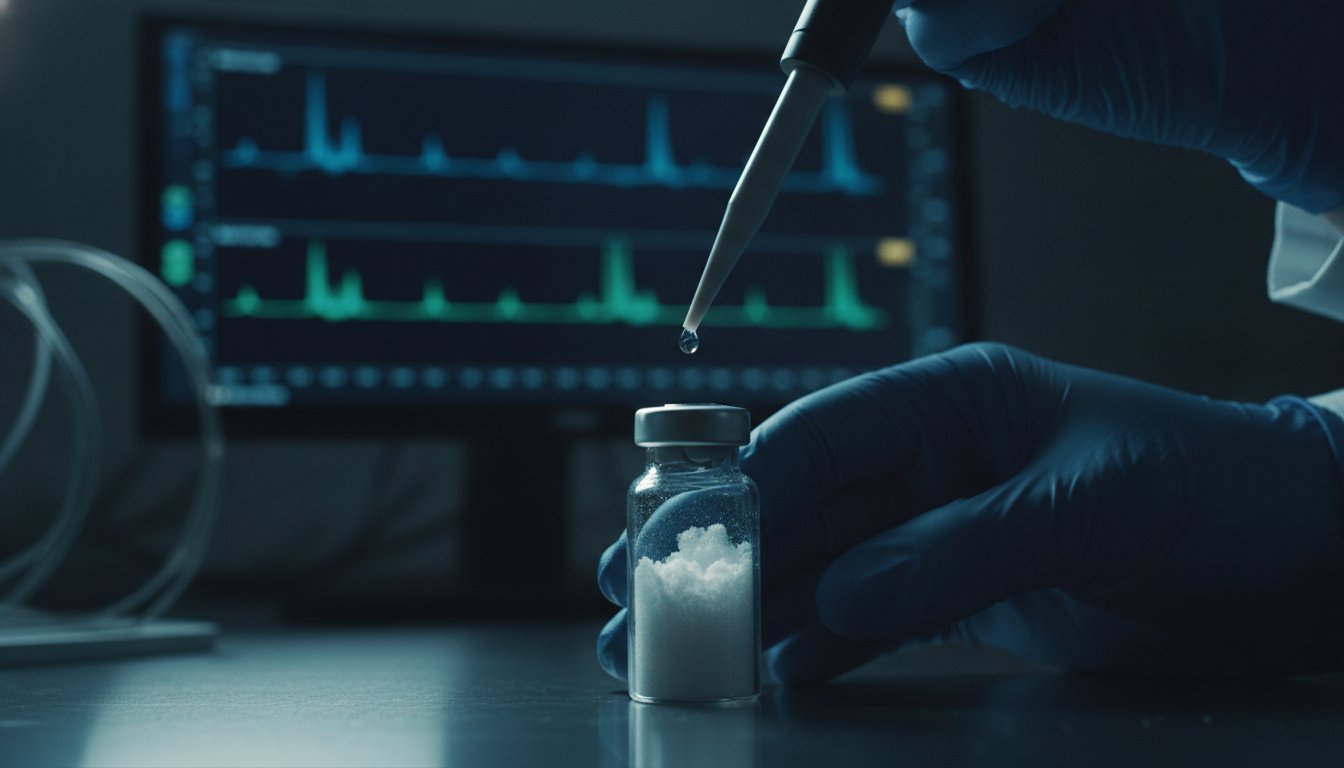
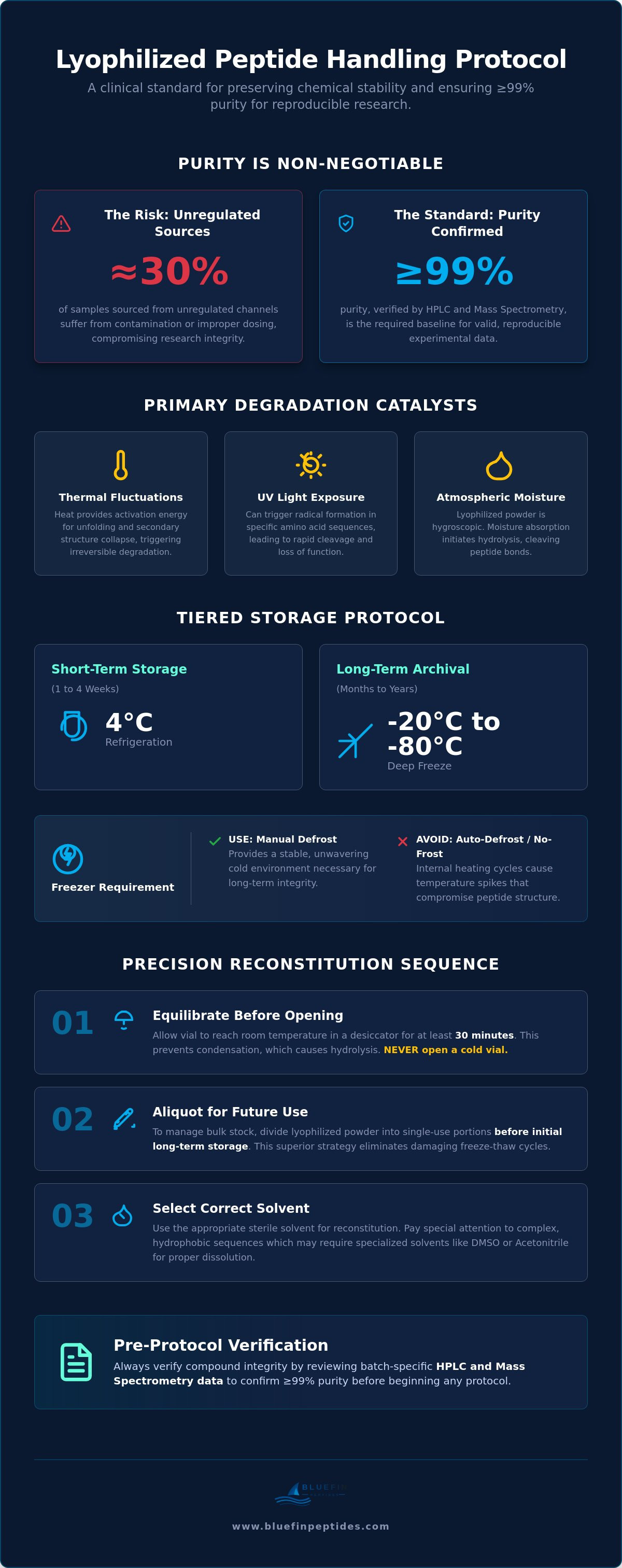
Independent analysis identifies contamination or improper dosing in approximately 30% of peptide samples sourced from unregulated channels. This volatility compromises the foundational integrity of laboratory research. Precision is the only anchor in such a high-stakes environment. Adhering to the best practices for lyophilized peptide handling isn't merely a recommendation; it's a requirement for maintaining ≥99% purity throughout the duration of a study. Every variable matters when dealing with delicate biochemical structures.
You recognize that even minor thermal fluctuations or mechanical stress can trigger irreversible degradation. It's a common hurdle for researchers seeking absolute consistency in their data. This protocol provides the clinical standards for storing, handling, and reconstituting lyophilized peptides to ensure maximum stability and reproducibility. We will detail the exact sequences for thermal equilibration, solvent selection for complex hydrophobic sequences, and the long-term storage protocols necessary to secure your research stock against the currents of chemical instability.
Key Takeaways
- Master the best practices for lyophilized peptide handling to preserve chemical stability and ensure experimental reproducibility across all research phases.
- Implement tiered storage protocols, utilizing -20°C or -80°C environments for long-term archival stock to prevent proteolytic degradation.
- Execute a precise reconstitution sequence, including mandatory room-temperature equilibration and the use of specialized solvents for hydrophobic sequences.
- Verify compound integrity through batch-specific HPLC and Mass Spectrometry data to confirm ≥99% purity before beginning any protocol.
Understanding Lyophilized Peptides and Chemical Stability
Lyophilization represents the pinnacle of peptide preservation. It is a process where solvent is removed via sublimation under vacuum. Understanding What is Lyophilization (Freeze-Drying) is essential for recognizing why the resulting "cake" or powder form serves as the gold standard for peptide longevity. By transitioning the compound into a solid state with negligible moisture content, the kinetic energy available for chemical reactions is drastically reduced. This state effectively anchors the peptide's structural integrity against the currents of degradation. Stability is the priority. Verification is the method.
Chemical stability is a managed outcome. Primary degradation pathways include hydrolysis, oxidation, and covalent aggregation. Hydrolysis occurs when residual moisture cleaves peptide bonds, while oxidation targets specific side chains. Aggregation involves the formation of irreversible, high-molecular-weight complexes that render the compound biologically inert. Adhering to the research peptide quality standards established for high-purity compounds ensures the starting material possesses the ≥99% purity required for reliable data. Implementation of the best practices for lyophilized peptide handling begins with this analytical baseline.
Degradation Catalysts in Research Environments
Thermal fluctuations represent the most immediate threat. Heat provides the activation energy necessary for unfolding and secondary structure collapse. Photo-sensitivity is equally critical; UV light exposure can trigger radical formation in specific sequences, leading to rapid cleavage. Lyophilized powders are also highly hygroscopic. They attract atmospheric moisture like a reef absorbing nutrients. If a vial is opened in a high-humidity environment without proper equilibration, the powder will absorb water, initiating the hydrolysis process immediately. Adopting the best practices for lyophilized peptide handling requires a deep understanding of these catalysts to prevent experimental drift.
Sequence-Specific Vulnerabilities
Vulnerability is encoded in the primary structure. Methionine (Met) and Cysteine (Cys) residues are highly susceptible to oxidation, often requiring an inert gas blanket for long-term storage. Asparagine (Asn) and Glutamine (Gln) residues face risks from deamidation, a reaction that alters the peptide’s charge and potentially its binding affinity. These sequence-level risks demand a disciplined approach to storage and reconstitution. Peptide stability is fundamentally defined by the inherent chemical properties and spatial arrangement of its primary amino acid sequence.
Optimal Storage Conditions for Lyophilized Research Vials
Precision is the baseline. Storage is the constant. For immediate usage vials—those intended for use within a 1 to 4 week window—refrigeration at 4°C is sufficient. However, archival stock intended for months or years must be anchored at -20°C or, ideally, -80°C. These cold depths arrest molecular motion. They preserve the analytical integrity required for valid research. Implementing these best practices for lyophilized peptide handling ensures that the compound's purity remains ≥99% from the moment of receipt to the final assay.
The choice of equipment is as critical as the temperature setting. Avoid "auto-defrost" or "no-frost" freezers. These units utilize internal heating cycles to prevent ice buildup, causing repeated temperature spikes that can compromise peptide secondary structure. Manual defrost freezers are mandatory. They provide the stoic, unwavering environment necessary for long-term stability. Seal integrity is your first line of defense. Wrap vial caps with Parafilm and place them in secondary, airtight containers. This creates a redundant barrier against atmospheric moisture. High-purity research compounds, such as the HPLC-verified offerings from Bluefin Peptides, require this level of logistical rigor to maintain their chemical potential.
Thermal Management and Cold Chain Integrity
Navigating the transition from deep-freeze to the laboratory bench requires patience. Never open a cold vial immediately. Rapid warming causes condensation on the lyophilized cake. Water is a catalyst for hydrolysis. Allow vials to equilibrate to room temperature in a desiccator for at least 30 minutes before opening. Aliquoting is the superior strategy for managing bulk stock. Divide the powder into single-use portions before long-term storage to eliminate repeated freeze-thaw cycles. Following established Guidelines for Handling Special Peptides ensures that even sensitive residues like Cysteine or Methionine remain stable during these critical transitions.
Desiccation Strategies for Lab Longevity
Humidity is the silent predator of lyophilized compounds. Use silica gel or molecular sieves within secondary containers to maintain a zero-moisture environment. Think of the vial as a research vessel. The seal must be a watertight hull. If the hull is breached, the cargo is lost to moisture-driven degradation. Verify seal integrity regularly. A compromised seal is a compromised study. Utilizing best practices for lyophilized peptide handling means treating every vial as a high-stakes asset that requires total isolation from the surrounding environment. Consistency in storage conditions is the only way to guarantee consistency in experimental results.
Step-by-Step Reconstitution Protocol for Laboratory Use
Reconstitution is the transition from a stable, lyophilized state to a reactive liquid phase. This represents the moment of highest risk for degradation. Precision is the only safeguard. Adhering to best practices for lyophilized peptide handling during this phase ensures that the chemical potential of the compound is fully realized. Every drop of solvent and every movement of the vial must be calculated to prevent structural collapse. The following sequence is the laboratory standard for maintaining compound integrity.
- Step 1: Equilibrate the vial to room temperature for 30 to 60 minutes. This critical pause prevents atmospheric moisture from condensing on the lyophilized cake when the seal is breached.
- Step 2: Calculate the precise volume of reconstitution solution required to reach the target concentration. Verification of the exact mass provided in the batch-specific COA is essential for dosing accuracy.
- Step 3: Introduce the solvent aseptically by aiming the needle at the vial wall. Allowing the liquid to flow down the glass prevents the impact stress and foaming associated with direct contact on the powder.
- Step 4: Swirl the vial with a gentle, rhythmic motion until the powder is fully dissolved.
Solvent Selection for Research Models
The choice of solvent determines the longevity of the resulting solution. For the retatrutide research peptide, bacteriostatic water provides a preserved environment for multi-dose studies, whereas sterile water is reserved for assays where benzyl alcohol might skew analytical data. Problematic sequences often require pH adjustment for successful solubilization. Basic peptides may require 1% acetic acid to achieve a clear solution. Conversely, acidic sequences often necessitate the use of dilute ammonia. Compatibility with the final laboratory assay remains the deciding factor in solvent selection. Consistency in solvent quality is a pillar of best practices for lyophilized peptide handling.
Mechanical Handling and Concentration Precision
Peptide loss is a silent threat to experimental reproducibility. Material often adheres to vial walls or standard pipette tips, reducing the effective concentration of the research liquid. Use low-binding plasticware to mitigate this loss. Visual clarity is a reliable indicator of solubilization, but it isn't the only metric. A clear solution signifies that the peptide has transitioned from a suspension to a fully dissolved state. Gentle agitation facilitates molecular dispersion without the risk of shearing delicate peptide chains that mechanical vortexing presents.

Handling Special Sequences and Multi-Peptide Blends
Chemical uniformity is a myth in peptide research. Different sequences possess vastly different physical properties. Complex sequences demand a departure from basic aqueous protocols. Managing hydrophobic sequences requires the strategic use of organic solvents like DMSO or Acetonitrile. These solvents should be used in minimal volumes, typically less than 5% of the total reconstitution volume, to initiate solubilization before diluting with the primary aqueous buffer. Adhering to best practices for lyophilized peptide handling in these instances prevents the formation of insoluble aggregates that can compromise assay accuracy. Precision is the anchor.
Synergistic blends, such as the BPC-157 / TB-500 Research Blend, introduce additional variables. These formulations contain molecules with distinct molecular weights and varying isoelectric points. Achieving a uniform reconstitution requires a disciplined approach to ensure both compounds reach a stable equilibrium in the liquid phase. Reconstituted blends often exhibit different stability profiles compared to single-compound solutions. Molecular interactions within the matrix can accelerate degradation if the environment isn't strictly controlled. Explore the full range of HPLC-verified research blends to secure a foundation of ≥99% purity for your multi-peptide studies.
Hydrophobic vs. Hydrophilic Navigation
Identifying "problem" amino acids is the first step in solubility management. Residues like Valine, Leucine, Isoleucine, and Phenylalanine hinder water solubility. If gentle swirling fails to achieve clarity, sonication serves as a controlled alternative. Sonication should be applied in short bursts to avoid localized heating of the solution. This is particularly relevant when handling the GHK-Cu / BPC-157 / TB-500 multi-peptide matrix. Each component must be fully integrated into the solvent to ensure the integrity of the research liquid. Verification of visual clarity is the final check before laboratory use.
Storage of Reconstituted Solutions
The lyophilized state is a fortress. Once breached, the peptide is vulnerable. Reconstituted solutions face immediate shelf-life limitations. Hydrolysis and oxidation accelerate in the liquid phase, making temperature control paramount. Reconstituted peptides must be stored at 4°C and utilized within a 7 to 14 day window to ensure maximum bioactivity. Beyond this period, the risk of covalent aggregation increases significantly. The pH of the solution also plays a decisive role in long-term stability. Deviations from the optimal pH range can trigger rapid structural collapse. Implementing best practices for lyophilized peptide handling means acknowledging that the clock starts the moment the solvent touches the powder.
Procurement and Quality Verification Standards
Handling protocols remain futile if the starting material is fundamentally compromised. Purity isn't a suggestion; it's the bedrock of experimental validity. High-performance liquid chromatography (HPLC) serves as the primary filter, ensuring that ≥99% purity is maintained as the floor for all research compounds. This analytical rigor ensures that observed biological responses are attributable solely to the peptide of interest rather than synthesis byproducts or residual solvents. Mass Spectrometry provides the secondary layer of verification, confirming molecular identity by mapping the precise mass-to-charge ratios against theoretical values. Qualified researchers recognize that batch-specific Certificates of Analysis (COAs) are non-negotiable. These documents act as the analytical fingerprints of the compound. They offer the transparency required to justify the implementation of best practices for lyophilized peptide handling.
Transit represents a period of extreme vulnerability for delicate biochemical structures. Prolonged exposure to ambient temperatures during international shipping can trigger silent, pre-laboratory degradation that no amount of proper reconstitution can fix. US-based stocking provides a strategic advantage by significantly minimizing transit-related thermal stress. Rapid fulfillment is a logistical necessity for maintaining cold-chain integrity. It ensures the compound moves from the controlled environment of the warehouse to the laboratory freezer with minimal exposure to fluctuating external conditions. This speed acts as a shield against the turbulent thermal environments often encountered in long-haul logistics. It's a commitment to preserving the chemical potential of the offering before it even reaches the bench.
The Bluefin Standard: Clinical Precision in Logistics
Bluefin Peptides bridges the gap between high-level synthesis and the research bench. Every vial meets rigid analytical specifications designed for high-stakes laboratory work. We prioritize transparency over marketing claims. By providing batch-specific COAs and mass-spec confirmation, we allow researchers to verify the integrity of their stock before the first solvent is introduced. This commitment to data-driven quality ensures that your study begins from a position of absolute clarity. Our US-based fulfillment system is engineered to preserve the ≥99% purity floor that your protocols demand. We treat logistical speed as a component of quality control.
Conclusion: Establishing a Laboratory Gold Standard
The arc of peptide handling is a disciplined sequence that requires unwavering attention to detail. Each phase is a critical link in the chain of chemical stability. Neglecting any single step introduces variables that can jeopardize experimental reproducibility and lead to inconsistent data. The standard laboratory workflow should include:
- Verification of analytical purity and molecular identity via batch-specific COA.
- Tiered storage at -20°C or -80°C in manual-defrost environments.
- Mandatory room-temperature equilibration for 30-60 minutes before opening.
- Reconstitution using gentle agitation and sequence-appropriate solvents.
Establishing a laboratory gold standard begins with procurement from a verified source. Secure HPLC-verified compounds for your next study and apply these best practices for lyophilized peptide handling to ensure your research remains anchored in precision and purity.
Securing Experimental Reproducibility Through Analytical Rigor
The integrity of your research liquid is a direct reflection of the protocols applied at the bench. Mastery of best practices for lyophilized peptide handling requires a disciplined transition from deep-freeze storage to precise reconstitution. By prioritizing thermal equilibration and sequence-specific solvent selection, you eliminate the variables that lead to chemical degradation. It's the only way to ensure that your analytical data remains anchored in reality rather than compromised by structural collapse. Consistency is the result of methodical execution.
Reliable handling begins with verified material. Starting with a ≥99% purity HPLC-verified compound provides the necessary foundation for any successful study. Every vial should be backed by batch-specific COAs to confirm identity and purity before the first drop of solvent is added. Our US-based stock ensures rapid fulfillment, protecting your research assets from the thermal turbulence of extended international transit. View our HPLC-verified research peptide catalog to secure the high-performance compounds your laboratory requires. Your dedication to precision ensures the clarity of your results.
Frequently Asked Questions
How long can lyophilized peptides stay at room temperature during shipping?
Lyophilized peptides are stable at room temperature for approximately 1 to 4 weeks without significant degradation. However, US-based fulfillment typically ensures a transit window of 24 to 72 hours to minimize any potential thermal stress. While the solid state provides a robust defense against kinetic instability, immediate refrigeration at 4°C upon receipt is a foundational requirement for maintaining long-term chemical potential.
Can I freeze a peptide solution after it has been reconstituted?
Repeatedly freezing reconstituted solutions is strongly discouraged because ice crystal formation can shear delicate peptide chains. If a liquid peptide must be stored for an extended period, it should be divided into single-use aliquots before a single freeze at -20°C. This strategy prevents the destructive impact of multiple freeze-thaw cycles. Implementing these best practices for lyophilized peptide handling preserves the analytical integrity of the stock.
What is the best way to determine the solubility of a new research peptide?
Solubility is dictated by the primary amino acid sequence and the resulting isoelectric point. Begin by testing a small aliquot of the powder with the primary aqueous solvent to observe for clear molecular dispersion. If the solution remains opaque or particulate, refer to the sequence data. Hydrophobic residues often require a minimal volume of DMSO or Acetonitrile to initiate solubilization before the final volume is reached.
Why did my peptide solution turn cloudy after reconstitution?
Cloudiness signifies incomplete solubilization or the formation of high-molecular-weight aggregates. This phenomenon typically occurs when the solvent pH is too close to the peptide's isoelectric point, causing the molecule to lose its net charge and precipitate. Restoring clarity requires a slight adjustment of the pH using dilute acetic acid or ammonia. A clear solution is the only acceptable baseline for a stable research liquid.
Is bacteriostatic water the same as sterile water for research use?
Bacteriostatic water contains 0.9% benzyl alcohol to serve as a preservative for multi-use vials. Sterile water lacks this additive, making it the preferred choice for single-use assays where benzyl alcohol might interfere with the analytical data or the biological model. The choice of solvent must be calibrated to the specific requirements of the study and the intended duration of the reconstituted solution.
How does oxidation affect the bioactivity of research peptides?
Oxidation modifies the chemical structure of residues such as Methionine and Cysteine, often rendering the compound biologically inert. These modifications can alter the binding affinity or spatial folding of the molecule, which compromises experimental reproducibility. Adhering to the best practices for lyophilized peptide handling, including the use of inert gas blankets for sensitive sequences, prevents these oxidative shifts from occurring during storage.
Should I use a vacuum when drawing solvent into the peptide vial?
The internal vacuum of the vial should never be used to pull solvent directly onto the lyophilized cake. Rapid suction causes impact stress and foaming, which can trigger the denaturation of the peptide secondary structure. Instead, equalize the pressure by inserting a needle before introducing the solvent slowly down the interior wall of the glass. This controlled approach protects the structural integrity of the compound.
How do I read an HPLC purity report for a research peptide?
An HPLC report quantifies purity by measuring the area under the curve of the primary peak relative to the total signal. The dominant peak represents the target peptide, while secondary peaks indicate synthesis byproducts or residual impurities. A purity of ≥99% confirms that the target molecule is the primary constituent. This level of verification provides the clinical precision necessary for high-stakes research environments.
For laboratory research use only. Not for human or veterinary use. This content is educational and does not constitute medical, dosing, or usage guidance.
Browse the BLUEFIN catalog