How to Verify Peptide Purity: A Researcher’s Guide to Analytical Validation
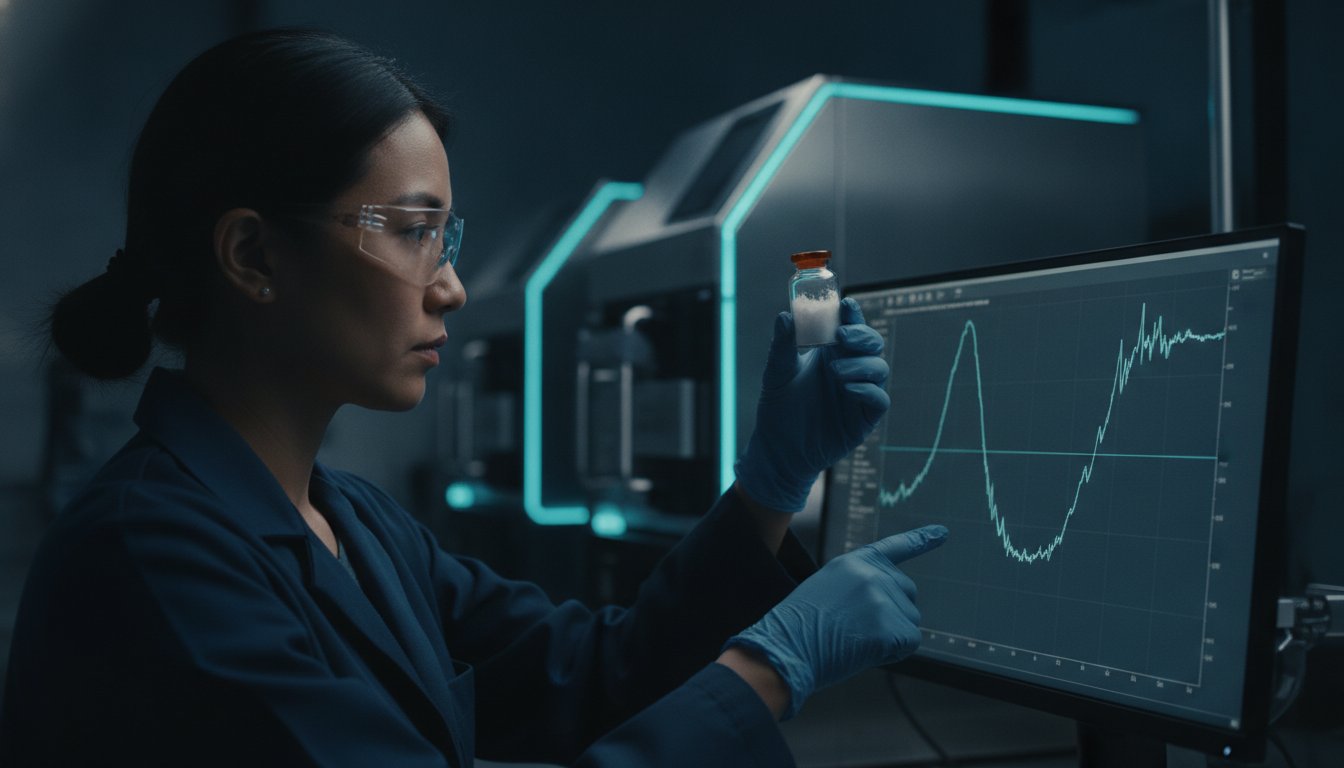
A Certificate of Analysis is not a guarantee of quality; it is a claim that requires rigorous analytical validation. In high-stakes research, the distance between a successful study and a contaminated model often comes down to a single percentage point of impurity. You recognize that raw data is only as reliable as the chemical integrity of your reagents. Understanding how to verify peptide purity is the only way to safeguard your laboratory results against the risks of inconsistent batch quality and falsified documentation. Blind trust has no place in a disciplined laboratory environment.
Mastering the technical protocols for verifying peptide purity ensures the absolute integrity of your research data. This guide provides a reliable framework for independent validation. We will examine the precise interpretation of High-Performance Liquid Chromatography (HPLC) and Mass Spectrometry (LC-MS) data. This deep-sea precision allows you to identify chemical signatures with unwavering clarity. By the conclusion of this analysis, you will possess the expertise to distinguish authentic reports from substandard compounds. We prioritize a "show, don't tell" philosophy regarding quality. Precise. Verifiable. Secure.
Key Takeaways
- Understand why ≥99% purity is the required baseline for high-precision laboratory data and how to define the target sequence relative to impurities.
- Learn the technical distinction between HPLC for purity quantification and Mass Spectrometry for molecular identity and sequence confirmation.
- Master how to verify peptide purity by independently auditing batch-specific Certificates of Analysis for baseline stability and timestamped analytical conditions.
- Identify critical red flags in falsified reports, including inconsistent batch numbers and deviations from theoretical molecular mass.
- Establish a secure procurement framework that prioritizes US-stocked compounds and transparent, batch-level documentation.
The Critical Necessity of Peptide Purity Verification in Laboratory Research
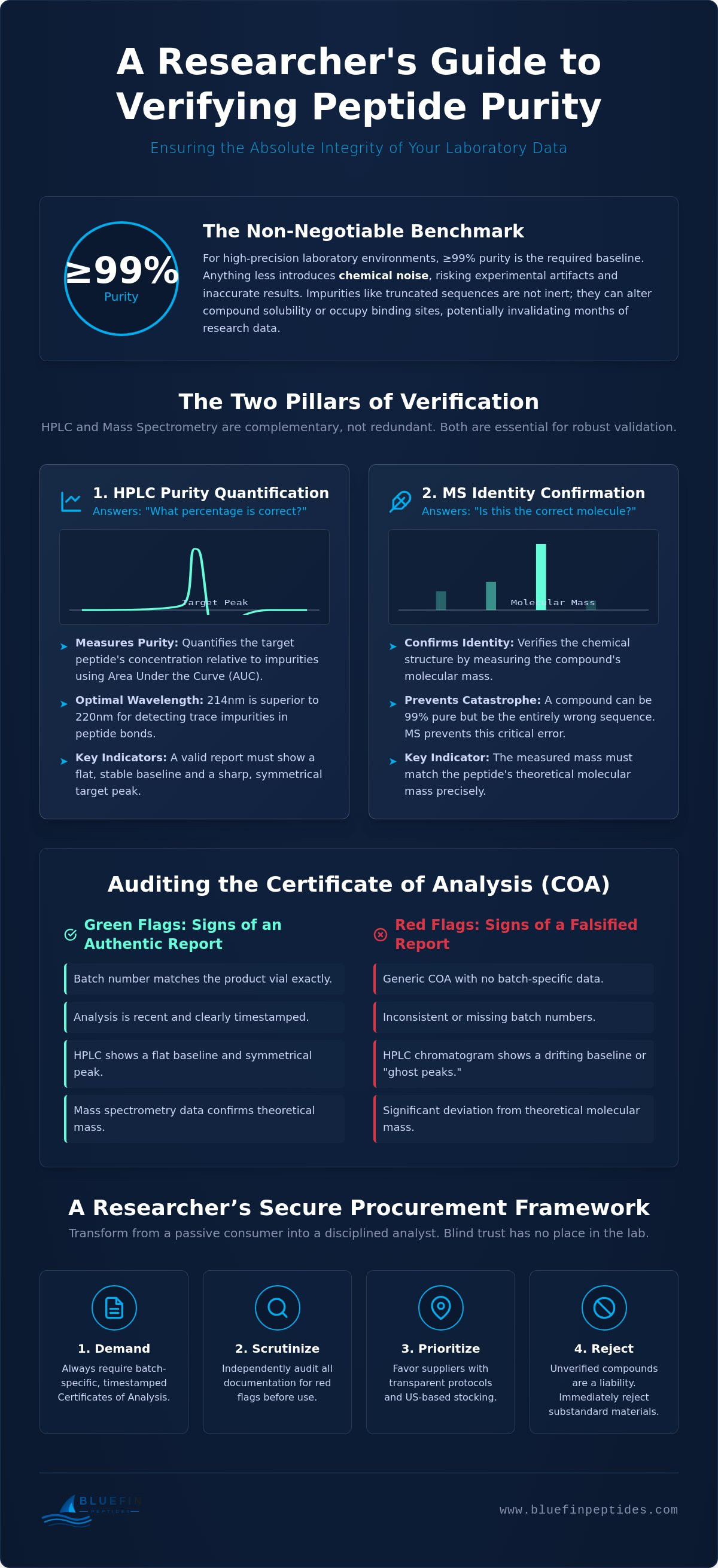
Peptide purity represents the mass percentage of the target amino acid sequence compared to the total mass of all UV-absorbing impurities. During high-performance liquid chromatography (HPLC) analysis, this value is determined by the area under the curve (AUC) of the target peak relative to the total area of all detected peaks. For high-precision laboratory environments, 99% purity is the non-negotiable benchmark. Anything less introduces chemical noise. Truncated sequences and deprotection failures are common byproducts of the synthesis process. These impurities are not inert. They can occupy binding sites or alter the solubility of the compound. Understanding how to verify peptide purity is the only defense against the risks inherent in a market often prioritized by cost over chemical accuracy. Unverified compounds are a liability.
Defining Purity vs. Identity
Purity measures the concentration of the target molecule, but identity confirms its chemical structure. A compound can be 99% pure while being the entirely wrong sequence. This occurs when synthesis protocols fail or labeling errors occur. Robust validation requires liquid chromatography-mass spectrometry (LC-MS) to confirm the theoretical molecular mass. Peptide mass fingerprinting is an essential tool for verifying that the sequence matches the intended design. The compound's physical state also matters. Lyophilization is employed to remove residual solvents and ensure long-term stability. This deep-sea precision in processing prevents degradation. Researchers must distinguish between external contaminants, such as heavy metals, and internal peptide byproducts created during the chain-building process. Knowing how to verify peptide purity transforms a researcher from a passive consumer into a disciplined analyst.
Consequences of Sub-Standard Research Material
Sub-standard materials degrade the signal-to-noise ratio in sensitive cellular assays. When impurities share structural homology with the target peptide, they may exhibit unintended biological activity. This creates a "ghost" effect where results are attributed to the target compound but are actually driven by sequence variants. The impact is catastrophic for longitudinal studies. A single batch of inconsistent material can invalidate months of data. The economic fallout includes lost grant funding and depleted laboratory resources. High-stakes research demands a disciplined approach to procurement. Verification is the anchor of trust. It's the only way to ensure that the "what" of the result is supported by the "how" of the analytical process.
Analytical Methodologies: Deciphering HPLC and Mass Spectrometry
Analytical validation is the bedrock of scientific reproducibility. To understand how to verify peptide purity, a researcher must navigate the technical interplay between High-Performance Liquid Chromatography (HPLC) and Mass Spectrometry (MS). These are not redundant processes. They're complementary layers of verification. HPLC provides the quantitative assessment of purity by separating chemical components based on their physical properties. MS provides the qualitative anchor by confirming that the separated substance is the correct molecule. Relying on a single metric is a tactical error in a high-stakes laboratory environment. Dual-method verification ensures that the fluid dynamics of the synthesis process have resulted in a stable, accurate compound.
HPLC: Measuring the Fluidity of Chemical Components
Reverse-phase HPLC is the primary engine for purity assessment. This methodology utilizes a non-polar stationary phase to separate peptides according to their hydrophobicity. As the mobile phase moves through the column, different molecules emerge at specific retention times. Precision in this process depends on the detection wavelength. While many analysts use 220 nm, the 214 nm wavelength is superior for peptide bonds. The carbonyl groups in the peptide backbone exhibit maximum absorption at 214 nm, allowing for the detection of even trace impurities that other wavelengths might overlook.
- Baseline Stability: A clean chromatogram must show a flat baseline, free from significant drift or ghost peaks.
- Peak Symmetry: The target peak should be sharp and symmetrical. Tailing or fronting suggests the presence of closely related impurities.
- AUC Calculation: Purity is determined by calculating the Area Under the Curve (AUC) for the main peak relative to the total integrated area.
Researchers who prioritize data integrity often source from providers who maintain these rigorous standards. You can evaluate our batch-specific HPLC chromatograms to see this level of precision in practice.
Mass Spectrometry: Anchoring the Molecular Identity
Mass Spectrometry serves as the definitive tool for molecular weight confirmation by measuring the mass-to-charge ratio of ionized particles. While HPLC determines how much of a substance is present, MS determines what that substance actually is. This is critical for complex chains like Retatrutide or Tirzepatide. HPLC can sometimes produce a single, clean peak that masks "deletion sequences"—variants where a single amino acid was failed to be added during synthesis. Because these variants often have similar hydrophobicity, they may elute simultaneously with the target peptide. Only the m/z ratio in a Mass Spec report will reveal the resulting mass discrepancy.
Identity confirmation requires matching the observed mass against the theoretical molecular weight. If the MS data shows a peak at 4731 Da for a compound intended to be Retatrutide, the identity is verified. If the mass deviates beyond the expected isotopic distribution, the batch is compromised. Mastering how to verify peptide purity requires this forensic attention to molecular weight. It's the only way to ensure your research model isn't compromised by sequence errors.
How to Interpret a Certificate of Analysis (COA) and Identify Red Flags
A Certificate of Analysis (COA) serves as the primary forensic record of a batch's chemical history. Learning how to verify peptide purity requires more than a casual glance at the final percentage. You must scrutinize the raw data provided in the report. A valid COA must include a unique batch identifier, a specific test date, and the precise analytical conditions used during the run. Baseline stability in the HPLC chromatogram is non-negotiable. If the baseline shows significant drift or rhythmic noise, the purity calculation is inherently compromised. Similarly, the Mass Spectrometry report must align with the theoretical molecular weight of the peptide. Any deviation beyond standard isotopic variance indicates a sequence error or a contaminated sample. Verification is an active process of interrogation.
Forensic Data Verification
Verification begins with the document's metadata. Digital reports should possess intact properties that align with the stated testing date. Cross-reference the batch number with the supplier's internal database to ensure the report isn't a recycled relic from a previous production cycle. The chromatogram must explicitly name the compound. Generic reports are a hallmark of substandard vendors. If the analytical parameters, such as the solvent gradient or column type, are omitted, the data cannot be independently validated. Precision requires total transparency. Everyオーダー must be anchored by these specific identifiers to maintain the integrity of your laboratory data.
Common COA Deceptions to Avoid
The "representative COA" is a common industry deception. This practice involves providing a high-quality report for a "typical" batch rather than the specific material you received. Batch-specific data is non-negotiable for high-stakes research. Visual inconsistencies are another critical red flag. Look for mismatched fonts, misaligned text, or "Photoshopped" peaks where the resolution of the peak doesn't match the background grid. These are clear indicators of data manipulation.
- Improbable Purity: Treat a 100.0% purity claim with extreme skepticism. In analytical chemistry, 100.0% is statistically improbable and typically suggests a lack of sensitivity in the equipment or a manipulated result.
- Blurry Documentation: Low-resolution scans often mask subtle edits to dates or batch numbers.
- Mismatched Weights: If the observed mass in the MS report deviates from the theoretical mass, the identity is unverified.
Knowing how to verify peptide purity means recognizing that perfection is often a mask for fabrication. A disciplined researcher looks past the marketing fluff to find the underlying chemical truth. Trust is built on verifiable data, not polished claims.

A Researcher’s Step-by-Step Checklist for Batch Verification
Verification is a proactive protocol. It starts before the transaction. Understanding how to verify peptide purity requires a systematic approach to procurement. You must demand batch-specific data. Generic data sheets are insufficient for high-stakes research. Verify the supplier's domestic infrastructure. US-based logistics ensure a shorter cold chain and greater accountability. A disciplined researcher interrogates the data before the compound ever reaches the bench. This is the only way to ensure the physical state of the reagent matches its chemical promise.
Pre-Procurement Due Diligence
Query the supplier on their internal testing frequency. A disciplined partner provides more than just a PDF. They offer technical depth. Use the Retatrutide research peptide analytical specifications as a baseline for comparison. If a vendor cannot explain their HPLC equipment standards or solvent gradients, their data is suspect. Speed of response is a metric of reliability. Technical support should treat you as a peer in a scientific field. Security is found in the "how" of their processes.
- Batch-Specific Reports: Request HPLC and MS data for the exact lot number being shipped. Cross-reference the date of analysis with current inventory cycles.
- Mass Confirmation: Cross-reference the observed mass on the MS report with the theoretical molecular weight. The m/z ratio must align with the peptide's atomic composition.
- Peak Analysis: Look for a singular, sharp peak. The report header should specify a 214 nm wavelength for maximum sensitivity. Avoid batches showing "shoulders" or multiple minor peaks that indicate sequence deletions.
- Logistical Transparency: Confirm US-stocked status. Domestic fulfillment reduces the risk of degradation during international transit.
You can browse our HPLC-verified compounds to secure materials that meet these rigorous verification standards.
Post-Arrival Inspection Protocols
Visual inspection is the final gate. Inspect the vacuum seal integrity. The lyophilized cake should appear uniform and stable. A collapsed cake or "melt-back" suggests moisture ingress or temperature excursions during transit. Storage is critical. Maintain the cold chain immediately upon receipt to prevent peptide hydrolysis. Most research peptides require storage at -20°C for long-term stability. Initial reconstitution provides the last data point. Solubility should be rapid. The resulting solution must be clear. Turbidity or persistent particulates are indicators of residual salts or hydrophobic impurities. Knowing how to verify peptide purity at the point of use prevents the introduction of unknown variables into your research model. Precision is a constant requirement.
The Bluefin Standard: Rigorous Analytical Protocols and US-Based Logistics
Reliability is anchored in methodology. At Bluefin Peptides, we recognize that the question of how to verify peptide purity shouldn't be left to chance or unverified international supply chains. We operate as a high-performance laboratory partner. Our commitment to ≥99% HPLC-verified purity is a non-negotiable standard for every research compound in our inventory. Transparency is our primary protocol. Every order is anchored by comprehensive, batch-specific Certificates of Analysis. We don't ask for blind trust. We provide the raw data required for independent validation. This "show, don't tell" philosophy ensures that your laboratory data remains untainted by chemical variance. Professional. Verifiable. Disciplined.
Unwavering Precision in Fulfillment
Logistical speed must never compromise analytical integrity. Our US-based facilities serve as the command center for quality control and fulfillment. By maintaining domestic stock, we eliminate the uncertainty and degradation risks associated with international transit and customs delays. Bluefin Peptides prioritizes analytical verification over all marketing claims. Our infrastructure ensures that the cold chain remains intact from the point of synthesis to the moment of delivery. This fluid movement through our supply chain guarantees that the lyophilized state of your peptides is preserved. We are disciplined logistics specialists. We focus on the "how" of our delivery to protect the "what" of your research results. Speed meets security.
Your Partner in Laboratory Integrity
Accessing the analytical reports for your specific batch is a seamless process. We provide the tools for qualified researchers to navigate complex data sets with confidence. Our technical register assumes a knowledgeable audience. We provide the support necessary to interpret m/z ratios and chromatogram baselines for our specific offerings, including Retatrutide and Tirzepatide. These compounds are exclusively for laboratory research. Maintaining these professional boundaries is essential for the security of the scientific community. When the integrity of your study is at stake, you need a partner that treats verification as a forensic necessity. We provide the data. You provide the discovery.
Secure HPLC-Verified Peptides for Your Laboratory
Securing Analytical Integrity for Longitudinal Research
Analytical integrity is the bedrock of reproducible science. You now possess the forensic framework required for batch validation. By triangulating HPLC chromatograms with Mass Spectrometry identity reports, you ensure that your research reagents match their theoretical specifications. Mastering how to verify peptide purity is not merely a procurement step; it's a commitment to the data that defines your career. Substandard materials are a liability that no disciplined laboratory can afford.
Bluefin Peptides provides ≥99% HPLC-verified purity and batch-specific COAs with every order. Our US-based logistics ensure that the cold chain remains secure; providing the stability required for high-precision assays. We provide the tools for verification because we prioritize chemical truth over marketing fluff. Secure. Verifiable. Disciplined.
Procure HPLC-Verified Research Peptides
Advance your research with the security of verifiable data and the precision of a high-performance laboratory partner. Your results depend on it.
Frequently Asked Questions
What is the difference between HPLC purity and peptide content?
HPLC purity measures the ratio of the target peptide sequence to all other UV-absorbing impurities in the sample. Peptide content refers to the actual weight percentage of the peptide in the lyophilized powder, which also includes residual water and counter-ions like acetate or TFA. A compound can exhibit 99% HPLC purity while having a peptide content of only 80% due to these non-peptide components.
How do I know if a peptide COA is authentic or falsified?
Authenticity is determined by forensic data inspection. Look for sharp, high-resolution chromatograms and timestamped analytical conditions that match the specific batch identifier. Falsified reports often exhibit misaligned fonts, blurry text, or improbable baseline perfection. Understanding how to verify peptide purity requires cross-referencing these data points with the supplier's internal database to ensure the report isn't a recycled relic.
Why is mass spectrometry necessary if I already have an HPLC report?
HPLC determines quantity; Mass Spectrometry determines identity. Without MS data, you cannot confirm that the peptide sequence is correct. Structurally similar impurities, such as deletion sequences, may elute at the same retention time as the target, masking their presence on an HPLC report. MS anchors the molecular weight by measuring the m/z ratio. Identity is a non-negotiable requirement for data integrity.
What are the common impurities found in synthetic peptides?
Common impurities include truncated sequences and deletion variants formed during the coupling steps of solid-phase synthesis. Deprotection failures and residual trifluoroacetic acid (TFA) are also frequent contaminants. These substances are structurally homologous to the target molecule and can interfere with binding assays. Precision synthesis aims to minimize these specific chemical signatures to maintain a clean signal-to-noise ratio.
Can I verify peptide purity after the compound has been reconstituted?
Post-reconstitution verification is possible through analytical HPLC, but the peptide begins to degrade once in solution. Reconstitution should only occur immediately before use or analysis to prevent hydrolysis. This secondary check confirms the compound remains stable after the physical state changes from powder to liquid. However, the most reliable purity baseline is established while the compound is in its lyophilized state.
What does a '99% purity' claim actually mean in a research context?
A 99% purity claim indicates that 99% of the detected UV-absorbing mass at a specific wavelength is the intended peptide sequence. This threshold is the gold standard for high-precision laboratory studies. It reduces the risk of unintended biological activity from sequence variants. In high-stakes research, even a single percentage point of impurity can skew cellular signaling results or receptor-binding data.
How should I store lyophilized peptides to maintain their verified purity?
Lyophilized peptides must be stored at -20°C in a desiccated, vacuum-sealed environment to prevent moisture ingress. For long-term stability beyond six months, -80°C is the preferred standard. Maintaining the cold chain is the only way to preserve the how to verify peptide purity baseline established at the point of synthesis. Exposure to room temperature or moisture leads to rapid chemical degradation.
Is third-party testing mandatory for all research peptide suppliers?
Third-party testing isn't a legal requirement for research-grade compounds, but it's a hallmark of professional transparency. It provides an independent audit of the manufacturer's internal claims. Reliable US-based suppliers utilize third-party validation to offer an additional layer of security to the researcher. Trust is built on this independent data rather than polished marketing claims. Verification is the anchor of laboratory trust.
For laboratory research use only. Not for human or veterinary use. This content is educational and does not constitute medical, dosing, or usage guidance.
Browse the BLUEFIN catalog