Analytical Standards for Peptide Research: A Framework for Laboratory Verification

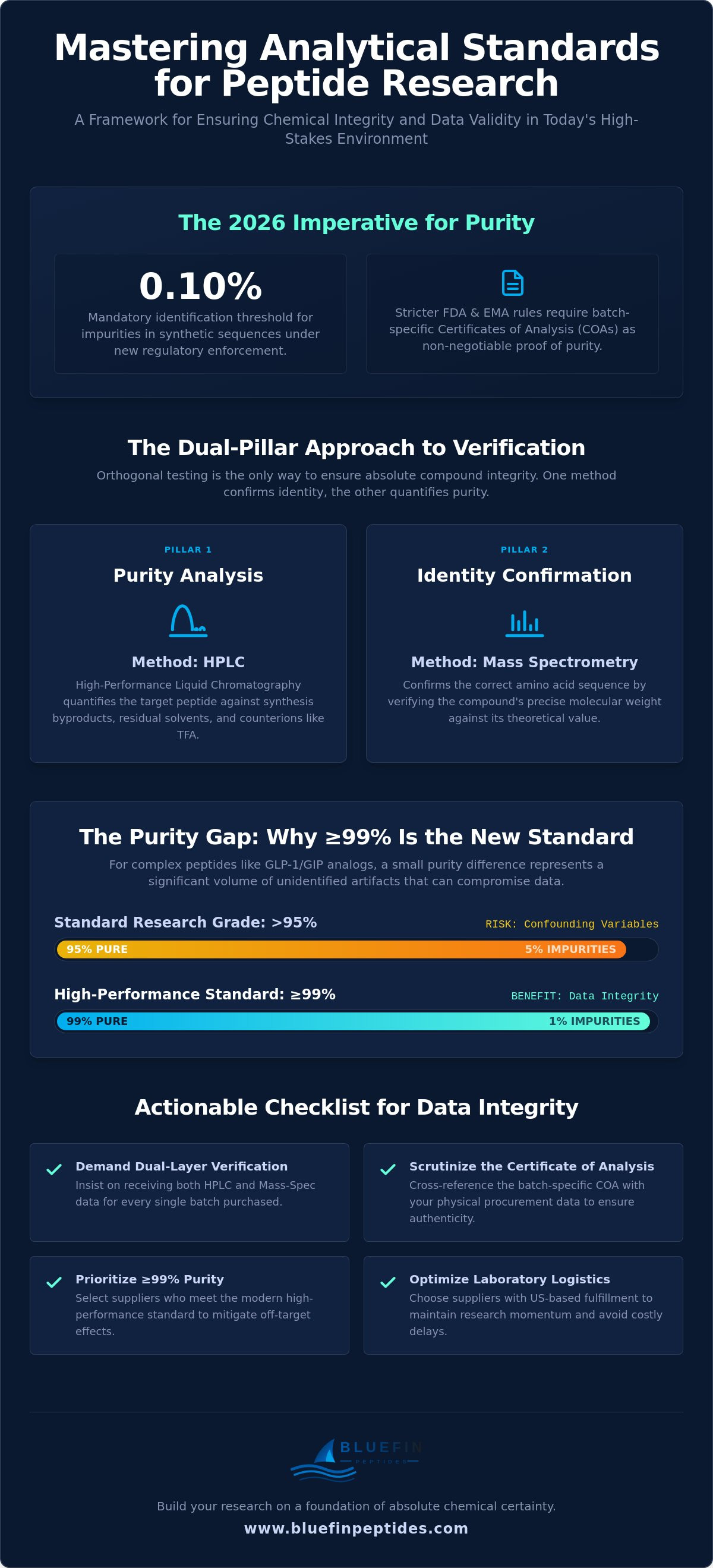
Experimental validity is anchored in analytical transparency. In 2026, the margin for error has narrowed as regulatory bodies enforce a 0.10% identification threshold for impurities in synthetic sequences. You've likely encountered the frustration of incomplete HPLC reports or the silent risk of impure compounds compromising months of disciplined laboratory work. These aren't just minor inconsistencies. They're structural failures in the research pipeline that threaten to sink your data integrity.
Mastering the analytical standards for peptide research is now a prerequisite for any high-stakes study. This framework provides the technical requirements and verification protocols necessary to ensure the chemical integrity of your compounds against the latest ISO 10993-1:2025 benchmarks. We'll examine the transition from high-purity lyophilized compounds to verifiable, batch-specific HPLC and Mass-Spec results. You'll gain a peer-level understanding of how to authenticate every batch, ensuring your research is built on a foundation of absolute chemical certainty.
Key Takeaways
- Anchor experimental validity by defining the 2026 benchmarks for chemical identity and reproducibility in high-stakes environments.
- Utilize the dual-layer verification of HPLC for purity assessment and Mass Spectrometry for definitive molecular weight confirmation.
- Apply rigorous analytical standards for peptide research to mitigate the risk of off-target effects caused by sub-threshold purity levels.
- Implement an actionable checklist to cross-reference batch-specific Certificates of Analysis (COAs) with physical procurement data.
- Maintain laboratory momentum by prioritizing suppliers that offer ≥99% purity and US-based fulfillment logistics.
The Framework of Analytical Standards in Peptide Synthesis
Analytical standards represent the navigational charts of biochemical synthesis. Without these benchmarks, laboratory data drifts into speculation. In the current 2026 regulatory environment, the FDA requires identification of any impurities exceeding 0.10% for synthetic sequences. While research-grade materials operate in a distinct legal category, the scientific demand for analytical standards for peptide research remains equally rigorous to ensure experimental reproducibility. Verification is not a luxury. It's the anchor of data integrity. Accuracy is non-negotiable. Verification is mandatory.
The regulatory landscape for research-grade chemical compounds is tightening. In 2026, regulatory agencies like the FDA and EMA are implementing stricter rules for peptide therapies, requiring more rigorous safety data and clearer product classification. This shift increases the burden on researchers to prove the provenance and purity of their materials. A batch-specific Certificate of Analysis (COA) is the only acceptable evidence of compliance in this high-stakes environment. Relying on generic specifications is a risk that modern laboratories can't afford to take.
Identity vs. Purity: The Two Pillars of Verification
Chemical identity and purity are distinct metrics that must converge for a compound to be considered verified. Identity confirms the amino acid sequence through molecular weight verification. Utilizing Peptide mass fingerprinting allows researchers to cross-reference the observed mass against the theoretical sequence with high-resolution accuracy. Purity, conversely, quantifies the presence of the target peptide relative to synthesis byproducts, residual solvents, or counterions such as acetate or trifluoroacetate (TFA). These contaminants aren't inert. Residual solvents can induce cytotoxic effects in cell culture models. Improper counterion levels can alter the solubility and bioactivity of the compound, leading to skewed results in quantitative biological studies.
The Evolution of Standards for GLP-1 and GIP Analogs
Peptide synthesis has transitioned from simple sequences to complex multi-agonist architectures. Historically, single-target peptides allowed for broader margins. The emergence of multi-receptor compounds like Retatrutide, which targets GLP-1, GIP, and glucagon receptors, demands a higher tier of precision. These complex structures are prone to truncation or deletion during synthesis. The 99% purity threshold serves as a bulkhead against confounding variables. While the accepted purity threshold for research peptides is historically >95% in literature, modern high-performance laboratories require a higher degree of transparency. A 4% difference in purity represents a significant volume of unidentified chemical artifacts that can interfere with receptor-binding assays. As research shifts toward higher-order peptide blends, the verification of each individual component becomes critical to maintaining the stoichiometry of the final solution.
Core Verification Methodologies: HPLC and Mass Spectrometry
Analytical transparency requires more than a single data point. It demands a dual-pillar approach. High-Performance Liquid Chromatography (HPLC) and Mass Spectrometry (MS) serve as the essential instruments for maintaining analytical standards for peptide research. These methodologies operate as twin engines of verification. One quantifies purity. The other confirms identity. Orthogonal testing is the only way to ensure absolute compound integrity. It prevents research drift. It secures your data.
Relying on a single testing method is a structural vulnerability in any laboratory protocol. Impurities can occasionally co-elute with the target peptide during HPLC, masking their presence within the primary peak. Conversely, a compound might appear pure but possess the wrong molecular sequence. Mass Spectrometry provides the necessary secondary layer of confirmation. This level of maritime-level precision ensures that the chemical substance in the vial matches the theoretical model precisely. For researchers requiring this level of rigorous data, sourcing HPLC-verified research peptides provides the necessary foundation for experimental reproducibility.
Interpreting HPLC Chromatograms for Research Vials
The HPLC chromatogram is a visual map of chemical purity. Researchers must focus on peak integration. The area under the primary peak, relative to the total area of all detected peaks, determines the purity percentage. A sharp, symmetrical peak indicates a well-defined compound. Secondary peaks or "shoulders" on the primary peak suggest the presence of truncated sequences or diastereomers. Baseline noise must be minimal to ensure that low-level impurities aren't overlooked. In complex sequences like Retatrutide or Tirzepatide, gradient elution is critical. By varying the solvent composition over time, the laboratory can resolve closely related impurities that would otherwise remain hidden. Precision is paramount. Resolution is mandatory.
Mass Spectrometry: Confirming the Molecular Signature
Mass Spectrometry provides the definitive molecular signature. It measures the mass-to-charge ratio of the ionized peptide. Electrospray ionization (ESI) is the standard technique for analyzing large, non-volatile peptides without causing fragmentation. The resulting spectrum allows for a direct comparison between the observed mass and the theoretical molecular weight. Even a minor discrepancy of a few Daltons can indicate an incorrect amino acid substitution or a missing protective group. This verification step is the final bulkhead against mislabeled compounds. It ensures that the compound's physical state aligns perfectly with its chemical designation. High-purity lyophilized compounds must survive this scrutiny before they are cleared for use in quantitative biological studies. Documentation is the evidence of quality.
Purity Thresholds and Their Impact on Laboratory Data
The delta between 95% and 99% purity isn't merely a statistical nuance. It's a fundamental shift in experimental control. While academic literature often cites 95% as the accepted purity threshold for research peptides, this margin allows for a significant volume of unidentified chemical artifacts. In a 10mg vial, a 5% impurity rate represents 0.5mg of extraneous material. This isn't just dead weight. These impurities are often structural analogs, such as truncated sequences or diastereomers, that can interfere with receptor-binding kinetics. Anchoring your methodology in analytical standards for peptide research requires a move toward the 99% benchmark to eliminate these confounding variables.
Experimental drift often begins with the assumption that all impurities are inert. They aren't. In many cases, synthesis byproducts possess enough structural similarity to the target peptide to act as competitive inhibitors. They occupy the receptor without triggering the intended biological response, leading to a false underestimation of the compound's potency. For complex sequences, researchers should consult the Retatrutide Research Peptide: Analytical Specifications to understand how high-resolution verification prevents these data skews. Precision is the only protection against failed replication.
The Risks of Sub-Standard Peptide Purity
Incomplete sequences are the primary culprits in sub-standard vials. During solid-phase synthesis, a failure in a single coupling step results in "deletion peptides" that lack specific amino acids. These artifacts often co-elute with the target during low-resolution purification. Beyond the peptide itself, residual Trifluoroacetic acid (TFA) presents a serious risk. TFA is a standard counterion used in synthesis, but excessive levels can lower the pH of cell culture media, inducing cytotoxic effects that have nothing to do with the peptide's bioactivity. The cumulative cost of failed experiments due to these hidden variables far outweighs the initial investment in verified materials. Quality pays for itself.
Lyophilization: Preserving the Chemical State
The physical state of the compound is as critical as its chemical identity. Lyophilization, or freeze-drying, is the process of removing water through sublimation to ensure long-term stability. A high-quality lyophilized "cake" should appear as a uniform, porous solid. If the cake has collapsed or appears "melted," it's a visual indicator of moisture ingress or thermal stress during processing. This structural failure often leads to rapid peptide degradation. To maintain the analytical integrity of research vials, storage protocols must be strictly followed. Peptides should be stored at -20°C or -80°C to prevent hydrolysis and oxidation. Stability is the bulkhead that protects your research from the elements.

The Actionable Checklist: Evaluating Batch-Specific COAs
A Certificate of Analysis (COA) is not a marketing brochure. It's a technical affidavit. Professional analytical standards for peptide research dictate that every vial in your inventory must be tethered to a specific, verifiable data set. If the batch number on the vial doesn't match the report, the data is void. This alignment is the first bulkhead against experimental error. Verify the batch. Secure the sequence. Documentation is the logbook of your laboratory's integrity. It's the only way to ensure your research doesn't drift into unverified waters.
Timing matters in the world of biochemical stability. Cross-reference the HPLC analysis date with your procurement timeline. A report dated several years prior to acquisition suggests potential degradation despite the presence of high-purity lyophilized compounds. You must also ensure the report contains both HPLC and Mass Spectrometry data. One without the other leaves a blind spot in your verification process. Finally, inspect the chromatogram image. A high-resolution, clear trace is the hallmark of professional transparency. If the image is pixelated or obscured, the underlying data is suspect. For researchers who demand this level of transparency, you can access batch-specific HPLC and Mass-Spec reports for every compound in our inventory. Accuracy is our baseline. Data is our commitment.
Red Flags in Peptide Analytical Reports
Report forgery is a persistent risk in the research chemical sector. Blurred or pixelated chromatograms are immediate indicators of a manipulated document. A legitimate lab report will always include the theoretical mass of the specific peptide sequence. If this field is missing or generic, the supplier hasn't performed the necessary identity confirmation. Generic reports that lack a unique lot number are equally dangerous. They offer the illusion of quality without the accountability of batch-level testing. Trust the data, not the claim. If the report looks like a photocopy of a photocopy, the chemical integrity is likely compromised. Vigilance is mandatory.
Standardizing Documentation for Institutional Review
Documentation is the final stage of laboratory discipline. Maintain a digital repository of COAs for every research project. This practice streamlines the audit trail for institutional procurement and is essential for navigating the currents of peer-reviewed publication. In 2026, reviewers are increasingly skeptical of data derived from unverified sources. Providing batch-specific analytical data demonstrates a commitment to the highest scientific standards. It transforms your results from anecdotal observations into verifiable facts. Organization is efficiency. Verification is truth. Every data point must be anchored in a specific, documented reality to survive the scrutiny of the scientific community.
Procuring Verified Research Peptides from Bluefin Peptides
Bluefin Peptides operates as a disciplined logistics partner for high-stakes laboratory environments. Our adherence to analytical standards for peptide research begins at the point of synthesis and extends through the final delivery of verified compounds. While the broader industry often accepts a 95% purity threshold as sufficient, we maintain a baseline of ≥99% HPLC-verified purity for all research chemicals. This isn't a marketing claim. It's a structural requirement. We provide the analytical tools for immediate researcher verification. Transparency is our standard. Accuracy is our protocol. We serve the academic and professional communities with clinical precision.
The procurement process is the final bulkhead against research drift. Reliability in 2026 requires more than just a product; it requires a verifiable data trail. We provide batch-specific Certificates of Analysis (COAs) for every order, ensuring that your laboratory can authenticate the chemical identity and purity of your compounds before the first assay begins. This commitment to transparency allows researchers to focus on data generation rather than compound validation. We don't ask for trust. We provide the evidence. Our operations are anchored in the necessity of absolute chemical certainty.
Our Analytical Protocol for Retatrutide and Tirzepatide
Our analytical protocol for complex sequences like Retatrutide Research Peptide and Tirzepatide Research Peptide involves batch-level HPLC verification for every synthesis cycle. This ensures that the primary peak resolution meets our rigorous internal benchmarks before the compound is cleared for inventory. Mass-spec confirmation follows to ensure precise molecular alignment with theoretical sequences. We utilize consistent lyophilization standards to maximize chemical stability, ensuring the lyophilized cake remains structurally sound during transit and storage. Every batch is a unique data point. Every vial is a verified asset. We maintain the stoichiometry of your research through unwavering testing protocols.
Logistical Precision: From Synthesis to Laboratory
Logistical precision is the final stage of our quality assurance framework. We maintain a US-based inventory to bypass the delays and uncertainties of international shipping currents. Secure, climate-controlled storage prevents thermal degradation, preserving the analytical integrity of the peptides until the moment of fulfillment. Our fast-strike shipping protocols ensure rapid fulfillment across the United States, maintaining your laboratory's momentum. We provide direct access to batch-specific data for all procurement orders, allowing researchers to cross-reference HPLC and Mass-Spec results immediately upon receipt. We serve qualified laboratory environments. We uphold professional standards. Bluefin Peptides is the anchor of your analytical workflow, providing the high-purity compounds necessary for reproducible science.
Securing the Future of Quantitative Peptide Analysis
Experimental validity is a choice. It requires a permanent commitment to transparency. By implementing a dual-pillar verification approach using HPLC and Mass Spectrometry, you eliminate the blind spots that lead to research drift. The 99% purity benchmark isn't a suggestion. It's a bulkhead. It protects your cellular assays from the interference of truncated sequences and residual solvents. Precision is non-negotiable. Verification is mandatory.
Maintaining rigorous analytical standards for peptide research ensures your data survives institutional scrutiny. Every vial must be tethered to its own batch-specific COA. This level of precision is the only way to transform observations into verifiable facts. We provide the tools for this certainty. Our inventory features ≥99% HPLC-verified purity and includes batch-specific documentation for every order. With fast US shipping, your laboratory momentum remains uninterrupted.
Secure HPLC-Verified Research Peptides for Your Laboratory and anchor your methodology in absolute chemical integrity. Your commitment to quality is the foundation of your success.
Frequently Asked Questions
What is the difference between a research peptide and an analytical standard?
An analytical standard is a highly characterized reference material used primarily to calibrate laboratory equipment and validate methodology. A research peptide is the active chemical sequence used within experimental models. While both must adhere to rigorous analytical standards for peptide research, standards require ISO-certified traceability. Research peptides require batch-specific verification to ensure the data generated is reproducible and free from synthesis artifacts.
Why is HPLC verification essential for Retatrutide research?
Retatrutide is a complex multi-agonist architecture prone to truncation during solid-phase synthesis. HPLC verification is mandatory to resolve these closely related impurities from the target peptide. Without high-resolution chromatograms, researchers risk using vials containing deletion sequences that can competitively inhibit receptor binding. This leads to inaccurate potency measurements in quantitative biological studies. Precision is the only bulkhead against such experimental drift.
How do I read a peptide mass spectrometry report?
Focus on the observed mass-to-charge (m/z) ratio relative to the theoretical molecular weight. A valid report shows a primary peak aligning with the calculated mass of the peptide sequence, often accounting for ionization states such as [M+H]+. Discrepancies exceeding a few Daltons indicate incorrect amino acid substitutions or incomplete deprotection. Identity confirmation is the final stage of chemical verification. It secures the sequence before research begins.
What does "99% purity" actually mean in a laboratory context?
In a laboratory context, 99% purity indicates that the target peptide constitutes 99% of the total peptide material detected by HPLC. This metric typically excludes water and counterions like acetate or TFA. It ensures that only 1% or less of the material consists of synthesis byproducts. This high threshold provides a clean bulkhead against confounding variables. It's the industry anchor for reliable, high-stakes laboratory results.
Can I use a single COA for multiple batches of the same peptide?
No. Every synthesis cycle is a unique chemical event with its own distinct impurity profile. Professional analytical standards for peptide research require batch-specific documentation for every vial. Using a generic COA for multiple lots is a structural failure in laboratory protocol. It invalidates the audit trail. It risks the use of sub-standard material that doesn't match your previously verified specifications. Documentation must be batch-specific.
How do residual solvents affect the results of my peptide research?
Residual solvents such as acetonitrile or DMF are cytotoxic and can induce off-target effects in cell-based assays. High levels of these volatile organic compounds alter the physical state of the lyophilized cake. This compromises the stoichiometric accuracy of your resulting solutions. Proper purification and secondary lyophilization steps are required to ensure these contaminants remain below established thresholds. Quality purification preserves the integrity of your experimental model.
What are the storage requirements for maintaining analytical standards?
Lyophilized peptides must be stored at -20°C or -80°C in a desiccated environment to prevent hydrolysis and oxidation. Repeated freeze-thaw cycles must be avoided to maintain stability. Once reconstituted, peptides are far more susceptible to degradation. Solutions should be aliquoted and used within short timelines. This maintains the chemical integrity established during the initial verification process. Proper storage is the bulkhead that protects your research from environmental degradation.
Why should researchers prioritize US-stocked peptides for their studies?
US-based inventory eliminates the thermal stress and moisture exposure associated with prolonged international transit across varying climates. Rapid fulfillment allows laboratories to maintain momentum without the risk of degradation during customs delays. Sourcing from domestic suppliers like Bluefin Peptides ensures that the compound's physical state remains consistent. It ensures the peptide moves from the point of verification to the laboratory bench with maritime-level precision.
For laboratory research use only. Not for human or veterinary use. This content is educational and does not constitute medical, dosing, or usage guidance.
Browse the BLUEFIN catalog