Analytical Integrity: The Definitive Guide to Research Peptide Third-Party Testing (2026)

Verification is the only valid currency in the laboratory. Relying on unverified reagents is a calculated risk that often leads to catastrophic project failure. You recognize that inconsistent batch quality from suppliers threatens the integrity of your data and the viability of your research. This reality necessitates a disciplined approach to research peptide third-party testing to ensure every compound meets the stringent requirements of your methodology. Precision is the baseline. Security is the result.
This guide provides the technical framework required to master the nuances of High-Performance Liquid Chromatography and Mass Spectrometry. You will learn to identify the subtle red flags in analytical reports that indicate impurity or misidentification. By the end of this analysis, you will possess the expertise to procure ≥99% HPLC-verified compounds with the precision of a deep-sea navigator. We examine the 2026 standards for analytical integrity and the specific methodologies required to confirm both molecular identity and chromatographic purity.
Key Takeaways
- Eliminate the risk of data manipulation by implementing independent external audits as the baseline for chemical purity and identity.
- Distinguish between the technical roles of HPLC for purity assessment and Mass Spectrometry for molecular identity confirmation to ensure absolute compound precision.
- Utilize a rigorous technical checklist to spot red flags in analytical reports, ensuring your laboratory reagents are current, authentic, and untampered.
- Master a systematic procurement protocol for research peptide third-party testing that prioritizes transparency and verifiable batch-specific data.
- Secure a reliable supply chain of ≥99% HPLC-verified compounds through disciplined supplier vetting and high-precision logistical oversight.
The Critical Role of Independent Verification in Peptide Synthesis
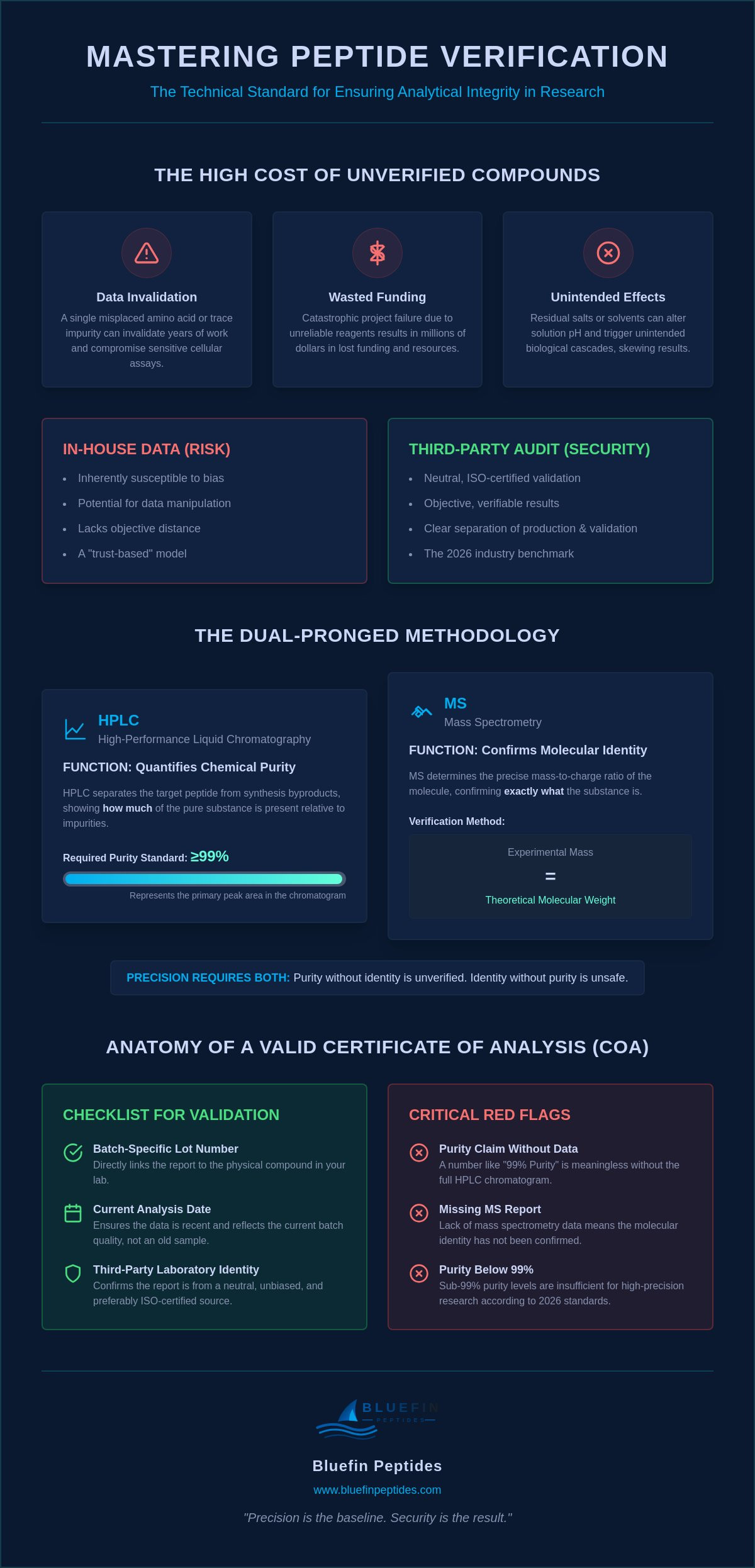
Verification is the only valid currency in the modern laboratory. Within the high-stakes environment of molecular research, research peptide third-party testing functions as a vital external audit. It's the process of subjecting a compound to a neutral, ISO-certified laboratory to verify its chemical purity and molecular identity. Relying on a manufacturer's internal data is a calculated risk. In-house verification is inherently susceptible to bias and data manipulation. Security requires a clear separation between the entity producing the compound and the entity validating it.
A declaration of "99% Purity" is a hollow claim without a corresponding batch-specific report. In the current 2026 landscape, the industry benchmark has shifted. A 98% purity level is no longer sufficient for high-precision research. Precision is the baseline; transparency is the vehicle. Without a report that links a specific lot number to its analytical results, a purity claim is merely marketing fluff. True analytical integrity demands documentation that proves the physical state of the reagent matches its theoretical design.
This standard of analytical integrity is also vital in the health sector; for example, My Whey provides lab-tested wellness products, ensuring that their bulk supplements meet rigorous quality and transparency benchmarks.
The Distinction Between In-House and Third-Party Audits
Neutrality is a prerequisite for accuracy. ISO-certified laboratories provide the objective distance required to generate reliable data. The global peptide supply chain often lacks transparency, leaving researchers to navigate murky data sets. Understanding the complexities of various Peptide Synthesis Methods reveals how easily truncated sequences or residual reagents can contaminate a batch. Bluefin Peptides rejects the "trust-based" model. We prioritize external validation for every catalog item to ensure that every data point is a cold, objective reflection of the compound's nature.
Navigating the Risks of Unverified Research Compounds
Trace impurities are not benign. Residual salts or solvents can fluctuate the pH of a solution and compromise sensitive cellular assays. Even a 1% variance in purity can introduce reagents that trigger unintended biological cascades. Sequence misidentification is an even more severe threat. In longitudinal studies, a single misplaced amino acid can invalidate years of work and millions in funding. Analytical integrity is the rigorous adherence to verifiable data protocols that ensures a research compound remains chemically identical to its theoretical model throughout the entire procurement process.
Decoding the HPLC-MS Methodology for High-Purity Research
Analytical precision requires a dual-pronged methodology. High-Performance Liquid Chromatography (HPLC) defines purity, while Mass Spectrometry (MS) confirms identity. One without the other leaves a laboratory vulnerable to significant FDA safety concerns regarding reagent reliability and batch consistency. Bluefin Peptides employs a maritime precision in its testing protocols. We navigate the molecular weight of complex sequences to ensure every batch is anchored in verifiable data. For high-stakes research, these tests aren't optional. They're the floor.
HPLC: Quantifying the Purity Gradient
HPLC is the primary tool for quantifying chemical purity. The process utilizes a mobile phase, often a gradient of water and acetonitrile, to separate the target peptide from synthesis byproducts. As the sample interacts with the stationary phase of the chromatography column, different molecules move at different rates based on their hydrophobicity. In a valid research peptide third-party testing report, the primary peak area must exceed 99%. This percentage represents the relative concentration of the target molecule compared to any detected impurities. Trifluoroacetic acid (TFA) is frequently utilized in the mobile phase as an ion-pairing agent. It improves peak resolution and maintains peptide stability during the run, ensuring the resulting chromatogram is a sharp, accurate reflection of the batch's physical state.
Mass Spectrometry: Anchoring Identity
Mass Spectrometry provides the definitive confirmation of sequence identity. While HPLC shows how much of a substance is present, MS determines exactly what that substance is. The mechanism involves the ionization of the peptide sample, typically via electrospray ionization (ESI), followed by an analysis of the mass-to-charge ratio (m/z). By comparing the experimental mass found in the report to the theoretical molecular weight, researchers can confirm the sequence is correct. This level of research peptide third-party testing is critical for complex sequences like Retatrutide Research Peptide. With its multi-receptor agonism, even a minor sequence error could fundamentally alter the research outcome. For researchers requiring this level of documentation, you can view our batch-specific analytical data online to verify identity before procurement.
The synergy between these two methods creates a fail-safe for laboratory standards. HPLC identifies the "trash" in a sample, while MS identifies the "treasure." Relying on HPLC alone might tell you a substance is 99% pure, but it won't tell you if that substance is actually the peptide you ordered. Conversely, MS can confirm identity but might miss significant levels of contamination. Only the combination of both provides the security necessary for modern biochemistry. We treat these data points as non-negotiable requirements for every batch we ship.
Anatomy of a Valid Certificate of Analysis (COA)
Analytical integrity isn't a suggestion. It's a requirement. The Certificate of Analysis (COA) serves as the primary instrument of verification in any research peptide third-party testing protocol. A valid report acts as a forensic snapshot of a specific batch at a specific moment in time. Without it, the compound is an unknown variable. Security in the lab depends on your ability to dissect these documents with clinical precision. Every report must contain three non-negotiable pillars of data.
- Batch ID: A unique identifier that links the physical vial to the digital data.
- Testing Date: The chronological anchor that ensures the data is current and relevant.
- Laboratory Credentials: Verification that the auditing facility is ISO-certified and independent from the manufacturer.
Verifying Batch Consistency and Recency
Time is a relentless variable in biochemistry. A COA issued in 2024 is technically irrelevant for a procurement made in July 2026. Batch-level details must be fresh to be valid. The shelf-life of trust for an analytical report terminates the moment the specific lot it represents is exhausted or the synthesis conditions change. It's imperative to match the batch number on the vial’s physical label to the report provided by the supplier. Discrepancies here are a terminal red flag. Bluefin Peptides maintains a disciplined logistics chain where every vial is paired with its specific analytical history to ensure absolute consistency.
Spotting Counterfeit and Reused Reports
Fraud is a persistent current in the grey-market peptide industry. Reused or "borrowed" reports are common tactics used to mask inconsistent synthesis quality. You must scrutinize the document for visual inconsistencies. Blurry logos, mismatched fonts, or evidence of PDF layering often indicate report tampering. These anomalies suggest the data's been altered to fit a narrative of purity that doesn't exist in the physical state of the reagent. If the visual integrity of the report is compromised, the chemical integrity of the peptide is likely compromised as well.
Authenticity requires direct verification. Contact the third-party laboratory directly to confirm the report number and the associated data. Most certified facilities provide a verification portal or a direct line for researchers to validate research peptide third-party testing results. This step eliminates the possibility of relying on a counterfeit document. We provide the tools for this verification rather than asking for blind trust. Our commitment is to total data transparency, providing the high-level technical documentation required for peer-level professional research.

Establishing a Procurement Protocol for Laboratory Standards
Procurement in a high-performance laboratory isn't a simple transaction. It's a rigorous protocol. A disciplined strategy serves as the final barrier against reagent degradation and data contamination. You must implement a systematic four-step framework to ensure the chemical integrity of your materials. Relying on a supplier's marketing claims is a vulnerability. Security requires data. Verification is the only valid metric for success.
- Step 1: Audit Testing Frequency. Evaluate how often the supplier subjects their inventory to research peptide third-party testing. A single, static report is insufficient. You require proof of continuous, batch-level validation to account for potential synthesis drift.
- Step 2: Evaluate Logistical Security. Analyze the shipping duration and the supplier's ability to maintain a stable chain of custody from the laboratory to your facility.
- Step 3: Confirm Chemical State. Ensure the compound is provided as a lyophilized powder. This physical state is the industry standard for stability during transit.
- Step 4: Verify SKU-Specific Data. Demand both HPLC and Mass Spectrometry data for the specific lot number you're procuring. Generic reports for the product category are unacceptable.
Domestic vs. International Sourcing Risks
International procurement introduces variables that compromise molecular stability. Customs delays often lead to uncontrolled temperature fluctuations that can degrade sensitive peptide chains before they reach your bench. US-stocked inventory acts as a stable anchor for your research timelines, eliminating the unpredictability of trans-oceanic transit. For a detailed breakdown of these requirements in high-complexity sequences, review the Retatrutide Research Peptide: Analytical Specifications to understand how we maintain these benchmarks. Domestic fulfillment ensures that the "urgent precision" of your project isn't derailed by logistical bottlenecks.
Storage and Stability of Lyophilized Vials
Lyophilization is critical for maintaining chemical integrity during fulfillment. This process of freeze-drying removes moisture, preventing hydrolysis and extending the shelf-life of the compound. Once received, research-grade peptides should be stored at -20°C for short-term use, while long-term preservation often requires -80°C. Maintaining these conditions is vital to prevent the aggregation of the peptide chain. Bluefin utilizes rapid transit protocols to minimize environmental exposure during the fulfillment window, ensuring the reagent arrives in its optimal physical state. You can secure HPLC-verified research compounds from our domestic inventory to ensure your laboratory standards are never compromised.
Adhering to this protocol ensures that your research is built on a foundation of verifiable facts. In the 2026 landscape of increased regulatory scrutiny, the ability to document the purity and identity of your reagents is a professional necessity. We provide the technical documentation required to meet these standards, treating every order as a high-stakes laboratory partnership rather than a retail sale.
Bluefin Peptides: Navigating the Depths of Analytical Precision
Bluefin Peptides operates with a singular focus: the elimination of analytical ambiguity. We reject the standard retail model in favor of a disciplined laboratory partnership. For us, research peptide third-party testing isn't a marketing angle. It's a structural requirement. We provide the data required for verification rather than asking for blind trust. Precision. Security. Stability. These are the anchors of our operation. Our approach is cold, objective, and rooted in the physical state of the compounds we provide.
The Bluefin standard identifies ≥99% purity as a baseline, not a goal. In the 2026 research landscape, anything less is a compromise to the integrity of your data. We function as a high-performance logistics specialist, maintaining US-based inventory to ensure fast-strike deployment. This domestic stocking strategy eliminates the variables of international transit, providing a stable anchor for your project timelines. We prioritize urgent precision. We move quickly without ever cutting corners on the underlying batch-level data.
Our Catalog of Verified Compounds
Our inventory is curated for high-stakes molecular research. We offer a specialized selection of compounds, including Retatrutide Research Peptide, Tirzepatide Research Peptide, and the BPC-157 / TB-500 Research Blend. Every vial in our catalog is HPLC-verified and Mass-Spec confirmed. We don't provide generic data. Every order is accompanied by batch-specific documentation that links your physical reagent to its analytical history. This includes our multi-peptide formulations, such as the GHK-Cu / BPC-157 / TB-500 Research Blend, where sequence identity confirmation is paramount for complex experimental models.
The Bluefin Commitment to Academic Transparency
We treat our clients as professional peers. There's no room for marketing fluff in a laboratory environment. Our communication is direct, information-heavy, and focused on methodology. As the global peptide synthesis market continues to evolve in 2026, the demand for transparency has become the new industry benchmark. We meet this demand by providing the tools for independent verification of every batch. We don't just claim quality; we show the chromatograms that prove it. Our role is to provide the high-purity reagents you require to maintain the momentum of your research without the risk of reagent-induced failure.
Analytical integrity is a choice. It's the decision to prioritize verifiable data over supplier promises. By implementing a rigorous protocol for research peptide third-party testing, you secure the future of your laboratory's output. We are here to provide the technical depth and logistical speed necessary for that security. Secure your research compounds with Bluefin Peptides and ensure your work is anchored in absolute chemical precision.
Anchoring Your Research in Verifiable Data
Analytical integrity is the baseline for reproducible science. This guide has detailed the technical synergy between HPLC purity assessments and Mass Spectrometry identity confirmation. These methodologies are the only defense against the inconsistent batch quality that plagues the global supply chain. Implementing a disciplined research peptide third-party testing protocol ensures that your laboratory reagents meet the stringent requirements of 2026 standards. Security is found in the data; trust is found in the documentation.
Precision requires a partner focused on methodology rather than marketing. By auditing COA authenticity and prioritizing domestic fulfillment, you mitigate the risks of chemical degradation and sequence misidentification. We provide the high-level technical register and logistical speed necessary to maintain your project's momentum. Every data point we provide is a cold, objective reflection of the compound's physical state.
Procure HPLC-Verified Research Peptides with ≥99% HPLC-verified purity and Mass Spectrometry confirmed identity. Our US-based inventory provides rapid fulfillment to ensure your materials arrive in an optimal, stable state. Move your research forward with the confidence of deep-sea precision.
Just as laboratory precision is vital for research, professional-grade standards are equally important in personal care; you can learn more about GLI GLI to see how dental-grade technology is being used to achieve professional results at home.
Frequently Asked Questions
What is the difference between HPLC and Mass Spectrometry in peptide testing?
HPLC quantifies the purity gradient while Mass Spectrometry anchors the molecular identity. High-Performance Liquid Chromatography separates compounds based on hydrophobicity to determine the relative concentration of the target molecule versus synthesis byproducts. Mass Spectrometry measures the mass-to-charge ratio to confirm the experimental mass matches the theoretical sequence. Both are required for absolute security in the laboratory.
How can I verify that a peptide COA is not a forgery?
Verification requires a direct audit of the testing facility. Cross-reference the report ID on the Certificate of Analysis with the laboratory’s online verification portal or contact their technical support team directly. You should also scrutinize the document for visual anomalies like mismatched fonts or blurry headers. These often indicate report tampering or the use of "borrowed" data from other batches.
Why is 99% purity considered the minimum standard for laboratory research?
A purity level of ≥99% is the established 2026 benchmark for high-precision cellular assays and longitudinal studies. Trace impurities in lower-purity batches can introduce residual salts or solvents that fluctuate pH levels and trigger unintended biological cascades. High-stakes research necessitates the elimination of these unknown variables to ensure data reproducibility and project success.
Do Bluefin Peptides provide batch-specific testing for every order?
We provide batch-specific documentation for every catalog item as a non-negotiable operational standard. Every vial is paired with its specific analytical history through rigorous research peptide third-party testing. This protocol ensures the physical state of the reagent matches the documented data for that specific lot number, providing the transparency required for professional peer-level research.
What are the red flags to look for when choosing a peptide supplier?
Red flags include static COAs from previous years and the absence of mass spectrometry confirmation data. Suppliers who fail to provide batch-level transparency or utilize generic reports for entire product categories represent a terminal risk to your data. Logistical opacity regarding shipping and storage conditions is another primary indicator of potential synthesis instability and poor quality control.
How does domestic USA shipping impact the stability of research peptides?
Domestic fulfillment acts as a stable anchor for research timelines by eliminating the variables of trans-oceanic transit. Customs delays frequently lead to uncontrolled temperature spikes that can degrade sensitive lyophilized powders before they reach your facility. US-based inventory ensures a secure chain of custody and rapid deployment to the laboratory bench, minimizing environmental exposure.
Are research peptides intended for any form of human or veterinary use?
Research peptides are strictly for laboratory use and aren't intended for any form of human or veterinary administration. These compounds are chemical reagents designed exclusively for in vitro and in vivo research models. They're not human-grade pharmaceuticals, retail supplements, or medical treatments, and they should only be handled by qualified laboratory professionals.
What does "HPLC-verified" actually mean for my laboratory study?
HPLC-verified means the compound has undergone research peptide third-party testing to quantify its chemical purity relative to synthesis byproducts. It indicates that the primary peak on the chromatogram represents ≥99% of the total sample area. This verification ensures that truncated sequences and residual reagents have been successfully separated from the target molecule during the purification process.
For laboratory research use only. Not for human or veterinary use. This content is educational and does not constitute medical, dosing, or usage guidance.
Browse the BLUEFIN catalog