Academic Lab Peptide Sourcing: A Framework for High-Purity Procurement

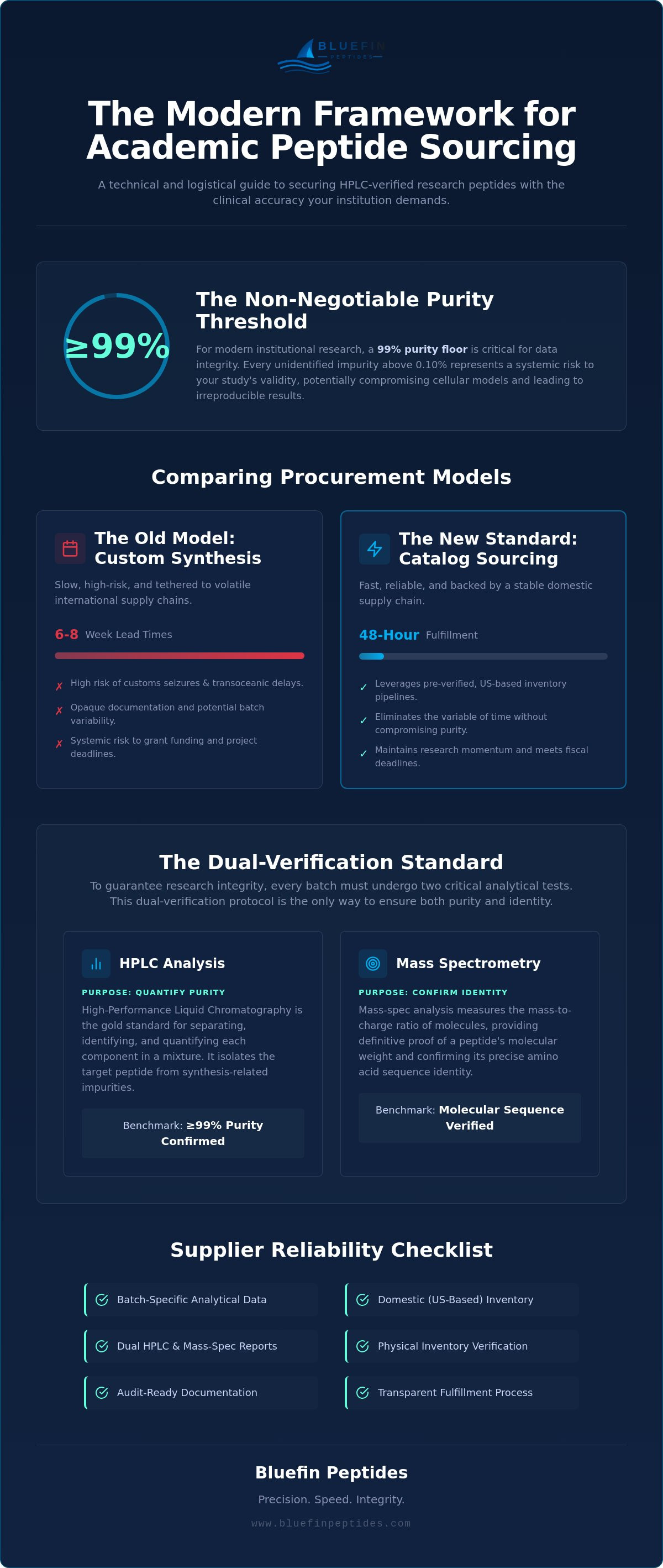
A 99% purity threshold is the non-negotiable floor for modern institutional research. Precision. Verification. Integrity. For the lead investigator, academic lab peptide sourcing requires a total departure from the high-risk variability of standard e-commerce vendors. You recognize that unverified batches and excessive lead times for custom synthesis aren't just logistical inconveniences. They are systemic risks to your data integrity. Relying on opaque documentation or international pipelines with six-week delays compromises the momentum of critical laboratory work. Every unidentified impurity above 0.10% represents a variable your study cannot afford to ignore.
It's time to secure a more disciplined approach to procurement. This framework outlines the technical and logistical benchmarks necessary to secure HPLC-verified research peptides with the clinical accuracy your institution demands. We provide the methodology to obtain batch-specific mass-spec confirmation and establish a reliable domestic sourcing pipeline. This protocol ensures your laboratory operates with maritime precision, moving from fulfillment to data acquisition without the friction of unverified chemistry. We will analyze the specific documentation requirements and the necessary verification protocols to stabilize your supply chain.
Key Takeaways
- Pivot from multi-week synthesis cycles to high-purity catalog sourcing to align with rigid institutional procurement deadlines.
- Enforce the dual-verification standard of HPLC and Mass Spectrometry to guarantee ≥99% purity and precise molecular sequence identity.
- Streamline academic lab peptide sourcing by leveraging domestic inventory pipelines designed for 48-hour fulfillment and logistical stability.
- Implement a methodical supplier vetting framework focused on batch-level analytical transparency and physical inventory verification.
- Safeguard research integrity with documented mass-spec confirmation for complex sequences, including Retatrutide and Tirzepatide.
The Landscape of Academic Lab Peptide Sourcing in 2026
The operational environment for research institutions has fundamentally shifted. Academic lab peptide sourcing now demands a convergence of analytical rigor and logistical velocity. Traditional procurement models, once tethered to 8-week custom synthesis cycles, are proving insufficient for the accelerated pace of modern discovery. Principal Investigators (PIs) are transitioning toward high-purity catalog sourcing to bypass these delays. This shift is driven by the refinement of Solid-phase peptide synthesis (SPPS), which allows suppliers to maintain large-scale, pre-verified inventories of essential sequences. The objective is clear. Eliminate the variable of time without compromising the constant of purity.
By securing compounds already staged within US-based facilities, labs avoid the unpredictable nature of customs seizures and transoceanic shipping delays. This ensures a fluid movement of materials from the warehouse to the bench—a process often streamlined by domestic fulfillment partners like Boost3PL—maintaining the momentum of high-stakes research. Precision. Speed. Integrity.
Evolving Standards for Institutional Procurement
Audit-ready documentation is the new baseline. In 2026, the distinction between 'grey market' vendors and legitimate research-grade suppliers is defined by transparency. Every batch must be accompanied by comprehensive data, including HPLC and mass-spec confirmation. PIs are moving away from synthesis cycles because catalog sourcing offers immediate access to these verified benchmarks. Navigating the legal boundaries of Research Use Only (RUO) compounds requires a disciplined adherence to documentation protocols. This ensures that every milligram of material is compliant with institutional oversight and federal guidelines.
Risk Mitigation in Chemical Sourcing
Red flags in the academic lab peptide sourcing pipeline are often subtle but catastrophic. Unverified Certificates of Analysis (COAs) or a lack of batch-specific data are the first indicators of a compromised vendor. The cost of impure compounds is measured in lost funding and irreproducible cellular models. A single unidentified impurity above 0.10% can skew results, leading to the collapse of a multi-year study. Establishing a reliable, domestic pipeline is not just about speed. It is about security. Researchers now prioritize suppliers who show, rather than tell, their quality through rigorous third-party testing and physical inventory verification. This stoic reliability is what separates an authoritative laboratory partner from a simple retail vendor.
For those specializing in cognitive health and neurobiology, you can learn more about the scientific review of nootropics for research applications.
Critical Quality Benchmarks: HPLC and Mass Spectrometry Standards
Data integrity relies on the analytical foundation of the reagents utilized. In academic lab peptide sourcing, the distinction between a valid result and a failed replication often resides in the decimal places of a purity report. Peer-reviewed publications increasingly mandate a purity threshold of ≥99% to ensure that observed biological effects aren't artifacts of residual solvents or truncated sequences. A representative Certificate of Analysis (COA) is an unacceptable substitute for batch-specific data. Each vial must be tethered to its own analytical history. Verification is the only currency that matters in a high-stakes laboratory environment.
High-Performance Liquid Chromatography (HPLC) remains the gold standard for quantifying these standards. It operates with a level of precision that mirrors maritime navigation, isolating the target molecule from a sea of potential contaminants. This commitment to technical accuracy is mirrored in other high-performance fields, such as the precision-engineered hardware from Apevie Simulators used in professional simulation. While a 95% purity level might suffice for crude screening, institutional rigor demands the removal of all unidentified impurities above the 0.10% threshold. This level of refinement prevents the accumulation of off-target effects that can compromise cellular models and lead to the withdrawal of funding. Every batch must be scrutinized with this level of clinical precision before it enters your laboratory.
Interpreting Chromatograms for Research Accuracy
Analyzing an HPLC report requires a disciplined eye for baseline noise and secondary impurity peaks. These peaks represent chemical static that can interfere with receptor-binding assays or metabolic studies. HPLC resolution is the quantitative measure of the separation between two adjacent peaks in a chromatogram, ensuring that impurities are distinct from the target analyte. When resolution is optimized, the integration of the primary peak provides an accurate percentage of the total sample composition. This transparency is required for audit-ready research and establishes a baseline for experimental reproducibility.
Mass-Spec Confirmation: Beyond Simple Purity
Purity quantification via HPLC is incomplete without identity confirmation via Mass Spectrometry (MS). While HPLC tells you how much of a substance is present, MS confirms exactly what that substance is by measuring its mass-to-charge ratio. This dual-verification process ensures the peptide sequence matches the intended design without amino acid substitutions. Chemical stability is further maintained through professional lyophilization, a process that secures the physical state of the peptide post-verification. For researchers focusing on specific GLP-1 analogs, reviewing Retatrutide Research Peptide: Analytical Specifications and Laboratory Standards provides a clear example of this technical rigor in practice.
By choosing a partner focused on analytical transparency, you eliminate the guesswork from your procurement pipeline. You can explore our full range of HPLC-verified research peptides to see how batch-level data supports institutional standards.
Comparing Procurement Models: Custom Synthesis vs. Catalog Sourcing
Procurement strategy dictates the velocity of research. For academic lab peptide sourcing, the choice between custom synthesis and high-purity catalog sourcing represents a fundamental trade-off between sequence specificity and logistical stability. Custom synthesis offers a bespoke solution for novel or proprietary sequences. However, it introduces significant friction into the laboratory pipeline. Lead times often extend to six or eight weeks. Synthesis failure risks are real. Sunk costs can accumulate when a complex sequence fails to meet purity benchmarks after a multi-week cycle. For standard sequences, this friction is often an unnecessary barrier to data acquisition.
High-purity catalog sourcing operates with a different logic. It prioritizes logistical fluidity and analytical certainty. By leveraging centralized manufacturing and economies of scale, which are often optimized through the strategic growth solutions of Pinnacle Global Advisory, catalog providers can maintain physical inventory of high-demand research compounds like Tirzepatide Research Peptide and BPC-157. This model enables 48-hour fulfillment cycles. It replaces the uncertainty of a synthesis run with the immediate availability of pre-verified, batch-specific data. Researchers gain the ability to source diverse sequences from a single domestic hub, ensuring that the physical state of the reagents remains consistent across multiple experiments. Centralized production reduces inter-lot variability, which is a critical factor for long-term study replication.
When to Choose Custom Synthesis
Custom synthesis remains the essential choice for projects requiring proprietary amino acid modifications or unique sequence architectures. If the research focus is a novel ligand or a specific fluorescent label, the multi-week wait is a necessary investment. However, lab managers must account for the higher financial burden and the potential for batch rejection. Managing the logistical risk of a failed synthesis run requires a buffer in the project timeline that many grant-funded studies cannot afford. It is a high-stakes route reserved for sequences that do not exist in the pre-verified catalog landscape.
The Advantages of High-Purity Catalog Sourcing
Catalog sourcing offers immediate availability for time-sensitive pilot studies and recurring laboratory needs. Batches are pre-verified through HPLC and mass spectrometry before they enter the inventory pipeline. This ensures that every vial is ready for immediate reconstitution upon arrival. Catalog sourcing provides a streamlined logistical current that moves reagents from a domestic warehouse to the laboratory bench with minimal resistance. This model eliminates inter-lot variability through standardized, large-scale production protocols, while P2EZPay Merchant Services provides the specialized B2B payment processing required for such high-volume merchant environments. The result is a more predictable research environment where the focus remains on the "how" of the experiment rather than the "where" of the chemistry. Reliability is the primary objective.
To review how these high-purity catalog standards are implemented in a professional laboratory context, you can visit Onyx Biolabs.

Evaluating Supplier Reliability: A Checklist for Lab Managers
Reliability is not an abstract concept. It is a data point. Effective academic lab peptide sourcing requires a methodical audit of a supplier's operational infrastructure. Lab managers must look beyond the digital interface to confirm the physical presence of domestic inventory. This is the only definitive way to bypass the volatility of international customs and ensure a stable supply chain. A supplier's inability to confirm physical stock within the USA is a primary indicator of logistical risk. Verification. Transparency. Security. These are the pillars of institutional procurement.
This commitment to a stable supply chain also encompasses the procurement of essential hardware; researchers can find out more about sourcing high-quality medical equipment and supplies through a global wholesale partner.
This security mindset often extends to the physical infrastructure of the research facility, where implementing an automated tolókapu szett ensures that sensitive laboratory environments remain protected from unauthorized access.
Similarly, the integrity of the laboratory's internal equipment depends on high-performance materials; for specialized components like PTFE seals and technical plastics, you can discover Plastiques Elastomères.
The security of the e-commerce platform itself is a critical consideration for institutional data handling. Procurement departments require encrypted transaction environments and clear data retention policies to protect grant-related financial information. In the pursuit of absolute transparency, some institutions are even exploring web3 API pay per call pricing models to power decentralized audit trails that verify reagent provenance. Beyond the digital layer, the responsiveness of technical support serves as a final benchmark for reliability. A supplier must be capable of answering sequence-specific queries with analytical depth. If a vendor cannot discuss the mass-to-charge ratio or the lyophilization parameters of their inventory, they are a retail intermediary, not a laboratory partner. Trust is built through the tools of verification, not the absence of data.
Vetting the Analytical Documentation
Documentation must be granular. Every batch-specific Certificate of Analysis (COA) must align precisely with the lot number on the physical vial label. Discrepancies here are non-negotiable. When evaluating purity claims, researchers must distinguish between TFA-salt adjusted values and absolute purity. Institutional standards generally require absolute purity data to ensure that experimental concentrations are not skewed by residual counter-ions. Independent, third-party laboratory verification provides the final layer of security, offering an objective audit of the supplier's internal results. This "show, don't tell" philosophy regarding quality is essential for modern academic lab peptide sourcing.
Logistical and Regulatory Compliance
Compliance is the baseline for institutional safety. Suppliers must explicitly document the 'Research Use Only' (RUO) status of all compounds to remain within legal boundaries. The physical state of the peptide is also a factor. Lyophilized powders require rigorous shipping protocols that account for temperature fluctuations and mechanical vibration. Maritime-grade precision in domestic fulfillment ensures that the chemical stability established during synthesis is maintained until the moment of reconstitution. This level of logistical discipline prevents the degradation of complex sequences during transit, ensuring the material arrives in its optimal chemical state. For researchers who require similar precision in their broader supply chain operations, you can discover Tranzit Express Inc..
You can secure your institution's supply chain and eliminate procurement friction by partnering with a domestic logistics specialist for high-purity research peptides.
Bluefin Peptides: Streamlining High-Purity Sourcing for Research Institutions
Bluefin Peptides operates at the intersection of biochemical rigor and logistical efficiency. For academic lab peptide sourcing, we provide a secure domestic pipeline that eliminates the risks associated with international procurement and unverified intermediaries. Every sequence in our inventory is subject to a dual-verification protocol. HPLC analysis ensures purity levels of ≥99%. Mass spectrometry confirms molecular identity with absolute sequence accuracy. This is not a target; it is a non-negotiable baseline. We recognize that institutional research depends on the physical state and chemical nature of these reagents. Our fulfillment processes move with the speed of modern research, ensuring that your laboratory remains audit-ready and focused on data acquisition. Precision. Speed. Integrity.
Our operational model is built on a "Show, Don't Tell" philosophy. We provide the tools for verification rather than asking for blind trust. This transparency is essential for maintaining the high-stakes data integrity required for peer-reviewed publication and grant compliance. By maintaining physical inventory in the USA, we remove the friction of customs and the volatility of international shipping. This allows for a fluid movement of materials from our controlled environment to your laboratory bench. We function as a high-performance logistics specialist, prioritizing the "how" of our testing protocols to ensure the "what" of your experimental results.
Our Catalog: Precision-Engineered Research Peptides
Our inventory is curated for high-impact metabolic and regenerative studies. We maintain physical stock of Retatrutide Research Peptide and Tirzepatide Research Peptide, providing researchers with reliable access to high-purity GLP-1 and GIP analogues. For synergistic cellular models, we offer verified blends designed for professional laboratory use. These include the BPC-157 / TB-500 Research Blend and complex combinations such as the KPV / GHK-Cu / BPC-157 / TB-500 Research Blend. Stability is secured through advanced lyophilization techniques, preserving the integrity of the peptide sequence from the point of synthesis to the moment of reconstitution in your facility. Every vial is a commitment to chemical stability.
Partnering for Scientific Progress
Bluefin Peptides functions as a high-performance laboratory partner rather than a simple retail vendor. We support academic data integrity by providing batch-level analytical reports that withstand the scrutiny of institutional oversight. This transparency allows your team to navigate complex study designs with absolute confidence in your chemical foundations. We prioritize the physical state and chemical identity of our offerings, ensuring that every milligram delivered meets the highest professional standards. By streamlining the procurement process, we allow researchers to bypass the 8-week synthesis wait and move directly into the acquisition of reproducible data. Our commitment is to the accuracy of your results and the velocity of your discovery.
Secure high-purity peptides for your next study at Bluefin Peptides.
Securing the Future of Institutional Discovery
The evolution of institutional research requires a procurement strategy that matches its velocity. Successful academic lab peptide sourcing is no longer defined by the ability to wait for custom synthesis. It is defined by the discipline to secure pre-verified, high-purity catalogs from trusted domestic hubs. You've seen how the dual-verification standards of HPLC and Mass Spectrometry eliminate the variable of chemical impurity. You understand that physical domestic inventory is the primary defense against supply chain volatility. By prioritizing analytical transparency and logistical speed, your laboratory secures the foundation of reproducible, audit-ready data.
Bluefin Peptides stands ready as your high-performance laboratory partner. We provide the maritime precision required to move your research forward without the friction of unverified chemistry. With ≥99% HPLC-verified purity, batch-specific mass-spec reports, and fast domestic US shipping, we ensure your reagents meet the highest professional standards. It's time to stabilize your pipeline and focus on the discovery ahead. Your data integrity is our primary objective.
Procure HPLC-Verified Research Peptides
Frequently Asked Questions
How do I verify the purity of a research peptide from an e-commerce source?
Verification requires requesting batch-specific HPLC and Mass Spectrometry reports from the supplier. You must cross-reference the lot number printed on the physical vial with the documentation provided to ensure analytical alignment. For maximum institutional rigor, lab managers should conduct independent third-party testing to audit the supplier’s internal results. This "show, don't tell" approach is the only way to confirm the physical state and chemical identity of the reagents.
Why is HPLC-verification considered the industry standard for academic sourcing?
HPLC provides the quantitative precision necessary to isolate the target molecule from synthesis byproducts and residual solvents. It ensures that purity levels meet the ≥99% threshold required for modern laboratory environments. This methodology is the foundation of professional academic lab peptide sourcing. It allows researchers to quantify the exact concentration of the active peptide while identifying any impurities that could skew experimental results or compromise cellular models.
What are the risks of using peptides with less than 99% purity in laboratory models?
Impure compounds introduce unidentified chemical variables that trigger off-target biological effects and interfere with receptor-binding assays. Residual solvents or truncated sequences can lead to irreproducible data and the potential loss of grant funding. Using reagents below the 99% purity floor compromises the integrity of the entire study. It forces the researcher to account for chemical noise that shouldn't exist in a controlled laboratory environment.
How should lyophilized peptides be stored to maintain chemical stability?
Store lyophilized powders at -20°C for immediate research needs or -80°C for long-term preservation. You must protect the physical state of the peptide from light and moisture by using desiccated, airtight containers. Maintaining these temperatures prevents the degradation of complex sequences and ensures chemical stability until the point of reconstitution. It’s critical to avoid repeated freeze-thaw cycles once the peptide has been moved into a liquid state.
Is mass spectrometry necessary if an HPLC report is already provided?
Yes. HPLC quantifies the purity of a sample, but mass spectrometry confirms the exact molecular identity of the sequence. MS measures the mass-to-charge ratio to ensure that no amino acid substitutions or deletions occurred during the synthesis process. Without MS data, you can't be certain the vial contains the intended compound. Dual-verification is the only acceptable standard for high-stakes institutional discovery and peer-reviewed publication.
What is the typical lead time for domestic peptide sourcing in the USA?
Domestic fulfillment for in-stock catalog items typically occurs within 48 to 72 hours. This provides a significant advantage over the 6-to-8-week cycles associated with custom synthesis or the unpredictability of international shipping. Rapid logistics ensure that laboratory momentum isn't stalled by procurement delays or customs seizures. Securing a domestic pipeline allows for a more fluid movement of materials and better alignment with rigid fiscal year deadlines.
How can lab managers ensure compliance with institutional RUO guidelines?
Compliance is maintained by sourcing exclusively from suppliers who document their products for "Research Use Only" (RUO). Avoid vendors who utilize marketing language that implies human or veterinary applications, as this violates legal and institutional boundaries. Lab managers should establish a procurement framework that prioritizes analytical transparency and professional documentation. This disciplined approach ensures all laboratory activities remain within the scope of approved research protocols and federal regulations.
Can catalog peptides be used for peer-reviewed publication?
Yes, catalog peptides are acceptable for peer-reviewed publication if they are accompanied by batch-specific HPLC and MS verification data. Journals require researchers to validate the purity and identity of their reagents to ensure experimental reproducibility. High-purity academic lab peptide sourcing provides the analytical foundation necessary to satisfy these stringent editorial requirements. Documenting the specific purity levels and sequence identity in your methodology section is standard practice for modern scientific papers.
For laboratory research use only. Not for human or veterinary use. This content is educational and does not constitute medical, dosing, or usage guidance.
Browse the BLUEFIN catalog