Verifying Peptide Purity: HPLC vs. Mass Spectrometry in Laboratory Research

What if the 99% purity reported on your latest batch of Retatrutide is actually a precise measurement of the wrong molecule? It's a common frustration in laboratory research; a chromatogram looks clean, yet the experimental results remain inconsistent. You likely understand the pressure of maintaining reproducibility when even a 0.10% impurity can alter a compound's behavior. Relying solely on one analytical method for verifying peptide purity HPLC vs mass spec leaves your data vulnerable to co-eluting impurities that hide in plain sight.
This article provides the technical clarity required to distinguish between quantitative purity and molecular essence. You'll master these distinctions to ensure your research is anchored in verifiable data rather than marketing claims. We will examine how to interpret complex batch-specific COAs and why the synthesis of these two methods is the only way to guarantee the integrity of compounds like Tirzepatide. By the end, you'll have a disciplined framework for evaluating every sample that enters your lab with clinical precision.
Key Takeaways
- Distinguish between chemical purity and molecular identity to prevent research failure caused by high-purity but incorrectly identified compounds.
- Explore the mechanics of Reversed-Phase HPLC and how mobile phase gradients separate target peptides from synthetic byproducts.
- Master the technical distinctions of verifying peptide purity HPLC vs mass spec to ensure analytical precision and eliminate uncertainty regarding co-eluting impurities.
- Identify the critical physics of Mass Spectrometry, including m/z ratio measurements and ionization techniques like Electrospray Ionization.
- Develop a disciplined framework for reading batch-specific COAs for compounds such as Retatrutide, focusing on baseline stability and rigorous peak integration.
The Purity vs. Identity Dilemma in Peptide Synthesis
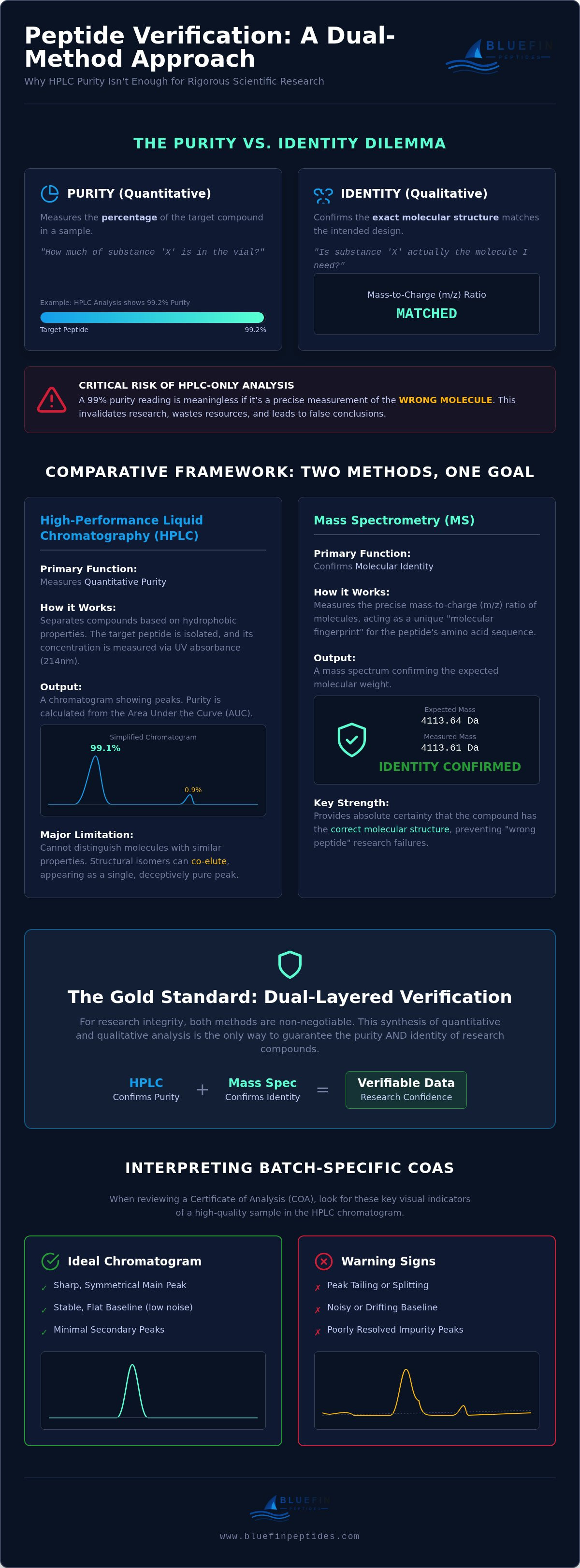
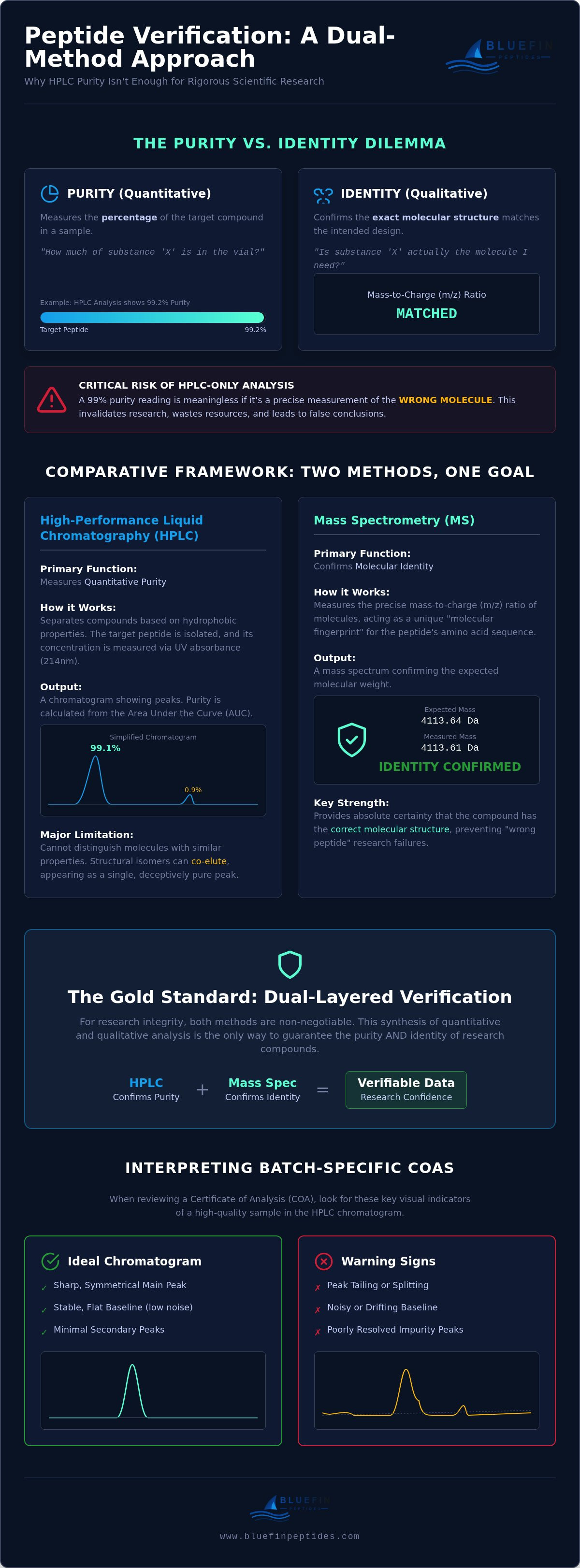
Chemical purity is a quantitative metric representing the relative presence of the target compound within a sample. It's distinct from molecular identity, which confirms that the synthesized amino acid sequence matches the intended design. Analytical precision demands both. A batch might yield a 99% purity result, yet the molecule could be synthesized incorrectly or contain truncated sequences that mimic the target's behavior during separation. Peptide analytical validation is the intersection of quantitative and qualitative metrics.
In the laboratory, the process of verifying peptide purity HPLC vs mass spec is not a choice between methods but a requirement for a dual-layered verification strategy. Relying on a single metric is insufficient for complex compounds like GLP-1 analogues. Even a 0.10% impurity, which meets the FDA's identification threshold for synthetic peptides, can significantly impact experimental outcomes if that impurity is a bioactive byproduct. Research integrity depends on knowing both the quantity of the compound and the exact nature of its molecular structure.
Why HPLC-Only Verification is a Laboratory Risk
High-Performance Liquid Chromatography (HPLC) is the industry standard for determining purity by measuring the area under the curve (AUC). However, relying on this alone presents a substantial laboratory risk. Structural isomers or closely related impurities can co-elute, appearing as a single, deceptive peak on a standard chromatogram. High-throughput synthesis environments occasionally produce "wrong peptide" scenarios where the purity is high but the sequence is flawed. For researchers, the impact of incorrect sequence identity on receptor binding studies is catastrophic. It leads to false negatives, invalid data, and a total loss of research momentum.
The Role of Identity Confirmation in Research Reproducibility
Reproducibility begins with the standardization of laboratory inputs. Mass spectrometry acts as a molecular fingerprint for the target sequence, measuring the mass-to-charge (m/z) ratio with absolute precision. This step confirms that the synthesized chain of amino acids is exactly what was ordered. Without mass-spec confirmation, a 99% pure label is merely a measure of a substance's concentration, not its essence. Bluefin Peptides maintains a commitment to transparency by providing both metrics for every batch. Whether you are utilizing Retatrutide Research Peptide or Tirzepatide Research Peptide, the documentation ensures that the molecular identity matches the quantitative purity. This rigorous adherence to protocol provides the security researchers need to proceed with confidence. It's a disciplined approach that treats the reader as a peer in a high-stakes scientific field.
High-Performance Liquid Chromatography (HPLC): Measuring Quantitative Purity
Reversed-Phase HPLC (RP-HPLC) is the primary methodology for determining the chemical purity of synthetic peptides. This technique operates on the principle of hydrophobic interaction. The stationary phase, typically composed of alkyl-bonded silica such as C18, interacts with the hydrophobic side chains of the peptide. As the mobile phase gradient increases in organic solvent concentration, usually acetonitrile, the peptides elute based on their decreasing affinity for the stationary phase. This temporal separation allows researchers to isolate the target molecule from residual reagents and synthetic byproducts. Separation. Precision. Verification.
Quantitative purity is determined through area-under-the-curve (AUC) integration. By calculating the ratio of the target peak's area to the total area of all detected peaks, laboratories establish a percentage of chemical purity. The standard detection wavelength of 214nm is utilized because it corresponds to the peak ultraviolet absorbance of the peptide bond's carbonyl groups. This ensures that even non-aromatic peptides are detected with high sensitivity. Researchers seeking verified compounds can view our current peptide inventory to access batch-specific data.
Understanding UV Absorbance and Chromatogram Peaks
The UV detector captures the electronic transitions of eluting compounds, translating chemical presence into a visual chromatogram. A high-quality sample exhibits a sharp main peak with a stable baseline. Baseline noise or secondary peaks indicate the presence of residual solvents or truncated sequences. Peak tailing or splitting often suggests column overload or the presence of closely related impurities that the system hasn't resolved fully. These visual cues are essential for assessing the physical state and chemical nature of the offering.
Limitations: When Impurities Co-elute
HPLC is a powerful tool, yet it possesses inherent limitations that a disciplined researcher must acknowledge. The process of verifying peptide purity HPLC vs mass spec reveals that HPLC alone can't always distinguish between the target and a closely related diastereomer. If an impurity shares an identical hydrophobic profile with the target, it'll co-elute. This means it hides within the main peak and inflates the reported purity. This "co-elution" problem is why quantitative purity must be paired with molecular identity. For a deeper look at these requirements, refer to our Analytical Quality Standards for Research Peptides: A Laboratory Guide. Relying on HPLC alone for complex sequences like Retatrutide Research Peptide carries a risk of co-eluting impurities that could compromise experimental reproducibility.
Mass Spectrometry (MS): Confirming Molecular Identity
Mass spectrometry provides the qualitative foundation for analytical verification. While HPLC measures how much of a substance is present, MS determines exactly what that substance is. By measuring the mass-to-charge (m/z) ratio of ionized molecules, this technique confirms that the synthesized amino acid sequence aligns with the theoretical model. It's the ultimate molecular audit. Every batch must pass this threshold to ensure research reproducibility and experimental safety.
Ionization is the critical first step in the analytical chain. Electrospray Ionization (ESI) is frequently preferred for liquid chromatography coupling because it's a soft technique that prevents the fragmentation of delicate peptide chains. In contrast, MALDI-TOF utilizes a laser-matrix interaction to vaporize samples, offering rapid throughput for identity confirmation. The Dalton (Da) serves as the primary unit for peptide mass verification, allowing for a direct comparison between the observed molecular weight and the calculated theoretical mass. Verifying peptide purity HPLC vs mass spec ensures that the compound's physical state matches its chemical design. Without this data, purity percentages are clinically blind.
Measuring the Mass-to-Charge (m/z) Ratio
In a mass spectrometer, peptides are vaporized and ionized before being accelerated through a vacuum chamber. The resulting spectrum displays the relative abundance of ions at specific m/z values. Researchers must interpret the primary molecular ion peak, typically the [M+H]+ ion, to confirm identity. It's also necessary to identify salt adducts. Sodium or potassium ions can attach to the peptide during synthesis or handling, shifting the observed mass by 23 or 39 Da, respectively. Recognizing these shifts prevents the misidentification of high-quality batches. Precision is non-negotiable in the vacuum of the analyzer.
Detecting Synthesis Errors: Deletions and Insertions
Mass spectrometry is the only tool capable of spotting subtle synthesis errors that HPLC might miss. Deletion sequences occur when an amino acid is skipped during solid-phase synthesis, resulting in a lighter molecule. Conversely, insertion sequences indicate a double coupling event where an extra residue is added. For long-chain compounds like Retatrutide Research Peptide or Tirzepatide Research Peptide, MS provides the precision needed to confirm the exact residue count. It eliminates the risk of using truncated sequences that could bind incorrectly to target receptors. A single missing amino acid can render a study invalid. MS acts as the final gatekeeper for sequence integrity. Verification. Identity. Integrity.
HPLC vs. Mass Spectrometry: A Comparative Framework
Analytical precision relies on a synergistic relationship between separation and identification. In the molecular hierarchy, identity must always precede purity. A 99% purity rating is functionally irrelevant if the compound isn't the intended sequence. The process of verifying peptide purity HPLC vs mass spec requires a framework where each method validates the other. This ensures researchers aren't navigating experimental waters with a flawed compass. Identity provides the anchor; purity provides the depth.
The Bluefin standard is absolute. No batch is released without tandem verification. This means every sample undergoes both HPLC for quantitative assessment and MS for qualitative confirmation. By maintaining this dual-layered protocol, we prioritize transparency and provide the tools for independent verification. It's a disciplined approach that treats laboratory results as a firm commitment to quality. Security. Trust. Verification.
Side-by-Side: Purity vs. Identity Metrics
While both methods are essential, they serve different analytical functions within a GLP-compliant environment. Understanding these distinctions is critical for long-term study integrity:
- HPLC: Best for quantifying degradation products, residual solvents, and related substances through AUC integration.
- MS: Best for absolute identity confirmation and detecting sequence errors like amino acid deletions or insertions.
- Hierarchy: Identity (MS) establishes the "what," while purity (HPLC) establishes the "how much."
The cost-benefit analysis of dual-method verification favors the researcher. While single-method testing might reduce initial overhead, the risk of research failure due to co-eluting impurities far outweighs the analytical investment. Consistent inputs lead to consistent outcomes.
The Rise of LC-MS: Integrated Analytical Workflows
The integration of these techniques into a hybrid LC-MS workflow represents the current peak of laboratory precision. This system combines the physical separation power of liquid chromatography with the immediate mass identification of a spectrometer. It effectively eliminates the "co-elution" blind spot. When two compounds elute at the same time, the mass-selective detector identifies them as distinct entities based on their m/z ratios. This level of detail is vital for complex chains. For specific data on these requirements, review our guide on Tirzepatide Research Peptide: Analytical Specifications and Purity Standards. Modern UPLC-MS/MS systems can process up to 500 samples per day, ensuring that rapid fulfillment never compromises batch-level details.
Secure your experimental data by utilizing HPLC and Mass-Spec verified peptides from Bluefin.
Bluefin Standards: Interpreting Batch-Specific COAs for GLP-1 Research
A Certificate of Analysis (COA) is the definitive record of a compound's physical state and chemical nature. It isn't a marketing document. It's a technical verification. Researchers must demand batch-specific data to ensure the integrity of their laboratory inputs. Representative reports provide a general map, but they lack the specific coordinates of the current batch. Every fulfillment from Bluefin Peptides is anchored in transparent, lot-specific documentation that treats the reader as a peer in a high-stakes scientific field. Trust is built through data.
When reviewing a Bluefin Peptides COA, follow this analytical checklist to confirm quality:
- Batch Identification: Match the lot number on the vial to the report to ensure data synchronization.
- Methodological Transparency: Confirm the use of 214nm UV absorbance for peptide bond detection.
- Peak Integration: Review the area-under-the-curve (AUC) table for a comprehensive account of all detected substances.
- Molecular Weight: Verify that the observed mass-to-charge (m/z) ratio aligns with the theoretical Dalton (Da) value.
Validating the HPLC chromatogram requires inspecting baseline stability. A drifting baseline or excessive noise indicates residual solvents or column contamination. Peak integration must be rigorous; ensure the detector captured all minor impurities. For the MS spectrum, the observed m/z peak must align with the theoretical mass within a narrow margin of error. This dual-layered approach is the core of verifying peptide purity HPLC vs mass spec. It's a disciplined process that eliminates the "co-elution" blind spot and ensures your research rests on a stable foundation.
Analyzing Retatrutide HPLC Reports for Lab Accuracy
Retatrutide’s 39-amino acid sequence presents unique analytical challenges due to its length and hydrophobic profile. Ensuring ≥99% purity is mandatory for metabolic research models where even a 0.5% variation in impurities can skew results. When analyzing the HPLC report, look for the clear separation of truncated sequences from the main peak. For a detailed breakdown of these parameters, consult our guide on Retatrutide Research Peptide: Analytical Specifications and Laboratory Standards. Precision in the chromatogram translates to precision in the lab.
Mass-Spec Confirmation in Tirzepatide Research
Tirzepatide’s complex structure requires precise molecular weight verification to confirm that the sequence was synthesized without deletions or insertions. Bluefin ensures batch-to-batch consistency for US-based researchers by anchoring every fulfillment in mass-spec confirmation. This provides the security needed for longitudinal studies where input stability is paramount. We focus on the "how" of our processes to ensure the "what" of your results. Review our HPLC verified research peptides for your next study.
Securing Analytical Integrity for Future Discovery
Analytical precision isn't a luxury; it's the bedrock of reproducible science. You've seen how the process of verifying peptide purity HPLC vs mass spec requires a disciplined synergy between quantitative separation and qualitative identification. Relying on a single metric invites the risk of co-eluting impurities and sequence errors that can derail high-stakes research models. True verification demands that molecular identity is confirmed before purity is measured. Consistent inputs lead to consistent outcomes.
Bluefin Peptides upholds this standard through unwavering transparency. Every compound in our catalog meets a ≥99% purity threshold, backed by batch-specific HPLC and mass-spec documentation. We provide the tools for verification so you can focus on the results of your study rather than the integrity of your inputs. With rapid domestic fulfillment from our US-based inventory, your laboratory maintains momentum without sacrificing data quality. Security. Reliability. Momentum.
Procure HPLC-Verified Research Peptides today to anchor your next project in verifiable data. Your commitment to rigorous methodology deserves a partner that operates with the same clinical precision.
Frequently Asked Questions
Is HPLC purity alone enough to verify a research peptide?
No, HPLC only measures quantitative purity, not molecular identity. A sample can be 99% pure by HPLC while being the entirely wrong sequence. HPLC relies on UV absorbance at 214nm to detect peptide bonds; it doesn't verify the specific amino acid arrangement. Comprehensive verification requires mass spectrometry to confirm the identity matches the theoretical molecular weight. Relying on HPLC alone introduces the risk of using truncated or incorrect sequences in sensitive research models.
What is the difference between LC-MS and standard HPLC?
LC-MS integrates liquid chromatography with mass spectrometry in a single, automated workflow. Standard HPLC utilizes a UV detector to identify peaks based on absorbance. In contrast, LC-MS uses a mass-selective detector to immediately identify the molecular weight of every eluting substance. This hybrid approach is superior for verifying peptide purity HPLC vs mass spec because it eliminates the uncertainty of co-eluting peaks. It provides simultaneous data on how much of a compound is present and exactly what it is.
How do I read the m/z value on a peptide mass spec report?
The m/z value represents the mass-to-charge ratio of the ionized peptide. In most reports, you'll see a primary peak corresponding to the [M+H]+ ion, which is the molecular weight plus one hydrogen atom. Compare this observed value against the theoretical mass provided in the documentation. Minor peaks often represent salt adducts like sodium (+23 Da) or potassium (+39 Da). Precision is critical; the observed mass should match the theoretical Dalton value within a narrow tolerance to confirm sequence integrity.
Can HPLC detect if the wrong peptide was synthesized?
HPLC generally cannot detect if the wrong peptide was synthesized if the incorrect molecule elutes at a similar time to the target. It measures the relative abundance of substances based on hydrophobicity, not sequence composition. If a synthesis error results in a different peptide with similar hydrophobic properties, it'll appear as a pure peak on a chromatogram. Only mass spectrometry can distinguish between molecules based on their unique mass-to-charge ratios, making it the essential gatekeeper for molecular identity.
What are co-eluting impurities and why are they dangerous for research?
Co-eluting impurities are substances that exit the HPLC column at the same time as the target peptide, appearing as a single, unified peak. These impurities hide within the main absorbance signal, artificially inflating the reported purity percentage. They're dangerous because they introduce unknown bioactive variables into your experimental environment. These hidden compounds can bind to receptors or interfere with metabolic pathways, leading to inconsistent data and research failure. Hybrid LC-MS workflows are required to resolve these obscured peaks.
Why does Bluefin Peptides require mass-spec confirmation for every batch?
We mandate mass-spec confirmation to ensure absolute identity before measuring quantitative purity. This disciplined approach eliminates the "wrong peptide" risk common in high-throughput synthesis environments. By verifying every batch against its theoretical molecular weight, we provide the security researchers need for reproducibility. This protocol is the foundation of our show, don't tell philosophy regarding quality. It treats the verifying peptide purity HPLC vs mass spec process as a non-negotiable laboratory standard for every compound we fulfill.
What is a Certificate of Analysis (COA) in the context of research peptides?
A COA is a batch-specific document that details the analytical results of a compound's testing. It should include the HPLC chromatogram for purity and the mass spectrometry spectrum for identity confirmation. For researchers, the COA serves as a verifiable record of the compound's physical state and residue count. It's the primary tool for validating that the batch meets the ≥99% purity standard required for high-stakes laboratory work. Always verify the lot number matches the vial to ensure data synchronization.
How does lyophilization affect the analytical verification of a peptide?
Lyophilization, or freeze-drying, stabilizes the peptide by removing water and solvents, but it doesn't change the underlying molecular structure. Analytical verification occurs post-synthesis and pre-lyophilization to ensure the bulk material meets purity standards. However, the physical state of the final powder must be handled with care to prevent moisture absorption, which could interfere with subsequent reconstitution. Verification ensures that the lyophilized cake contains the exact molecule and purity level documented in the batch-specific Certificate of Analysis.
For laboratory research use only. Not for human or veterinary use. This content is educational and does not constitute medical, dosing, or usage guidance.
Browse the BLUEFIN catalog