Troubleshooting Unexpected Peptide Experiment Results: A Laboratory Guide
An independent testing operation in 2026 reported that close to 30% of the peptide vials it analyzed were mislabeled, incorrectly quantified, or contaminated. This highlights a critical vulnerability: experimental variance is rarely a result of synthesis failure; it is usually a downstream consequence of non-standardized handling and analytical misinterpretation. You've likely experienced the professional friction of irreproducible results or the confusion when HPLC data doesn't align with your in-house observations. It's a costly delay that threatens the integrity of your research.
This guide provides a rigorous framework for troubleshooting unexpected peptide experiment results by isolating variables with clinical precision. We will provide the methodology to identify and resolve the root causes of variance to ensure data integrity and reproducibility. We'll examine standardized protocols for reconstitution, storage stability, and bioactivity verification. By anchoring your process in these verified standards, you transform your laboratory into a stable environment for reliable discovery.
Key Takeaways
- Differentiate between chemical degradation and procedural discrepancies to isolate the root cause of experimental divergence.
- Utilize a systematic framework for troubleshooting unexpected peptide experiment results by calculating exact molarity and selecting solvents based on isoelectric points.
- Protect the integrity of fragile sulfur-containing residues by mastering the thermodynamics of lyophilized storage at -20°C and -80°C.
- Resolve analytical discrepancies by identifying the variables that cause HPLC retention time shifts, such as mobile phase pH and column chemistry.
- Ensure longitudinal reproducibility by sourcing ≥99% HPLC-verified research compounds and utilizing batch-specific documentation as an analytical baseline.
Identifying the Source of Variance in Peptide Experiments
Experimental variance is the quantifiable divergence from a theoretical bioactivity or an established analytical baseline. When data drifts, researchers must distinguish between chemical impurity, structural degradation, and procedural error. Systematic troubleshooting unexpected peptide experiment results begins with a clinical triage of all active variables. This process relies on a Baseline Anchor. We define this anchor as the batch-specific Certificate of Analysis (COA) provided with the research material. This document serves as the ground truth for purity and identity; it allows the researcher to isolate whether the variance originated in the vial or at the bench. Reviewing the chain of custody from domestic arrival to the bench-top is the first step in maintaining data integrity.
Procedural vs. Material Failure
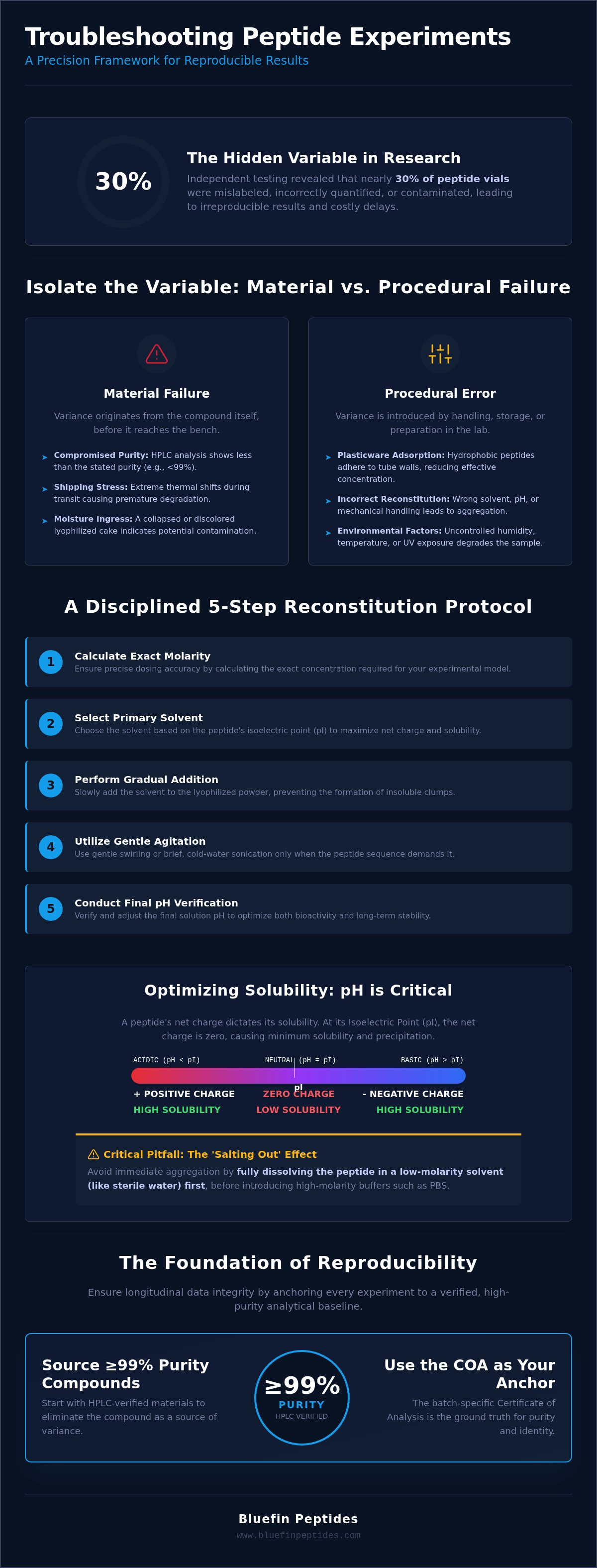
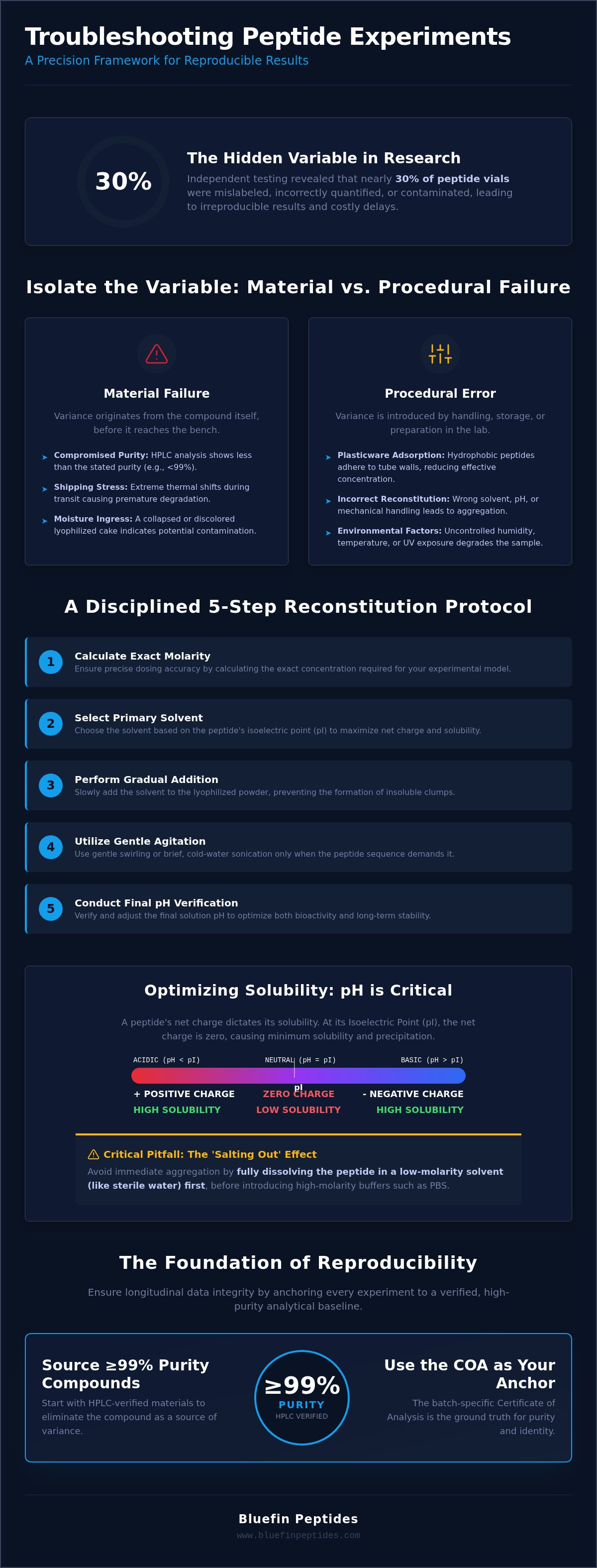
Isolating the specific lot number is the first step in verification. If the material maintains ≥99% purity via High-performance liquid chromatography, the focus shifts to laboratory environmental factors. We see concentration loss often occurring through plasticware adsorption. Peptides are hydrophobic; they frequently adhere to the walls of standard polypropylene tubes. This silent loss of material skews results significantly. It mimics a failure in peptide potency when the issue is actually a reduction in available concentration. Reviewing laboratory environmental factors is equally critical. Humidity, temperature, and UV exposure each exert specific pressures on peptide stability. High humidity can lead to hygroscopic weight gain, which results in inaccurate mass measurements during the weighing process.
The Impact of Domestic Logistics on Material Integrity
Integrity is often compromised during the "last mile" of domestic shipping. While lyophilized powders are generally stable, exposure to extreme thermal shifts can initiate premature degradation. A visual inspection of the lyophilized cake is mandatory upon arrival. A collapsed or discolored cake suggests moisture ingress or thermal stress that could impact the peptide's physical state. We prioritize US-based stocking and rapid fulfillment to minimize these risks. Standardizing receiving protocols is essential to prevent material shock. Don't subject the material to immediate thermal shifts. Move vials from shipping containers to stabilized cold storage in a graduated manner. This disciplined approach ensures the material remains viable before it ever reaches the reconstitution phase.
Reconstitution Protocol Failures and Solubility Hurdles
Precision in the reconstitution phase is the primary safeguard against troubleshooting unexpected peptide experiment results. The transition of a lyophilized cake into a stable solution is a delicate chemical process, not a simple mechanical one. Errors here often manifest as 'low potency' in assays; however, the reality is frequently incomplete dissolution or immediate peptide aggregation that sinks the experiment's reliability. To maintain the integrity of your research, follow this disciplined five-step framework:
- Step 1: Calculate the exact molarity required for the experimental model to ensure dosing accuracy.
- Step 2: Select the primary solvent based on the peptide's isoelectric point (pI) to maximize net charge and solubility.
- Step 3: Perform gradual addition of the solvent to the lyophilized powder to prevent the formation of insoluble clumps.
- Step 4: Utilize gentle agitation or brief, cold-water sonication only when the sequence complexity demands it.
- Step 5: Conduct final pH verification and adjustment to optimize bioactivity and long-term stability.
Solvent Selection and pH Dynamics
Solubility is dictated by the peptide's primary sequence and net charge. For instance, troubleshooting insoluble Retatrutide Research Peptide often requires moving beyond sterile water to dilute acetic acid (0.1% to 1%) if the isoelectric point suggests a neutral charge at physiological pH. GLP-1 and GIP analogues, such as Tirzepatide, are particularly sensitive to pH shifts. If the solution environment approaches the pI, the peptide loses its net charge and precipitates. The 'Salting Out' effect occurs when researchers add high-molarity buffers, like PBS, too early in the process. Always ensure initial dissolution in a low-molarity solvent before introducing salts to avoid immediate aggregation.
Mechanical Handling and Aggregation
Peptides are chemically fragile. High-shear mixing via aggressive vortexing can cause denaturation, especially in longer, more complex sequences. Gentle inversion or brief, cold-water sonication is the professional standard. Visible particulates indicate macro-aggregation, but sub-visible particulates are more insidious; they reduce the effective concentration without changing the solution's clarity. Once a peptide has fully precipitated due to improper pH or solvent choice, the secondary and tertiary structures may be permanently compromised. Prevention through standardized protocol is the only reliable path to data integrity. If you're encountering persistent solubility hurdles, it's essential to verify your baseline against the batch-specific COA provided with your material.
Stability and Degradation: Managing the Fragility of Lyophilized Peptides
Peptide stability is a function of thermodynamic equilibrium and chemical environment. When troubleshooting unexpected peptide experiment results, researchers must account for the degradation kinetics that occur even in a lyophilized state. Long-term preservation requires disciplined adherence to -80°C environments; -20°C is acceptable only for short-term transit or immediate-use stocks. Sulfur-containing residues, specifically Cysteine and Methionine, are highly prone to oxidation. This chemical shift alters the peptide's mass and bioactivity, potentially rendering an entire batch invalid. Repeated freeze-thaw cycles present another critical variable. These cycles exert mechanical stress that disrupts the secondary structure of complex research blends, which leads to irreversible denaturation and increased experimental noise.
Environmental Stressors in the Laboratory
Protease contamination represents the silent killer of experimental reproducibility. These enzymes can be introduced through non-sterile handling or atmospheric exposure, rapidly cleaving peptide bonds and rendering the sample inert. We recommend standardizing the use of bacteriostatic water for research models to inhibit microbial growth. Sterile saline often fails to provide sufficient protection against enzymatic degradation during multi-week studies. Light sensitivity is a critical factor for copper-peptide complexes. GHK-Cu and related blends must be protected from photo-degradation. Exposure to ambient laboratory light can catalyze the oxidation of the peptide backbone, which results in a loss of structural integrity that skews analytical results.
Storage Protocols for Multi-Peptide Blends
Managing the stability of the BPC-157 / TB-500 Research Blend requires a rigorous aliquoting strategy. Once reconstituted, the stability window is narrow. Peer-reviewed data indicates that reconstituted peptides are typically stable for four to six weeks when stored at 4°C. Beyond this point, degradation accelerates significantly. To minimize atmospheric moisture exposure and thermal shock, researchers should aliquot the solution into single-use vials immediately after reconstitution. This prevents the cumulative damage caused by repeated vial entry and temperature fluctuations. Determining when a sample has degraded beyond utility involves monitoring for changes in solution clarity or shifts in mass-spec profiles. If the baseline purity falls below the ≥99% threshold established by the initial batch-specific COA, the sample is no longer viable for high-precision research.
Interpreting HPLC and Mass Spectrometry Discrepancies
Discrepancies between in-house analytical data and manufacturer specifications represent a critical pivot point when troubleshooting unexpected peptide experiment results. Verification requires aligning laboratory parameters with the analytical quality standards established during the initial synthesis and verification phases. HPLC retention times are fluid variables. They are dictated by column chemistry, mobile phase pH, and the specific gradient slopes utilized during elution. A shift in retention time doesn't necessarily indicate a material failure. It often reflects a divergence in the analytical environment compared to the original testing conditions. Ghost Peaks further complicate the chromatogram. These artifacts frequently arise from solvent contamination or injector carryover. Rigorous blank runs are mandatory to isolate these external variables from the peptide's true profile. For high-stakes research involving Tirzepatide or Retatrutide, mass-spec confirmation is the final gate for identity verification.
Common Analytical Artifacts
Trifluoroacetic acid (TFA) is frequently utilized as a mobile phase additive to improve peak resolution. However, it can cause significant ion suppression during Mass Spectrometry, which obscures the detection of low-level impurities. Researchers must distinguish between peptide truncation and synthesis byproducts. Truncated sequences often elute near the main peak, which requires high-resolution gradients for separation. Mass Spectrometry verification utilizes high-resolution analysis to confirm the identity of a compound by measuring its mass-to-charge (m/z) ratio with absolute accuracy. This level of precision is non-negotiable for validating the structural integrity of complex research materials. By understanding these artifacts, you can navigate the analytical data with greater confidence and precision.
Verifying Purity in Research Blends
Analytical challenges intensify when evaluating the Ipamorelin CJC-1295 Research Blend USA. Deconvoluting multiple peaks in high-purity blends requires sophisticated software and a deep understanding of each component's hydrophobic profile. When in-house assays deviate from the manufacturer's COA, the researcher must audit the analytical method before questioning the material. The batch-specific COA remains the primary baseline. If your in-house data shows a ≥1% divergence from the ≥99% purity specification, re-calibrate your equipment and verify your mobile phase freshness. For researchers requiring absolute analytical certainty, it's vital to source verified research peptides from a partner that provides full transparency on batch-level data.
Standardizing Laboratory Protocols with Verified Research Materials
Reducing experimental noise begins at the point of procurement. If the underlying material lacks independent verification, troubleshooting unexpected peptide experiment results becomes an exercise in speculation rather than science. Sourcing ≥99% HPLC-purity compounds provides the clinical baseline necessary for high-stakes discovery. Batch-specific documentation isn't a secondary requirement; it's the primary tool for maintaining longitudinal integrity. We recommend implementing a 'Control Vial' strategy. Before committing your primary sample to a complex assay, validate the system using a known control from a previous, verified batch. This isolates procedural errors from material performance. Finalizing the troubleshooting loop requires a stoic approach to failure. Documenting every variance allows for the refinement of Standard Operating Procedures (SOPs), turning experimental noise into actionable data.
Anchoring Your Research in Verified Data
Precision is the baseline for metabolic modeling. The Tirzepatide Research Peptide specifications provided in our analytical reports offer the deep-sea precision required to close the gap between theoretical chemistry and bench-top reality. Leveraging US-stocked inventory ensures consistent batch access, which is critical for longitudinal studies where material drift can sink an entire data set. When you anchor your research in verified specifications, you eliminate the most volatile variable in the laboratory environment. This disciplined approach to sourcing ensures that your focus remains on biological discovery rather than material verification.
Next Steps: Refining Your Reconstitution SOP
Standardizing the transition from lyophilized powder to bioavailable solution requires a meticulous data management system. We advise creating a master log for every Retatrutide Research Peptide vial utilized in your facility. This log should integrate our batch-specific analytical reports, including mass-spec and HPLC profiles, directly into your laboratory's internal records. Consistency is maintained through rhythmic adherence to these protocols. By documenting solvent choice, pH adjustments, and storage durations, you create a verifiable trail that simplifies future troubleshooting efforts. This level of organizational discipline transforms a simple vendor-client relationship into a high-performance laboratory partnership focused on the "how" of the process to secure the "what" of the results.
Achieving Analytical Certainty in Peptide Research
Mastering the variables of peptide research requires a transition from reactive correction to proactive standardization. We have established that troubleshooting unexpected peptide experiment results is most effective when anchored in verified analytical baselines. By auditing reconstitution protocols, managing thermodynamic stability, and deconvoluting complex HPLC data, you eliminate the procedural noise that threatens data integrity. Precision is a deliberate choice made at the bench and the point of procurement. Every deviation corrected is a step toward more robust and reproducible discovery.
Success in longitudinal studies depends on the unwavering reliability of your starting material. Every vial must align perfectly with the theoretical specifications of your experimental model to ensure reproducibility across batches. To support your next high-stakes discovery, Secure HPLC-Verified Peptides for Your Next Laboratory Study. Our commitment to clinical quality includes ≥99% purity guaranteed via HPLC and Mass-Spec, US-based logistics for maximum stability, and a batch-specific COA included with every order. Maintain the momentum of your research with the security of verified data.
Frequently Asked Questions
Why is my research peptide not dissolving in sterile water?
Solubility is primarily dictated by the peptide's net charge and isoelectric point. If a sequence is highly hydrophobic or carries a neutral charge at pH 7.0, it will resist dissolution in pure water. Researchers must adjust the environment by adding dilute acetic acid for basic peptides or dilute ammonia for acidic ones. This shift creates the electrostatic repulsion necessary for molecules to separate and enter the solution phase.
How can I tell if my peptide degraded during shipping?
Visual and analytical inspections provide the first indicators of thermal or moisture-induced degradation. A collapsed, discolored, or "melted" lyophilized cake suggests exposure to extreme heat or moisture ingress during the domestic logistics phase. While lyophilized powders are generally stable, significant structural changes often require mass spectrometry to confirm if the molecular weight still aligns with the theoretical baseline established in the batch-specific COA.
Does the presence of TFA in the lyophilized powder affect my experimental results?
TFA (Trifluoroacetic acid) is a common counterion used during HPLC purification that can influence biological assays and analytical resolution. In cell-based models, high TFA concentrations may induce cytotoxicity or alter the local pH, which skews bioactivity data. When troubleshooting unexpected peptide experiment results, consider if the TFA content is causing ion suppression in Mass Spectrometry or interfering with the peptide's interaction with target receptors.
How long can I store a reconstituted Tirzepatide vial in the refrigerator?
Reconstituted Tirzepatide Research Peptide is typically stable for four to six weeks when stored at 4°C. Beyond this window, the peptide begins to undergo gradual hydrolysis and oxidation, which reduces the effective concentration. To maximize stability, utilize bacteriostatic water to prevent microbial growth and minimize atmospheric exposure. If your study extends beyond six weeks, we recommend aliquoting the solution and storing it at -20°C to preserve structural integrity.
Why does my in-house HPLC report show a lower purity than the Bluefin COA?
Discrepancies often arise from differences in column chemistry, mobile phase age, or gradient parameters. An aging column or contaminated solvents can create "ghost peaks" or cause peak broadening, which artificially lowers the purity calculation. Before questioning the material, ensure your analytical method matches the conditions specified in the original COA. A ≥99% purity rating is a verified baseline that is reproducible under identical laboratory standards and calibrated equipment.
Can I use sonication to speed up the reconstitution of a research blend?
Sonication is appropriate only as a secondary measure for highly hydrophobic sequences or complex blends that resist gentle agitation. Use brief, five-second bursts in a cold-water bath to prevent localized heating, which can lead to peptide denaturation. For most research blends, gentle inversion is preferred. Excessive mechanical shear can disrupt the delicate secondary structures of longer peptides, potentially compromising the bioactivity required for your specific experimental model.
What are the visual signs of peptide aggregation in a solution?
Visual indicators include persistent cloudiness, opalescence, or the presence of fine, needle-like precipitates after reconstitution. Aggregation occurs when peptide molecules associate through hydrophobic interactions rather than dissolving. This often happens when the solution pH is too close to the peptide's isoelectric point. If particulates remain visible after gentle agitation, the effective concentration of the peptide in the supernatant will be significantly lower than the calculated molarity.
Is it necessary to use a protease inhibitor cocktail during my peptide assays?
Protease inhibitors are essential when working with biological matrices, such as serum or tissue homogenates, that contain endogenous enzymes. These enzymes rapidly cleave peptide bonds, which leads to immediate degradation and irreproducible data. When troubleshooting unexpected peptide experiment results in complex environments, the addition of a broad-spectrum inhibitor cocktail preserves the peptide's primary sequence. This ensures that the observed bioactivity reflects the intact compound rather than its fragments.
For laboratory research use only. Not for human or veterinary use. This content is educational and does not constitute medical, dosing, or usage guidance.
Browse the BLUEFIN catalog