Research Peptide Price vs. Purity: An Analytical Framework for Laboratory Procurement
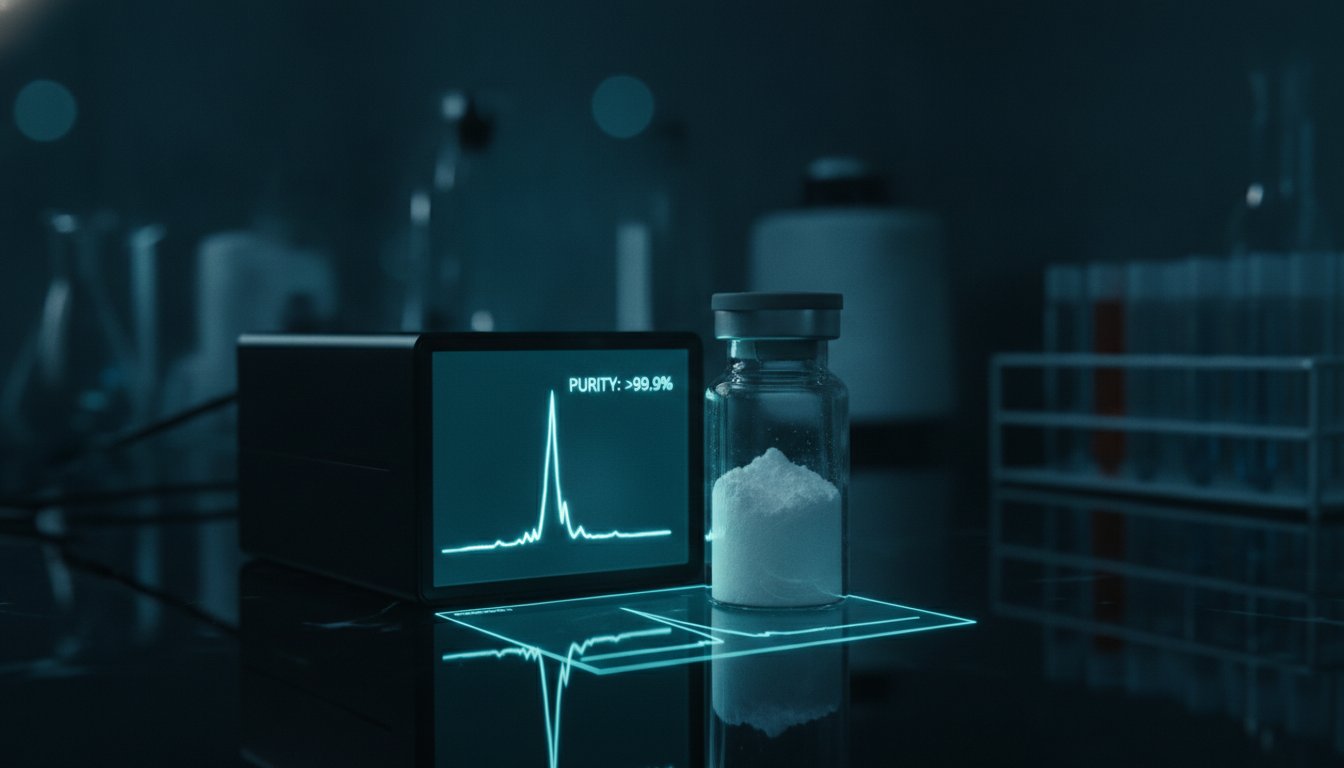
In high-stakes biochemistry, the most expensive peptide is often the one that carries the lowest initial invoice. Selecting materials based on a narrow view of research peptide price vs purity frequently results in the catastrophic failure of longitudinal studies. Low-cost synthesis often masks residual solvents, salts, or truncated sequences that compromise experimental reproducibility and damage sensitive fluidic systems. Precision. Verification. Security. These are not merely administrative goals; they are the baseline requirements for any serious laboratory operation.
You likely recognize the friction inherent in balancing finite grant funding with the non-negotiable demand for ≥99% purity. This article provides a disciplined framework for navigating these complex procurement waters. You will learn to decode the relationship between synthesis complexity and analytical cost, ensuring your data remains untainted by batch-to-batch variance. We will detail the specific HPLC and mass spectrometry protocols necessary to verify documentation and shield your sophisticated laboratory equipment from the chemical debris of inferior compounds. This is your guide to anchoring your research in verifiable truth.
Key Takeaways
- Understand why ≥99% purity is the critical benchmark for preventing truncated sequence interference and ensuring reproducibility in high-precision research.
- Examine the research peptide price vs purity relationship and the exponential cost drivers involved in multi-cycle HPLC purification processes.
- Identify the logistical hazards of international sourcing, including customs-related delays and the impact of trans-oceanic temperature fluctuations on peptide stability.
- Master the analytical requirements for verification by distinguishing between HPLC purity results and Mass-Spec identity confirmation within a Certificate of Analysis.
- Implement a rigorous procurement framework that prioritizes batch-specific documentation and domestic fulfillment to protect data integrity and laboratory hardware.
The Correlation Between Peptide Purity and Data Integrity
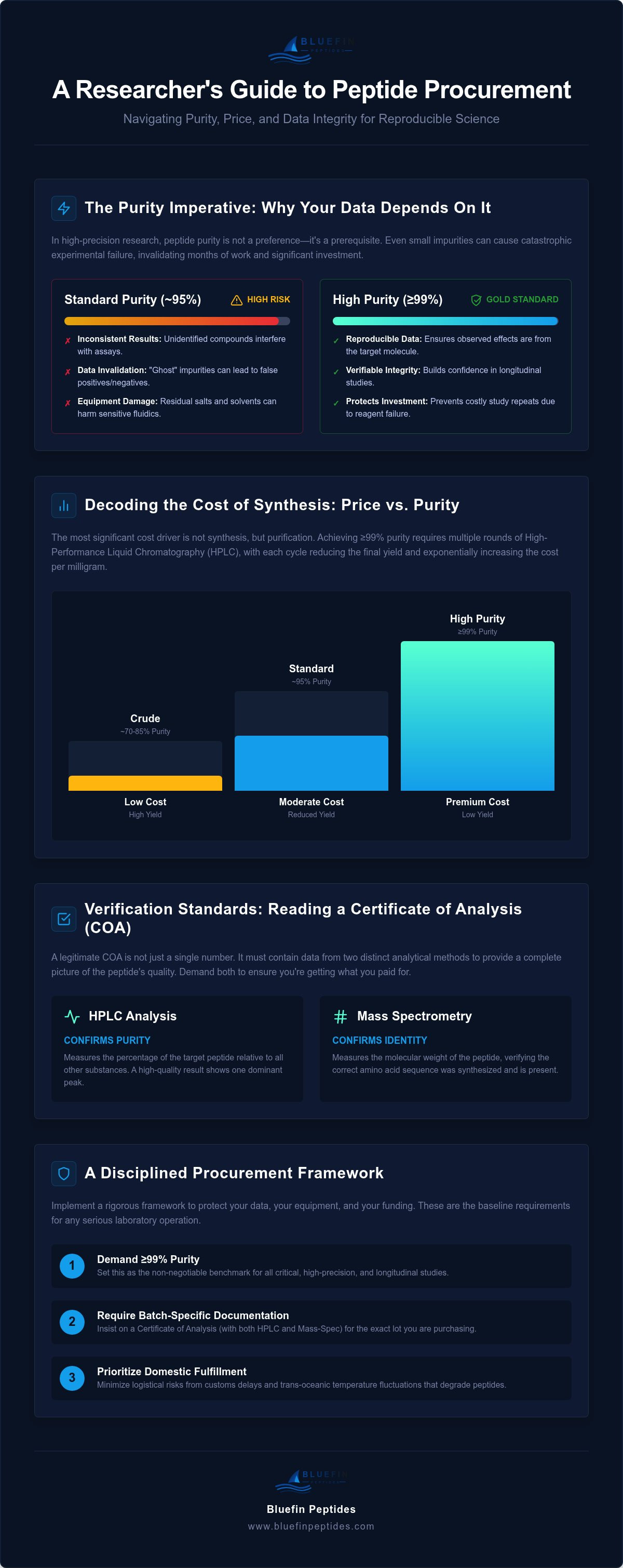
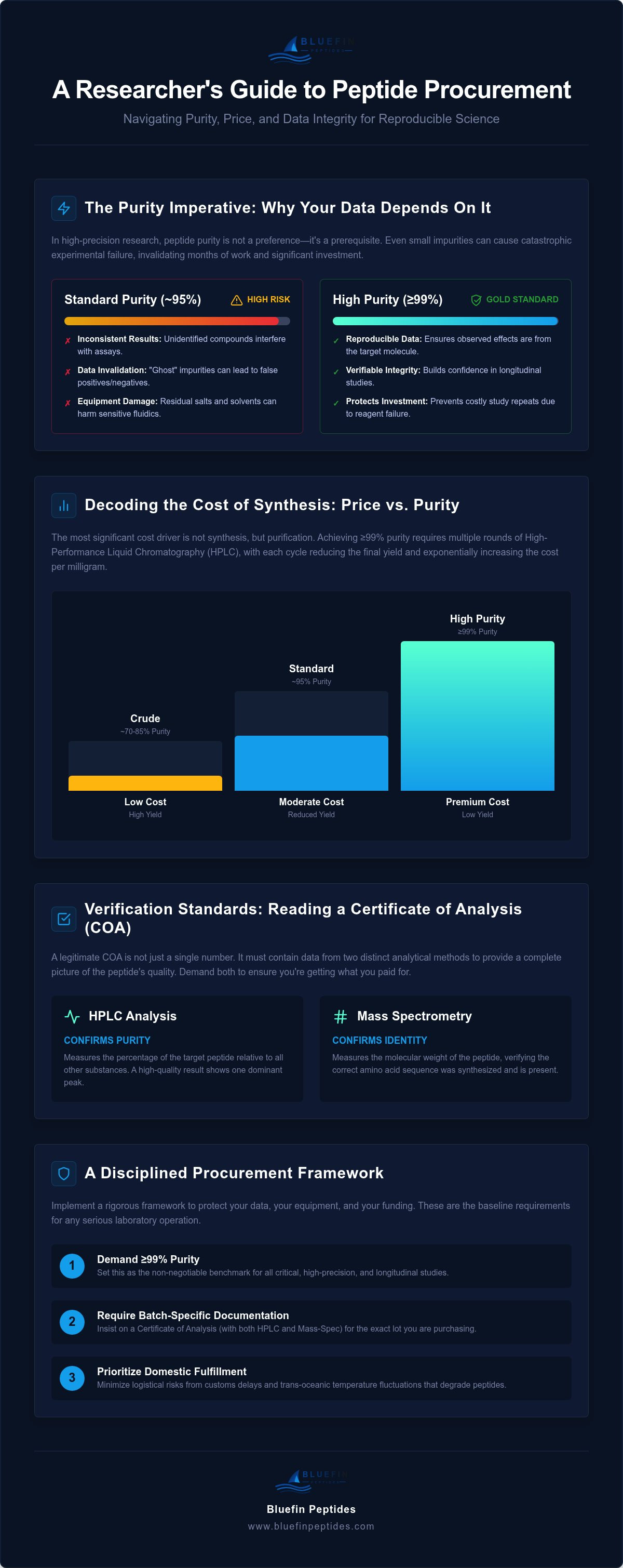
In the disciplined environment of a high-performance laboratory, the distinction between a breakthrough and a failure often rests on a single percentage point. Analytical purity represents the quantitative ratio of the target amino acid sequence to the sum of all other detected substances, including truncated sequences, salts, and residual solvents. While the entry-level research peptide price vs purity calculation often favors lower-tier compounds, the technical reality is that anything less than ≥99% purity introduces unacceptable variables into cellular assays. Precision. Verification. Reliability. These aren't just goals; they're the bedrock of reproducible science.
The Definition of Analytical Purity in Biochemistry
Biochemical purity is categorized by the level of refinement achieved during the final stages of commercial peptide synthesis. Crude peptides, often used for initial screening, contain significant levels of non-target material. Standard tiers of 95% or 98% are frequently marketed, yet they allow for a margin of error that can mask subtle biological signals or damage sensitive fluidic systems. Peptide purity is defined as the chromatographic peak area of the target compound relative to the total area of all detected peaks at a specific wavelength.
Beyond the target sequence, laboratory reagents contain counterions such as trifluoroacetic acid (TFA). These ions are necessary for stability during the purification process but must be meticulously accounted for in mass balance calculations. High-purity peptides ensure that the observed biological effect is a direct result of the target molecule. This eliminates the risk of reactions to residual contaminants or truncated sequences that lack the intended binding affinity.
Experimental Risk: When 95% Is Not Enough
Inconsistent batch results are the silent killers of longitudinal research. When a compound is only 95% pure, the remaining 5% of "ghost" impurities can trigger unintended biological responses or act as competitive inhibitors at receptor sites. This is particularly dangerous in high-precision molecular biology where binding affinity must be measured with absolute certainty. A minor impurity that mimics a target sequence can lead to false negatives or skewed data points that invalidate months of effort. Data integrity depends on reagent clarity.
The true cost of failure isn't found in the procurement invoice; it's found in the labor burden of repeating a six-month study because of reagent inconsistency. Maintaining a rigorous standard of ≥99% purity provides the logistical security needed to ensure that every data point is verifiable. For a deeper analysis of these benchmarks, researchers should consult the guide on Analytical Quality Standards for Research Peptides. Precision is the primary defense against the erosion of research outcomes.
Decoding the Cost of Synthesis: Why Purity Tiers Matter
Synthesis is merely the preliminary phase of peptide production. The true driver of the research peptide price vs purity relationship is the purification stage. While Solid Phase Peptide Synthesis (SPPS) can generate a crude product relatively quickly, the transition from a 90% crude mixture to a ≥99% refined compound requires an exponential increase in resources. Every additional pass through preparative High-Performance Liquid Chromatography (HPLC) reduces the final yield. This yield penalty is the primary reason why high-purity peptides carry a premium. Precision. Investment. Data security.
The technical difficulty of purification is further compounded by the physical properties of the molecule. Hydrophobic sequences or those prone to aggregation require specialized resins and mobile phases to prevent column fouling and ensure separation. Maintaining Verification Standards for Peptide Purity during these cycles is essential for identifying closely eluting impurities, such as diastereomers or truncated sequences, that standard analytical methods might overlook. Researchers must decide whether their study phase justifies the cost of absolute purity or if a lower tier suffices for initial pilot screening.
The Purification Process and Yield Penalties
Multiple rounds of HPLC are non-negotiable for achieving the precision required in modern metabolic research. For complex molecules like GLP-1 analogues, the purification process must isolate the target peptide from a sea of chemically similar side products. This rigorous refinement is what defines the Retatrutide analytical specifications required for high-stakes laboratory environments. When yield drops by 30% or 50% during a single purification cycle, the cost per milligram inevitably rises to reflect the loss of raw material in exchange for heightened chemical integrity.
Structural Complexity as a Price Driver
Sequence length and secondary structures act as significant anchors on synthesis efficiency. Simple fragments are predictable. In contrast, multi-peptide formulations like GHK-Cu BPC-157 TB-500 blends introduce logistical complexity during both the synthesis and the verification phases. Each component must be independently verified for purity before the final blend is analyzed for homogeneity. This ensures that the interaction between the compounds is not influenced by residual salts or truncated chains from any single constituent. For those seeking the highest level of batch-to-batch consistency, procuring from a disciplined US-based supplier provides the necessary verification tools to anchor your research in reliable data.
Lyophilization also plays a role in the final price. This vacuum-drying process removes residual water and solvents, creating a stable, "cake-like" physical state that preserves the peptide's primary structure during storage. While it adds a final layer of cost, it's a vital step for long-term stability in longitudinal studies. In pivotal research, where a single failed batch can invalidate a year of data, the cost-benefit ratio clearly favors the highest possible purity tier.
Beyond the Vial: Hidden Costs in Global Peptide Sourcing
Procurement decisions based solely on the upfront research peptide price vs purity ratio often fail to account for the "price of time." International sourcing introduces a spectrum of variables that can jeopardize both the physical integrity of the compound and the viability of the research timeline. Customs seizures. Indefinite transit delays. These are not merely inconveniences; they are structural risks that can derail grant-funded projects. Security in the supply chain is as vital as precision in the vial.
The Logistical Price of International Procurement
Trans-oceanic shipping is a high-risk environment for sensitive biomolecules. While overseas vendors may offer lower per-milligram costs, the "customs lottery" often results in the seizure of materials or extended holding periods in non-climate-controlled warehouses. Tarmac heat is a silent degradant. Exposure to extreme temperature fluctuations during customs inspections can compromise the peptide's secondary structure, leading to inconsistent biological activity. Relying on "re-shipment" policies is a flawed strategy; a second shipment takes weeks to arrive, stalling laboratory momentum and increasing the total cost of the project.
Domestic US shipping ensures a controlled chain-of-custody. It provides the logistical speed necessary to move material from a stabilized environment to the laboratory bench without the intervention of international regulatory hurdles. Speed. Security. Predictability. These are the hallmarks of a professional procurement framework.
Inventory Stability and Batch Traceability
Traceability is the antidote to analytical deception. Many international suppliers utilize "representative" Certificates of Analysis (COAs), which provide data for a "standard" batch rather than the specific lot being shipped. This practice masks batch-to-batch variance and undermines the reproducibility of longitudinal studies. A disciplined procurement model requires batch-specific documentation for every vial. This level of transparency is essential for verifying that a compound meets the Tirzepatide purity standards required for metabolic research.
Purchasing from suppliers with immediate domestic inventory eliminates the uncertainty of drop-shipping. It ensures that the analytical documentation matches the physical state of the offering. Verification. Documentation. Results. By prioritizing US-stocked inventory, researchers safeguard their budgets against the hidden costs of global logistical failure. This approach anchors the laboratory in a foundation of verifiable data and logistical reliability.
Verification Standards: Interpreting HPLC and Mass-Spec
Verification is the terminal stage of a disciplined procurement process. While the research peptide price vs purity debate often centers on a single numerical value, the methodology behind that percentage determines its validity. Purity data is functionally useless without confirmed identity. A compound can be 99% pure yet consist of an entirely incorrect sequence due to synthesis errors or mislabeling. True analytical security requires the integration of both High-Performance Liquid Chromatography (HPLC) and Mass Spectrometry (MS).
Mass Spectrometry: Confirming Chemical Identity
Confirming the molecular weight of a compound is the only way to ensure the synthesized chain matches the target sequence. Mass-Spec is the essential fingerprint of the peptide. Without this data, a researcher risks introducing high-purity 'ghost' sequences into their models, leading to biological results that are impossible to replicate. Identity confirmation is the first step in establishing a baseline for data integrity and ensuring the compound is what the label claims.
HPLC Chromatograms: Visualizing Purity
Reading an HPLC report provides a visual map of chemical refinement. The integration table on a valid chromatogram lists every detected peak, calculating the percentage of the total area occupied by the target molecule. Shoulder peaks are critical indicators of failure. These subtle deviations signal incomplete deprotection or degradation during synthesis. High-precision Ipamorelin CJC-1295 research mandates ≥99% purity to ensure secondary peaks don't interfere with receptor interactions.
Scrutinizing supplier documentation in 2026 requires an eye for red flags like blurred dates, generic headers, or Certificates of Analysis (COAs) that lack a specific batch number. These discrepancies often indicate 'representative' testing rather than lot-specific analysis. Third-party verification acts as an independent auditor in an unregulated market, providing the transparency required to justify laboratory costs. A transparent framework for research peptide price vs purity analysis requires more than a simple invoice. For laboratories that prioritize verification over marketing, accessing batch-specific analytical documentation is the only path to absolute certainty.
Procurement Excellence: The Bluefin Standard of Precision
High-stakes research demands more than just a vendor; it requires a disciplined logistical partner. The framework for evaluating research peptide price vs purity concludes with the necessity of verifiable quality. Bluefin Peptides operates with a singular focus on providing the tools for verification rather than asking for blind trust. Every compound in our catalog is anchored by a commitment to ≥99% HPLC-verified purity. This is not a marketing claim; it's a non-negotiable laboratory standard that ensures experimental reproducibility and the long-term integrity of your data.
In a market often characterized by opaque testing protocols, we prioritize transparency. We understand that the cost of a failed study far outweighs the initial procurement expense. By providing the analytical evidence required to justify laboratory costs, we empower researchers to focus on their results rather than questioning their reagents. Security, precision, and speed are the pillars of our fulfillment process.
Unwavering Analytical Transparency
We operate on a "Show, Don't Tell" philosophy regarding chemical integrity. Trust in a laboratory environment is earned through data, not promises. Every order is accompanied by batch-specific Certificates of Analysis (COAs) and Mass-Spec confirmation to prove that the material in the vial matches the target sequence with absolute precision. This level of documentation is essential for maintaining the high-level technical register required by modern biochemistry. Our offerings are provided exclusively as laboratory-grade lyophilized powders. This physical state ensures maximum stability during transit and long-term storage, protecting the primary structure of the peptide from degradation.
- Batch-Specific COAs: Direct verification of the specific lot in your possession.
- Mass-Spec Confirmation: Absolute identity verification to prevent sequence errors.
- Stability Focused: Lyophilization protocols designed for longitudinal research security.
Streamlined Logistics for Modern Research
Logistical speed is a vital component of research precision. By maintaining domestic US operations, we effectively remove the "Customs Variable" from your laboratory procurement strategy. There is no risk of international seizure, no indefinite holding periods in non-climate-controlled warehouses, and no exposure to the extreme temperature fluctuations typical of trans-oceanic transit. This domestic focus ensures a controlled chain-of-custody from our stabilized inventory to your bench.
Orders are fulfilled with a sense of urgent precision, allowing researchers to maintain strict project timelines without the fear of reagent stockouts or logistical delays. This reliability is what positions us as the preferred academic partner for rigorous studies. For qualified researchers ready to anchor their next project in verifiable truth, we invite you to explore our high-purity catalog. Secure your supply chain and your results with a partner that prioritizes analytical depth over e-commerce fluff.
Anchoring Your Research in Analytical Truth
Success in the laboratory is built upon a foundation of verifiable data. The calculation of research peptide price vs purity must extend beyond the initial invoice to include the security of data integrity and experimental reproducibility. Prioritizing ≥99% purity isn't just a procurement preference; it's a defensive strategy against the variables that compromise longitudinal studies and damage sensitive instrumentation. By insisting on both HPLC and Mass-Spec documentation, you move from a position of blind trust to one of empirical certainty.
Bluefin Peptides remains committed to this standard of precision. We provide the transparency you need through batch-specific COAs and Mass-Spec confirmation for every catalog item. Our domestic US shipping infrastructure eliminates the logistical hazards of international transit, ensuring your materials arrive stabilized and ready for the bench. It's time to remove the uncertainty from your supply chain. Explore HPLC-Verified Research Peptides today and establish a new benchmark for accuracy in your laboratory. Your pursuit of scientific breakthroughs deserves nothing less than absolute clarity.
Frequently Asked Questions
How does peptide purity affect research results?
Impure reagents introduce uncontrolled variables that can compromise the validity of your data. Contaminants such as truncated sequences or residual solvents can trigger unintended biological responses or act as competitive inhibitors at receptor sites. This often leads to false negatives or non-reproducible results in longitudinal studies. High-precision research requires a baseline of purity to ensure that all observed effects are solely attributable to the target molecule.
What is the difference between peptide purity and peptide content?
Peptide purity refers to the percentage of the target sequence relative to total peptide impurities detected via HPLC. In contrast, peptide content measures the actual weight of the peptide in a sample, accounting for non-peptide components like water and counterions. A vial may possess 99% purity but only 80% total peptide content. Understanding this distinction is critical for performing accurate molar calculations and ensuring consistent dosing in cellular assays.
Why are HPLC and Mass Spectrometry both required for verification?
High-Performance Liquid Chromatography (HPLC) determines the quantitative purity of a compound but cannot confirm its molecular identity. Mass Spectrometry (MS) provides the molecular weight, acting as a chemical fingerprint to verify the synthesized sequence matches the target. Relying on HPLC alone leaves the laboratory vulnerable to high-purity "ghost" sequences. Using both methods ensures the material is both refined and correctly identified, anchoring your research in verifiable truth.
Can I rely on a representative COA for my research batch?
No. A representative Certificate of Analysis (COA) only reflects a generalized production run rather than the specific lot in your possession. Batch-to-batch variance is a primary cause of failure in high-stakes research models. To maintain data integrity, you must demand documentation that matches the specific batch number on your vial. This transparency ensures that the analytical profile you're reviewing is the one currently on your laboratory bench.
How does international shipping impact peptide stability?
Trans-oceanic transit exposes sensitive biomolecules to extreme temperature fluctuations and indefinite customs-related delays. Tarmac heat is a silent degradant that can compromise the secondary structure of a peptide before it reaches your facility. Domestic fulfillment removes these variables by providing a controlled chain-of-custody and rapid transit. Prioritizing US-stocked inventory is a disciplined logistical choice that protects the physical state and chemical nature of your reagents.
Why is ≥99% purity necessary for GLP-1 research peptides?
GLP-1 analogues are complex sequences where even minor amino acid deletions can significantly alter receptor binding affinity. Achieving ≥99% purity is essential for measuring metabolic responses without interference from chemically similar side products. This high threshold is the gold standard for high-precision molecular biology. Lower purity tiers introduce noise into the data, making it impossible to distinguish between the effects of the target peptide and those of its impurities.
What are the red flags of a low-quality peptide supplier?
Red flags include blurred dates on analytical reports, generic headers, and the absence of batch-specific Mass-Spec data. Suppliers who prioritize marketing fluff over raw analytical documentation often mask inconsistencies in their synthesis process. A lack of domestic US shipping is another logistical warning sign, as it increases the risk of degradation during transit. Scrutinize the documentation; verification is the only antidote to the risks of an unregulated market.
How should lyophilized research peptides be stored for maximum purity retention?
Lyophilized powders should be stored in a desiccated environment at -20°C for short-term use or -80°C for long-term preservation. Repeated freeze-thaw cycles must be avoided as they introduce moisture and promote chemical degradation. Proper storage is the final step in maintaining the research peptide price vs purity value over the course of a study. Stability is a function of environment; disciplined storage protocols preserve the integrity of the primary structure.
For laboratory research use only. Not for human or veterinary use. This content is educational and does not constitute medical, dosing, or usage guidance.
Browse the BLUEFIN catalog