Peptide Solubility: Issues and Solutions Guide
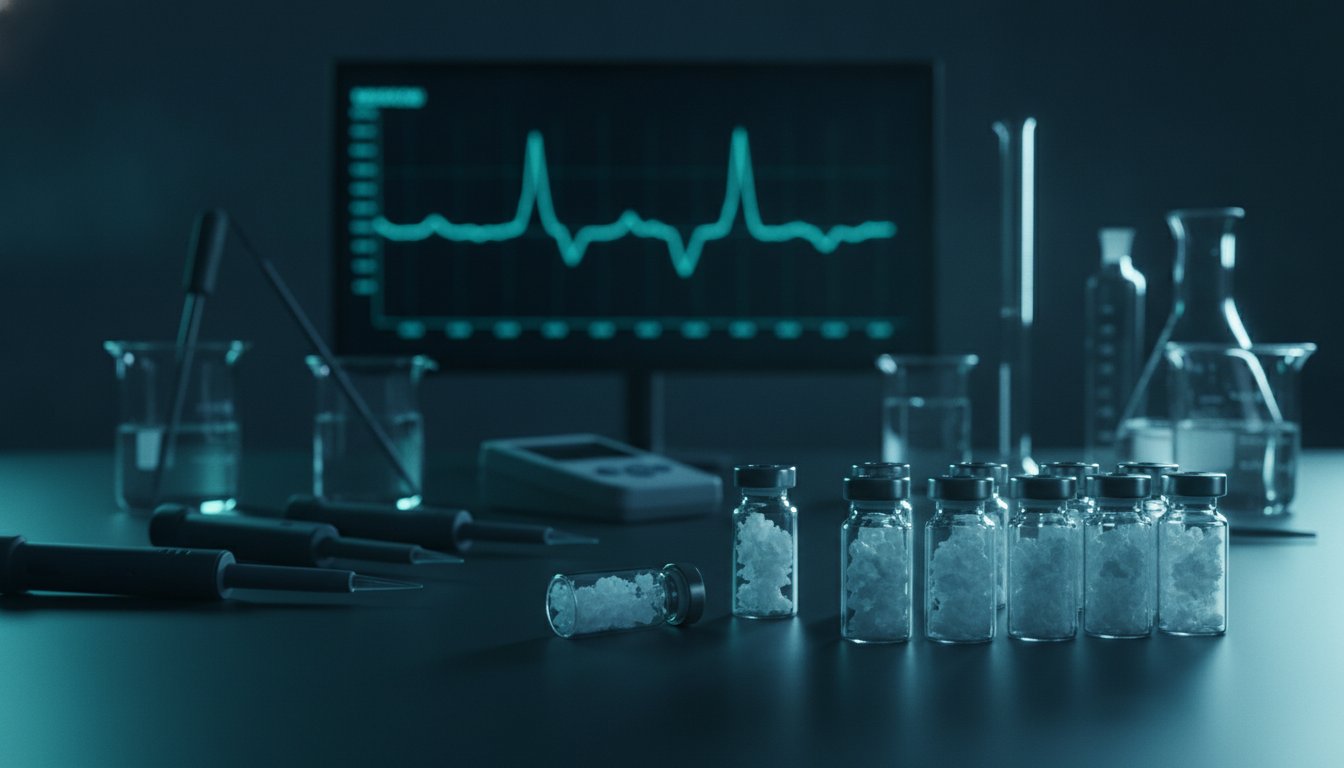
The most sophisticated peptide sequence is functionally inert if it remains trapped in a state of irreversible aggregation. For the disciplined researcher, a cloudy, precipitated solution represents more than a failed trial. It is a loss of high-purity material and a direct compromise of experimental integrity. Precision. Verification. Reliability. Addressing peptide solubility issues and solutions requires moving beyond guesswork toward a methodology rooted in chemical precision. You understand that even a ≥99% HPLC-verified compound like Retatrutide or Tirzepatide can behave unpredictably when the solvent environment isn't perfectly calibrated to its specific amino acid profile.
This guide provides the technical framework to master these molecular dynamics. We'll outline a clear protocol for selecting the optimal solvent and provide verified methods to recover peptides that have already precipitated. You'll gain a deeper understanding of how sequence length and purity levels dictate solubility, ensuring your laboratory operations maintain the fluid precision required for valid results. From pH titration to the strategic use of organic modifiers, we'll map the path to complete solubilization and eliminate the phantom variables that stall research momentum.
Key Takeaways
- Analyze the lyophilized cake structure and hydrophobic-hydrophilic balance to predict dissolution behavior before adding the first drop of solvent.
- Calculate the isoelectric point (pI) to steer clear of the zero-charge zone, a primary cause of peptide solubility issues and solutions in complex laboratory environments.
- Apply the "Minimal Volume" protocol and methodical solvent selection—moving from aqueous to organic modifiers like DMSO—to prevent the loss of expensive research material.
- Deploy advanced troubleshooting methods, including thermal-stable sonication and chaotropic agents, to recover peptides that have already precipitated.
- Verify batch-specific purity levels, as ≥99% HPLC-verified sequences minimize the presence of deletion sequences that trigger irreversible aggregation.
Navigating the Chemical Landscape: Why Peptide Solubility Fails
Peptide reconstitution is the first critical threshold in laboratory protocols. When a lyophilized cake fails to dissolve, it isn't just a logistical delay; it's a chemical failure. Lyophilization creates a high-surface-area porous matrix designed for rapid hydration. A well-formed cake is a functional requirement. This porous matrix allows the solvent to penetrate the entire volume of the peptide simultaneously. If the cake has collapsed into a dense, glassy film, the surface area decreases. Solvation becomes a slow, outer-layer-only process that increases the risk of local over-concentration and subsequent aggregation. Precision. Verification. Reliability.
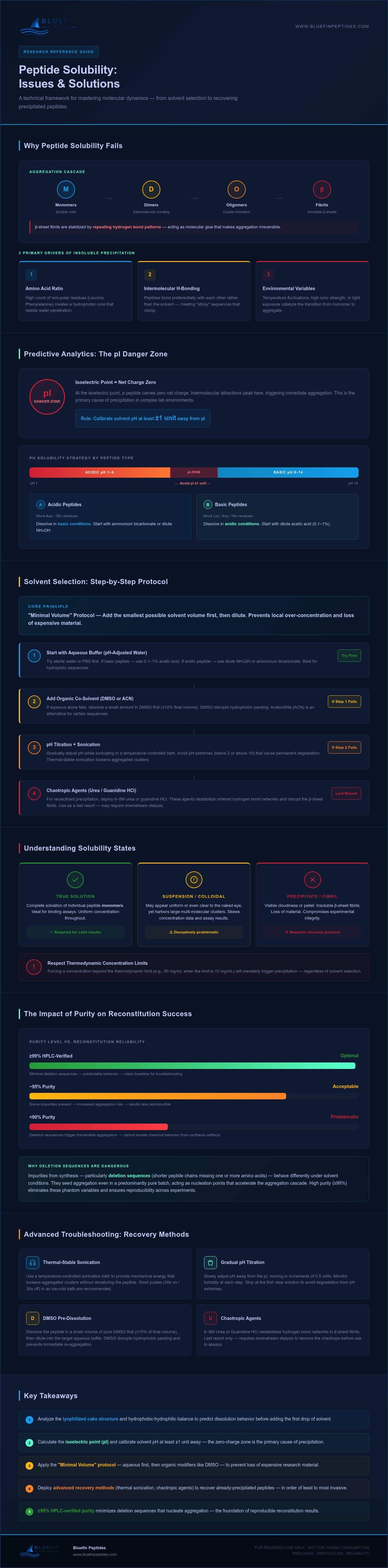
The core tension lies in the balance between hydrophobicity and hydrophilicity. Non-polar side chains seek to escape the aqueous environment, driving the peptide to "hide" within its own structure. This creates a kinetic trap. Aggregation follows a predictable, albeit destructive, path. Monomers align into dimers, then oligomers, eventually forming insoluble fibrils or dense beta-sheet structures. These cross-beta structures are governed by highly stable, repeating patterns of hydrogen bonds that act like molecular glue. In GLP-1 analogues like Tirzepatide or Retatrutide, increased sequence length and specific modifications often enhance secondary structure formation. These structural depths make the compound prone to complex peptide solubility issues and solutions that depend entirely on the initial solvent choice.
Defining Solubility in a Research Context
Solubility in a professional laboratory context is more than a binary state. True dissolution involves the complete solvation of individual peptide monomers. A suspension may appear uniform but consists of large, multi-molecular clusters that skew concentration data. Colloidal aggregation is even more deceptive. The solution might appear clear to the naked eye while harboring high-molecular-weight aggregates that interfere with binding assays. Precision requires a monomeric state. Achieving this requires respecting concentration limits. Attempting to force a 50 mg/mL concentration when the thermodynamic limit is 10 mg/mL will inevitably trigger precipitation.
Primary Drivers of Insoluble Precipitation
The failure to achieve a stable solution usually stems from three primary vectors:
- Amino Acid Ratio: A high count of non-polar residues like Leucine or Phenylalanine creates a hydrophobic core that resists water penetration.
- Intermolecular Hydrogen Bonding: Peptides possess a natural tendency to form hydrogen bonds with each other rather than the surrounding solvent, leading to "sticky" sequences.
- Environmental Variables: Temperature fluctuations, high ionic strength, or even light exposure can catalyze the transition from soluble monomer to insoluble aggregate.
Precision in synthesis, such as the ≥99% HPLC-verified purity found in research peptides, ensures that these drivers aren't exacerbated by unknown byproducts. High-purity standards provide a clear baseline, allowing researchers to isolate chemical behavior from synthesis-related artifacts. When dealing with complex peptide solubility issues and solutions, the clarity of the raw material is the only way to ensure the clarity of the result.
Predictive Analytics: Sequence-Based Solubility Modeling
Solubility isn't a matter of chance. It's a function of sequence. Predictive modeling allows for the anticipation of peptide solubility issues and solutions by quantifying the chemical nature of the compound before the first drop of solvent is added. The primary metric for this analysis is the isoelectric point (pI). At its pI, a peptide maintains a net charge of zero. This is the precipitation danger zone. Intermolecular attractions reach their peak here, leading to immediate aggregation. To ensure monomeric stability, the solvent pH must be calibrated to at least one full unit away from the pI. Precision. Verification. Reliability.
A fundamental rule of thumb involves counting the charged residues. Acidic residues (Aspartate, Glutamate) must be balanced against basic residues (Lysine, Arginine, Histidine). If basic residues outnumber acidic ones, the peptide is basic. If the reverse is true, it's acidic. For long-chain sequences like Tirzepatide Research Peptide, hydrophobic hotspots—dense clusters of non-polar residues—create localized resistance to aqueous environments. These sequences often require a dual-solvent approach to penetrate the hydrophobic core while maintaining overall charge stability. Batch-specific HPLC reports and mass-spec data provided by Bluefin Peptides offer the necessary transparency to identify these challenges before reconstitution begins. High-purity documentation is the primary tool for predicting molecular behavior.
Charge-Based Solvent Selection
Strategic titration is mandatory for successful dissolution. For acidic peptides, researchers should utilize basic buffers such as 0.1% NH4OH. This increase in pH raises the net negative charge, promoting electrostatic repulsion between molecules. Conversely, basic peptides require dilute acetic acid (1% to 10%) to achieve rapid dissolution through protonation. Neutral sequences present the most significant challenge. Since they lack a strong net charge at physiological pH, they aggregate with high frequency. Success depends on moving the environment away from the pI-adjacent zone or introducing organic modifiers during the initial wetting phase.
Hydrophobicity and the Grand Average of Hydropathy (GRAVY)
The GRAVY score represents the arithmetic mean of hydropathy values for all amino acids in a sequence. Positive scores indicate significant hydrophobicity. High leucine, isoleucine, and tryptophan content drive these numbers upward, signaling a mandatory requirement for organic co-solvents like DMSO or acetonitrile. Consider the Retatrutide Research Peptide. Its specific analytical profile reveals a complex balance of residues that demands precise solvent calibration to maintain monomeric stability. These long-chain analogues often exhibit secondary structures that further complicate the hydropathy profile. Utilizing predictive modeling ensures that the laboratory process remains a disciplined execution of data rather than an expensive exercise in trial and error.
Standard Operating Procedures for Reconstitution and Solvent Selection
Reconstitution is a controlled chemical intervention. It is the bridge between a stable, lyophilized state and a functional experimental medium. The "Minimal Volume" rule serves as the primary defense against the loss of expensive research material. By attempting dissolution in a fraction of the total target volume, researchers maintain the flexibility to adjust the solvent environment without reaching unmanageable dilution levels. This disciplined approach is essential for resolving peptide solubility issues and solutions when dealing with complex, long-chain sequences that exhibit unpredictable aggregation kinetics. Precision. Verification. Reliability.
The Step-by-Step Reconstitution Workflow
A systematic protocol minimizes the risk of irreversible precipitation. The workflow must be linear and documented to ensure reproducibility across different laboratory batches. Every step is designed to maintain the peptide in a monomeric state while avoiding chemical degradation.
- Verification: Review the batch-specific Certificate of Analysis (COA). Confirm the HPLC purity and mass-spec data to ensure the material meets the ≥99% benchmark before proceeding.
- Aqueous Baseline: Attempt dissolution in degassed, sterile water. While bacteriostatic water is often used for its antimicrobial properties, the presence of benzyl alcohol can occasionally interfere with the solubility of highly sensitive sequences.
- pH Titration: If the solution remains turbid after gentle agitation, adjust the environment based on the sequence's net charge. Utilize 0.1% acetic acid for basic peptides or 0.1% ammonium hydroxide for acidic ones. This shift in pH increases electrostatic repulsion, forcing the molecules apart.
Utilizing Organic Solvents Safely
Recalcitrant peptides with high GRAVY scores often require organic intervention to disrupt intermolecular hydrogen bonds. DMSO (Dimethyl Sulfoxide) is the preferred choice for highly hydrophobic compounds due to its high dielectric constant and ability to penetrate dense peptide cakes. DMF and Acetonitrile serve as secondary alternatives depending on the specific requirements of the downstream assay. The "seeding" technique is the most effective method for these compounds. It involves dissolving the peptide in a small volume of 100% organic solvent first, followed by the slow, dropwise addition of the aqueous buffer. This prevents the peptide from encountering a "solvent shock" that often triggers immediate, irreversible aggregation.
Researchers must remain cognizant of the maximum tolerable organic percentage. Most biological assays and cell culture systems can only tolerate DMSO concentrations below 5% to 10% before cytotoxic effects or enzyme inhibition occur. Chemical stability is equally paramount. Avoid maintaining peptides in extreme pH ranges—specifically below pH 2.0 or above pH 10.0—for extended periods. These environments catalyze hydrolysis, leading to the permanent cleavage of the peptide backbone. Maintaining a high formality register and adhering to these strict protocols ensures that peptide solubility issues and solutions are handled with the clinical precision required for valid scientific inquiry.
Advanced Troubleshooting: Resolving Recalcitrant Precipitation
Precision is paramount when a solution crashes. Troubleshooting is not a chaotic attempt to force dissolution; it's a disciplined sequence of mechanical and chemical adjustments. If a peptide precipitates after initial reconstitution, the researcher must act to disrupt the aggregate without cleaving the backbone or oxidizing sensitive residues. This is the final frontier of peptide solubility issues and solutions. Success depends on the ability to steer the compound back into a monomeric state while maintaining molecular integrity. Verification. Reliability. Security.
Mechanical and Thermal Interventions
Sonication provides the mechanical energy necessary to break apart stable fibrils and beta-sheet aggregates. However, ultrasonic waves generate localized heat that can be destructive. To prevent thermal degradation, researchers should use a chilled water bath or pulse the sonicator in brief, 10-second intervals. Excessive energy can catalyze the oxidation of Methionine or Tryptophan residues, leading to inaccurate experimental data. For long GLP-1 chains, avoid vigorous vortexing. The air-liquid interface promotes denaturation and surface-induced aggregation. Gentle swirling is the laboratory standard. It preserves the secondary structure while encouraging solvation.
A 37°C water bath can assist in overcoming the kinetic barrier of dissolution for hydrophobic sequences. This intervention is only appropriate for peptides lacking heat-sensitive modifications or labile bonds. The success of these recovery efforts is intrinsically linked to research peptide quality standards. Lower-purity materials often contain truncated sequences or synthesis byproducts that form irreversible nuclei. These "phantom" aggregates make troubleshooting impossible, as the impurities act as a permanent anchor for precipitation.
Chemical Additives for Enhanced Solubility
Chaotropic agents like 6M Urea or 6M Guanidine HCl serve as the ultimate solvent modifiers. They disrupt the hydrogen-bonding network of the water and weaken the hydrophobic effect, forcing recalcitrant aggregates into solution. If the peptide contains multiple Cysteine residues, the addition of a reducing agent like TCEP (1 to 5 mM) is mandatory. This prevents the formation of non-native intermolecular disulfide bridges that lock the peptide into an insoluble state. For sequences prone to sticking to plasticware, 0.01% Tween-20 or Triton X-100 minimizes surface adsorption and maintains the effective concentration.
Researchers must also account for the "salting-out" effect. High salt concentrations reduce the availability of water molecules for solvation, often causing peptides to crash out of solution. If a peptide has already precipitated, the most effective recovery strategy involves centrifugation to pellet the aggregate, followed by a complete solvent swap to a more aggressive organic modifier or chaotrope. This methodical approach ensures that even the most stubborn sequences can be salvaged for analytical use.
Secure HPLC-verified research peptides from US-based stock to ensure your laboratory protocols start with a verifiable, high-purity baseline.
The Impact of Purity on Reconstitution Success
Predictable dissolution is a direct byproduct of chemical uniformity. In the study of peptide solubility issues and solutions, the purity of the lyophilized powder is the primary determinant of how the compound will interact with its solvent. A benchmark of ≥99% HPLC-verified purity isn't an arbitrary quality standard; it's a functional requirement for experimental consistency. When purity drops to 95% or lower, the remaining 5% isn't merely inert filler. It consists of synthesis byproducts, including deletion sequences and truncated variants, that fundamentally alter the chemical environment of the vial. Precision. Verification. Reliability.
Residual Trifluoroacetic acid (TFA) from the cleavage and purification process also plays a critical role. Most research peptides are supplied as TFA salts. If the residual TFA content is high, it can dramatically lower the pH of the reconstitution medium upon contact. This shift can inadvertently move the solution into the zero-charge precipitation zone, even if the researcher has calculated the pI correctly. Accessing batch-specific Certificates of Analysis (COAs) allows researchers to anticipate these pH shifts and adjust their buffering strategies before the peptide is exposed to the solvent. High-purity standards provide the only reliable baseline for these calculations.
Impurities as Nucleation Sites
Aggregation is often a catalyzed process. Minor contaminants act as "seeds" or nucleation sites, triggering a chain reaction that pulls the primary peptide out of solution. This seeding effect makes lower-purity batches highly unpredictable. For instance, comparing Tirzepatide Research Peptide batches reveals that those maintaining higher purity standards exhibit significantly more stable monomeric profiles during hydration. Mass-spec confirmation is essential here. It identifies insoluble variants that HPLC alone might miss, ensuring that the researcher isn't battling phantom peptide solubility issues and solutions caused by synthesis artifacts rather than the target sequence itself.
Bluefin Peptides: Precision Logistics and Purity
The Bluefin standard is built on the necessity of laboratory-grade transparency. By providing ≥99% HPLC-verified compounds, the risk of impurity-induced aggregation is minimized at the molecular level. Reliable research requires a stable baseline. Our US-based inventory ensures that peptides aren't subjected to the thermal stresses of prolonged international transit, which can degrade the lyophilized cake and compromise solubility. Researchers have direct access to batch-specific analytical data, including mass-spec and HPLC reports, to facilitate optimal reconstitution planning. This level of documentation transforms the resolution of solubility challenges from a trial-and-error process into a disciplined laboratory execution.
Mastering the Solvation Threshold
Navigating the complexities of peptide reconstitution requires a shift from trial-and-error to disciplined chemical execution. Success depends on your ability to predict molecular behavior through pI calculations and hydropathy scores before the first drop of solvent is added. Adhering to a systematic workflow ensures that even recalcitrant sequences remain in a stable, monomeric state. Addressing peptide solubility issues and solutions is ultimately a matter of starting with a verifiable baseline. When you eliminate the variables introduced by synthesis byproducts, you secure the integrity of your downstream assays. Don't let unpredictable aggregation stall your research progress.
Bluefin Peptides provides the technical infrastructure needed for these high-stakes environments. We maintain US-based laboratory stock of ≥99% HPLC-verified compounds, each accompanied by batch-specific COAs for absolute transparency. By prioritizing purity and logistical speed, we help you maintain experimental momentum and avoid the costly loss of research material. Our commitment to quality ensures that your focus remains on the data, not the troubleshooting.
Procure HPLC-Verified Research Peptides from Bluefin Peptides and ensure your laboratory protocols are anchored in precision. Valid data begins with a clear solution.
Frequently Asked Questions
Is bacteriostatic water the same as reconstitution solution for research peptides?
Bacteriostatic water is a specific formulation containing 0.9% benzyl alcohol to inhibit bacterial growth. While it's frequently used for reconstitution, it's not identical to pure sterile water or specialized buffers. The presence of benzyl alcohol can occasionally impact the stability of sensitive sequences. Researchers must verify compatibility with their specific assay. For most peptide solubility issues and solutions, sterile water is the baseline, while bacteriostatic water is reserved for multi-dose laboratory applications.
What should I do if my peptide forms a gel instead of a clear solution?
Gelling typically signifies that the peptide has reached its solubility limit or is interacting with the solvent at an suboptimal pH. This physical state indicates the formation of a dense molecular network. To resolve this, increase the solvent volume to lower the concentration or adjust the pH away from the isoelectric point. Gentle agitation is preferred over vigorous mixing. If gelling persists, the introduction of a small percentage of organic modifier may be required to disrupt these intermolecular bonds.
Can I freeze a reconstituted peptide solution for long-term storage?
Reconstituted peptides are generally less stable than their lyophilized counterparts. While freezing at -20°C or -80°C can extend shelf life, repeated freeze-thaw cycles induce mechanical stress that cleaves delicate peptide bonds. The professional standard involves dividing the solution into single-use aliquots before the initial freeze. This protocol ensures that each sample is only thawed once, maintaining the chemical integrity and verified purity levels required for accurate laboratory results.
How does sonication affect the bioactivity of complex research blends?
Sonication provides the mechanical energy needed to disrupt recalcitrant aggregates, but it carries risks of thermal degradation and oxidation. High-frequency waves generate localized heat that can alter the secondary structure of complex research blends. To maintain bioactivity, use a chilled water bath and limit sonication to brief, controlled pulses. This disciplined approach prevents the degradation of sensitive residues like Methionine or Tryptophan while ensuring the compound achieves a monomeric state for consistent experimental outcomes.
Why is my peptide soluble in DMSO but precipitates when I add water?
This phenomenon, known as "solvent shock," occurs when a hydrophobic peptide is rapidly transitioned from a non-polar environment to a polar one. DMSO effectively disrupts the hydrophobic core, but the sudden addition of water forces the residues to aggregate to avoid the aqueous phase. To prevent this, add the aqueous buffer dropwise while maintaining constant, gentle agitation. This incremental approach allows the molecules to adjust to the shifting polarity without triggering immediate precipitation.
Does the presence of residual TFA in the lyophilized powder affect solubility?
Residual Trifluoroacetic acid (TFA) is a byproduct of the cleavage process and significantly impacts the initial pH of the solution. Since TFA is a strong acid, it can lower the pH of the reconstitution medium, potentially moving the environment closer to the peptide's isoelectric point. This shift increases the risk of aggregation. Reviewing batch-specific COAs allows researchers to anticipate these acidic shifts and utilize appropriate buffers to maintain the target pH for complete dissolution.
What is the maximum concentration I should aim for when dissolving GLP-1 analogues?
For long-chain GLP-1 analogues like Tirzepatide or Retatrutide, researchers should generally aim for a concentration between 1 mg/mL and 10 mg/mL. Exceeding these limits significantly increases the probability of intermolecular collisions and subsequent fibril formation. While some sequences can tolerate higher concentrations, the risk of irreversible aggregation rises exponentially. Maintaining a conservative concentration ensures the peptide remains in a monomeric state, providing the fluid precision necessary for valid binding assays and longitudinal studies.
How do I determine if a peptide has degraded or simply failed to dissolve?
Visual inspection only confirms the physical state of the solution, not the chemical integrity of the compound. A peptide that fails to dissolve will appear as a turbid suspension or visible precipitate. Degradation, however, is often invisible and involves the cleavage of the backbone or deamidation of residues. The only verifiable method to distinguish between these states is through analytical HPLC. Utilizing ≥99% HPLC-verified material ensures that any observed issues are related to solubility protocols rather than underlying chemical decay.
For laboratory research use only. Not for human or veterinary use. This content is educational and does not constitute medical, dosing, or usage guidance.
Browse the BLUEFIN catalog